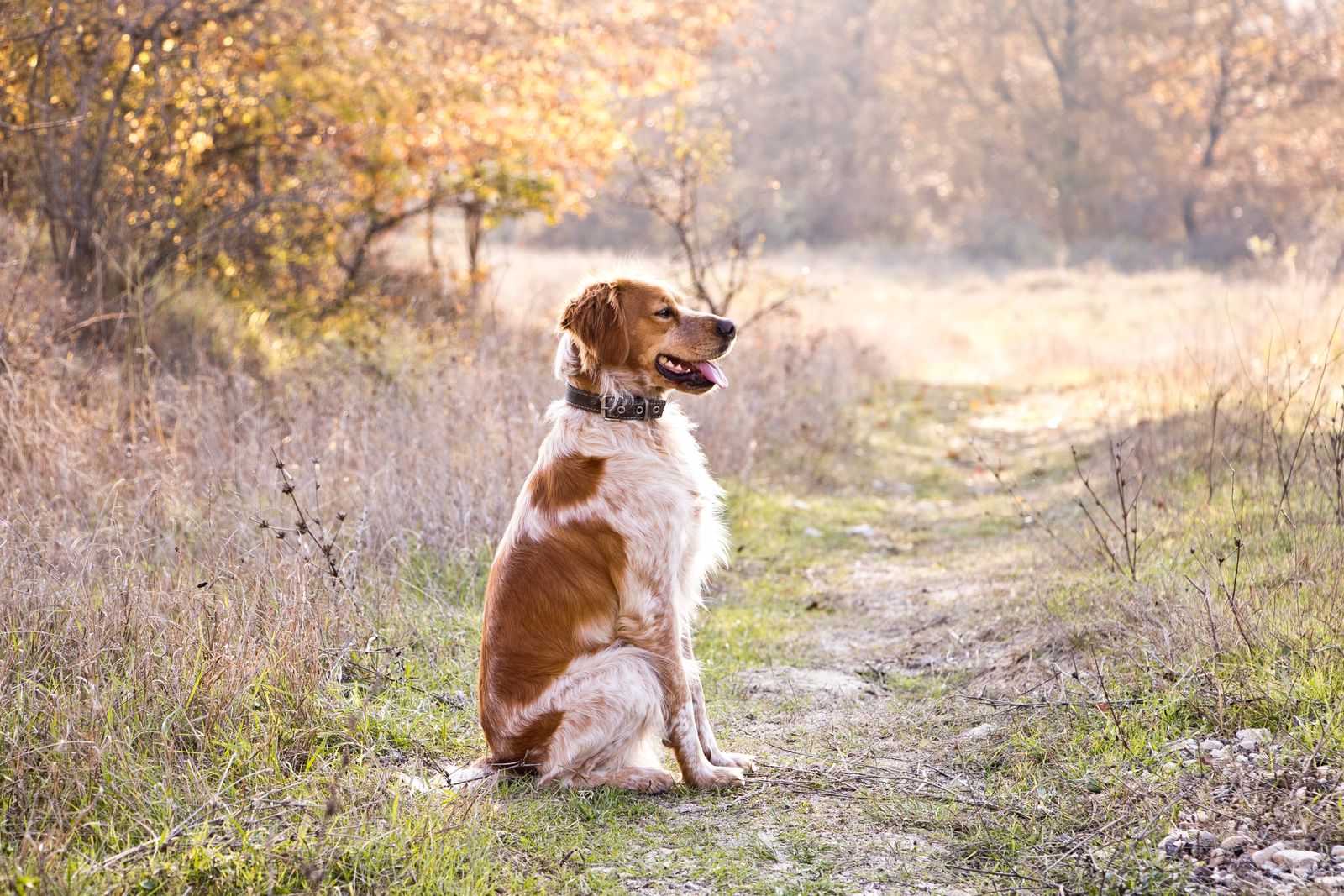
Brittany snapshot
The AKC Official Standard of the Brittany describes a compact, closely knit, medium sized, leggy dog built for agility and speed over ground. The breed comes from the province of Brittany in France and was first recognized by the AKC in 1934. The standard sets height at 17.5 to 20.5 inches at the highest point of the shoulders, and a dog under or over that range is disqualified in the show ring. Weight is 30 to 40 pounds. The AKC breed page gives life expectancy as 12 to 14 years and places the breed in the Sporting Group. The breed ranked No. 31 on the AKC list of the Most Popular Dog Breeds of 2024, a list built from AKC registration figures for that year.
The coat is dense, flat or wavy, and never curly, with a texture that is neither wiry nor silky. There is little fringe on the ears and some feathering on the legs. The standard colors are orange and white or liver and white, in clear or roan patterns, and some ticking is desirable. A tri-colour dog, liver and white with orange markings in specified places, is allowed but not preferred. Black in the coat is a disqualification, and so is a black nose. The tail is tailless to about four inches long, natural or docked. The ears are set high and are short and triangular, rather than hanging long. That ear detail matters later in this guide, because it contradicts a claim other websites make about this breed.
The AKC's own summary of the breed is an exercise warning. Bright and eager at home, tireless in the field, and requiring a lot of exercise, preferably with their favorite humans, is a description of a dog whose joints, weight, and behavior all depend on daily work. That matters for this guide in two practical ways. A young Brittany that cannot exercise because of a hip problem loses more than fitness, and an owner weighing surgery against management is weighing the dog's whole way of life, which is why the claim walkthrough later in this guide treats the decision slowly. And a Brittany kept lean by real daily exercise is doing the single most effective piece of hip care Cornell lists, weight control, as a side effect of an ordinary day. The breed's energy is not a footnote to its health file. It is one of the tools in it.
| Fact | Brittany | Source |
|---|---|---|
| AKC group | Sporting Group | AKC breed page |
| Origin | France, the province of Brittany | AKC breed summary |
| AKC recognition | 1934 | AKC breed summary |
| Popularity | No. 31, Most Popular Dog Breeds of 2024 | AKC 2024 list |
| Height | 17.5 to 20.5 inches at the shoulder | AKC Official Standard |
| Weight | 30 to 40 pounds | AKC Official Standard |
| Life expectancy | 12 to 14 years | AKC breed page |
| Temperament | Bright, fun-loving, upbeat. The standard adds: a happy, alert dog, neither mean nor shy | AKC breed page and Official Standard |
| Coat | Dense, flat or wavy, never curly | AKC Official Standard |
| Colors | Orange and white or liver and white, clear or roan | AKC Official Standard |
| Tail | Tailless to about 4 inches, natural or docked | AKC Official Standard |
| Parent club health tests on the AKC breed page | Hip Evaluation and Ophthalmologist Evaluation | AKC breed page |
Two habits will help you read the rest of this guide. The first is the difference between a tendency and a promise. A breed being prone to a condition means the condition appears in the breed often enough that the club, a screening program, or a veterinary source names it. It never means your dog will develop it, and a clean screening record never means your dog cannot. The second habit is the difference between a result and a diagnosis. A result is what a laboratory or a screening program reports, such as a hip grade, an eye exam form, or a DNA result. A diagnosis is a veterinarian's conclusion that a dog has a condition, reached from signs, examination, and tests together. A Brittany file can hold results for years before any diagnosis exists. Insurance wording often turns on that difference, so this guide keeps the two words separate every time.
Health tendencies in Brittanys
The American Brittany Club, called the ABC in this guide, is the AKC parent club for the breed. Its breeders code of ethics, adopted on November 30, 1996, lists the serious inheritable defects a Brittany must not be bred with. The list names canine hip and elbow dysplasia, primary epilepsy, described by the club as a seizure disorder, and eye disorders, with retinal atrophy named. Club health writing from 2007, published through the club's DNA bank work at UC Davis, calls hip dysplasia the primary genetic disorder affecting the breed and names epilepsy second. The cards below build on that club record, checked against Cornell, Merck, OFA, and UC Davis. Each card follows the same shape: what the condition is, the signs an owner can watch for, how a veterinarian diagnoses it, the categories of care, and the exact policy wording to check.
This section also does something the other breed pages on the internet mostly do not do. At the end of the cards, it lists two conditions that appear on almost every other Brittany page and explains, with the primary sources named, why this guide does not give them condition cards. A guide that will show you what it left out, and why, is a guide you can check. That checking habit is the whole point of this site.
How the cards were chosen is also part of the record. A condition earned a full card only when a primary source ties it to this breed: the club's code of ethics, the club's health writing, the AKC breed page, the CHIC requirement list, or a veterinary reference naming the breed. A condition supported only by the club's screening menu earned a short card or a menu mention, and the card says so. A condition that appears only on other insurance and breed websites earned nothing, and the end of this section names the two biggest examples. That standard cuts in both directions. It is why the rare C3 card is in this guide at all, because Merck names this breed for it in plain words, and it is why hypothyroidism is out, because the same publisher's breed lists leave this breed off. The sources are not being cited when they agree with the guide and ignored when they do not. They are the guide.
1. Hip dysplasia
What it is. Hip dysplasia is an inherited condition in which the hip joint forms incorrectly. The ball at the top of the thigh bone sits loosely in the socket instead of fitting deeply and evenly. That looseness, called laxity, lets the joint move in ways it should not. Over time the joint wears, arthritis develops, and the dog hurts. Cornell's Riney Canine Health Center describes the condition as common in medium and large breeds and as genetic in origin, modified by nutrition and growth. Overfeeding and rapid growth in a puppy make a genetically loose hip worse. The ABC calls this the primary genetic disorder affecting the Brittany, the AKC breed page tells buyers that a responsible breeder screens breeding stock for it, and the CHIC screening program requires a hip evaluation for this breed. Three independent primary sources point at the same joint.
Signs to watch for. Cornell lists difficulty getting up, a bunny hopping gait in which both back legs move together, limping or stiffness in the back legs, reduced activity, unwillingness to jump or climb, loss of muscle in the hind legs, swaying hips, and weight shifted forward onto the front legs. A young Brittany that starts sitting out of games it used to chase, or that bunny hops at a run instead of using each back leg in turn, is showing the pattern Cornell describes. Signs can be mild for a long time in a fit, lean dog, which is one reason the screening record matters even for a dog that looks sound.
How it is diagnosed. Cornell describes diagnosis by X-ray, physical examination, and a palpation test called the Ortolani test, in which the veterinarian feels for looseness in the joint. Sedation or anesthesia is used for correct positioning. Two screening systems grade hips before a dog ever shows a sign. PennHIP measures laxity directly and can be used in puppies, and it requires a certified operator. The OFA system grades hip X-rays, and its final grading happens after age 2 years. A screening grade and a diagnosis are different records, and the screening section of this guide explains exactly which of these the CHIC file for a Brittany requires.
The two screening systems, side by side. Because both names appear in Brittany paperwork, the difference is worth stating plainly. The OFA system reads hip X-rays and assigns a grade. Its preliminary readings can happen earlier, but the final, certifiable grading is done after the dog is 2 years old, which is one reason a young breeding dog's file can be incomplete in a way that is normal rather than evasive. PennHIP measures the looseness itself, using a specific technique and a distraction measurement, and it can be used in much younger dogs, but only veterinarians certified in the method can perform it, and the results are registered with OFA for the CHIC file. Cornell describes PennHIP as the most accurate measure of laxity. Neither system predicts an individual dog's future with certainty. Both exist to take the worst hips out of breeding and to give a buyer a dated, third party record instead of an opinion. When a breeder says the parents' hips were checked, the follow-up question is which system, at what age, and may I see the record.
Care categories. Cornell's care list starts with weight control, because a lean dog loads a loose joint less. It continues with anti-inflammatory and pain medicines, with blood work monitoring while a dog takes them, cartilage supplements and omega-3 fatty acids, low impact exercise such as walking and swimming, and physiotherapy. Surgery depends on severity and age. A femoral head ostectomy, called an FHO, removes the ball of the joint so the leg forms a false joint. Cornell notes that an FHO is more common in small to medium dogs and that dogs under 40 pounds generally regain good function. The Brittany's standard weight range is 30 to 40 pounds, so the whole breed sits inside the range Cornell names. A total hip replacement rebuilds the joint with implants and is more common in large dogs. Two further procedures, a juvenile pubic symphysiodesis at 12 to 20 weeks and a triple pelvic osteotomy before maturity, exist only inside narrow age windows in puppies whose looseness is found very early.
2. Epilepsy and seizure disorders
What it is. Epilepsy means recurrent seizures. A seizure is a burst of abnormal electrical activity in the brain. Idiopathic epilepsy, also called primary epilepsy, is the form in which careful testing finds no underlying cause in the brain, the blood, or the rest of the body. Cornell describes it as a diagnosis of exclusion, which means the diagnosis is what remains after other causes are ruled out. The ABC names primary epilepsy in its breeders code of ethics as a defect a Brittany must not be bred with, names epilepsy in its 2007 health writing, and its breeder guidance states that epilepsy appears in all lines of Brittanys. One honesty note belongs in this card, not in a footnote. Cornell's epilepsy page names the breeds it lists as more commonly affected, and the Brittany is not on that list. Merck's epilepsy entry does not name the Brittany either. The breed specific support for this card is the club's own record. This guide treats that record as real, and tells you which kind of source it is.
Signs to watch for. Cornell describes two broad patterns. A generalized seizure involves the whole body. The dog loses consciousness, the body stiffens, the legs paddle, and there may be drooling, vocalizing, and involuntary urination or defecation. A focal seizure involves one part of the body, with repetitive movement in one muscle group, salivation, or dilated pupils. Many dogs are restless before an episode and confused or tired afterward. Two situations are emergencies on Cornell's guidance. A seizure lasting more than 5 minutes, and seizures clustering within 24 hours, both need emergency care the same day.
How it is diagnosed. There is no single test for idiopathic epilepsy, and there is no DNA test for it in this breed. Cornell and Merck describe a workup that rules other causes out: blood counts, a biochemistry profile, and urinalysis first, then, where the case calls for it, an MRI scan of the brain and a cerebrospinal fluid test, usually through a referral neurologist. A tentative diagnosis of idiopathic epilepsy is made when the workup finds no abnormality and the dog has had at least two seizures at least 24 hours apart. Cornell gives typical onset as between 6 months and 6 years of age, with a median of 2.5 years. That age pattern is one reason the timing of enrollment matters so much for this breed, and the life stages section returns to it.
Care categories. Cornell lists the anti-seizure medicines used for long term control: phenobarbital, levetiracetam, zonisamide, and potassium bromide. Once started, these medicines are often lifelong, and dogs taking them need regular blood monitoring. Cornell describes treatment generally starting when a dog has more than two seizures in six months, has cluster seizures, or has a seizure longer than 5 minutes. Some dogs also carry emergency medicine, such as rectal diazepam or intranasal midazolam, for a prolonged episode at home. The record keeping is part of the care. A seizure diary and a phone video of an episode give the veterinarian the pattern, the duration, and the recovery, and they give an insurer a dated record that matches the clinic file.
The first episode at home. Cornell's sign list doubles as a home protocol. Time the episode, because the 5 minute threshold changes what you do next. Keep hands away from the mouth. Move objects the dog could strike, keep other animals and children back, and film the episode if you can do it safely, because the video is diagnostic evidence. Note what happened just before and how long the confusion afterward lasts. Then call the veterinarian the same day, even if the dog seems fully recovered, because the workup Cornell describes starts with blood testing that is most useful when it is planned promptly, and because a first recorded seizure is a date that will matter in every later file, including an insurance file. If the episode passes 5 minutes, or episodes cluster inside 24 hours, that is emergency care now, not a phone call tomorrow.
Monitoring is part of the treatment. Anti-seizure medicines are measured, not guessed. Cornell describes regular blood work for dogs on these medicines, checking both the drug level in the blood and the organs that process the drug. Missed doses, stopped medicine, and unrecorded dose changes all show up in that monitoring record, which is one more reason the diary in the life stages section is a care tool and not paperwork for its own sake. For insurance, this monitoring is a recurring, predictable cost of a diagnosed condition, and it is the clearest test of a policy's chronic condition wording: a plan that covers the dramatic first workup but not the quiet years of blood tests has the shape exactly backwards for this disease.
3. Inherited eye disease, and the yearly eye exam
What it is. This card is a screening card, and it is honest about that. The AKC breed page lists exactly two recommended health tests from the national breed club for the Brittany: a hip evaluation and an ophthalmologist evaluation. The CHIC program requires the eye examination, performed by a board certified veterinary ophthalmologist, every year from age 2 to age 8. A screening rule that repeats every year for six years exists because inherited eye disease can appear in a dog whose earlier exams were clear. The ABC code of ethics names eye disorders in its do not breed list, with retinal atrophy named directly. Progressive retinal atrophy, called PRA, is an inherited degeneration of the retina, the light sensing layer at the back of the eye. Cornell describes it as non painful and slow, with night vision failing first because the rod cells, which work in dim light, die before the cone cells, which work in bright light. There is no cure. The UC Davis Veterinary Genetics Laboratory lists one health DNA test for this breed, a test for the prcd form of PRA, called PRA-prcd, a late onset form found in many breeds. A dog needs two copies of that gene change to be at risk for that form.
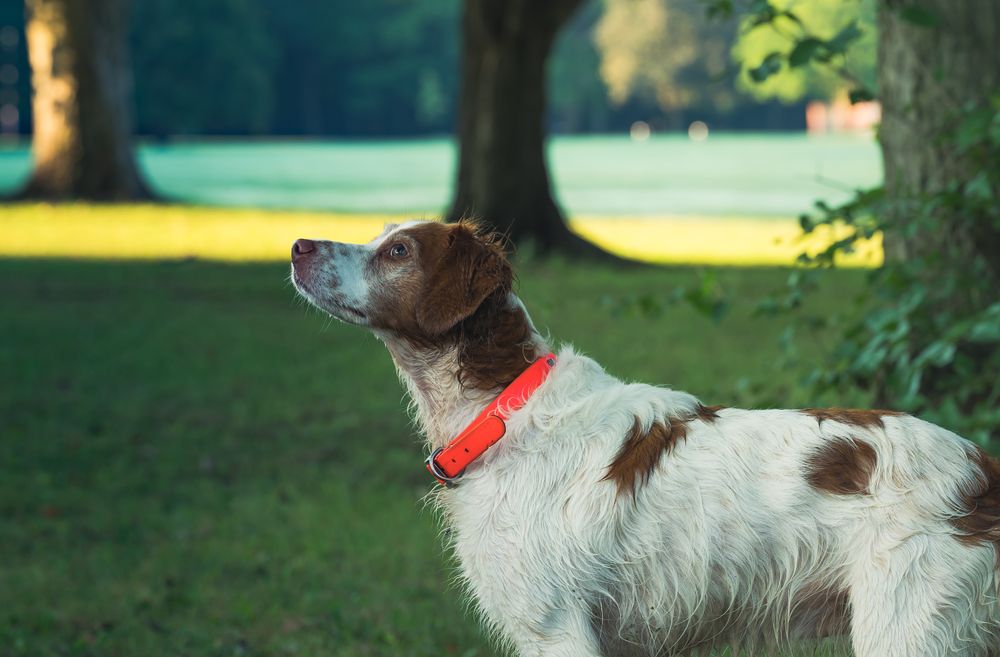
Signs to watch for. Cornell's PRA signs are vision signs in dim light first: reluctance to enter dark rooms or go out at night, hesitance on stairs, and bumping into things in new surroundings. The pupils may look dilated and the eyes unusually reflective. Cataracts, a clouding of the lens, can form late in PRA, and Cornell's cataract guidance adds the signs of lens disease itself: a cloudy or opaque lens, cautious movement, and a dog that stays close to its owner. The club's 2007 health writing mentions adult cataracts among the breed's studied problems. One limit belongs here. Merck's table of inherited cataracts in dogs does not list the Brittany. This guide therefore treats cataracts in this breed as a watch item that the yearly eye exam exists to catch, not as a Merck listed inherited Brittany cataract.
How it is diagnosed. The central test is the eye examination itself, performed by a board certified ophthalmologist and registered through the OFA eye registry system, the exam the CHIC file requires each year between ages 2 and 8. PRA confirmation can require an electroretinogram, called an ERG, a test that measures the retina's electrical response, especially when a cataract blocks the view of the retina. The PRA-prcd DNA test, taken by cheek swab, answers a breeding question about one gene. It does not examine the actual eye, and Cornell notes that DNA tests exist for known gene variants while not all variants are known. A clear DNA result for prcd does not clear the eye, and a clear eye exam at age 2 does not clear the eye at age 6. The two records answer different questions, and the screening file needs both kinds.
Care categories. For PRA there is no treatment that restores the retina. Cornell's management is practical: keep lighting consistent, keep furniture in stable places, use safety gates at stairs, guide on a leash in new places, and teach verbal cues before vision loss advances, because dogs adapt well when the home stays predictable. For cataracts, Cornell describes surgery, called phacoemulsification, in which the cloudy lens is broken up and removed. Surgery works best before the cataract matures, and Cornell reports success in 80 to 90 percent of ideal candidates. An untreated chronic cataract carries risks of inflammation inside the eye, glaucoma, lens displacement, and retinal detachment, which is why a cataract found on a yearly exam is a decision with a clock on it, not a finding to file and forget.
4. Elbow dysplasia
What it is. Elbow dysplasia is a group of developmental faults in the elbow joint of the front leg, in which the bones of the joint do not fit and grow together cleanly. The ABC names canine hip and elbow dysplasia together in its code of ethics list of defects a Brittany must not be bred with, and an OFA radiographic elbow evaluation is one of the options on the CHIC elective menu for this breed. That is the whole of the breed specific primary support, and this card is short on purpose. No primary source used for this guide gives a Brittany elbow prevalence figure or a Brittany specific elbow protocol, so this guide does not print one.
Signs, diagnosis, and care in general terms. In general, elbow problems in young, active, medium sized dogs show as front leg lameness or stiffness that is worse after rest or after hard exercise. Diagnosis is by examination and X-ray, and the screening version of that X-ray is the OFA elbow evaluation named above. Care in general follows the orthopedic pattern of the hip card: lean weight, pain management, controlled exercise, and surgery in severe cases where a specialist advises it. If elbow wording matters in a policy you are reading, it will usually sit inside the same hereditary and bilateral clauses as the hip wording, so the questions from the hip card apply here too.
5. Complement component C3 deficiency, the rare one
What it is. The complement system is a set of proteins in the blood that helps the immune system destroy bacteria. One of those proteins is called complement component 3, or C3. Merck's Veterinary Manual, in both its owner edition and its professional edition, states that a congenital lack of the complement protein C3 has been described in Brittany Spaniels, using the breed's older name. Congenital means present from birth. The original research description came from a colony of Brittany spaniels studied in work published in the journal Science in 1981, and the gene variant was recorded in 1998 in the Online Mendelian Inheritance in Animals database. The inheritance is autosomal recessive, which means a dog needs two copies of the gene change to lack C3. This is a real Brittany condition with a primary source trail most breed pages never mention. It is also rare, and this card keeps it at that size.
Signs to watch for. Merck's wording is the guide here: dogs with this deficiency developed recurrent bacterial infections, especially skin diseases and pneumonia. Recurrent is the operative word. One skin infection is ordinary dog life. A pattern of bacterial infections that keep returning, in a young Brittany, is the picture Merck describes, and it is a picture to raise with the veterinarian as a pattern, not as a single visit.
How it is diagnosed. Merck describes diagnosis by a blood test showing a reduced C3 level. That sentence carries a correction this guide wants on the record. There is no C3 DNA test on the UC Davis Veterinary Genetics Laboratory Brittany page. That page was read in full for this guide, and its only health DNA test for the breed is PRA-prcd. Pages elsewhere that describe routine C3 DNA screening for Brittanys are describing a test the laboratory does not list. The diagnosis Merck describes is a measured blood level, ordered because the infection pattern raised the question.
Care categories. Merck states there is no specific treatment for the deficiency itself. Care is vaccination and antibiotics used to prevent and treat infections, and careful selection of breeding stock. For insurance, the practical point is the pattern. Recurrent infections generate repeated ordinary claims, and the policy questions that matter are the chronic and recurring condition rules in the policy section below, not a special clause for this condition.
What this guide does not list, and why
Hypothyroidism. Almost every other Brittany page on the internet lists hypothyroidism, an underactive thyroid gland, as a breed predisposition. The primary sources do not support that claim for this breed. Cornell's hypothyroidism page lists the breeds most commonly diagnosed with the condition, and the Brittany is not on the list. Merck's professional entry lists the breeds it reports as predisposed, seven breeds, and the Brittany is not among them. The breed's only thyroid footprint in the primary record is real but smaller: an autoimmune thyroiditis evaluation, a blood test for immune attack on the thyroid, is one of the six options on the CHIC elective menu, and the club's 2007 research writing included hypothyroidism in a long list of conditions being studied, a list that also included cleft palate and diabetes insipidus. Screening availability is not a predisposition. If a breeder chose the thyroid elective, that record exists and is worth asking for. If a source tells you Brittanys are a thyroid breed, ask it for its list, and compare the list with Cornell's and Merck's.
Ear infections. Other pages also attribute ear infections in this breed to long, floppy ears. The AKC standard describes the Brittany's ears as set high, short and triangular, and rather than pendulous, which means rather than hanging long. No primary source used for this guide ties ear infection to this breed specifically. Merck's ear guidance is general dog guidance, and Cornell's hypothyroidism page lists recurrent ear infections as a sign of thyroid disease in dogs generally, not as a Brittany trait. Brittanys that swim and hunt in wet cover will get ordinary ear trouble like any active dog, and ordinary ear trouble matters for the recurring condition wording in a policy. It does not earn a breed card here, because the breed claim behind it does not survive the standard.
Heart defects and patellar luxation, a slipping kneecap, appear in this breed's record only as items on the CHIC elective menu and, for heart defects, one generic line in the club's code of ethics. No primary source names a specific Brittany heart disease or a Brittany kneecap predisposition, so neither gets a card. Glaucoma and discoid lupus appear on competitor pages with no primary backing found in this build, so neither appears here at all.
What testing actually exists for a Brittany, and what does not
No other guide on this site needs this section, because no other breed on the site is so routinely described online with tests that do not exist. The Brittany testing landscape is small, specific, and checkable. There is a hip evaluation. There is a yearly eye examination. There is one elective slot in the CHIC file, filled from a menu of six. There is one health DNA test at the laboratory that runs the breed club's own DNA bank work. And there are three absences that matter as much as the tests: no DNA test for epilepsy, no DNA test for C3 deficiency, and no DNA requirement anywhere in the CHIC file. The table below is the whole landscape on one screen.
| Test or record | Exists for a Brittany? | Where it lives | What it does and does not prove |
|---|---|---|---|
| Hip evaluation, OFA radiographic or PennHIP | Yes, required for CHIC | OFA records; PennHIP results registered with OFA | Grades the hips of that dog on that date. It does not guarantee the dog's puppies, and it is a screening result, not a diagnosis. |
| Eye examination by a board certified ophthalmologist | Yes, required for CHIC, every year from age 2 to age 8 | OFA eye registry records | Examines the actual eye on that date. A clear exam does not clear future years, which is why the rule repeats. |
| PRA-prcd DNA test | Yes, the only health DNA test listed for the breed at UC Davis VGL | UC Davis Veterinary Genetics Laboratory | Reads one gene for one late onset form of PRA. Clear, carrier, or at risk for that form only. It does not examine the eye and does not cover other PRA forms. |
| One CHIC health elective, chosen from six options | Yes, one required, from a menu | OFA records | The menu is a standard congenital cardiac exam, an elbow evaluation, a patella evaluation, an autoimmune thyroiditis evaluation, an advanced cardiac exam, or a basic cardiac exam. Which one a breeder chose is itself information. |
| Epilepsy DNA test | No | Nowhere. The club's breeder guidance states there is currently no test to identify carriers | Any seller offering an epilepsy clear DNA result for a Brittany is offering a record that does not exist. The honest records are the parents' and relatives' seizure histories, given in words. |
| C3 deficiency DNA test | No, not at UC Davis VGL | Diagnosis is by measured blood C3 level, per Merck | A routine C3 panel claim does not match the laboratory's Brittany page. The real test is a blood level, ordered when an infection pattern raises the question. |
| A general Brittany DNA health panel | Not as a club or CHIC requirement | CHIC for this breed contains no DNA test at all | Trait and parentage tests exist at VGL for this breed, such as coat color and natural bobtail. They are not health screening, and they do not substitute for the hip and eye records. |
The insurance value of this table is timing.
How to read a breeder's answers against this table. A complete Brittany answer sounds like this: hip records with a system and a date, eye exam dates that repeat inside the 2 to 8 window, one named elective, and an honest spoken account of seizure history in the family. An incomplete answer is not always a dishonest one. A young parent dog may legitimately have a preliminary hip reading and a first eye exam only. The answers that should end a conversation are different in kind: a DNA printout offered instead of hip and eye records, an epilepsy clearance certificate for a test that does not exist, or a refusal to name which elective was chosen. Each of those fails against the table above, and the table is checkable at the OFA, the breed club, and the UC Davis laboratory, which is the point of building the guide this way.
Every record in the top half of the table can exist in a dog's file before the dog shows a single sign. Whether a policy treats a screening result as history, and what kind of history, is a wording question with a written answer. The policy section below turns this table into questions. The checklist near the end of the guide turns it into a page you can work through with a breeder and an insurer in the same week.The breeder screening file: what CHIC requires and what it leaves to choice
CHIC stands for the Canine Health Information Center. It is a screening record program run with the Orthopedic Foundation for Animals, called the OFA. Each breed's parent club sets the list of tests for that breed. When a dog completes the required tests and the results are recorded publicly, the dog receives a CHIC number. A CHIC number means the required tests were done and the results were made public. It does not mean every result was normal. That distinction is the most misread sentence in dog breeding, so it comes first here.
For the Brittany, the required file has three parts. The first is a hip evaluation, by OFA radiographic grading or by PennHIP with the results registered with OFA. The second is an eye examination by a board certified ophthalmologist, repeated every year from age 2 to age 8. The third is one health elective, a single test the breeder chooses from a menu of six: a standard congenital cardiac exam, an OFA radiographic elbow evaluation, a veterinary evaluation of patellar luxation, an autoimmune thyroiditis evaluation from an approved laboratory, an advanced cardiac exam, or a basic cardiac exam. Three of the six menu items are heart exams of different depth, which tells you the menu is a general sporting breed menu applied to this breed, not a list of Brittany diseases.
| CHIC file part | What it is | Required or chosen |
|---|---|---|
| Hip evaluation | OFA radiographic hip evaluation, or PennHIP evaluation with results registered with OFA | Required |
| ACVO eye exam | Eye examination each year from 2 to 8 years of age | Required |
| Health elective | One of: standard congenital cardiac exam, OFA elbow evaluation, patella evaluation, autoimmune thyroiditis evaluation, advanced cardiac exam, or basic cardiac exam | One required, chosen from the menu |
Notice the difference between the two public lists for this breed. The AKC breed page names two recommended health tests from the national breed club: hip evaluation and ophthalmologist evaluation. The CHIC file adds the elective on top of those two. Neither list is wrong. The AKC page is the short public summary, and the CHIC file is the fuller breeder level record. A buyer who only knows the AKC list will not know to ask which elective a breeder chose, and that choice is a real piece of information. A breeder who chose the elbow evaluation has front leg screening in the file. A breeder who chose the thyroid evaluation has a dated thyroid record. Ask which one, and ask to see it.
The club's code of ethics adds the paperwork habit behind the file. It states that breeding stock should carry OFA, GDC, or PennHIP certification numbers for hips, for the sire and the dam, preferably across three generations, and that other tests, such as brucellosis, eyes, and elbows, are declared by agreement between the parties. Read that as a buyer and it becomes a short script. Ask for the hip record by number. Ask for the eye exam dates, and check that they fall inside the yearly pattern between ages 2 and 8, not a single exam years ago. Ask which elective was chosen. Ask about seizure history in the parents and close relatives in plain words, because for epilepsy there is no test record to ask for, and the club's own guidance says the condition appears in all lines. A breeder who answers those four questions with documents is showing you the file this section describes. A breeder who answers with a DNA panel printout covering conditions this breed has no DNA tests for is showing you something else.
What the CHIC file does not contain for this breed. The absences deserve their own paragraph, because they are where buyers get misled. There is no DNA test anywhere in the Brittany CHIC file, even though a PRA-prcd DNA test exists at UC Davis. The eye requirement is the examination, repeated yearly, not the gene test. There is no epilepsy item, because there is no epilepsy test to require. There is no thyroid requirement, only the option of choosing the thyroid evaluation as the one elective. And there is no C3 item of any kind. A breeder file that matches CHIC exactly is therefore a file of hips, eyes, and one chosen extra, and anything beyond that shape, good or bad, is the breeder's own addition and should be described as such.
One more record belongs in the puppy buyer's file. Keep copies of everything the breeder hands over, with dates. If a hip record, an eye finding, or a DNA result exists before you enroll a policy, its date and its exact wording are what an insurer will read later. The claim section below shows how a record made years earlier walks into a claim.
Policy decisions that matter for a Brittany
For a Brittany, read a policy from the conditions this breed actually carries, not from a general checklist. The breed file is short: hips that may need surgery, a seizure condition the club documents, eyes under a yearly exam rule, and a pattern question about recurring infections. Work down this table in order, because the first rows can make the later rows irrelevant. The table names kinds of wording to look for and wording to watch out for. It does not rank insurers, rate plans, or pick a product. For the mechanics underneath the table, see how pet insurance works and our guide to waiting periods.
| Policy feature | Why it matters for a Brittany | Stronger wording looks like | Watch out for |
|---|---|---|---|
| Hereditary condition coverage | Hip dysplasia, epilepsy, and the inherited eye conditions in this guide are hereditary in nature. This row decides more Brittany claims than any other. | Hereditary conditions are covered on the same terms as other illnesses, with no breed carve out. | Hereditary exclusions, low separate limits for genetic conditions, or coverage that starts only after a long special wait. |
| Hip dysplasia wording and waiting periods | The club calls hip dysplasia the breed's primary genetic disorder, and surgery is the breed's largest likely orthopedic claim. | Hip dysplasia is covered after the standard illness waiting period, with no separate breed specific wait. | A special hip waiting period measured in months or a year, or hip coverage that begins only after a vet exam the policy requires you to schedule. |
| Bilateral condition rules | Hips and elbows come in pairs. A bilateral rule treats the second side as the same condition as the first. | Each side is treated on its own facts, or the bilateral rule is stated plainly with its limits. | Wording that excludes the second hip or elbow entirely once the first has been treated. |
| Screening results and pre-existing wording | A Brittany file can hold an OFA hip grade, dated eye exam forms, one elective result, and a PRA-prcd DNA result, all before any sign exists. | The policy defines how screening results are classified, and a screening result with no signs and no diagnosis is not treated as the condition itself. | Wording that treats any recorded result, including a DNA carrier result or a screening grade, as a pre-existing condition. |
| Chronic condition and renewal wording | Epilepsy care is measured in years of medicine and blood monitoring, not in one bill. Arthritis care after a hip diagnosis runs the same way. | Conditions covered in one policy year stay covered in the next, up to the policy limit, with no re-underwriting at renewal. | Annual condition limits that reset coverage away, or renewal terms that let the insurer exclude a condition it has already paid for. |
| Seizure workup coverage | An epilepsy diagnosis is a diagnosis of exclusion. The cost sits in the ruling out: blood work, then possibly an MRI and a spinal fluid test at a referral center. | Diagnostic testing, including advanced imaging, is covered when a veterinarian recommends it to find a cause. | Coverage that pays for treatment but limits or excludes the diagnostic workup that must come first. |
| Recurring condition wording | The C3 pattern, and ordinary active dog life, both produce repeat visits for the same kind of problem, such as skin infections. | Recurrences are treated as the same ongoing condition with one deductible logic, stated plainly. | Wording that treats each recurrence as a new condition with a new wait, or that counts a cured minor problem against later coverage. |
| Eye wording | The eye file holds a DNA result, dated exam forms, and possibly a cataract decision with a time limit on surgical success. | Hereditary eye conditions and cataract surgery are covered, with the conditions for surgery stated in the policy. | Eye exclusions for hereditary conditions, or cataract wording that excludes the surgery this breed's screening exists to time. |
Two habits protect a Brittany owner more than any single clause. First, get answers about this breed's rows in writing before you enroll, using the questions in the checklist below. A written answer is part of your file. A phone answer is not. Second, match the enrollment date to the record, not to the calendar. Enrolling before the first seizure, before the first eye finding, and before the first hip sign is worth more than a small price difference between two policies, because wording about pre-existing conditions turns on what was recorded first. Our guide to comparing plans shows how to hold two policies to the same settings while you read them side by side.
Life stages: puppy, adult, and senior
Puppy
A Brittany puppy's insurance question is mostly a timing question. Cornell's epilepsy onset range begins at 6 months of age. Hip looseness that will matter is present early even when signs are not, and the two puppy hip procedures Cornell names exist only inside narrow windows, at 12 to 20 weeks for one and before maturity for the other. None of that argues for panic. It argues for enrolling early, before the first record of a seizure, a gait concern, or an eye finding exists, and for feeding and exercise that respect a growing joint. Cornell's hip guidance is plain that overfeeding and rapid growth worsen a loose hip, and a lean puppy is the cheapest orthopedic care there is. Ask the breeder for the screening file from the section above before the puppy comes home, and file it with dates. Our guide to pet insurance for puppies covers the first year mechanics in full.
Adult
The adult years are when this breed's file fills in. The eye exam rhythm that CHIC sets for breeding dogs, every year from age 2 to age 8, is a sensible rhythm for any Brittany owner to borrow, because the conditions it watches for do not announce themselves early. Hip signs, when they come, tend to arrive as the stiffness and activity changes Cornell lists, in a dog that still wants to run. Seizure onset, when it comes, has a median age of 2.5 years on Cornell's figures. Keep the seizure log habit from the box below even if your dog never has an episode, because the same log format is what a veterinarian will ask for after a first episode, and reconstructing dates from memory is the weakest version of the record.
| If an episode happens, record | Why it matters |
|---|---|
| The date, the time, and how long it lasted | Duration separates an ordinary episode from the emergency thresholds: over 5 minutes, or clustering within 24 hours |
| What the body did: whole body or one part, stiffening, paddling, drooling, loss of bladder control | Generalized and focal patterns point the workup in different directions |
| What happened just before: sleep, excitement, missed medicine, a new food or chemical exposure | Triggers and patterns are diagnostic information, and some causes are ruled out from this list |
| How long the confusion or tiredness afterward lasted | The recovery period is part of the clinical picture the veterinarian grades |
| A phone video, when it is safe to take one | A video shows the pattern better than any description, and it is dated automatically |
Senior
A senior Brittany's file is usually a management file: arthritis care for hips that have been loose for years, eye changes watched against a long run of dated exam forms, and, for the dogs diagnosed young, a seizure medicine routine with regular blood monitoring that has become part of the household. The insurance questions change shape at this stage. Annual limits and renewal wording matter more than first year price, because the senior claims are steady rather than sudden. Cornell's hip care categories, weight control, pain medicines with monitoring, low impact exercise, and physiotherapy, are the shape of senior hip care whether or not surgery ever happened. Our guide to pet insurance for senior dogs covers the stage in full, including how policies treat conditions they have paid for before.
Two senior habits pay for themselves in this breed. The first is keeping the eye exams going past the CHIC window. The 2 to 8 yearly rule is a breeding rule, not a biology rule, and cataracts in an older dog are a decision with a surgical clock, as the eye card explains. A senior eye finding recorded at a routine exam, with a specialist's note on timing, is a far stronger file than the same finding recorded after the dog has lost confidence on stairs. The second habit is weight. Cornell's hip care starts with weight control at every age, and in a senior dog with arthritic hips, the pounds an owner can actually control are the largest single lever left. A senior Brittany that stays lean is protecting both its hips and its owner's claim history at once.
A claim, step by step: hip surgery for a young adult Brittany
The example below is hypothetical. It is not a real dog, a real claim, or a guarantee of how any insurer will decide. It follows a three year old Brittany through a hip dysplasia diagnosis and a femoral head ostectomy, because that arc is what Brittany hip coverage has to handle, and because it shows how the screening record, the waiting period wording, and the bilateral rule meet in one file. Pet insurance generally reimburses after you pay the vet, as explained in how pet insurance works. If a claim is accepted, the insurer applies the deductible, which is the amount you pay first, and the reimbursement share described in the policy wording. No prices appear in this example, because the lesson is in the sequence and the records, not in invented figures.
The signs stop looking like tiredness
A three year old Brittany that has always finished long runs starts bunny hopping at speed, sits down on hills, and is stiff in the back legs after rest. Read against Cornell's sign list, that is bunny hopping, reduced activity, and stiffness arriving together. The owner books a veterinary visit instead of waiting for the dog to grow out of it.
The workup: examine, palpate, X-ray
The veterinarian examines the dog, performs the palpation testing Cornell describes, and takes hip X-rays under sedation. The record names the signs and when they started, the examination findings, and the X-ray conclusion: hip dysplasia with joint changes beyond what pain management alone is likely to control. At this point the file holds a diagnosis, not only a screening result, and the two records read differently to an insurer.
The decision: FHO surgery
A specialist lays out the options Cornell lists: continued medical management, a femoral head ostectomy, or a total hip replacement. The dog weighs within the breed's 30 to 40 pound range, the range in which Cornell notes FHO patients generally regain good function. The owner chooses the ostectomy. The estimate is given in writing before surgery, and the owner checks the policy wording on hereditary conditions, the hip waiting period, and the bilateral rule before agreeing, not after.
Paying, then claiming
The owner pays the clinic, then submits the claim with the full file: the visit notes with the first recorded signs, the X-ray report, the surgical report, the itemized invoice, and the dog's prior records, which include a clean enrollment history with no hip sign recorded before the policy started. If the claim is accepted, the insurer applies the deductible and the reimbursement percentage from the policy. If any part is denied, the denial will cite a clause, and the clauses it can cite are the ones in the policy table above, which is why those questions are asked before enrollment.
Recovery and the second hip
What the insurer sees
Read the same file from the other desk and the logic of the earlier sections becomes obvious. The insurer sees dates: enrollment first, then no hip record, then signs, then a diagnosis, then surgery. It sees a hereditary condition, so it checks the hereditary clause. It sees a hip, so it checks the hip wait and the bilateral rule. Every question in the policy table is a question about one line of that timeline. An owner who has asked those questions in writing before enrollment already knows how each line will be read, and an owner who has not is reading the policy for the first time on the worst week to read it.
Recovery is physiotherapy, controlled exercise, and weight kept lean, per Cornell's care categories. The other hip is watched, not treated. If it needs surgery later, the bilateral wording decides whether it is read as the same condition. That single sentence of policy wording, read at enrollment, is the difference between one hard year and two.
| Claim file document | Why to keep it |
|---|---|
| Visit notes showing the first recorded signs, with dates | Establishes when the condition was first recorded, which pre-existing wording turns on |
| X-ray reports and the specialist's surgical recommendation | Shows the diagnosis and why surgery, rather than continued management, was advised |
| The written estimate obtained before surgery | Proves the decision sequence and lets you check policy wording before you commit |
| Itemized invoices and proof of payment | Reimbursement runs on itemized records, not on summaries |
| The breeder screening file, with dates | Shows what was known and recorded before enrollment, in the breeder's own paperwork |
| The policy wording and the insurer's written answers to your questions | The standard any denial has to be measured against |
What drives a Brittany premium
This guide publishes no premium figures, because a premium is a quote given by an insurer for a specific dog, and an average gathered without a disclosed method would be an invented number wearing a costume. What can be stated honestly is what moves the figure. Insurers price from the dog's age, the breed's claim history across their book, where you live, and the settings you choose: the deductible, the reimbursement share, and the annual limit. The mechanics are covered in our guide to what pet insurance costs. For a Brittany, three breed facts sit behind the pricing. The breed is medium sized and long lived at 12 to 14 years, so a policy bought young can run a long time. The breed's headline condition is orthopedic and surgical, the shape of claim that costs more in one event than a year of medicine. And the breed's chronic condition, epilepsy, is the opposite shape: modest recurring cost, over years. A cheap first year price paired with weak hereditary wording is the most expensive combination this breed can buy, because the claims this breed actually makes arrive in years two through ten.
When you compare quotes, hold the settings equal
The three settings deserve one plain paragraph each, because Brittany owners meet them first in a quote screen. The deductible is the amount you pay toward covered care before reimbursement starts, and policies count it either per year or per condition, a difference that matters enormously for a chronic condition like epilepsy, where per condition counting charges the deductible once and per year counting charges it every year. The reimbursement share is the percentage of the covered bill the insurer pays after the deductible, and the rest is yours. The annual limit is the ceiling on what the insurer pays in a policy year, and the hip surgery in the claim walkthrough is exactly the kind of single event that tests whether a low ceiling was a saving or a mistake. None of these settings is good or bad alone. They are a budget shape, and the right shape for this breed is the one that survives the breed's real claim shapes: one surgical event, or years of monitored chronic care, or both in the same dog.
, as the comparison guide describes, and read the Brittany rows of the policy table against each quote. The better question for this breed is rarely which quote is lowest this year. It is which wording still fits the dog at age nine, with a hip history, a seizure log, and a run of eye exam forms in the file.Pre-purchase checklist for a Brittany policy
Work through this list before you enroll. Each item attaches the question to the reason it exists for this breed.
- Hereditary coverage, in writing. Ask: are hereditary conditions, including hip dysplasia, epilepsy, and inherited eye conditions, covered for a Brittany on the same terms as other illnesses? The breed's whole card list is hereditary.
- The hip wait. Ask: is there a separate waiting period for hip dysplasia, how long is it, and what starts it? See the waiting periods guide for how these clocks usually work.
- The bilateral rule. Ask: if one hip or elbow is treated, how is the other side treated later?
- Screening results. Ask: how are an OFA hip grade, a dated eye exam finding, and a PRA-prcd DNA result, each recorded before any sign, treated under the pre-existing condition wording?
- The seizure workup. Ask: is diagnostic testing to find a cause, including an MRI when a veterinarian recommends it, covered, or only treatment after a diagnosis?
- Chronic renewals. Ask: if the insurer pays for epilepsy medicine and monitoring this year, does the coverage continue next year on the same terms?
- Recurring conditions. Ask: how are repeat visits for the same kind of infection or problem counted, as one condition or as new conditions?
- Eye surgery conditions. Ask: is cataract surgery covered, and are there conditions on timing or severity?
- The breeder file. Before enrollment, collect the hip record by number, the eye exam dates, the elective the breeder chose, and the seizure history in words, and keep them dated. Use the screening section as the script.
- Enroll before the first record. Where you can, complete enrollment before the first seizure, the first eye finding, and the first recorded hip sign exist in any file.
Questions Brittany owners ask
What health problems are Brittanys actually prone to?
The primary sources support a short list. The American Brittany Club calls hip dysplasia the primary genetic disorder affecting the breed. The club's breeders code of ethics also names primary epilepsy and eye disorders, including retinal atrophy. Elbow dysplasia is named by the club alongside hips, and a rare immune condition, complement component C3 deficiency, is documented in this breed in the Merck Veterinary Manual. Longer lists on other websites add conditions, such as hypothyroidism, that Cornell and Merck do not tie to this breed.
What health testing should a Brittany breeder show me?
Ask for the CHIC file. It requires a hip evaluation, by OFA grading or PennHIP registered with OFA, an eye examination by a board certified ophthalmologist every year from age 2 to age 8, and one health elective chosen from a menu of six options, which include elbow, patella, thyroid, and three levels of cardiac exam. Ask which elective was chosen. For epilepsy there is no test, so ask about seizure history in the parents and relatives in plain words.
Is there a DNA test for epilepsy or C3 deficiency in Brittanys?
No. The UC Davis Veterinary Genetics Laboratory Brittany page lists one health DNA test for the breed, the PRA-prcd test for one form of progressive retinal atrophy. The club's breeder guidance states there is currently no test to identify epilepsy carriers. C3 deficiency is diagnosed by a measured blood C3 level, as described in the Merck Veterinary Manual, not by a DNA test the laboratory lists.
Are Brittanys a high risk breed for hypothyroidism?
The primary sources do not support that claim. Cornell's list of breeds most commonly diagnosed with hypothyroidism does not include the Brittany, and Merck's list of predisposed breeds does not include it. A thyroid evaluation exists in this breed's file only as one option on the CHIC elective menu, which shows that screening is available, not that the breed is predisposed.
Does pet insurance cover hip surgery for a Brittany?
It depends on the policy wording, which is why this guide treats the question as a wording question. Check whether hereditary conditions are covered, whether a separate hip dysplasia waiting period applies, and how the bilateral rule treats the second hip. Get the answers in writing before you enroll, because a hip sign or a screening result recorded before enrollment can change how a later claim is read.
When should I enroll a Brittany puppy?
As early as you reasonably can. Cornell gives typical epilepsy onset from 6 months of age, hip looseness is present before signs appear, and eye findings can be recorded at any scheduled exam. Enrollment before the first seizure, the first eye finding, and the first recorded hip sign keeps those records from predating the policy, which is what pre-existing condition wording turns on.
Sources and further reading
Sources checked on November 13, 2026.
- American Kennel Club, Brittany breed page, for Sporting Group placement, life expectancy of 12 to 14 years, the description of a bright and eager dog that is tireless in the field, the statement that a responsible breeder screens for hip dysplasia and eye disease, and the two recommended health tests from the national breed club: hip evaluation and ophthalmologist evaluation.
- American Kennel Club, Most Popular Dog Breeds of 2024, for the year labeled 2024 list in which the Brittany ranks No. 31.
- American Kennel Club, Official Standard of the Brittany (1990 standard), for height of 17.5 to 20.5 inches, weight of 30 to 40 pounds, the dense flat or wavy coat, orange and white or liver and white colors, the tailless to four inch tail, the short triangular ears described as rather than pendulous, and the standard temperament of a happy, alert dog, neither mean nor shy. The club hosted copy and the AKC sporting group copy differ by a day on the 1990 approval and effective dates, so this guide cites the year only.
- American Brittany Club, Breeders Code of Ethics (adopted November 30, 1996), for the do not breed list naming hip and elbow dysplasia, primary epilepsy, and eye disorders including retinal atrophy, and for the requirement that breeding stock carry hip certification numbers, preferably across three generations.
- American Brittany Club health writing on the breed DNA bank at UC Davis (2007), for the statement that the primary genetic disorder affecting the breed is hip dysplasia, with epilepsy named among the breed's other health problems.
- Orthopedic Foundation for Animals, CHIC breed page for the Brittany, for the required hip evaluation, the eye examination each year from age 2 to 8, and the health elective menu of six options. The structure is corroborated by the American Brittany Club health committee guidance hosted by AKC.
- Cornell Riney Canine Health Center, Canine hip dysplasia, for signs, diagnosis by X-ray, examination, and the Ortolani test, PennHIP and OFA screening, care categories, and the note that dogs under 40 pounds generally regain good function after a femoral head ostectomy.
- Cornell Riney Canine Health Center, Idiopathic epilepsy in dogs (updated April 2025), for seizure patterns, the emergency thresholds of more than 5 minutes and clustering within 24 hours, diagnosis of exclusion, onset from 6 months to 6 years with a median of 2.5 years, and the anti-seizure medicines and monitoring described. Cornell's breed list on that page does not name the Brittany, and the guide says so.
- Cornell Riney Canine Health Center, Progressive retinal atrophy, for night blindness first, the rod and cone sequence, diagnosis, and home management. Cornell's breed predisposition list on that page does not name the Brittany.
- Cornell Riney Canine Health Center, Canine cataracts, for cataract signs, phacoemulsification surgery, success in 80 to 90 percent of ideal candidates, and the complications of untreated chronic cataracts.
- Cornell Riney Canine Health Center, Hypothyroidism, for the list of breeds most commonly diagnosed, which does not include the Brittany, the basis for this guide's decision not to build a Brittany thyroid card.
- Merck Veterinary Manual, Immune deficiency diseases in dogs, for the statement that a congenital lack of the complement protein C3 has been described in Brittany Spaniels, with recurrent bacterial infections, especially skin diseases and pneumonia, diagnosis by blood C3 level, and no specific treatment.
- Merck Veterinary Manual, Table of inherited cataracts in dogs, which does not list the Brittany, the basis for treating cataracts in this guide as a screening watch item rather than a listed inherited Brittany cataract.
- UC Davis Veterinary Genetics Laboratory, Brittany breed page, read in full, for the test list in which PRA-prcd is the only health DNA test offered for the breed, and for the absence of any epilepsy or C3 test.
- American Brittany Club breeder guidance hosted on AKC Marketplace, for the CHIC summary of hips, yearly eye exams between ages 2 and 8, and one additional test, and for the statements that epilepsy is a problem in the breed, that it appears in all lines, and that no test currently identifies carriers.
This guide is general information about a breed and about how pet insurance wording works. It is not veterinary advice and it is not a recommendation of any policy. CoverageForPets is not an insurer. Decisions about an individual dog's care belong with its veterinarian, and decisions about a policy belong with the reader and the insurer's own written terms.
Keep reading
- All breed guides, including the full dog breeds hub with the breed finder.
- Pet insurance for hip dysplasia in dogs, the condition guide behind this breed's headline card.
- Pet insurance for epilepsy in dogs, the condition guide behind the seizure card.
- Pet insurance for puppies and pet insurance for senior dogs, for the life stage detail.
- How pet insurance works, what pet insurance costs, waiting periods, and how to compare plans, for the foundation guides this breed guide relies on.