
IVDD at a glance
Intervertebral disc disease is a condition of the discs that sit between the bones of the spine. When a disc degenerates, its soft centre can bulge or burst into the space where the spinal cord runs. The pressure that follows is what causes pain, wobbly walking, and, in severe cases, paralysis. This guide explains the condition in plain language first. It then turns to the insurance questions that decide whether a policy actually helps when a disc episode arrives.
| What it is | Degeneration of a spinal disc, so the disc bulges or ruptures and presses on the spinal cord or nearby nerves |
|---|---|
| Where it happens | The Cornell Riney Canine Health Center puts about 65% of problems in the thoracolumbar region, the middle to lower back, and about 18% in the neck alone. The rest combine the two areas |
| Who is at risk | Chondrodystrophic breeds, dogs built with short legs and a long body. Dachshunds alone account for an estimated 40 to 75% of all cases |
| Typical first signs | Back or neck pain, reluctance to jump or climb, a stiff or arched back, yelping when lifted or touched |
| Emergency signs | Wobbly or dragging back legs, knuckling paws, inability to stand or walk, loss of bladder or bowel control |
| How it is diagnosed | A physical and neurological examination first. X-rays may follow. MRI or CT at a referral hospital when signs are more than mild or surgery is being considered |
| How it is treated | Mild cases with strict rest and medication. Severe, worsening, or repeated cases with surgery to remove the disc material pressing on the cord, followed by rest and rehabilitation |
| The insurance question | Whether the policy treats disc disease as hereditary for your dog's breed, what spinal waiting period applies, and whether an earlier sore back note makes later disc care pre-existing |
What IVDD is, in plain language
A dog's spine is a chain of bones called vertebrae. Between each pair of vertebrae sits a disc. Cornell's veterinary school describes a disc as a ring of cartilage around a gel-like centre called the nucleus pulposus. The disc does two jobs. It cushions the vertebrae, and it lets the back bend and turn.
Disc disease begins when that structure breaks down. With age, discs can calcify, which means the soft centre hardens and loses its cushioning. A hardened or weakened disc can bulge into the spinal canal. It can also rupture, which pushes disc material up against the delicate spinal cord. Vets call that a disc herniation. The injury is not really about the disc itself. It is about the pressure on the cord and the nerves that branch from it.
The signs follow from where the pressure sits and how hard it presses. A disc problem in the neck can make a dog hold its head stiffly and refuse to turn toward a food bowl, then eat happily if the bowl is raised. A disc problem in the back can make the rear legs wobble, as if the dog is battling weakness behind. Severe disease can leave a dog paralysed, unable to get up or use the rear legs at all, and possibly incontinent, which means unable to control bladder or bowels. Cornell is clear that severity varies widely, from mild discomfort to paralysis, and that the symptoms depend on which discs are affected.
There are two broad patterns. In chondrodystrophic breeds, the short-legged, long-bodied dogs, the centre of the disc hardens prematurely, starting from birth to one year of age. That early change leads to degeneration, and the centre can rupture suddenly through tears in the outer layer. Vets call this Type I disease. It is the pattern behind most emergency back cases in Dachshunds and their relatives. In other dogs, discs tend to bulge slowly with age instead. That slower pattern is often called Type II disease. Either pattern can press on the cord. The sudden pattern is the one that turns an ordinary evening into an emergency visit.
One more distinction matters for everything that follows in this guide. IVDD is a disease of degeneration over time, not a single accident. The rupture may happen in a moment, often during something as ordinary as jumping off a sofa. The weakness that allowed it built up over years. That is exactly why insurers argue about this condition more than almost any other, and why the policy clauses in the second half of this guide matter so much.
Signs at home, sorted by what to do next
Owners usually meet IVDD as a behaviour change before they meet it as a diagnosis. A dog that will not jump into the car, cries when picked up, or walks as if the floor is moving is telling you something about its spine. The table below sorts the common signs by the response they call for. It is general information, not a diagnosis. Signs like these can have other causes, and only a veterinarian who examines your dog can say what is going on. When in doubt, treat the sign as one level more urgent than the table suggests, and call your vet.
| What you see | What it can mean | What to do next | Write this down |
|---|---|---|---|
| Reluctance to jump, climb stairs, or get into the car. A stiff neck or an arched, hunched back | Early back or neck pain, often the first stage of a disc problem | Watch closely and call the vet. Restrict activity now. No stairs, no jumping, short leash walks for the toilet only. Book a vet visit and say the words back pain when you call | The date and time you first noticed it, and what the dog was doing just before |
| Yelping or crying when moving, being lifted, or being touched along the back. Shivering, panting, hiding, or snapping when approached | Pain that is no longer mild. Cornell notes that even a sweet dog may snap or growl when back pain is severe | Call the vet today. Keep the dog still and warm. Lift with the whole body supported, chest and rear together, so the spine stays level | When the crying happens, which movements trigger it, and any pain medication already given |
| A wobbly, drunken walk in the back legs. Crossing the back legs over each other. Scuffed nails or worn tops of the back paws | The cord is being pressed hard enough to disrupt coordination. Vets call the wobble ataxia | Same-day urgent care. This is the stage where hours matter. Carry the dog rather than walking it to the car | When the wobble started, whether it is getting worse, and a short phone video of the walk if you can take one safely |
| Knuckling, which means the paw folds under and the dog stands or drags on the top of the paw. Dragging one or both back legs | Signals from the brain are not reaching the legs properly. This is advanced cord compression | Emergency, now. Go to an emergency or referral hospital. Call ahead and tell them a dog is dragging its legs so they can prepare | The time the dragging started. Do not wait to see if it improves by morning |
| Unable to stand or walk. Crying out and unable to settle. Loss of bladder or bowel control, or a full bladder the dog cannot empty | Severe cord compression, up to paralysis. Cornell describes dogs at this stage as unable to get up or use the rear legs at all | Emergency, now. Keep the dog on a firm, padded surface. Support the whole body if you must move it. If surgery is recommended at the hospital, Cornell's advice is direct. Do not wait, because delay raises the chance the cord will not recover | Arrival time at the hospital, and the name of the clinician who examined the dog. These details anchor the claim record later |
The last column is not an afterthought. The notes you make on the first night become part of the story an insurer reads later. A dated note that says when signs started, what you saw, and where the dog was treated is worth more than a memory reconstructed weeks afterward. It also helps your vet. Neurological signs are graded partly on how they change over time, and your timeline is evidence.
Which dogs are at risk, and why
Any dog can develop disc disease. Age alone wears discs down. But the risk is not spread evenly, and the unevenness is written into certain breeds' bodies.
The key word is chondrodystrophy. It describes an inherited body shape with relatively shortened legs compared with the length of the body. Dachshunds are the textbook example, and the American College of Veterinary Surgeons estimates that Dachshunds alone account for 40 to 75% of all IVDD cases. Cornell notes that Dachshunds may be clinically affected by 3 to 6 years of age, which is young for a serious spinal condition. The same early disc hardening happens across the chondrodystrophic family. Veterinary hospital studies have found a significantly increased risk in the beagle, cocker spaniel, dachshund, French bulldog, Lhasa apso, Pekingese, Pembroke Welsh corgi, and shih tzu. If your breed is on that list, this guide is written for you first.
The genetics are unusually well mapped for a dog disease. Researchers identified an FGF4 retrogene, an extra copy of a growth gene inserted on chromosome 12, as the change responsible for both the chondrodystrophic body shape and the disc disease that travels with it across breeds. That is why the body shape and the spinal risk cannot be separated. The short legs and the early-hardening discs are two results of the same inheritance. Cornell adds a practical point for breeders and puppy buyers. Genetic testing can predict the risk of a disc problem, and breeders can use it to plan matings that minimise risk. A puppy buyer can ask whether the parents were tested, and what the results were.
Larger breeds meet a different version of the disease. In big, non-chondrodystrophic dogs, discs more often bulge gradually in older age than rupture suddenly in youth. German Shepherds, Labrador Retrievers, and Doberman Pinschers appear in the literature for this slower pattern. The insurance questions are the same, but the timeline is different. The risk builds across the senior years rather than peaking in young adulthood.
Two risk factors belong to the owner, not the genes. The first is weight. Cornell's prevention advice starts with keeping the dog trim and fit, because every extra pound is load the spine carries with every step. The second is impact. Minimising stairs and jumping on and off beds, decks, and sofas reduces the repeated shocks that a weakened disc absorbs. Neither step removes the inherited risk. Both change how hard the spine has to work while carrying it.
For the breed-by-breed detail, see our guides to pet insurance for Dachshunds and pet insurance for French Bulldogs, the two breeds where disc disease shapes the whole policy decision. The full list of breed guides is on the breed guides hub, and every condition guide on this site is collected on the condition guides hub.
The first episode, step by step
No sibling guide on this site has this section, because no other condition arrives the way this one does. A first IVDD episode usually starts with an ordinary moment. The dog jumps down from the sofa, lands, and yelps. Or it refuses the stairs it climbed that morning. Or it comes in from the garden walking oddly behind. What happens in the next few hours shapes both the medical outcome and the paperwork. This walkthrough is the sequence owners describe again and again, in general terms.
Hour one, at home. Stop the activity. Do not test the dog by encouraging it to walk, climb, or jump to see how bad it is. Confine it to a crate or a small pen with padded bedding. Call your veterinarian or, outside clinic hours, an emergency hospital, and describe exactly what you saw using the language of the signs table above. A wobbly back end or dragging legs will usually get you told to come in now.
The first examination. The vet performs a physical and neurological examination. They check how the dog stands and walks, how the paws are placed, reflexes, and where the dog reacts to touch along the spine. For a mild case, Cornell notes this examination may be all that is needed at first, although X-rays may be done as well. The exam answers two questions. Is this likely a disc problem, and how severe is it right now?
The referral decision. If signs are more than mild pain, expect a referral to a veterinary neurologist or a surgical specialist. That is where MRI or CT imaging happens. Imaging is not a luxury extra. It is how the team locates the exact disc, sees how much cord compression exists, and rules out other causes of the same signs, such as a growth on the spine. If your policy is going to be tested, it is tested here first, because referral imaging is usually the first large item in the episode.
The treatment fork. The team will land on one of two paths, medical management or surgery, described in the treatment section below. If surgery is recommended, Cornell's guidance is to not delay. The longer the cord stays compressed, the greater the chance it degenerates past recovery. That medical fact has an insurance consequence owners rarely expect. There may be no time to shop, compare, or wait out anything. The decisions that protect you were the ones made when you chose the policy, which is why this guide spends so much of its length there.
The first night home. Whether the path was surgery or rest, the dog comes home to confinement. Post-surgery dogs need crate rest at first, then strictly controlled exercise. They may need help going to the toilet, and they need monitoring for pressure sores. Recovery can take months. Keep every discharge sheet, invoice, and imaging report in one folder from day one. That folder is your claim file, and it is far easier to build as you go than to assemble later.
How a veterinarian diagnoses IVDD
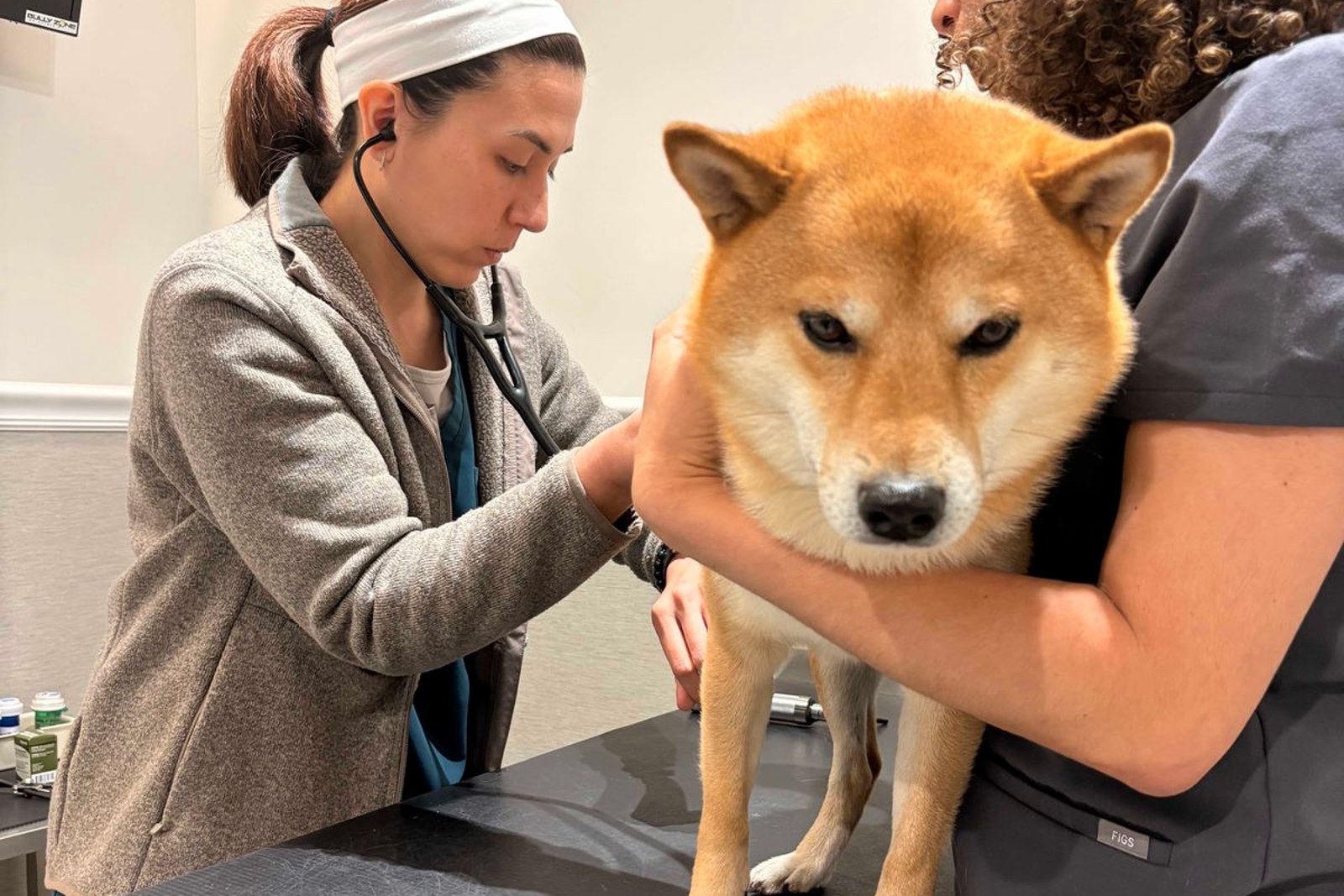
Diagnosis starts with the hands, not the scanner. The first step is a thorough physical examination, paired with a neurological examination. The vet watches the gait, which means the way the dog walks. They test paw placement by gently turning a paw over to see if the dog corrects it. They palpate, which means feeling along the spine for a painful segment. They check reflexes and, in serious cases, whether the dog can feel a firm toe pinch, a test vets call deep pain perception. Together these findings localise the problem, which means narrowing it to a region of the spine, and grade its severity.
X-rays are often the next step, and their limits are worth understanding. An X-ray can show a narrowed disc space or a calcified disc, and it helps rule out fractures and some tumours. It cannot show the spinal cord itself. A dog can have a dramatic herniation and an unremarkable plain X-ray. That is why Cornell describes referral for specialised imaging, an MRI or CT scan, for dogs with more than mild pain. MRI shows the cord, the discs, and the soft tissues around them. CT is faster and shows calcified disc material well. Either one gives the surgeon the map they need if surgery follows.
For insurance, the diagnostic path matters as much as the diagnosis. Policies treat the components differently. One plan may cover the consultation and X-rays but classify advanced imaging as a separate service with its own limit. Another may require the imaging to happen at a referral centre to count as covered. A third may ask for pre-authorisation, which means approval requested before the service, for non-emergency imaging. None of that is visible in a headline that says back problems are covered. It is visible in the sample policy's definitions of diagnostic services, which is where the policy table below sends you.
Treatment: rest, medicine, or surgery
Treatment follows severity, and Cornell draws the same dividing line most specialists use. Mild cases may be managed medically, at least at first. Severe cases, cases that worsen, and cases that keep returning are the surgical ones.
Medical management
Medical management means strict rest plus medication. Restricted activity is the active ingredient, not a suggestion. The dog is confined to a crate or small pen, carried or supported outside for toilet breaks, and kept away from stairs, furniture, and play. Pain medications are prescribed for comfort, and muscle relaxants are sometimes added, because muscle spasm around an injured segment is its own source of pain. Cornell describes exactly this combination for mild cases. The goal is to let the torn disc seal and the inflammation settle before more material can push into the canal.
The honest weakness of medical management is recurrence. A disc that has ruptured once has neighbours that degenerated alongside it, and the dog's body shape has not changed. Owners should ask the vet directly what would trigger a change of plan: worsening signs, signs that plateau without improving, or a second episode. Knowing the trigger in advance turns a frightening night into a decision already half made.
Surgery
Surgery for IVDD removes the pressure. In Cornell's description, bone is removed so that the extruded disc material can be extracted and pressure is taken off the spinal cord. In the back, the common approach opens a window in the vertebra from the side. In the neck, the approach is usually from underneath. The operation is intensive, and it is done by a specialist team with the imaging map in hand.
Timing is the part owners most need to hear plainly. If surgery is recommended, do not wait. The cord tolerates compression poorly, and the chance of recovery falls as hours pass, especially once deep pain perception is lost. This is also the point where insurance design stops being abstract. A policy that reimburses after the fact still helps, because the bill exists either way. A policy that excludes the condition, or that is still inside its spinal waiting period, helps not at all. There is no version of this night where reading the fine print at the hospital fixes the problem. The fine print had to be read at purchase.
Recovery and rehabilitation

Recovery is slow, structured, and mostly done by the owner. Dogs who undergo spinal surgery need crate rest initially, followed by strictly controlled exercise while they heal. Cornell notes that post-surgery dogs may need help going to the bathroom and monitoring for pressure sores, and that recovery can take months. The same discipline applies after medical management. Rest that ends a week early because the dog looks brighter is one of the common ways a healing disc is re-injured.
As healing progresses, rehabilitation enters. Cornell describes rehabilitation that can include laser therapy and underwater treadmill work, with prescribed exercises at home and a gradually increasing programme of walks. Rehabilitation is also a policy question in its own right. Some plans include rehabilitation after a covered surgery. Others cover it only under a therapy benefit, limit the number of sessions, or exclude it. If your dog's recovery plan includes rehab, the covered services list, not the brochure, tells you whether those sessions are part of the claim.
Weight and home layout are the long-term treatment. Keep the dog at an ideal body condition. Use ramps or steps so the dog is not jumping on and off furniture. Cornell lists both steps among its treatment guidance, and they are the two changes an owner fully controls. They cost little next to an episode, and they work every day, not only during a crisis.
The policy clauses that decide an IVDD claim
Most pet insurance disputes about disc disease are not arguments about what happened at the hospital. They are arguments about what the policy said before anything happened. Eight clauses do nearly all of that deciding. The table below names each clause, explains what it does in plain language, and states the question to settle for IVDD specifically. Every answer lives in the insurer's sample policy, which is the full contract wording, not the marketing summary. Read it before you enroll, and keep the answers in writing.
| Clause to check | What it means | The IVDD question to settle |
|---|---|---|
| Hereditary condition coverage | Some plans exclude conditions passed down through a breed's bloodlines, or cover them only under a hereditary section with its own rules | Is intervertebral disc disease covered for a chondrodystrophic breed at all, or does the hereditary wording remove the very condition the breed is known for? |
| Breed specific exclusions | A plan may name certain conditions for certain breeds and exclude them outright | Does the exclusion list name disc disease, spinal conditions, or your dog's breed anywhere? Check the exact breed name, including size variants such as miniature |
| Spinal or orthopedic waiting period | Many plans delay coverage for bone, joint, and spinal problems beyond the standard illness waiting period. The delay is stated in the sample policy | How long is the spinal waiting period in this plan, and does a vet examination during that period shorten or waive it? A disc episode inside the window is not covered, however urgent it is |
| Pre-existing condition definition | A pre-existing condition is one whose signs appeared before the policy started or during a waiting period, whether or not it was formally diagnosed | Would a single earlier note about back pain, a sore spine, or reluctance to jump make all later disc care pre-existing? For IVDD this is the most consequential definition in the contract |
| Curable versus chronic classification | Some plans treat a condition as curable and restore coverage after a symptom-free period. Others treat a diagnosis as permanent | After a first mild episode that resolved with rest, is disc disease treated as finished, or does the spine stay classified for the life of the policy? |
| Repeat episode and renewal handling | Policies differ on whether a new episode in a later year is a new claim or a continuation of the first condition | If a second disc ruptures two policy years later, is it a fresh claim under that year's terms, or is it linked to the first episode and any limit already used? |
| Annual limit and per condition limits | The annual limit caps what a plan pays in a policy year. Some plans also cap a single condition across its lifetime | Picture one year containing referral imaging, surgery, hospital days, and rehabilitation. Does the limit survive that year with room for ordinary illness care as well? |
| Covered services list | The contract lists which services count: consultations, imaging, surgery, hospitalisation, medication, rehabilitation | Are MRI and CT, specialist neurology, spinal surgery, hospital care, and post-surgical rehabilitation each covered, and does any of them carry a sublimit, a smaller cap inside the main limit? |
Two of these rows deserve emphasis because they catch owners out most often. The waiting period row is a timing trap. Disc disease does not schedule itself after your waiting period ends, and Dachshunds are often affected young. Our guide to waiting periods explains how these delays work across conditions. The pre-existing row is a records trap. Insurers read the medical record, not your memory of it. A casual note from a routine visit, written years before you thought about insurance, can be the document that decides the claim. That is why the strongest IVDD advice in this guide is also the simplest. Enroll while the record is clean if you can, and never hide a sign from your vet to protect a future claim. The dog's care comes first, and a hidden sign helps no one at claim time either.
An IVDD claim, step by step
This walkthrough uses no dollar figures, because treatment prices vary by region, hospital, and severity, and invented figures would not help you judge a real policy. It follows the sequence of a typical claim so you can see where the paperwork is created.
- The episode begins. Your dog shows signs from the table above. You restrict activity and call the vet. Note the date and time. If the policy has an advice line, a call now also creates a timestamped record that you acted promptly.
- The first visit. The vet examines the dog, records the neurological grade, and writes the findings in the medical record. This record is the foundation of the claim. Keep the invoice and the visit notes.
- Referral and imaging. If signs are more than mild, the dog is referred for MRI or CT. The imaging report names the exact disc and the degree of cord compression. Keep the report itself, not only the bill. It is the document that connects the treatment to the diagnosis.
- The treatment decision. The specialist recommends medical management or surgery. If surgery proceeds, the hospital stay, the operation, and the medication are each documented. Discharge instructions set the rest and rehabilitation plan in writing.
- Filing the claim. You submit the claim form with the invoices, the medical record, and the imaging report. Most insurers also ask for the dog's full history from every vet the dog has seen, because the pre-existing check runs on the whole record, not only this episode.
- The assessment. The insurer matches the episode against the clauses in the table above. Was the condition inside its waiting period? Did any earlier note describe back signs? Is disc disease hereditary-classified for this breed in this plan? The answers, not the size of the bill, decide the outcome.
- Reimbursement and the deductible. If the claim is accepted, the plan applies the deductible, which is the amount you pay first, and the reimbursement percentage stated in the policy, up to the remaining annual limit. Our guide to how pet insurance works walks through that arithmetic with a labelled hypothetical example.
- Recovery claims. Rehabilitation sessions, recheck visits, and medication refills may follow for months. File them as they happen, under the same episode, and keep the folder complete until the vet discharges the dog.
If a claim is denied, ask for the denial in writing with the exact clause cited. A denial that names a clause can be checked against the sample policy you read at purchase. A denial based on an earlier record note can be answered with the timeline you kept from the first night. Neither guarantees a reversal. Both turn an argument into a document review, which is the ground where owners do best.
Before you enroll a dog at risk of IVDD
- Get a written answer on whether intervertebral disc disease is covered for your dog's exact breed under the exact plan you are considering.
- Confirm hereditary conditions are covered, because disc disease in chondrodystrophic breeds is tied to an inherited body shape.
- Find the spinal or orthopedic waiting period in the sample policy, and ask whether a vet examination can shorten or waive it.
- Ask what earlier signs count as pre-existing for the spine: back pain, a sore back note, reluctance to jump, a previous limping episode.
- Ask how a second disc episode in a later year is handled, and whether any per condition limit would already be used up by the first.
- Check that MRI and CT, specialist neurology, spinal surgery, hospital care, and rehabilitation are covered services, and note any sublimits.
- Choose the annual limit by picturing imaging, surgery, hospital days, and rehabilitation in a single policy year.
- Enroll young, while the medical record shows no back signs, and keep breeder or rescue paperwork that shows the dog's history.
- At home, set up the ramp, the crate, and the weight plan now, while they are prevention rather than recovery.
Questions to ask an insurer, in writing
Copy these into an email or the insurer's contact form, and keep the reply with your policy. Written answers are the ones that can be quoted back at claim time.
- Is intervertebral disc disease covered for my dog's breed under this plan, and is it classified as a hereditary condition?
- What waiting period applies to spinal conditions, and can a veterinary examination shorten or waive it?
- My dog's record contains a note about back pain on a past visit. Would that make later disc treatment pre-existing under this plan?
- If my dog has a disc episode this year and a different disc ruptures in a later year, how is the second episode treated?
- Are MRI, CT, specialist neurology consultations, spinal surgery, hospitalisation, and post-surgical rehabilitation covered, and are there sublimits on any of them?
- Does this plan have a per condition limit that a first IVDD episode could exhaust?
- Is rehabilitation covered only after surgery, or also during medical management with rest and medication?
For the wider comparison method behind these questions, see how to compare plans and what pet insurance covers. For the money side in general terms, see what shapes the cost of pet insurance.
The at-home kit for a dog at risk
Owners who fare best in a first episode tend to own the same short list of things before they need them. A crate or small pen the dog already accepts as a resting place, so confinement is not a new stress on the worst night. A ramp for the sofa or the car, in daily use rather than still in its box. A well-fitting harness, so walks never pull on the neck. A folder, paper or digital, holding vaccination records, prior imaging, and your insurer's written answers, ready to hand to an emergency team. None of this treats a disc. All of it removes friction from the hours when friction costs the most.
Frequently asked questions
Is IVDD covered by pet insurance?
It depends on the exact policy. Some plans cover intervertebral disc disease as a standard illness. Others classify it as hereditary and apply hereditary rules, attach a longer spinal waiting period, or restrict it for breeds prone to disc disease. The only reliable answer comes from the sample policy for the plan you are considering, confirmed in writing for your dog's breed.
My dog yelped once and seemed sore for a day. Is disc disease now pre-existing?
It can be treated that way. Insurers read the medical record for signs such as back pain, reluctance to jump, or a sore spine, even when no formal IVDD diagnosis was made. A note like that, dated before the policy started or during a waiting period, can be used to treat later disc care as pre-existing. This is the main reason owners of at-risk breeds are advised to enroll before the first episode reaches the record.
Does my dog need surgery, or can IVDD be treated with rest?
Both paths are real, and severity decides. Cornell advises that mild cases may be managed medically at first, with restricted activity, pain medication, and possibly muscle relaxants. Surgery is the path for severe cases, cases that worsen, and cases that keep returning. If a specialist recommends surgery, Cornell's advice is not to wait, because delay raises the chance the spinal cord will not recover. Only the veterinarian examining your dog can say which path fits.
Is a second disc episode a new claim?
Policies handle this differently. Some treat each new episode under the terms of the policy year in which it happens. Others link repeat episodes to the first condition, apply a per condition limit, or treat a returning problem differently at renewal. Because a dog with one degenerated disc often has others, ask how repeat episodes are handled before you buy, not after the second episode.
Does insurance pay for MRI scans and rehabilitation for IVDD?
Only if those services are in the plan's covered services list. Some policies include MRI and CT as standard diagnostics. Others sublimit advanced imaging or require it to happen at a referral centre. Rehabilitation after surgery is covered by some plans, limited by others, and excluded by some. Check both services by name before enrolling a dog at risk.
Can I prevent IVDD in my dog?
The inherited risk cannot be removed, but the load on the spine can be reduced. Cornell's prevention advice is to keep the dog trim and fit, minimise time spent going up and down stairs and jumping on and off furniture and beds, and favour walking over leaping activities. Ramps or steps to furniture, a harness rather than a collar for dogs with neck involvement, and a vet visit at the first sign of back discomfort all help. None of it guarantees a disc will never rupture. It improves the odds and the starting position if one does.
Sources and further reading
- Cornell Riney Canine Health Center, Intervertebral disc disease
- Cornell Riney Canine Health Center, Chondrodystrophy and intervertebral disc disease (CDDY/IVDD)
- Brown et al., FGF4 retrogene on CFA12 is responsible for chondrodystrophy and intervertebral disc disease in dogs, PNAS 2017
- American Kennel Club, Intervertebral disc disease in dogs
Sources checked on November 6, 2026. CoverageForPets is operated by its publisher and researched from the primary sources listed above. This guide is general information only. It is not veterinary advice and not a recommendation to buy any specific policy.