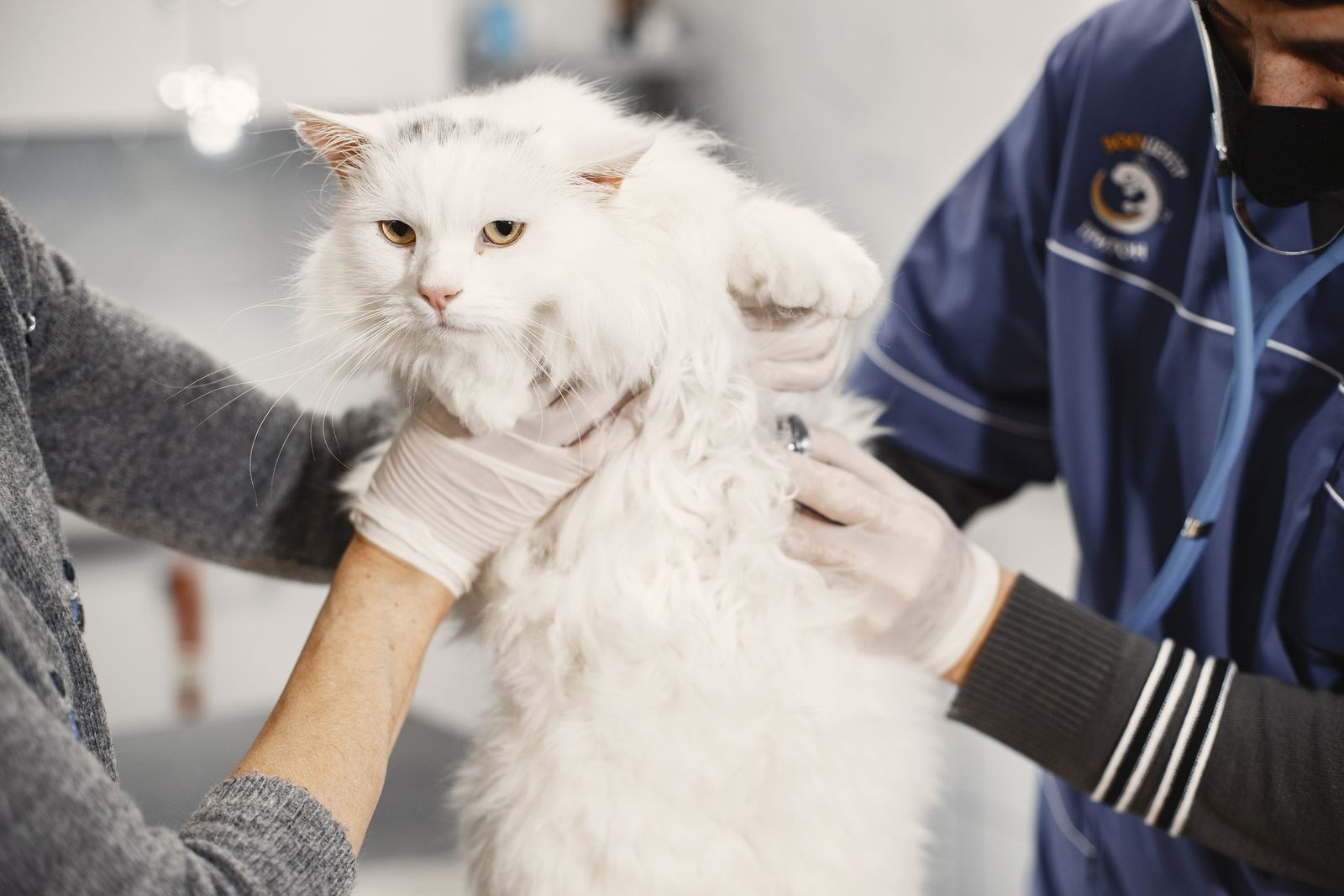
HCM at a glance
Hypertrophic cardiomyopathy is a disease of the heart muscle. The walls of the left ventricle, the heart's main pumping chamber, thicken. The chamber holds less blood, the muscle relaxes less well, and the heart works harder to do the same job. Cornell's Feline Health Center calls HCM the most common heart disease of cats, and UC Davis puts it at about 1 in 7 cats. This guide explains the condition in plain language first, then the screening tests that find it, and then the insurance questions that decide whether a policy actually helps.
| What it is | Abnormal thickening of the heart muscle, mainly the left ventricle, so the chamber volume falls and the heart relaxes poorly |
|---|---|
| Who is at risk | Any cat, including ordinary mixed breed cats. Cornell lists Maine Coon, Ragdoll, British Shorthair, American Shorthair, Sphynx, Bengal, Chartreux, Norwegian Forest, Siberian, and Persian cats among the breeds where it is more prevalent |
| Typical first signs | Often none at all. Many cats with HCM do not appear ill, and the condition is found at a routine exam or on a screening scan |
| Emergency signs | Labored or rapid breathing, open mouth breathing, collapse, or sudden hind leg pain or paralysis from a blood clot |
| How it is diagnosed | By echocardiography, an ultrasound of the heart. High blood pressure and hyperthyroidism can also thicken the heart wall and must be ruled out first |
| How it is managed | There is no known cure. Care focuses on monitoring, controlling heart rate, relieving congestion if heart failure develops, and reducing the risk of blood clots |
| The insurance question | Whether the policy treats HCM as hereditary for your cat's breed, whether screening scans count as covered diagnostics or excluded wellness care, and whether a murmur note or a diagnosis made before symptoms makes later care pre-existing |
What HCM is, in plain language
A cat's heart is a pump with four chambers. The left ventricle is the strongest chamber. It pushes blood out to the whole body. In HCM, the muscle wall of that chamber thickens inward. Cornell describes the result in two parts. The chamber volume shrinks, so each beat moves less blood. The muscle also relaxes abnormally between beats, so the chamber does not fill as well as it should.
The heart compensates at first, which is why so many cats seem fine. Cornell notes that the changes can make the heart beat rapidly, and that less efficient pumping can let blood back up toward the lungs. That backup is what produces congestive heart failure, in which fluid accumulates in or around the lungs and breathing becomes work. A second consequence is more sudden. Slow, swirling blood in an enlarged heart chamber can form clots. A clot can leave the heart and lodge where the blood supply to the hind legs branches. Vets call that a thromboembolism. Cornell describes the result as acute hind limb pain or, in extreme cases, hind limb paralysis.
Cornell is clear on two points that shape everything else in this guide. HCM is generally considered a progressive disease, meaning the thickening and its signs commonly worsen over time. And many cats with HCM do not appear to be ill at all. UC Davis adds that more than half of affected cats may show no clinical signs. A condition can therefore be real, recorded, and advancing while the cat on the sofa looks entirely normal. That gap between appearance and record is where most HCM insurance questions live.
The cause is not fully identified. Cornell notes that the condition is more prevalent in certain breeds and that mutations in several cardiac genes have been identified in some cats with the disease, which suggests genetics plays a role. UC Davis makes the same point more sharply. Breed specific mutations have been identified in Maine Coons and Ragdolls, but they account for only a small number of reported cases, and the mutation behind HCM is unknown in the vast majority of cats. HCM is not one genetic disease with one test. It is a heart muscle pattern with several roads leading to it, most of them unmapped.
Signs at home, sorted by what to do next
The honest starting point is that there may be nothing to see. Owners usually meet HCM through a vet visit, not through a symptom. Still, when signs do appear, they tend to belong to one of two groups: the breathing signs of heart failure, and the sudden leg signs of a clot. The table below sorts the common signs by the response they call for. It is general information, not a diagnosis. Signs like these can have other causes, and only a veterinarian who examines your cat can say what is going on. When in doubt, treat the sign as one level more urgent than the table suggests, and call your vet.
| What you see | What it can mean | What to do next | Write this down |
|---|---|---|---|
| No signs at all. Your cat eats, plays, and sleeps as usual, but a vet has mentioned a murmur, a gallop sound, or an irregular rhythm | Possible subclinical heart disease. The ACVIM consensus statement recommends further investigation when a murmur is detected in any cat, because the exam alone cannot show the heart muscle | Book the follow up. Ask whether an echocardiogram is advised, and keep the appointment even though the cat seems well. This is the screening moment this guide is built around | The date the murmur was first recorded, its description in the visit notes, and any screening the vet recommended |
| Less energy than usual, hiding more, eating less, or tiring quickly in play | Nonspecific signs. UC Davis lists lethargy and loss of appetite among the signs HCM can produce, and the ACVIM statement notes that hiding and inappetence may be the only signs some cats show | Call the vet and say what changed. Vague signs in a cat of an at-risk breed, or a cat with a known murmur, deserve a heart check as part of the workup | When the change started, and how appetite, activity, and breathing compare with the cat's normal pattern |
| Faster breathing at rest, breathing that looks like hard work, or a resting breathing rate that is climbing over days | Possible congestive heart failure, in which fluid builds up in or around the lungs. Labored breathing is the most common presenting sign in the ACVIM statement | Same day urgent care. Keep the cat calm and warm, minimise handling, and do not wait for a routine appointment. Tell the clinic the cat is breathing fast so they can prepare oxygen | The breathing rate counted over a full minute while the cat rests, and the time you first noticed the change |
| Open mouth breathing, collapse, or sudden weakness | Advanced breathing distress or a serious rhythm problem. Cornell lists open mouth breathing among the signs of congestive heart failure, and both Cornell and the ACVIM statement record sudden death as a risk in this condition | Emergency, now. Go to an emergency hospital. Keep the cat in a carrier, quiet and warm, and handle it as little as possible on the way | The time the episode started. Do not delay the trip to finish notes. Add them at the hospital |
| Sudden crying out, one or both hind legs dragging, weak, painful, or cold, with paws that look pale | A possible arterial thromboembolism, a clot blocking blood flow to the hind legs. Cornell describes acute hind limb pain and, in extreme cases, paralysis as the classic result, and the ACVIM statement lists acute paresis or paralysis with absent femoral pulses among its exam findings | Emergency, now. This is painful and time critical. Wrap the cat gently, do not massage or try to stretch the legs, and go straight to an emergency hospital | The time the leg signs started, and which legs are affected. These details anchor both the treatment decisions and the claim record |
One home habit is worth starting for any cat with a heart finding. Count the resting or sleeping breathing rate now and then, over a full minute while the cat is asleep or resting quietly, and keep the numbers with dates. The ACVIM consensus statement recommends that owners of cats with more advanced subclinical disease, and cats that have had heart failure, monitor this rate at home, because a rising trend is information a vet can act on between visits. It also creates a dated record of when breathing was normal, which matters later if anyone asks when signs began.
Which cats are at risk, and why
Any cat can develop HCM, and most cats with the condition are not pedigree cats at all. The ACVIM consensus statement notes that most cats with HCM are nonpedigree, while some pedigree breeds are believed to be at increased risk. Cornell's breed list is the one our breed guides use: Maine Coon, Ragdoll, British Shorthair, American Shorthair, Sphynx, Bengal, Chartreux, Norwegian Forest, Siberian, and Persian cats. UC Davis lists a similar group and adds that males are more commonly affected than females, and that HCM is an adult onset disease in most cases, with prevalence rising with age.
Within that list, two breeds carry a known, testable mutation, and they carry different ones. In Maine Coons, the A31P mutation in the MYBPC3 gene, a gene for a heart muscle protein, is associated with increased risk. In Ragdolls, a different change in the same gene, called R820W, is the breed's known mutation. UC Davis describes both as autosomal dominant with incomplete penetrance. In plain language, one copy can be enough to matter, but carrying the mutation does not guarantee the disease, and the number of copies changes the risk. The screening section below works through what those tests can and cannot tell you.
For the other named breeds, there is no equivalent single mutation test behind the breed guides on this site. Our Sphynx guide works through that breed's careful DNA test story, and our Devon Rex guide notes that the sources name no Devon Rex DNA test for HCM, so scanning the parents is the screening route there. Our Siberian guide and British Shorthair guide both rest on Cornell's breed list and on echocardiography as the test that shows the heart. For those breeds, the echo is not the backup plan. It is the plan.
Family history is the other risk signal, and it is free. A parent or littermate diagnosed with HCM raises the value of screening your cat, whatever the breed. When you buy a kitten of an at-risk breed, ask the breeder two separate questions and keep both answers. Were the parents DNA tested, where a breed test exists, and what were the results? And were the parents scanned by echocardiogram, and when? The Maine Coon guide and the Ragdoll guide each work through their breed's version of those questions in detail.
Age changes the picture rather than settling it. A clear scan in a young adult cat is good news about that day. It is not a lifetime finding, because the muscle can thicken later. That is why every serious screening programme for this condition is built on repetition, and why the worksheet at the end of this guide is arranged by life stage instead of by a single test date.
Screening and diagnosis: the murmur, the DNA test, and the scan
Three records dominate this condition, and confusing them is the most common screening mistake. A DNA result, a murmur note, and an echocardiogram report answer three different questions. The table below separates them, because insurers separate them too.
| Record | What it actually shows | What it cannot show | How it tends to be read later |
|---|---|---|---|
| A DNA test result | Whether the cat carries one known mutation. UC Davis offers a test for the A31P mutation in Maine Coons and a separate test for the R820W mutation in Ragdolls | Whether the heart muscle is thickened today, and whether HCM will develop from any other cause. Each test detects only its named mutation | Evidence of inherited risk. A positive result is a risk record, not a diagnosis, and how a policy treats risk records varies by plan |
| A murmur in the exam notes | That the vet heard an abnormal sound. The ACVIM statement reports murmurs in many cats with subclinical HCM, and also in a substantial share of healthy cats without HCM | Whether HCM is present. Many affected cats have no murmur, and many cats with a murmur have a normal heart. A murmur alone does not diagnose, and its absence does not clear | A dated sign in the medical record. Insurers read signs, not only diagnoses, when they apply a pre-existing definition |
| An echocardiogram report | The heart itself: wall thickness, chamber size, and how the heart fills and pumps. Cornell and the ACVIM statement both treat echocardiography as the test that diagnoses HCM | The future. A normal scan describes the heart on that date. It cannot promise the muscle will not thicken later, which is why screening repeats | The diagnosis document. Its date is usually the date the condition starts for policy purposes, and its measurements drive the monitoring plan |
The murmur: a reason to look, not a verdict
Auscultation, listening with a stethoscope, is where most HCM stories begin. The ACVIM consensus statement recommends further investigation if a heart murmur is detected in any cat. It also sets out the limits plainly. A murmur has been reported in many cats with subclinical HCM, but a substantial share of healthy cats without HCM have one too. Many affected cats have no auscultatory abnormality at all. A louder murmur is more common in cats with HCM than in normal cats, but a murmur growing louder over time does not necessarily mean disease is present or worsening. And cats with more advanced disease may have no audible murmur. A gallop sound or an irregular rhythm, by contrast, is more likely to be associated with cardiomyopathy. The practical reading is simple. A murmur is a referral slip for an echocardiogram, not a diagnosis, and a quiet chest is reassurance of a limited kind, not a clear heart.
The DNA tests: precise, narrow, and easy to overread
For Maine Coons, the UC Davis Veterinary Genetics Laboratory test detects the A31P mutation in MYBPC3. UC Davis reports that cats with two copies of the mutation can develop moderate to severe cardiac disease, which can lead to sudden death by 4 years of age or less, while cats with one copy live longer on average but may still develop HCM. For Ragdolls, the separate test detects the R820W mutation in the same gene. UC Davis reports that Ragdolls with two copies are at high risk of severe signs, usually between 1 and 2 years of age, with a greater likelihood of early cardiac death, while cats with one copy are not likely to show signs and may live a normal lifespan.
The limits matter as much as the results. Each test detects only its named mutation, in its named breed. The ACVIM consensus statement does not recommend using these two tests in cats of other breeds, because the mutations are almost completely specific to Maine Coons and Ragdolls. More importantly for owners of those two breeds, Maine Coon and Ragdoll cats that test negative for their mutations have been reported with HCM. The mutation is not the only cause, even in the breeds where it is known. That is why the ACVIM statement says regular echocardiographic screening should be considered even in Maine Coon and Ragdoll cats without these mutations, and why it recommends the genetic tests mainly for cats intended for breeding, where the aim is to reduce the incidence of the mutations over generations. A DNA result sorts risk. It never inspects the heart.
The echocardiogram: the confirming test
Echocardiography is an ultrasound examination of the heart, done while the cat is awake in most cases, with the heart imaged from several angles. Cornell states the diagnosis plainly: HCM is diagnosed by echocardiography, which reveals the thickened walls and the constricted volume of the left ventricle. UC Davis describes a definitive diagnosis in terms of measured wall thickness, greater than 6 mm at the end of filling, without another explanation for the thickening. The ACVIM statement calls echocardiography the gold standard test for cardiomyopathies in cats and the most accurate clinical test available, while noting that it is highly dependent on the operator, which is why specialist scans carry the most weight.
Two lookalike causes must be excluded before the diagnosis settles. High blood pressure and hyperthyroidism, an overactive thyroid, can each thicken the left ventricular wall. Cornell says these diseases must be ruled out before arriving at a diagnosis of HCM. Expect blood pressure measurement and, in older cats, a thyroid blood test to travel with the scan. The ACVIM statement recommends blood pressure measurement for cats with increased wall thickness, and thyroid measurement in cats aged 6 years and over with abnormal heart sounds or wall thickening. Other tests support the picture rather than replacing the scan. Chest imaging can show fluid if heart failure is suspected. An electrocardiogram records rhythm. A blood biomarker test called NT-proBNP can help sort out breathing problems and can flag advanced disease, but the ACVIM statement does not recommend it for telling a normal cat from one with mild to moderate HCM, and a normal result does not assure that a cat is free of cardiomyopathy. If a biomarker result is positive, the statement recommends that an echocardiogram follow.
How HCM is managed, in general categories
There is no known cure for HCM. Cornell and UC Davis agree on that point, and UC Davis adds that no preventive therapy has been shown to change its course. Management is therefore about staging, monitoring, and treating the consequences as they arise. The ACVIM consensus statement stages cardiomyopathy in a way that maps well onto those decisions, and the stages are worth knowing because vets and referral letters use them.
| Stage | What it means | The general approach |
|---|---|---|
| Stage A | Predisposed to cardiomyopathy, by breed or family history, with no evidence of heart muscle disease | No treatment. This is the screening stage, where DNA results, family history, and baseline scans do their work |
| Stage B1 | Heart changes on a scan, but no symptoms, and low risk of imminent heart failure or clot | Monitoring rather than medication in general. The ACVIM statement recommends that stage B1 cats be monitored annually for progression |
| Stage B2 | Heart changes on a scan, still no symptoms, but higher risk, driven mainly by a moderately or severely enlarged left atrium and other risk markers | Clot prevention medication is recommended when risk factors are present, and owners monitor the resting or sleeping breathing rate at home |
| Stage C | The cat has had congestive heart failure or a thromboembolism, even if signs later resolve with treatment | Emergency care at the crisis, then ongoing medication to control congestion and reduce clot risk, with rechecks and home breathing rate monitoring |
| Stage D | Heart failure that no longer responds adequately to standard treatment | Adjusted medication under specialist direction, with comfort and quality of life at the centre of decisions |
Across those stages, Cornell summarises the treatment goals in four parts: controlling heart rate, alleviating lung congestion in congestive heart failure, removing fluid from around the lungs when present, and decreasing the likelihood of thromboembolism. Medication can be given by mouth to stable patients or by injection in more serious situations. UC Davis describes the same supportive picture in general categories: medication to prevent blood clots, improve blood flow, and control heart rate or rhythm, with routine reevaluations to monitor progression for cats that need no treatment yet.
Prognosis varies more in this condition than in most. Cornell notes that cats showing no clinical signs are often able to survive for years with mildly compromised heart function, while findings that suggest a worse prognosis include congestive heart failure, thromboembolism, and low body temperature. UC Davis gives the same range, from cats that never develop signs and live a normal lifespan to cats that progress rapidly to heart failure or sudden cardiac death, with cats that develop blood clots carrying the worst prognosis. Those ranges are exactly why no honest guide can tell you what a diagnosis means for your individual cat. Only the scan measurements, the staging, and the follow up pattern can do that, and they come from your veterinary team.
The policy clauses that decide an HCM claim
Most pet insurance disputes about HCM are not arguments about what the scan showed. They are arguments about dates, definitions, and which kind of test the policy thinks an echocardiogram is. Eight clauses do nearly all of that deciding. The table below names each clause, explains what it does in plain language, and states the question to settle for HCM specifically. Every answer lives in the insurer's sample policy, which is the full contract wording, not the marketing summary. Read it before you enroll, and keep the answers in writing.
| Clause to check | What it means | The HCM question to settle |
|---|---|---|
| Hereditary condition coverage | Some plans exclude conditions passed down through a breed's bloodlines, or cover them only under a hereditary section with its own rules | Is hypertrophic cardiomyopathy covered for your cat's breed at all, or does the hereditary wording remove the very condition the breed is known for? |
| Breed specific exclusions | A plan may name certain conditions for certain breeds and exclude them outright | Does the exclusion list name heart conditions, cardiomyopathy, or your cat's breed anywhere? Check the exact breed name as it appears on your cat's records |
| Screening versus diagnostic testing | Policies separate tests done because signs exist from tests done to screen a healthy animal. Screening is often classed as wellness or preventive care, which illness policies commonly exclude | Is an echocardiogram covered when it follows a recorded murmur, when it is done purely because the breed is at risk, and when it repeats to monitor a diagnosed condition? These are three different answers in many plans |
| Pre-existing condition definition | A pre-existing condition is one whose signs appeared before the policy started or during a waiting period, whether or not it was formally diagnosed | Would a single earlier note about a heart murmur, a gallop sound, or an irregular rhythm make all later heart care pre-existing? For HCM this is the most consequential definition in the contract |
| Diagnosed but asymptomatic handling | Most policies start a condition at diagnosis, not at first symptoms. A scan finding on a healthy looking cat is still a diagnosis with a date | If an echocardiogram diagnoses HCM in a cat with no symptoms, does the plan treat that date as the start of the condition, and does later treatment stay covered at renewal? |
| Waiting period | Coverage for illness begins only after the waiting period stated in the policy. A condition whose signs or diagnosis fall inside that window is usually treated as pre-existing | How long is the illness waiting period in this plan, and what happens if a screening scan is already booked inside it? Our guide to waiting periods explains how these windows work across conditions |
| Chronic condition and renewal handling | HCM, once diagnosed, does not resolve. Policies differ on whether a chronic condition stays covered year after year, is capped per condition, or is treated differently at renewal | Does this plan keep paying for a lifelong heart condition across renewals, and is there a per condition limit that years of monitoring and medication could exhaust? |
| Covered services list | The contract lists which services count: consultations, diagnostics, emergency care, hospitalisation, medication | Are cardiology referral, echocardiography, electrocardiography, chest imaging, blood pressure and thyroid testing, emergency heart failure care, and long term heart medication each covered, and does any of them carry a sublimit, a smaller cap inside the main limit? |
The diagnosed but asymptomatic case, walked through
No sibling guide on this site has this section, because no other condition so often produces a diagnosis in an animal that looks perfectly well. Picture the common sequence. You enroll a young adult Maine Coon with a clean record. The waiting period passes. At a routine exam the vet hears a murmur and refers the cat for an echocardiogram. The scan shows thickened heart muscle, and HCM is diagnosed. The cat has never had a symptom in its life.
That diagnosis is, for most policies, the start of the condition. From that date, the monitoring scans, any medication, and any later heart failure or clot care are claims about an existing, recorded condition. If the policy was in force, past its waiting period, and the record before enrollment shows no murmur, gallop, rhythm concern, or heart related visit, the case is generally handled as a covered illness under the plan's terms. Change any one date and the case changes with it. A murmur noted at the kitten exam, before enrollment, can be used to treat the later diagnosis as pre-existing. A scan done during the waiting period can do the same. This is why the order of operations matters more than the diagnosis itself: enroll first, while the record is clean, and let screening happen after the waiting period where you honestly can. Never delay a scan your vet says is urgent in order to protect a claim. A delayed diagnosis helps no one, and the record of why you waited helps even less.
The flip side also deserves plain words. A DNA test result is not a diagnosis, and a breeder's screening paperwork from before you owned the cat may or may not be part of the medical record an insurer can request. Ask the insurer, in writing, how it treats a known mutation result and a family history of HCM when no heart signs have ever been recorded for your cat. Plans answer that question differently, and the written answer is the one that can be quoted back later. For the wider framework behind these clauses, see what pet insurance covers.
An HCM claim, step by step
This walkthrough uses no dollar figures, because cardiology prices vary by region, clinic, and how much of the workup a cat needs, and invented figures would not help you judge a real policy. It follows the sequence of a typical claim so you can see where the paperwork is created.
- The finding. A murmur is heard at a routine exam, a breeder or breed risk prompts a screening discussion, or signs from the table above send you to the vet. Note the date. It is the first date in the story an insurer will read.
- The first visit. The vet records the exam findings in the medical record, including the murmur description or the signs you reported. This record is the foundation of the claim. Keep the invoice and the visit notes.
- Referral and the scan. The cat is referred for echocardiography, usually with blood pressure measurement and blood tests to rule out high blood pressure and hyperthyroidism as the cause of any thickening. Keep the full scan report, not only the bill. It is the document that makes or excludes the diagnosis.
- The diagnosis and stage. If the scan confirms HCM, the report records the measurements and, in specialist hands, the stage and risk picture. That date is usually the start date of the condition for policy purposes.
- Filing the claim. You submit the claim form with the invoices, the medical record, and the scan report. Most insurers also ask for the cat's full history from every vet the cat has seen, because the pre-existing check runs on the whole record, not only this episode.
- The assessment. The insurer matches the case against the clauses in the table above. Was any murmur or heart sign recorded before the policy started or during its waiting period? Is HCM hereditary classified for this breed in this plan? Was the scan screening or diagnostic under the plan's definitions? The answers, not the size of the bill, decide the outcome.
- Reimbursement and the deductible. If the claim is accepted, the plan applies the deductible, which is the amount you pay first, and the reimbursement percentage stated in the policy, up to the remaining annual limit. Our guide to how pet insurance works walks through that arithmetic with a labelled hypothetical example.
- Monitoring claims. Repeat scans, recheck visits, breathing rate concerns, and medication may follow for years. File them as they happen, under the same condition, and keep the folder complete. An emergency visit for breathing difficulty or a clot files under the same condition too, with its own hospital records added.
If a claim is denied, ask for the denial in writing with the exact clause cited. A denial that names a clause can be checked against the sample policy you read at purchase. A denial based on an earlier murmur note can be answered with the timeline you kept, including your home breathing rate log showing when breathing was normal. Neither guarantees a reversal. Both turn an argument into a document review, which is the ground where owners do best.
Before you enroll a cat at risk of HCM
- Get a written answer on whether hypertrophic cardiomyopathy is covered for your cat's exact breed under the exact plan you are considering.
- Confirm hereditary conditions are covered, because HCM in the named breeds is tied to inheritance, even where no single mutation has been found.
- Ask the three scan questions separately: an echocardiogram after a recorded murmur, a screening scan with no signs, and repeat scans to monitor a diagnosed condition.
- Ask what earlier findings count as pre-existing for the heart: a murmur note, a gallop sound, an irregular rhythm, a breeder screening result, a family history of HCM.
- Ask how a condition diagnosed between enrollment and symptoms is treated, and whether it stays covered at renewal as a chronic condition.
- Check that cardiology referral, echocardiography, electrocardiography, chest imaging, blood pressure and thyroid testing, emergency care, and long term medication are covered services, and note any sublimits.
- Choose the annual limit by picturing a cardiology workup, an emergency hospital stay, and a year of monitoring and medication in a single policy year.
- Enroll young, while the medical record shows no heart findings, and keep breeder paperwork, DNA results, and any parent screening records in the same folder as the policy.
- Start the home breathing rate log now, while the numbers are boring. A baseline is only useful if it was written before anyone needed it.
Questions to ask an insurer, in writing
Copy these into an email or the insurer's contact form, and keep the reply with your policy. Written answers are the ones that can be quoted back at claim time.
- Is hypertrophic cardiomyopathy covered for my cat's breed under this plan, and is it classified as a hereditary condition?
- Is an echocardiogram covered when it is done to investigate a murmur, when it is done as breed screening with no signs, and when it repeats to monitor a diagnosed condition?
- My cat's record contains a note about a heart murmur on a past visit. Would that make later heart treatment pre-existing under this plan?
- My cat carries a known HCM mutation result from a DNA test, with no heart signs recorded. How does this plan treat that result at enrollment and at claim time?
- If HCM is diagnosed by a scan after enrollment in a cat with no symptoms, is that date treated as the start of the condition, and does treatment stay covered at renewal?
- Are cardiology consultations, electrocardiography, chest imaging, blood pressure and thyroid testing, emergency hospital care, and long term heart medication covered, and are there sublimits on any of them?
- Does this plan have a per condition limit that a lifelong heart condition could exhaust?
For the wider comparison method behind these questions, see how to compare plans and what pet insurance covers. For the money side in general terms, see what shapes the cost of pet insurance.
The screening schedule worksheet, by life stage
This worksheet turns the screening story into a record you keep across the cat's life. Fill in the right hand column as each stage passes, and keep the finished rows with the policy. Intervals are a conversation with your vet, not a rule from this page. The one fixed rhythm in the sources is the ACVIM recommendation that cats with stage B1 disease be monitored annually, and that owners of higher risk cats track the resting breathing rate at home.
| Life stage | Screening step to discuss with your vet | What it can show | Record to keep |
|---|---|---|---|
| Kitten, before or just after coming home | Ask the breeder for the parents' DNA results where a breed test exists, and for the parents' echocardiogram dates and results. Book a first vet exam and ask the vet to listen carefully and record what is heard | Family risk, and a clean or noted baseline in your cat's own record | Breeder paperwork, DNA results, parent scan reports, and the first exam notes. Write the dates here: ______ |
| Young adult | Discuss a baseline echocardiogram for cats of at-risk breeds, and a DNA test for a Maine Coon or Ragdoll if knowing the result would change your screening plan. The ACVIM statement recommends the DNA tests mainly for breeding cats | The baseline scan shows the heart as it is now. The DNA result, where relevant, shows risk from one known mutation only | Scan report and DNA result, with dates. Baseline resting breathing rate: ______ breaths per minute |
| Adult, no findings | Keep heart listening in every routine exam. Discuss repeat echocardiograms at intervals your vet sets for the breed and family history, because a clear scan is a dated finding, not a lifetime one. ACVIM advises that repeat scanning be considered even for mutation negative Maine Coons and Ragdolls | Change over time, which is the pattern this condition follows | Each exam note and scan report in date order. Dates of clear scans: ______ |
| Adult, murmur or other finding recorded, no diagnosis yet | Follow through on the echocardiogram referral promptly. Add blood pressure measurement, and thyroid testing at the ages your vet advises, so lookalike causes are excluded in the same workup | Whether the sound was HCM, another cause, or a normal heart with a murmur | The referral letter, the scan report, and the blood pressure and thyroid results. Date of the finding: ______ |
| Diagnosed, no symptoms (stage B1 or B2) | Monitoring scans at the interval your cardiologist sets. The ACVIM statement recommends annual monitoring for stage B1 cats. For stage B2, owners monitor the resting or sleeping breathing rate at home, and clot prevention is discussed | Progression, left atrium size, and risk change, in time to act on them | Stage, scan dates, medication list, and the breathing rate log. Next scan due: ______ |
| Senior, or any age after heart failure or a clot (stage C or D) | Rechecks at the interval your veterinary team sets, medication reviews, and continued home breathing rate monitoring, with the emergency signs from this guide kept visible at home | How congestion and medication are balancing, and early warning of the next crisis | Discharge sheets, current medication list, recheck dates, and the name and number of the emergency hospital: ______ |
Print the table or copy it into a note on your phone. A worksheet with real dates in it does two jobs at once. It tells the next vet the screening story without relying on memory, and it shows any insurer exactly when each finding entered the record, which is the question every HCM claim turns on.
Frequently asked questions
Is HCM covered by pet insurance?
It depends on the exact policy. Some plans cover hypertrophic cardiomyopathy as a standard illness. Others classify it as hereditary and apply hereditary rules, exclude it for named breeds, or treat screening tests differently from treatment. The only reliable answer comes from the sample policy for the plan you are considering, confirmed in writing for your cat's breed.
My cat has a heart murmur. Does that mean HCM, and is it now pre-existing?
A murmur does not prove HCM. The ACVIM consensus statement notes that many cats with subclinical HCM have a murmur, that many affected cats have no murmur at all, and that murmurs also occur in healthy cats without HCM. Only an echocardiogram shows the heart muscle itself. For insurance, though, a murmur recorded before the policy started or during a waiting period can be treated as a sign of a pre-existing heart condition, even before any diagnosis. Ask the insurer that question in writing for your cat's record.
My Maine Coon's DNA test was negative. Does that rule out HCM?
No. The UC Davis Veterinary Genetics Laboratory test for Maine Coons detects one mutation, A31P in the MYBPC3 gene, and the Ragdoll test detects a different mutation in the same gene, R820W. Cats that test negative for these mutations have still been reported with HCM, which is why the ACVIM consensus statement says regular echocardiographic screening should be considered even in Maine Coon and Ragdoll cats without these mutations. A DNA result describes risk from one known cause. It does not describe the heart.
My cat was diagnosed with HCM but has no symptoms. How do insurers treat that?
Most policies treat a diagnosis as the start of the condition, whether or not the cat has symptoms. If the echocardiogram happened after enrollment and after the waiting period, and no murmur or heart concern was recorded earlier, later care for HCM is generally handled as a covered illness under the plan's terms. If the diagnosis, or an earlier murmur note, predates the policy or falls inside a waiting period, the condition is generally treated as pre-existing. The dates in the medical record decide which case you are in.
Does insurance pay for echocardiograms, including repeat scans?
Only if the plan's wording allows it. An echocardiogram done to investigate a murmur or other signs is usually assessed as a diagnostic test for an illness. A screening scan on a healthy cat with no recorded signs may be treated as wellness or preventive care, which many illness policies exclude. Repeat scans to monitor a diagnosed and covered condition are a separate question again. Check all three situations by name before enrolling a cat at risk.
Can HCM be cured or prevented?
Cornell and UC Davis are both clear that HCM has no known cure, and UC Davis notes that no preventive therapy has been shown to change its course. What care can do is manage signs, control heart rate and rhythm where needed, relieve congestion if heart failure develops, and reduce the risk of blood clots. Screening does not prevent the condition either. It finds it earlier, when monitoring and planning can start, and when the insurance record is still being written.
Sources and further reading
- Cornell Feline Health Center, Hypertrophic cardiomyopathy for the most common heart disease of cats, the thickened left ventricle and reduced chamber volume, breeds where the condition is more prevalent, cats that do not appear ill, the hind limb clot presentation, diagnosis by echocardiography, ruling out high blood pressure and hyperthyroidism, treatment goals, and prognosis.
- Luis Fuentes et al., ACVIM consensus statement guidelines for the classification, diagnosis, and management of cardiomyopathies in cats, Journal of Veterinary Internal Medicine, 2020 for the staging system from A to D, murmurs in affected and healthy cats, genetic testing recommendations and their limits, echocardiography as the gold standard, biomarker limits, annual monitoring for stage B1, clot prevention at stage B2, and home resting breathing rate monitoring.
- UC Davis School of Veterinary Medicine, Hypertrophic cardiomyopathy for the estimate of about 1 in 7 cats, males more commonly affected, adult onset, the share of affected cats with no signs, diagnosis by echocardiography with measured wall thickness, supportive treatment categories, and the inheritance patterns in Maine Coons and Ragdolls.
- UC Davis Veterinary Genetics Laboratory, Hypertrophic cardiomyopathy in Maine Coons for the A31P mutation in MYBPC3, what one and two copies mean, and the finding that the mutation is not the sole cause of HCM in the breed.
- UC Davis Veterinary Genetics Laboratory, Hypertrophic cardiomyopathy in Ragdolls for the R820W mutation in MYBPC3, autosomal dominant inheritance with incomplete penetrance, and what one and two copies mean in Ragdolls.
Sources checked on November 6, 2026. CoverageForPets is operated by its publisher and researched from the primary sources listed above. This guide is general information only. It is not veterinary advice and not a recommendation to buy any specific policy.