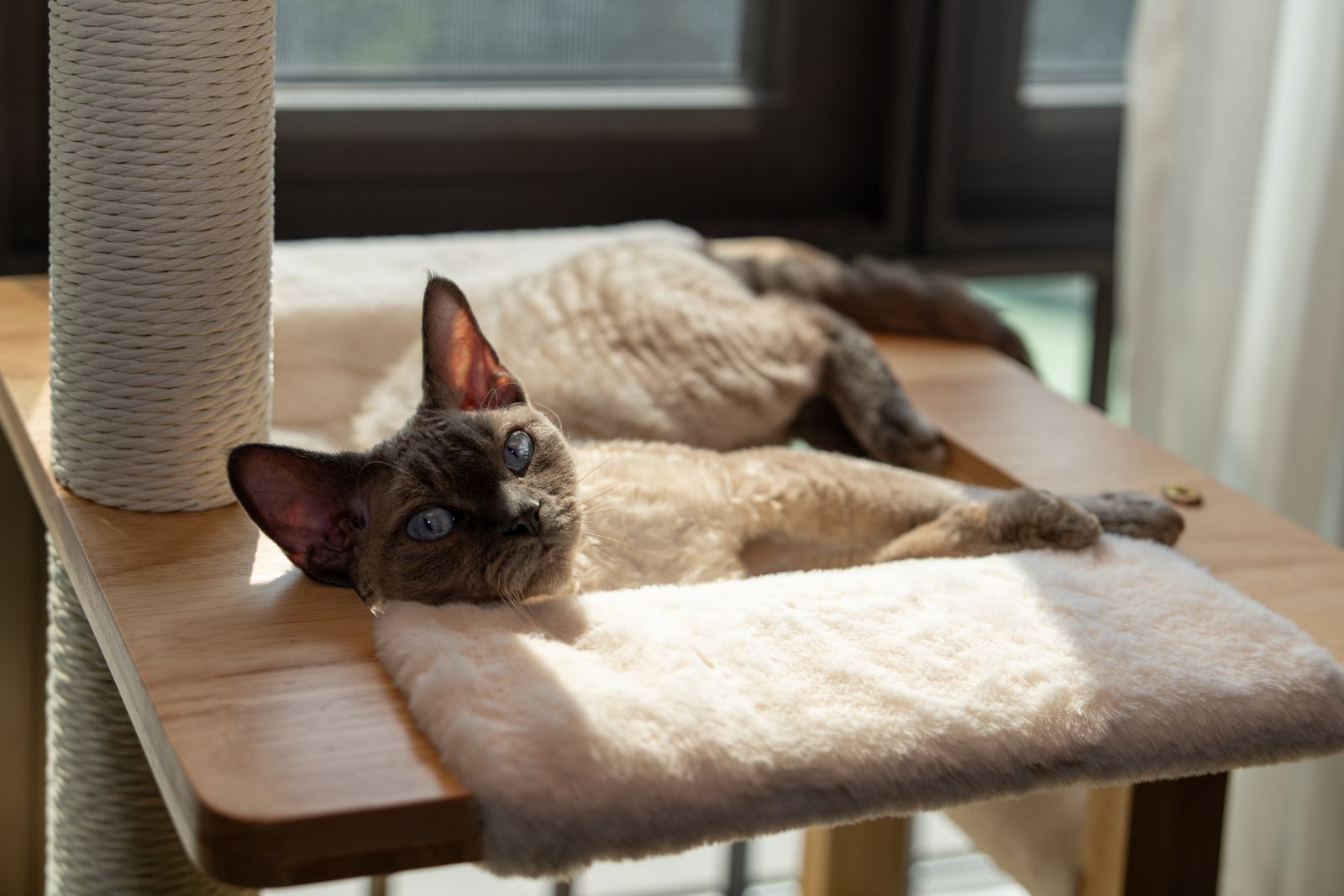
Devon Rex snapshot
The Cat Fanciers Association, known as the CFA, describes the Devon Rex as a breed of unique appearance. Its large eyes, short muzzle, prominent cheekbones, and huge, low set ears create what the CFA standard calls a characteristic elfin look. The International Cat Association, known as TICA, traces all Devon Rex back to Kirlee, a curly coated kitten born in Buckfastleigh, Devon, England, in 1960, and it is careful to separate this breed from the Cornish Rex. The gene behind the Devon coat is different from the gene behind the Cornish coat, the whiskers differ, and the ears and head shape differ. A Devon Rex is not a Cornish Rex with a new name, and it is not a hairless cat. It has a short, soft, wavy coat of its own.
| Size | Small to medium. TICA lists adult females at five to seven pounds and adult males at seven to nine pounds, and describes the breed overall as averaging six to nine pounds, with males heavier than females. |
|---|---|
| Origin | Buckfastleigh, Devon, England. TICA says all Devon Rex trace their ancestry back to Kirlee, born in 1960. |
| Body | Hard and muscular, lithe, and of medium length in the CFA standard, with a broad chest, long slim legs, and hind legs somewhat longer than the front legs. |
| Coat | Short, soft, fine, and wavy, with a rippled wave that shows when the coat is smoothed by hand. The CFA standard says the coat appears to be without guard hairs, and TICA notes that kittens may molt and regrow the coat as they develop. |
| Head and ears | A modified wedge head with a short muzzle, pronounced cheekbones, and a whisker break. The ears are strikingly large and set very low, very wide at the base. The eyes are large and wide set. |
| Temperament | People oriented, intelligent, playful, and highly active in the TICA description. TICA says Devons welcome attention, perch on a favorite person shoulder, follow household activity, and can become destructive if left bored for long periods. |
Two snapshot facts shape the insurance picture. The first is the narrow founding story. A breed that traces back to one foundation cat, and that was built through a small early population, is a breed where inherited conditions can be named, tested for, and written into the breed own health literature. That is useful, because named conditions can be asked about in writing before you buy a policy. It is also demanding, because an insurer may treat a condition written into the breed literature as a foreseeable breed risk, and the exact hereditary wording does real work.
The second fact is how early the breed main risk can appear. A condition whose signs can be observed at three weeks of age does not wait for an owner to finish comparing policies. In practice, the Devon Rex insurance file starts at the breeder, not at the first vet visit after the kitten comes home. The parents test results, the breeder notes on how the litter fed and moved, and the date the kitten first saw a vet are all part of that file. Later sections explain how to build it, and what each kind of paper can and cannot prove.
A note on lifespan belongs here, because owners often ask for a number first. The CFA and TICA breed pages checked for this guide describe size, coat, and temperament, and they do not state a lifespan range. This guide does not publish a lifespan figure it could not trace to those primary breed sources. What matters for insurance is not a headline lifespan. It is that this breed risks begin in kittenhood, while its heart and joint questions can continue across the whole of adult life, so a policy has to work at both ends of that span.
Health tendencies in Devon Rex cats
The conditions below are the ones with a documented link to this breed at a primary veterinary, academic, or breed source, plus one ear condition that is not breed specific but matters in a breed whose large ears collect oily buildup. These are tendencies, not predictions about an individual cat. Many Devon Rex will never develop most of them. The point of naming them is that each one tests a different line of policy wording, and in this breed several of them test the timing lines, the waiting period and pre-existing definitions, hardest of all.
This section is general information about conditions a breed can be prone to. It is not veterinary advice and it is not a diagnosis of any cat. Signs listed here are possible signs owners may notice, and many of them have several causes. Only a veterinarian who examines your cat can say what a sign means.
Devon Rex myopathy: congenital myasthenic syndrome (CMS)
What it is
A congenital muscle weakness, meaning a muscle weakness present from early life. The UC Davis Veterinary Genetics Laboratory explains that a mutation first reported as spasticity has been identified in a gene called COLQ, and that the mutation results in a congenital myasthenic syndrome similar to the condition in humans. Myasthenic refers to weakness in the connection between nerves and muscles, the point where a nerve signal tells a muscle to contract. The condition is inherited as an autosomal recessive trait. That term means a kitten must inherit the mutation from both parents to be affected, while a kitten with one copy is an unaffected carrier. UC Davis describes the condition as progressive, and as a condition that can be fatal in its severe form.
Signs owners may notice
- General muscle weakness, especially after exertion, stress, or excitement, which UC Davis names as the pattern in moderate to severely affected cats.
- A characteristic resting posture that UC Davis calls a dog begging or chipmunk position, with the front legs resting on a convenient object.
- A dropped head and neck posture, head bobbing, and shoulder blades that stand out, which the research summary hosted by the University of California, San Diego neuromuscular service lists among the presentations.
- Difficulty swallowing, choking on food, or trouble keeping food down, connected in that summary to an enlarged esophagus, the tube that carries food to the stomach.
- Signs at a very young age. UC Davis says signs can be observed as early as three weeks of age, and that they progress slowly but occasionally become static, meaning they stop changing.
How vets usually evaluate and treat it
Evaluation starts with the history and a hands on neurological and muscle examination, and the vet will want to place the weakness in context. Is it constant, or does it follow play and excitement. When was it first seen, and by whom. Is swallowing involved. Bloodwork helps rule out other causes of weakness in a young cat, including the low potassium condition covered in its own card below. The specific DNA test described by UC Davis identifies the COLQ mutation. It can identify affected cats and carriers, and UC Davis sets out the three result types plainly. A cat with two normal copies will not have this syndrome and cannot pass this variant on. A cat with one copy is a carrier and will not have the syndrome. A cat with two copies will have the syndrome. There is no cure described at the sources used for this guide. Care is supportive and vet directed, built around safe feeding, watching swallowing closely, and managing a cat whose muscles tire in a home set up for a weaker animal.
What a test can and cannot prove in this breed
This is the section Devon Rex owners need most, because this breed produces more kinds of paper than most, and the papers look more alike than they are. A clear result feels like a clean bill of health. In this breed, each test clears only the question it was built to ask.
| Paper in the file | What it actually answers | What it does not prove |
|---|---|---|
| DNA test for the COLQ muscle mutation | Whether this cat, or a parent, carries zero, one, or two copies of the one known mutation for congenital myasthenic syndrome, as UC Davis describes it. | Anything about the heart, the kneecaps, or blood potassium. It also says nothing about muscle weakness from a different cause. |
| Parents heart scan reports | What a parent heart looked like on the day that parent was scanned by echocardiogram. | What your kitten heart looks like, or what any cat heart will look like next year. TICA recommends parent scanning for hypertrophic cardiomyopathy, and a scan is a dated snapshot, not a guarantee passed down the litter. |
| DNA test for the inherited low potassium condition | Whether a cat carries the WNK4 gene change that International Cat Care names for periodic hypokalaemia in Burmese and related breeds, including the Devon Rex. | What the blood potassium level is during a weakness episode today. That is a blood test question, answered at the vet visit, not by a genotype. |
| A kneecap examination note | How the kneecaps tracked on that day, and, if luxation was found, the grade the vet assigned from one to four. | That the knees will track the same way as the kitten grows. Merck notes that signs of patellar luxation generally start before one year of age, so an early normal note and a later finding can both be true. |
| An ear examination note | Whether wax, yeast, bacteria, or ear mites were found in the ears on that day, and what treatment was given. | That the ears will stay clear. TICA notes that these large ears tend to collect oily buildup, so ear findings can recur, and the record of each episode matters. |
The practical takeaway is to keep every kind of paper, labelled by date and by cat. Breeder DNA reports describe inherited risk in the parents. Your own cat test results describe your cat genotype. Scan reports and examination notes describe your cat body on a date. An insurer judging a claim will read the dated examination record of your own cat first, and the breeder papers as background. When the two seem to disagree, for example clear parent DNA results and a kitten who tires and drops its head after play, the kitten in front of the vet is the record that drives care and claims.
Hypertrophic cardiomyopathy (HCM)
What it is
A disease of the heart muscle in which the muscular walls of the heart thicken, most importantly the left ventricle, the heart main pumping chamber. The Cornell Feline Health Center calls hypertrophic cardiomyopathy the most common heart disease of cats, and explains that the thickened wall leaves less room inside the chamber and relaxes poorly, so the heart works less efficiently, and that the disease is generally progressive. The Devon Rex link in the sources used here is a screening link. TICA states that the breed is considered overall healthy, and in the same passage recommends that all Devons be genetically tested for available markers, including Devon myopathy, and that parents should be scanned for hypertrophic cardiomyopathy. In other words, breeder heart scanning is part of responsible Devon Rex practice, even though Cornell breed list for higher prevalence does not name the Devon Rex in the passage checked for this guide. This guide presents the condition honestly on that basis. It is a condition this breed is screened for, and a condition any cat can develop.
Signs owners may notice
- Often, nothing at all. Cornell notes that many cats with this disease do not appear to be ill, which is why routine examinations and parent screening carry weight.
- Labored or rapid breathing, open mouth breathing, and unusual tiredness, which Cornell lists as signs of congestive heart failure, the stage where fluid builds up in or around the lungs.
- A murmur or an abnormal rhythm heard by the vet at a routine exam, in a cat that seems well at home. This is a finding, not a home sign, and it is a common door into diagnosis.
- Sudden pain or weakness in the back legs, which can signal a blood clot that has traveled from the heart and blocked blood flow to the hind limbs.
How vets usually evaluate and treat it
The diagnosis is made by echocardiography, called an echocardiogram or echo for short, an ultrasound scan that creates an image of the heart and shows the thickened walls and the smaller chamber. Cornell stresses that similar thickening can also be caused by high blood pressure and by an overactive thyroid, and that those conditions must be ruled out before the diagnosis is made, so blood pressure measurement and bloodwork are often part of the same workup. Chest X-rays and an electrocardiogram, a recording of the heart electrical activity, may also be recommended. Cornell is clear that the disease has no known cure. Care is a specialized plan built around controlling heart rate, easing lung congestion if heart failure develops, and reducing the chance of blood clots, with medication given by mouth to stable cats.
Patellar luxation (kneecap slipping out of place)
What it is
A developmental orthopedic disorder in which the patella, the kneecap, is displaced to one side or the other from the groove at the front of the thigh bone where it should track. The Merck Veterinary Manual describes that displacement, medially or laterally, and notes that medial luxation, toward the inside of the leg, is more common in cats. The disorder is tied to how the surrounding structures of the hind leg developed, including the shape of the groove itself, which can be shallow. In a small, light, athletic cat that jumps constantly, a kneecap that slips is easy to miss at first, because the cat often recovers within a few steps and carries on.
Signs owners may notice
- Intermittent lameness where the cat suddenly does not bear weight on a back leg, then walks normally again within a few steps. Merck calls this pattern a skipping gait, and names lameness as the main clinical sign.
- Holding a back leg at an odd angle, hesitating before a jump, or spending less time in favorite high places.
- Less grooming of the back half of the body, or a poorer coat there, which can follow reduced comfort in the hind legs.
- In more severe grades, consistent lameness rather than an occasional skip, because Merck explains that at grade three the kneecap is out of place most of the time, and at grade four it is permanently out of place and cannot be put back by hand.
When it can be urgent
A skipping gait that comes and goes is a prompt vet appointment, not usually an emergency. A cat that suddenly cannot bear weight at all, cries when a leg is touched, or has had a fall or other trauma needs same day care, because a sudden non weight bearing leg can also be an injury rather than a luxation episode.
How vets usually evaluate and treat it
The vet feels the kneecap position while moving the knee through flexion and extension, and assigns a grade from one to four based on how easily the kneecap leaves the groove and whether it returns on its own. Merck sets out those grades, from a grade one kneecap that can be moved out by hand but returns on its own, to a grade four kneecap that is permanently displaced. X-rays show the limb alignment and the shape of the groove. Merck describes conservative treatment, including weight management, controlled exercise, physical therapy, and pain relief medication, as care that improves comfort without correcting the underlying anatomy, generally reserved for mild cases. For moderate to severe cases, and for cases that keep worsening, Merck describes surgical correction, and notes that surgical treatment in cats shares many similarities with treatment in dogs, including procedures that deepen the groove and realign how the kneecap is pulled through the leg.
Episodic hypokalaemic polymyopathy (inherited low blood potassium episodes)
What it is
An inherited condition in which blood potassium falls intermittently, in episodes, and the muscles weaken while potassium is low. Hypokalaemia is the veterinary term for low levels of potassium in the blood, and International Cat Care explains that the balance of potassium inside and outside cells is critical for normal function, especially in muscle fibers. The periodic form is an inherited disease in Burmese and related cats. International Cat Care names the Devon Rex directly in that related breed list, alongside the Cornish Rex, the Sphynx, and several others, and it names the gene as WNK4, with a gene test available to determine a cat genetic status. Polymyopathy means a muscle condition affecting many muscles. This condition is easy to confuse with the breed myopathy in the first card, because both can produce a dropped head and weak muscles in a young cat. They are different conditions, with different genes, different tests, and different treatment, which is why the workup matters.
Signs owners may notice
- Episodes of muscle weakness that come and go. International Cat Care describes moderate to severe signs for several days, followed by periods of normality that can last weeks.
- A drooped neck, where the cat cannot hold its head up in a normal position. That posture is called ventroflexion, and International Cat Care calls it one of the first and most obvious signs of significant low potassium.
- Weak limbs, reluctance to walk or move, and a stiff or wobbly appearance during an episode, sometimes brought on by exercise, stress, or cold weather.
- In mild cases, no outward signs at all, with low potassium found only on a blood test, although International Cat Care notes that low potassium can still affect appetite and the kidneys.
How vets usually evaluate and treat it
Potassium itself is simple to measure, with a blood test. Confirming low potassium is the start, not the end, because International Cat Care lists several causes of low potassium in cats, including poor appetite, chronic kidney disease, severe vomiting or diarrhea, and an adrenal hormone disorder. Further blood and urine tests, and sometimes imaging, may be needed to find the underlying cause in an individual cat. For the periodic inherited form, a gene test can determine genetic status. Treatment of low potassium usually involves potassium supplementation, at first by a drip in severe cases and then by mouth in liquid, powder, or tablet form where longer supplementation is needed. International Cat Care notes that cats with the periodic form usually need continued supplementation to avoid repeat episodes, that repeat blood tests are needed to set the right amount, and that some cats improve on their own by one to two years of age and may not need supplementation for life.
Ear disease: otitis externa in very large ears
What it is
Inflammation and infection of the outer ear canal. The Cornell Feline Health Center describes otitis externa as, among acquired feline ear conditions, the most commonly diagnosed by far, and warns that it can lead to overproduction of earwax, progressive tissue damage, and, if untreated, permanent deafness in an affected cat. One honesty note matters here. Cornell does not present this as a hereditary Devon Rex condition, and this guide does not either. It is on this page because of the breed anatomy and care record. TICA states plainly that large ears tend to collect oily buildup and should be cleaned when they look dirty. A Devon Rex ear is a large, open, lightly furred structure, and what collects in it is part of this breed routine care and routine vet record.
Signs owners may notice
- A thick, dark, foul smelling accumulation of wax and debris in the ear, which Cornell describes as the mess ear mites make inside an infected ear canal. Ear mites are a tiny parasite that Cornell names as the most common cause of outer ear disease in cats.
- Scratching at the ears, head shaking, and rubbing the head along furniture or the floor.
- Redness, soreness when an ear is touched, and a cat that pulls away from ear handling it normally tolerates.
- Recurring wax and odor that return after cleaning, which can signal that a yeast called Malassezia has overgrown. Cornell explains that all feline ears have this yeast as part of their natural flora, and that infection follows when the climate in the ear changes and the organisms become too numerous.
When it can be urgent
A painful ear, a head held tilted, loss of balance, or an ear that swells suddenly should be seen promptly, the same day where possible. Ear disease that is left alone can damage tissue progressively, and a cat in ear pain should not wait for a routine slot.
How vets usually evaluate and treat it
Cornell describes diagnosis as a review of the cat medical history and a thorough physical examination, with special attention to the affected ears. In practice that usually includes looking inside the canal with an instrument, and examining wax or discharge under a microscope to separate mites from yeast and bacteria, because each cause is treated differently. Treatment categories are cleaning directed by the vet, medication for the specific organism found, and treatment of any underlying skin or allergy problem that keeps changing the climate in the ear. Home cleaning on a schedule the vet sets is part of life with this breed, and TICA cleaning note belongs in the routine record, not only in a claim file.
Policy decisions that matter for a Devon Rex
For most cats, a policy is judged on one bad year in middle age. For a Devon Rex, it is judged twice. First in kittenhood, when the breed named muscle condition, its low potassium look alike, and its kneecaps can all enter the record before the cat is a year old. Then across adult life, when heart monitoring, repeat ear episodes, and joint care produce steadier, smaller claims. Read these rows with both of those timelines in mind. Two terms appear throughout. The deductible is the amount you pay on eligible claims before reimbursement begins. A pre-existing condition is a condition, or a sign of one, that was present or recorded before enrollment or during a waiting period.
| Policy feature | Why it matters for a Devon Rex | Stronger wording looks like | Watch out for |
|---|---|---|---|
| Hereditary and congenital coverage | The breed core list runs on inheritance: congenital myasthenic syndrome and episodic hypokalaemic polymyopathy are both inherited, named, and testable. | Hereditary and congenital conditions are covered on the same terms as other illnesses. | Hereditary exclusions, or breed specific exclusions that quietly remove the conditions this breed is known for. |
| Kitten timing and waiting periods | Muscle signs can be observed as early as three weeks of age, low potassium episodes usually begin in young kittens, and kneecap signs generally start before one year of age. | Illness and orthopedic waiting periods are short, stated plainly, and already finished early in the kitten first year at home. | A long waiting period that overlaps the exact age window when this breed kitten conditions appear, combined with breeder notes that predate enrollment. |
| Testing: screening versus diagnosis | This breed file is built from tests. The same DNA test can be a breeder screening tool before purchase and a diagnostic step when a vet investigates weakness. | The policy states clearly how tests ordered after a clinical finding are treated, separate from tests ordered on a healthy animal. | All genetic tests treated as elective screening and denied, even when a vet ordered one to explain a kitten weakness. |
| Heart diagnostics and monitoring | Parent scanning is recommended practice in this breed, and a murmur in your own cat becomes a referral and an echocardiogram before any treatment begins. | Specialist exams and echocardiography are covered categories for a covered heart concern, including repeat monitoring at renewal. | Wording that covers heart medication but leaves the scan that diagnoses the disease outside the covered categories. |
| Orthopedic and bilateral terms | Kneecaps come in pairs, the grade can differ by knee, and the second knee can be noted months after the first. | Each knee is judged on its own record, with clear terms for the second side and for arthritis that follows a covered luxation. | A bilateral clause that treats the second knee as pre-existing once the first knee is diagnosed. |
| Episodic condition counting | Low potassium weakness and ear disease both improve and return. How episodes are counted decides how often a deductible restarts. | An episodic condition is counted as one ongoing condition, with its monitoring blood tests reimbursable. | Each episode treated as a new condition with a new deductible, or a recurring condition reclassified as pre-existing after its first episode. |
| Emergency and swallowing care | The severe end of the breed muscle condition is a feeding emergency: choking, inhaled food, and lung infection. | Emergency care for a covered condition is covered on the same terms as scheduled care, with no preapproval step that cannot be met at night. | Emergency surcharges or out of hours care excluded, or a preapproval rule that a choking kitten cannot wait for. |
| Deductible type | Kitten workups, repeat potassium blood tests, ear rechecks, and heart monitoring produce steady claims across a year. | An annual deductible that is met once, after which eligible claims across conditions are reimbursed. | A per-condition deductible that restarts the counting for the muscles, the knees, the ears, and the heart separately. |
Life stages: kitten, adult, and senior
Kitten
The kitten stage is the whole ballgame in this breed, and it starts before the kitten comes home. Congenital myasthenic syndrome signs can be observed as early as three weeks of age. Periodic low potassium signs are usually first seen in kittens from two to six months of age in the International Cat Care description, although they may not be noticed until around a year. Kneecap signs generally start before one year of age. Ask the breeder for both parents DNA results for the muscle condition, any gene test result for the low potassium condition, and the parents heart scan reports, and read them using the comparison table above. Keep the breeder litter notes as well, especially any note about a kitten who fed slowly, tired quickly, or lagged behind littermates. Enroll as early as the insurer allows, and bring the complete breeder file to the first vet visit, so the baseline record is accurate from the first page.
Adult
Adulthood in a Devon Rex is active, warm seeking, and people centered, and the insurance work of this stage is maintenance of the record. Kneecaps are rechecked as the cat matures. Ears are cleaned on the schedule the vet sets, and each infection episode is documented with its cause, not only its invoice. A routine examination may turn up a heart murmur in a cat that seems perfectly well, and that finding starts the cardiology path described in the heart card. If the cat had low potassium episodes as a kitten, note whether they have stopped. International Cat Care records that some cats improve by one to two years of age. At each renewal, confirm that any condition the cat now has is still described as covered, and keep every test result and scan report with its date in one file.
Senior
A senior Devon Rex carries the accumulated version of the breed list: a heart that may have been monitored for years, knees that may have developed arthritis where a kneecap tracked poorly, ears that still collect buildup, and muscles that should be watched for any new weakness, because new weakness in an older cat is a new workup, not an assumption that a kitten condition has returned. Review the policy for age based changes, premium increases, and any reduction in coverage at advanced ages. Check whether the monitoring rhythm built up over adult life, the heart scans, blood tests, and rechecks, is still reimbursable on the same terms. A plan that quietly thins out exactly when a long monitored cat needs it most fails the purpose it was bought for.
A claim, step by step: a kitten who tires and drops its head
The example below is hypothetical. It is not a real cat, a real claim, or a guarantee of how any insurer will decide. It follows a young Devon Rex from weakness noticed at home, through a workup that has to separate two breed conditions that look alike, to a diagnosis and supportive care. That separation, muscle condition or low potassium, is the diagnostic heart of this breed, and it is what the claim file has to show. Pet insurance generally reimburses after you pay the vet, as explained in how pet insurance works.
Weakness noticed at home, on video
A Devon Rex kitten who normally launches into play begins tiring within minutes. Twice, its head drops forward and it rests its front legs on a low step before it can lift its head again. The owner films the second episode on a phone, notes the date and what the kitten was doing just before it, and books a vet visit for the same week. That short video and the dated note become genuinely valuable. They show a vet, and later an insurer, exactly what the sign looked like and when it was first observed, relative to the policy start date.
The examination and the first blood test
The vet takes a full history, examines the kitten muscles and nerves, and watches its gait, posture, and swallowing. Bloodwork is drawn early, because one of the breed own conditions is found that way. The potassium result in this example comes back normal during this visit, which does not end the inquiry. The periodic low potassium condition is episodic, so a normal result between episodes is information, not a full answer. The owner pays the clinic and keeps the complete record and the itemized invoice, not only the payment receipt.
Checking the breeder file against the record
At home, the owner lines the file up in date order. Breeder papers show both parents DNA results for the muscle condition, the kitten own first health check, and the policy, which was started the week the kitten came home, with the illness waiting period already finished before the weakness was first filmed. No earlier note in the file mentions weakness, a dropped head, or swallowing trouble. That clean, dated timeline is what makes this a straightforward claim. Contrast it with the harder version of the same story, where a breeder note said one kitten in the litter seemed slow to feed and nobody recorded which kitten it was. That single undated line is the kind of record that turns a later muscle claim into an argument.
The DNA test as a diagnostic step
Because the weakness pattern fits the breed named muscle condition, the vet orders the DNA test for the COLQ mutation that UC Davis describes, as part of the diagnostic workup for a symptomatic kitten. This is the screening versus diagnosis line in practice. The same test, ordered by a breeder on a healthy cat, is screening. Ordered here, to explain a recorded sign, it is diagnosis, and the claim is filed on that basis, with the vet note stating why it was ordered. The owner keeps the full laboratory report, which names the gene, the result, and the date.
The diagnosis and the first claim
The result shows two copies of the mutation, which UC Davis explains means the cat will have congenital myasthenic syndrome. The diagnosis is recorded in those words, with the older name, Devon Rex myopathy, noted alongside it, because breeder papers and older records may use either name for the same condition. The claim is filed with the examination record, the bloodwork, the laboratory report, the home video note with its date, and the invoices. A feeding and activity plan begins at home, directed by the vet, built around safe swallowing and a kitten whose muscles tire.
Supportive care, rechecks, and how reimbursement works
Ongoing care settles into recheck visits, weight and swallowing checks, and prompt visits after any choking episode. Each eligible bill moves through the same mechanics described in what pet insurance costs and why. Charges count against the deductible first, the policy reimbursement rate applies to eligible charges after that, and totals are tracked against the annual limit. With an annual deductible already met by the workup, later rechecks in that year are no longer reduced by it. With a per-condition design, the counting works differently, which is why deductible type was flagged in the policy table above.
Renewal, and where muscle claims get denied
At renewal, the decisive question is whether the muscle condition is still a covered condition or has been reclassified. Under wording that keeps covered chronic and congenital conditions covered, rechecks and any related emergency care are filed the same way, referencing the original diagnosis date and the laboratory report. The denial pressure points in this breed story are a weakness note dated before enrollment, a DNA test denied as screening when the record shows it was ordered to investigate a sign, a hereditary exclusion that removes the breed named condition entirely, and an episode of low potassium weakness later argued to be the same claim, or a different claim, whichever suits the denial. Each of those is a clause question, and each can be asked in writing before you buy.
What drives a Devon Rex premium
No responsible guide will name a price for your cat, because the quote depends on the cat, the address, and the settings chosen. What can be explained is the shape of Devon Rex pricing and the choices that move it. The full mechanics are in what pet insurance costs and why.
Breed risk profile. Insurers see a small cat with a named, testable hereditary muscle condition written into its breed literature, an inherited episodic blood condition, a kneecap tendency that can lead to surgery, and a breeder screening expectation around the heart. That profile is priced on the named conditions, not on the cat size. A breed whose serious conditions have names, genes, and tests is a breed whose file an insurer can read closely, in both directions. Testing can support a claim, and a recorded sign can be used to question one.
Early onset. Most cat pricing assumes the expensive years arrive later. In this breed, the diagnostic workup for the signature condition can arrive in the first months at home. That does not make kitten enrollment a bargain trick. It makes the waiting period and the start date unusually important variables in this breed total cost, because a policy that begins after the first weakness note is a different product from one that began before it, at any premium.
Size. A Devon Rex is a small patient, and medication doses, anesthesia, and imaging for a cat of five to nine pounds sit at the small end of feline practice. That relative scale helps on individual bill size. It does not help on bill frequency. Repeat blood tests, rechecks, ear episodes, and heart monitoring are this breed pattern, and frequency across years is what renewal wording and deductible type decide.
Age curve. Premiums generally rise with age, and this breed cost story runs in two arcs. The first arc is the kitten workup arc, where the inherited conditions declare themselves or are ruled out. The second arc is the long adult and senior arc of monitoring, joints, ears, and heart. A slightly cheaper policy with hereditary exclusions or chronic condition caps can cost more over that span than a stronger policy, because the exclusions remove exactly the conditions this breed is most likely to claim for.
Location and plan settings. Vet prices in your area set the bill sizes the insurer expects, and specialist availability, for cardiology and neurology, varies widely by region, which affects both price and how care actually unfolds. Your deductible, reimbursement rate, and annual limit choices trade premium against claim returns. For this breed, deductible type deserves the same attention as deductible size, because an annual deductible and a per-condition deductible produce very different results across a muscle workup, potassium monitoring, and an ear claim in the same year.
Pre-purchase checklist for a Devon Rex policy
- Confirm hereditary and congenital conditions are covered, including congenital myasthenic syndrome and episodic hypokalaemic polymyopathy.
- Ask how a DNA test is treated when a vet orders it to investigate weakness, as distinct from screening a healthy cat.
- Confirm cardiology referral and echocardiogram coverage, for a murmur workup and for repeat monitoring of a covered heart condition.
- Read the orthopedic waiting period and the bilateral clause for kneecaps, and ask how arthritis in a luxating knee is treated.
- Ask how episodic conditions, such as low potassium weakness and recurring ear infection, are counted across episodes.
- Confirm emergency care for a choking or swallowing episode is covered on the same terms as scheduled care.
- Read the pre-existing definitions against the breeder file, and think about what is already written in the kitten earliest notes.
- Choose between an annual and a per-condition deductible using this breed pattern of kitten workups plus steady rechecks.
- Enroll as early as the insurer allows, ideally the week the kitten comes home, before any weakness, knee, ear, or heart note enters the record.
The kitten first-year documentation checklist
This is the breed tool. It is a file building checklist for the first year, because in this breed the file is the claim. Keep it as a single folder, paper or digital, and add each item with its date.
- Before the kitten comes home: both parents DNA results for the COLQ muscle condition, from the laboratory report itself, not a summary line. A result for each parent, named and dated.
- Before the kitten comes home: any WNK4 gene test results the breeder holds for the low potassium condition, and a written note if the breeder has not tested for it, so the gap is documented rather than discovered later.
- Before the kitten comes home: the parents heart scan reports, with the scan dates and the scanning vet name, read as dated snapshots of the parents, not as promises about the kitten.
- Before the kitten comes home: the breeder litter notes, especially any note about feeding speed, swallowing, tiredness, or a kitten who lagged behind littermates, with the kitten identified by name or marking, not left ambiguous.
- At the first vet visit: a baseline examination record that states, in words, what was found on gait, head and neck posture, muscle strength, swallowing, kneecap tracking in both knees, heart listening, and ear examination. A record that says these were normal on that date is valuable. A record that says nothing about them leaves a gap.
- At the first vet visit: the kitten weight, coat description, and vaccination and parasite record, so growth and coat changes later have a dated starting point.
- Through the first year: a dated home log of any weakness episode. What the kitten was doing, how long it lasted, whether the head dropped, whether swallowing was involved, and a short video where you can take one safely. Note normal weeks as well, because a pattern of episodes and gaps is itself diagnostic information for an episodic condition.
- Through the first year: every laboratory report, blood potassium result, scan report, and ear examination result, filed by date, with the invoice that matches it.
- At enrollment and at renewal: a copy of the exact policy wording in force, and the insurer written answers to the questions below, filed with the medical record rather than in a separate inbox.
Questions to ask an insurer, in writing
- Is congenital myasthenic syndrome, also recorded as Devon Rex myopathy, covered as a hereditary and congenital condition, including its diagnostic workup and supportive care?
- When a vet orders a DNA test to investigate recorded weakness, is that test treated as covered diagnosis or as excluded screening?
- How do you treat signs that a breeder recorded before the kitten came home and before enrollment, if the kitten own vet record is clean?
- Is an echocardiogram ordered because a vet heard a murmur treated as covered diagnosis, and do repeat scans for a covered heart condition stay covered at renewal?
- If one kneecap needs surgery, how is the other knee treated under your bilateral rule, and how is arthritis in an affected knee counted?
- How do you count an episodic condition, such as low potassium weakness or a recurring ear infection, when signs improve and later return?
Questions Devon Rex owners ask
Does pet insurance cover Devon Rex myopathy, also called congenital myasthenic syndrome?
An accident and illness policy can cover it when hereditary and congenital conditions are included, the illness waiting period has passed, and no weakness, head posture change, or muscle concern was recorded before enrollment. The timing is the hard part in this breed, because the UC Davis Veterinary Genetics Laboratory says signs can be observed as early as three weeks of age, before most kittens go to their new homes. Ask in writing how the diagnostic workup, the DNA test, and ongoing supportive care for a covered muscle condition are treated.
Both parents tested clear for the muscle condition. Is the health file settled?
It settles one named question. The UC Davis laboratory explains that a cat with two normal copies of the gene will not have this congenital myasthenic syndrome and cannot pass this variant on. That result says nothing about the heart, the kneecaps, or the inherited low potassium episodes that are also reported in this breed. Keep the parents test reports in the file, and keep reading the policy for heart screening, orthopedic wording, and hereditary coverage in general.
Is there a DNA test for heart disease in Devon Rex cats?
The sources used for this guide do not name a Devon Rex DNA test for hypertrophic cardiomyopathy. The International Cat Association instead recommends that parents be scanned for the condition, which means an echocardiogram, an ultrasound scan of the heart. A scan shows the heart as it is on that day. It is not a lifetime guarantee, so the hereditary coverage and repeat monitoring questions in a policy still matter even when a parent scan was normal.
My kitten showed weakness before I enrolled. Will later muscle claims be treated as pre-existing?
They may be, and that risk is exactly why the breeder record matters so much in this breed. Insurers judge pre-existing questions from the medical record, and signs recorded before enrollment or during a waiting period, such as weakness after play, a dropped head posture, or trouble swallowing, can be used to question later claims for the same body system. Save every breeder note, the first vet record, and any test results with their dates, enroll as early as you can, and ask the insurer in writing how it treats signs that were noted before a kitten came home.
If one kneecap needs surgery, how is the other knee treated?
That depends on the bilateral wording, the clause that sets the rule for paired body parts. The Merck Veterinary Manual explains that patellar luxation is graded from one to four by severity, and that treatment ranges from conservative care in mild cases to surgery in moderate to severe cases. Ask in writing whether a second knee that develops the same problem later is treated as its own claim, as part of the first condition, or as pre-existing once the first knee is diagnosed.
When is the best time to enroll a Devon Rex?
As early as the insurer allows, ideally right when the kitten comes home, and with the breeder file already in hand. The breed signature muscle condition can show signs in the first weeks of life, the inherited low potassium episodes usually begin in young kittens, and kneecap signs generally start before one year of age. Enrolling early clears the waiting periods while the record is as clean as it will ever be, and it makes the hereditary coverage wording worth reading from day one.
Sources and further reading
- Cat Fanciers Association, Devon Rex breed standard for the elfin look, the huge low set ears, the short muzzle and prominent cheekbones, the hard muscular body, and the short soft wavy coat.
- The International Cat Association, Devon Rex breed page for the Kirlee origin in Buckfastleigh, Devon, in 1960, adult weights for females and males, the people oriented temperament, the oily buildup in large ears, and the recommendation that Devons be genetically tested, including for Devon myopathy, with parents scanned for hypertrophic cardiomyopathy.
- UC Davis Veterinary Genetics Laboratory, Sphynx and Devon Rex congenital myasthenic syndrome for the COLQ mutation first reported as spasticity, autosomal recessive inheritance, weakness after exertion, stress, or excitement, the dog begging posture, signs as early as three weeks of age, and how the three test results are read.
- University of California, San Diego, Neuromuscular Cases, genetic testing for inherited myopathy in Sphynx and Devon Rex cats for head and neck ventroflexion, head bobbing, shoulder blade protrusion, an enlarged esophagus, and generalized muscle weakness and fatigability.
- Cornell Feline Health Center, Hypertrophic cardiomyopathy for heart muscle thickening as the most common heart disease of cats, its signs, diagnosis by echocardiography, the need to rule out high blood pressure and an overactive thyroid, and treatment goals.
- Merck Veterinary Manual, Patellar luxation in dogs and cats for displacement of the kneecap from its groove, medial luxation as more common in cats, the skipping gait, signs generally starting before one year of age, grading from one to four, and conservative and surgical treatment.
- International Cat Care, Hypokalaemia in cats for low blood potassium, ventroflexion of the neck as a sign, periodic hypokalaemia in Burmese and related cats including the Devon Rex, the WNK4 gene test, first signs in kittens from two to six months of age, and potassium supplementation.
- Cornell Feline Health Center, Otitis for otitis externa as the most commonly diagnosed acquired feline ear condition, ear mites as its most common cause, the Malassezia yeast that lives in all feline ears, and diagnosis by history and examination.