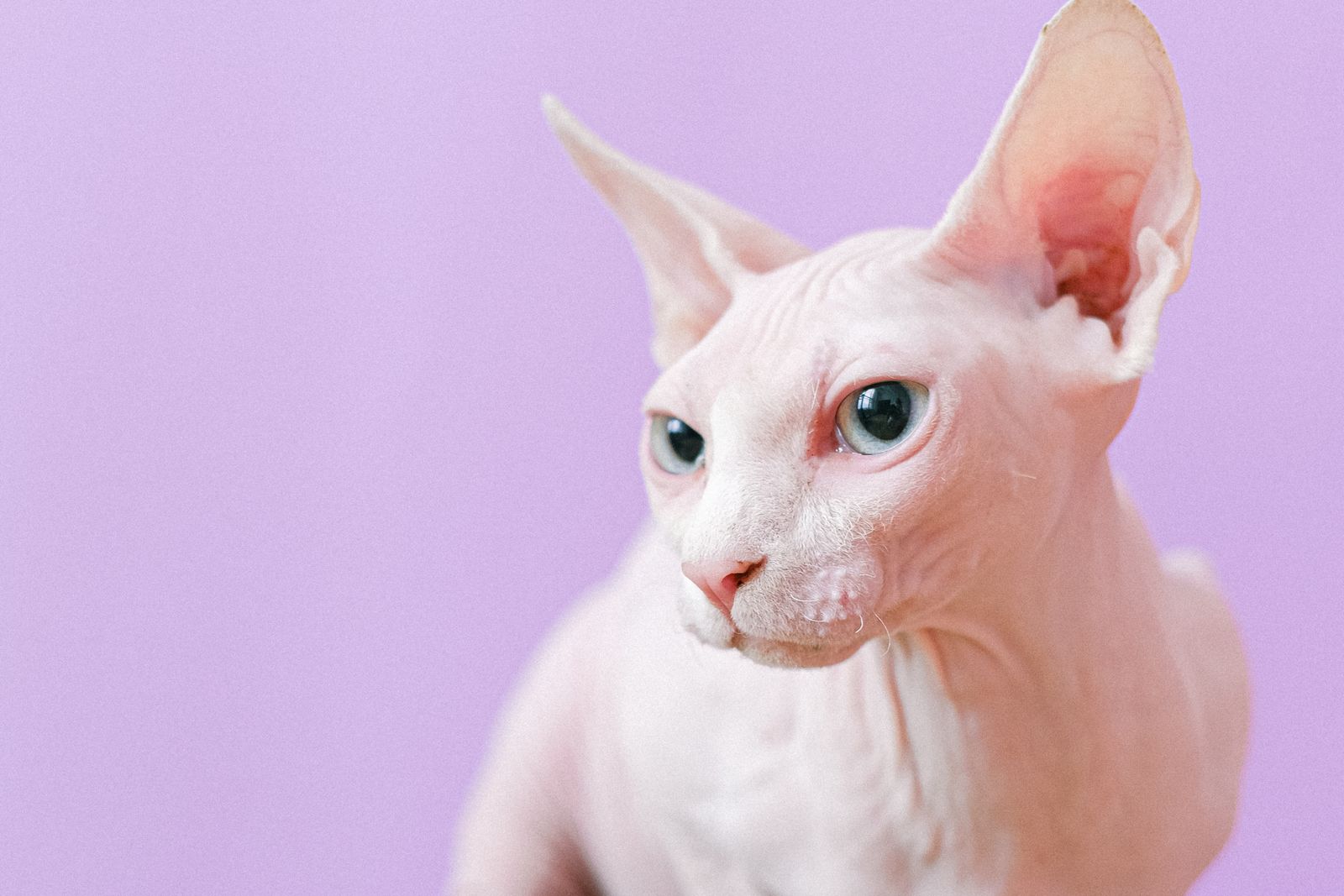
Sphynx snapshot
The Cat Fanciers' Association, known as the CFA, describes the Sphynx as a cat of medium size, with surprising weight for its size, and a skin texture like a soft peach or a smooth nectarine. The International Cat Association, known as TICA, says the same in its own standard: the Sphynx appears to be a hairless cat, although it is not truly hairless, and its skin should have the texture of chamois, a soft leather. Both standards agree on the features nobody mistakes: very large ears, wrinkled skin, and a hard, muscular body that is never delicate.
| Size | Medium, hard and muscular, with medium boning and surprising weight for the cat's size. Females are generally smaller than males. TICA breed presentation material gives a general guide of about seven to nine pounds for females and about nine to twelve pounds for males. |
|---|---|
| Coat and skin | Appears hairless, and is not truly hairless. The body can range from completely hairless to a covering of soft, peach like fuzz, with short, fine hair allowed on the feet, the outer edges of the ears, the tail, and the bridge of the nose. Color and pattern live in the pigment of the skin itself. |
| Wrinkles | Wrinkled skin is part of the breed, particularly around the muzzle, between the ears, and around the shoulders. TICA notes that the skin is very wrinkled in kittens, and that adults should retain as many wrinkles as possible, especially on the head. |
| Ears | Large to very large, broad at the base, open and upright. The CFA standard adds a detail that matters for care: the interior of the ears is naturally without furnishing, meaning there is no hair inside the ear. |
| Eyes | Large and lemon shaped in the CFA standard, slanting toward the outer corner of the ear in the TICA standard. All eye colors are accepted, and color should be harmonious with the skin color. |
| Temperament | Sweet tempered, lively, intelligent, and amenable to handling, in the words the standards use. TICA describes an outgoing and affectionate breed, which is part of why these cats are often handled, bathed, and examined more than most cats tolerate. |
Two snapshot facts shape the insurance picture. The first is that almost everything distinctive about this cat is skin. There is no coat to absorb the oil the skin makes, no hair inside those very large ears, and no fur between the sun and the body. Problems that stay minor in a coated breed, such as greasy skin, a waxy ear, or a sunburned ear tip, are everyday management questions in a Sphynx, and some become diagnoses with claims attached. The second fact is the size of the breed's foundation. The nearly hairless breed began with a mutation that appeared in 1966, in the UC Davis Veterinary Genetics Laboratory's account, and the permissible outcrosses in the TICA standard are only the American Shorthair and the Devon Rex. A breed rebuilt from few cats, around a recessive trait, concentrates inherited conditions. That is not a reason to worry about an individual cat. It is the reason this guide keeps returning to hereditary wording.
One correction belongs in an honest snapshot. A Sphynx is not hypoallergenic in the sense of allergen free. TICA addresses this on its breed page: the major cat allergen, called Fel d 1, is found in cat saliva, hair, and glands, and a Sphynx still produces it. Some people react less to a Sphynx, reactions are assessed person by person, and regular bathing may help lower the allergen load. Do not choose this breed on the promise that nobody will react to it.
This snapshot also does not promise a set lifespan. Published figures for this breed disagree by a wide margin, and none of the primary sources used here states one the way the standards state size, coat, and temperament. So this guide plans the way the breed's health file requires: a kitten whose inherited conditions can appear within weeks, an adult on a repeat screening rhythm, and a senior whose heart, skin, ears, and teeth all need the policy to still be working.
Health tendencies in Sphynx cats
The conditions below are the ones with a documented link to this breed at a primary veterinary or academic source, plus dental disease, which is not breed specific but matters here because dental wording varies so much between policies. These are tendencies, not predictions. Many Sphynx cats will never develop most of them. The point of naming them is that each one tests a different line of policy wording, and this breed tests the hereditary lines harder than most.
This section is general information about conditions a breed can be prone to. It is not veterinary advice and it is not a diagnosis of any cat. Signs listed here are possible signs owners may notice, and many of them have several causes. Only a veterinarian who examines your cat can say what a sign means.
A note on the breed's own genetics, because it frames everything that follows. The UC Davis Veterinary Genetics Laboratory explains that the nearly hairless coat is recessive to a normal coat, and that the mutation sits in a gene called KRT71. Recessive means a kitten needs two copies of the variant, one from each parent, to be hairless, while a cat with one copy has a normal coat and carries the trait silently. Keep that pattern in mind. Inherited conditions below follow the same pattern, and in each case the carrier cat looks completely normal. In a breed produced by concentrating recessive traits, the parents' test records and the policy's hereditary wording do real work.
Hypertrophic cardiomyopathy (HCM)
What it is
A disease of the heart muscle in which the muscular walls of the heart thicken, most importantly the left ventricle, the heart's main pumping chamber. The Cornell Feline Health Center calls hypertrophic cardiomyopathy the most common heart disease of cats, and lists the Sphynx among the breeds where it is more prevalent. Cornell explains that the thickened wall leaves less room inside the chamber and relaxes poorly, so the heart works less efficiently, and that the disease is generally progressive.
Signs owners may notice
- Often, nothing at all. Cornell notes that many cats with this disease do not appear to be ill, which is why a screening schedule, rather than waiting for signs, is the center of this breed's health plan.
- Labored or rapid breathing, open mouth breathing, and unusual tiredness, which Cornell lists as signs of congestive heart failure, the stage where fluid builds up in or around the lungs.
- A murmur or an abnormal rhythm heard by the vet at a routine exam, in a cat that seems completely well at home. This is a finding, not a home sign, and a common door into diagnosis.
- Sudden pain or weakness in the back legs, which can signal a blood clot that has traveled from the heart and blocked blood flow to the hind limbs.
How vets usually evaluate and treat it
The diagnosis is made by echocardiography, called an echocardiogram or echo for short, an ultrasound scan that creates an image of the heart and shows the thickened walls and smaller chamber. Cornell stresses that similar thickening can also be caused by high blood pressure and an overactive thyroid, and that those must be ruled out first, so blood pressure measurement and bloodwork are often part of the same workup. Chest X-rays and an electrocardiogram may also be recommended. Cornell is clear that the disease has no known cure. Care is a specialized plan built around controlling heart rate, easing lung congestion if heart failure develops, and reducing the chance of blood clots, with medication given by mouth to stable cats.
The Sphynx DNA story, handled carefully: a variant is not the whole heart
This breed has a DNA test story, and it is easy to get it wrong in both directions, so it gets its own section. In some breeds a single known mutation explains a large share of heart disease, and a DNA result carries real weight. The Sphynx story is unsettled, and an honest guide has to say exactly how unsettled it is.
Researchers reported in 2021 that a variant in a gene called ALMS1 was associated with hypertrophic cardiomyopathy in Sphynx cats. That report is real, and it is why Sphynx DNA panels began offering the test. But two qualifications matter more than the headline. First, even in that original study, a group of affected Sphynx cats carried neither the ALMS1 variant nor the two known heart gene variants from the Maine Coon and the Ragdoll, so the variant never explained all Sphynx heart disease. Second, later studies in other groups of Sphynx cats did not find the same link, and the variant has since been classified as a variant of unknown significance. The record for this variant in the Online Mendelian Inheritance in Animals database adds a practical wrinkle: later testing work found nearby variants that can make a standard DNA test misread this one, a problem called allele dropout. A 2025 multiomics study led by researchers at the University of California, Davis puts it plainly: the finding was not replicated, and the genetic cause of this disease remains unknown in a high proportion of cats.
| Question | DNA result for the reported Sphynx variant | Echocardiogram (heart ultrasound) |
|---|---|---|
| What it actually looks at | Whether the cat carries one reported variant, in the ALMS1 gene, whose link to this disease is disputed. | The heart itself: wall thickness, chamber size, and how the heart is moving and filling on the day of the scan. |
| What a clear or normal result means | The cat does not carry that one variant. Given the failed replications and the cats in the original study who were affected without it, a clear result says very little about whether this disease will develop. | No thickening consistent with the disease was seen on that day. It is a snapshot of the heart at that age, not a promise about later years. |
| What a positive or abnormal result means | The cat carries a variant of unknown significance. Cornell advises that genetic screening results should be interpreted carefully with a veterinary professional, since not all cats with these mutations will develop the condition. That caution applies with extra force to a variant whose status is unresolved. | Thickening was measured. The vet then rules out look alike causes, such as high blood pressure and an overactive thyroid, before naming the disease. |
| Does it need repeating? | No. A DNA result does not change over a cat's life. It only ever answers the one variant question, and in this breed that question is not settled science. | Yes, when a vet recommends it. Heart muscle can thicken later in a cat that scanned normally while young. That is the core reason a lifetime screening calendar, later in this guide, exists for this breed. |
| How an insurer is likely to see it | Background risk information at most. It is not a diagnosis, a breeder's clear result is not evidence that a later heart claim should be denied, and a positive result is not, by itself, a heart condition in the record. | The diagnostic record itself. The scan report, its date, and what it showed are the documents a heart claim will turn on. |
The practical takeaway is simple. Do not let a DNA panel, in either direction, set your screening plan or your policy choice for a Sphynx. Keep the breeder's test records, because they show a breeder who tests. Then build the file that actually decides care and claims: dated echocardiogram reports, kept across the cat's whole life. When a DNA result and a scan seem to disagree, the scan describes the real heart in front of the vet, and the scan wins.
Skin disease on bare skin: oil buildup, folds, and infection
What it is
A group of skin problems that follow from one fact: this breed has skin and essentially no coat. The Cornell Feline Health Center explains that a cat's skin carries sebaceous glands, glands that lubricate the skin and hair. In a coated cat, that oil travels along hair. In a Sphynx, it stays on the skin itself, collecting on the surface, in the wrinkles the standards describe, around the nail beds, and inside those large ears. Skin that stays oily can become inflamed, and the Merck Veterinary Manual describes seborrhea as oily dandruff and notes that secondary skin infection can accompany it. Merck also identifies topical treatment, including medicated shampoo therapy, as a key part of managing bacterial and yeast overgrowth. None of this makes routine bathing a medical event. It does mean skin changes here are visible earlier and worth a vet visit sooner than owners of coated cats are used to.
Signs owners may notice
- Skin that feels greasy soon after a bath, brownish oil marks where the cat sleeps, and dark material around the nail beds and in skin folds.
- Redness and swelling of the skin, scabby, scaly, or flaky skin, and swellings or bumps, which Cornell lists as the common signs of skin disease in cats.
- Excessive scratching, licking, or chewing, which Cornell also lists, and which in a hairless cat damages unprotected skin quickly.
- Sores on exposed places, especially the ear tips, temples, and nose. Cornell's page on squamous cell cancer, a skin cancer, explains that excessive sunlight is its most common cause and that ear tips and other hairless areas are among its most common sites.
When it can be urgent
Most oily skin is a routine appointment. A sore that does not heal, a rapidly spreading red or crusty patch, painful skin, or a cat that stops eating or hides deserves prompt care. A non healing sore on an ear tip or the nose deserves a prompt visit in its own right, because the serious causes on Cornell's list are the ones where early treatment changes the outcome.
How vets usually evaluate and treat it
Cornell describes skin diagnosis as a careful history, a physical examination of the nature and pattern of the changes, and diagnostic tests chosen to rule out specific causes, with skin scrapings among the tools. Treatment depends on the cause found: parasite control for parasites, antifungal medication for fungal disease, and topical therapy of the kind Merck describes for bacterial or yeast overgrowth, alongside any medicine the vet prescribes. Cornell adds that inflamed, itchy skin sets up a cycle of scratching, damage, and more inflammation, so controlling the itch is itself a treatment goal, not a cosmetic extra.
Urticaria pigmentosa (cutaneous mastocytosis)
What it is
A skin disorder in which mast cells, a type of immune cell, gather in the skin in abnormal numbers. It is rare in cats generally, and the breed link here is unusually direct. A peer reviewed case series in the Journal of Feline Medicine and Surgery, reviewing thirteen affected cats from a referral dermatology practice, found that nine were Sphynx cats and two more were Sphynx and Devon Rex crosses, and describes the series as confirming an apparent breed predisposition. An earlier report described the condition in three related Sphynx cats, which is why a family pattern is part of how vets think about it. The study describes three forms: large raised lesions and wheals that may resolve on their own, a reddened dermatitis with small lesions and crusts that runs a longer course, and a chronic form with thickened, darkened skin.
Signs owners may notice
- Raised bumps, papules, or wheals, typically on the head, shoulders, the underside of the neck, and the armpits in the form the study describes first.
- Small bumps with crusts across wider areas, with redness, in the longer running form.
- Thickened, darkened skin in a chronic case, with scratching damage at the same sites.
- Itching that varies. Some forms itch, and the study notes self trauma from scratching in several of its cases.
When it can be urgent
This condition is usually a prompt dermatology appointment rather than an emergency. Widespread hives with facial swelling, breathing difficulty, vomiting, or collapse is an emergency for any cat and needs same day care, whatever the underlying diagnosis turns out to be.
How vets usually evaluate and treat it
Evaluation starts with the pattern and history of the lesions. In the case series, tissue examination, called histopathology, showed dermatitis with infiltrates of mast cells, which is how the diagnosis is confirmed rather than guessed from the surface. That usually means a skin biopsy, a small sample of skin taken for the laboratory. The study reports that response to treatment, which included antihistamines, steroids, and ciclosporin, was variable, so owners should expect a management plan built and adjusted over time, not a single prescription that settles it.
Ear disease: otitis externa in large, unfurnished ears
What it is
Inflammation and infection of the outer ear and ear canal. The CFA standard's detail about this breed's ears deserves repeating: the interior is naturally without furnishing, so the ear canal has no hair barrier at all, and it is very large and open by design. The Merck Veterinary Manual notes that many skin diseases also affect the outer ear, and describes otodectic mange, infection with ear mites, as a common cause of external ear infection in cats, causing redness, itching, and general inflammation. The same skin oil that collects in the folds also collects in the ears, so dark, waxy material is a normal care finding in this breed. The insurance question begins only when waxy becomes inflamed or infected.
Signs owners may notice
- Head shaking, scratching at one or both ears, and redness or swelling of the ear flap or canal opening.
- An odor from the ear, increased discharge, or scaly and crusty skin around the ear, the pattern Merck lists across its ear disorder pages.
- Thick skin crusts on the inner surface of the ear flap, which Merck describes for one rarer form of otitis externa in cats, in which secondary bacterial or yeast infection can worsen the signs.
- A soft, fluid filled swelling of the ear flap. Merck explains that an ear hematoma can follow the scratching and head shaking of an ear infection, as a broken blood vessel fills the flap with blood.
When it can be urgent
An ear that is suddenly painful, a head held tilted, loss of balance, or a rapidly swelling ear flap needs prompt, same day care. Ordinary wax in a comfortable cat is a cleaning question for the next routine visit, and the difference between those two pictures is comfort and behavior.
How vets usually evaluate and treat it
A vet examination looks into the canal, checks the skin of the whole cat because ear and skin disease travel together, and may take a sample of ear material to look for mites, bacteria, or yeast under the microscope. Merck notes that mites can be hard to detect, and that vets sometimes treat for them even without confirmation. Treatment follows the cause found, and a hematoma, if one forms, typically involves a surgical procedure to drain and flush the swelling.
Congenital myasthenic syndrome (CMS)
What it is
An inherited condition of the connection between nerves and muscles. The UC Davis Veterinary Genetics Laboratory explains that a mutation in a gene called COLQ causes a congenital muscle weakness in Devon Rex and Sphynx cats, initially reported under the name spasticity, producing a congenital myasthenic syndrome. Congenital means present from birth. The condition is inherited as an autosomal recessive trait, the same pattern as the breed's hairlessness: a kitten must inherit the mutation from both parents to be affected, while a kitten with one copy is an unaffected carrier. UC Davis describes it as progressive and potentially fatal: affected cats generally succumb by choking on food or by aspiration pneumonia, pneumonia caused by inhaling food or fluid, by two years of age.
Signs owners may notice
- General muscle weakness, particularly after exertion, stress, or excitement, in a young kitten. UC Davis places the first observable signs as early as three weeks of age.
- A characteristic resting position UC Davis describes, with the front legs resting on a convenient object, sometimes called a dog begging or chipmunk position, adopted because holding the body up unaided is hard work.
- Difficulty holding the head and neck up, head bobbing, and tiring far sooner than littermates during play.
- Coughing, gagging, or trouble swallowing food, which in this condition is a serious sign, because swallowing weakness is how the fatal complications begin.
How vets usually evaluate and treat it
Evaluation starts with the history and a neurological and muscle examination, and the vet will want to rule out other causes of a weak kitten. The specific DNA test described by UC Davis identifies the COLQ mutation in affected kittens and carriers, which makes it a genuinely useful test, in clear contrast to the unsettled heart variant above. In this breed, one DNA test is settled and decision ready, and one is not. There is no cure described at the sources used for this guide. Care is supportive and safety focused, built with the treating vet around feeding, swallowing risk, and the cat's strength, and honest conversations about prognosis are part of it.
Dental disease: gingivitis, periodontitis, and tooth resorption
What it is
Disease of the teeth and gums. One honesty note matters here, as it does in several guides in this series. The Cornell Feline Health Center does not present dental disease as a Sphynx tendency. It presents it as common in cats generally, reporting that studies find some form of dental disease in a large share of cats older than four years of age. It is on this page for two reasons. This breed is handled and examined closely all its life, so mouth findings reach the vet record early, and early records shape claims. And dental wording is where policies differ most sharply, so it deserves the same care as the hereditary clauses. Cornell names the three most common forms: gingivitis, inflammation of the gums where they meet the teeth, which is usually reversible; periodontitis, in which the tissues and bone holding the tooth are destroyed and the damage cannot be reversed; and tooth resorption, in which the tooth structure itself breaks down, which Cornell calls the most common cause of tooth loss in cats.
Signs owners may notice
- Red, swollen, or bleeding gums where the gums meet the teeth, and bad breath.
- Hesitating to eat, turning the head unusually while eating, preferring soft food, or drooling, which Cornell lists among the signs of gum disease.
- A pinkish defect in a tooth at the gum line, which Cornell describes as how tooth resorption is usually first identified.
- Loose teeth, receding gums, or a cat that stops eating, which Cornell warns dental disease can cause, with wider health problems following from not eating.
When it can be urgent
A cat that cannot eat because of mouth pain needs prompt care, not a long wait. A cat that has stopped eating entirely should be seen quickly, whatever the cause, and a broken tooth with a crying, pawing cat is a same day call.
How vets usually evaluate and treat it
A complete evaluation involves probing the gums and examining X-rays of the head and jaw, and Cornell notes that this requires anesthesia, because most dental disease hides below the gum line where an awake cat cannot be examined. Treatment follows the form found. Gingivitis care centers on removing plaque, with scaling under anesthesia where needed. Periodontitis care aims to save teeth where possible and remove teeth that can no longer be saved. For a resorbing tooth causing pain, Cornell says removal is usually the right course. Cornell notes there is little or no evidence that antibiotics alone treat gingivitis effectively, which is why procedures are the cost center of dental claims.
Policy decisions that matter for a Sphynx
For most cats, a policy is judged on one bad night. For a Sphynx, it is judged on a schedule and a family tree: a kitten whose inherited muscle condition can declare itself within weeks, a lifetime of repeat heart scans in a breed built from few founders, and skin, ears, and teeth examined constantly because there is no coat in the way. Read these rows with that picture in mind.
| Policy feature | Why it matters for a Sphynx | Stronger wording looks like | Watch out for |
|---|---|---|---|
| Hereditary and congenital coverage | The breed file runs on inheritance: hypertrophic cardiomyopathy, congenital myasthenic syndrome, and a skin condition with a family pattern, in a breed built around recessive traits. | Hereditary and congenital conditions are both covered, on the same terms as other illnesses. | A congenital exclusion hiding beside a hereditary promise, or breed specific exclusions that quietly name this breed's conditions. |
| Cardiology diagnostics | A murmur becomes a referral, and a referral becomes an echocardiogram, before any treatment begins. | Specialist exams and echocardiography are covered categories for a covered heart concern. | Wording that covers heart medication but leaves the scan that diagnoses the disease outside the covered categories. |
| Screening versus diagnosis | This breed is screened on purpose, in health, because its heart disease is often silent. A routine scan of a healthy cat and a scan ordered after a murmur are different claim events. | The policy states clearly how scans ordered after a clinical finding are treated, and what, if anything, it does with screening scans. | All heart scans treated as elective screening and denied, even when a vet ordered one to investigate a murmur, and no written answer about screening before you enroll. |
| Repeat monitoring at renewal | Heart disease in this breed is progressive and has no known cure, so monitoring scans, blood tests, and medication continue for life once it is found. | A condition covered in one term stays covered in later terms, including its monitoring, while enrollment continues. | Renewal wording that caps a chronic condition, ends it at renewal, or reclassifies it as pre-existing. |
| Skin and ear terms | Bare skin and unfurnished ears produce a steady pattern of skin and ear diagnoses across a lifetime, from oily inflamed skin to ear infections. | Named skin and ear diagnoses, their tests, and prescribed topical treatment are covered, with each episode counted clearly. | Skin or ear conditions excluded as grooming or maintenance, recurring episodes counted against the owner in ways the summary never explains, or allergy wording that swallows every skin claim. |
| Dental illness terms | Dental care in cats can involve anesthesia, dental imaging, scaling, and removal of teeth, and this breed's mouth is on the record early. | Dental illness is included, with anesthesia and extractions for a painful mouth condition covered. | Dental disease excluded entirely, dental cover limited to injury only, or a cleaning history requirement you have already failed. |
| Kitten timing and waiting periods | Congenital myasthenic syndrome signs can be observed as early as three weeks of age, before many owners have even chosen a policy. | Illness waiting periods are short, stated plainly, and already finished before early signs are likely to be recorded at kitten visits. | A long waiting period that overlaps the exact age window when this breed's kitten conditions and first skin, ear, and dental notes appear. |
| Deductible type | Repeat heart scans, skin and ear rechecks, and dental work produce steady claims across a year, every year. | An annual deductible that is met once, after which eligible claims across conditions are reimbursed. | A per-condition deductible that restarts the counting for the heart, the skin, the ears, and the teeth separately. |
Life stages: kitten, adult, and senior
Kitten
The kitten stage is when the record is cleanest and when this breed's earliest inherited condition can appear. Congenital myasthenic syndrome signs can be observed as early as three weeks of age, and its DNA test is a settled one, so ask the breeder for both parents' COLQ results: a carrier parent is unaffected, and two carriers bred together are the combination the test exists to prevent. Ask for the parents' heart scan reports too. A parent's normal scan describes that parent on that date: useful evidence of a breeder who screens, not a scan of your kitten. Enrolling before the first murmur, skin note, or ear note exists is the single most valuable move a Sphynx owner makes, because those notes can arrive at the very first visits. Start the screening calendar in the checklist section now, and keep every visit record.
Adult
Adulthood in a Sphynx is a rhythm, not an event. The heart scan repeats on the schedule your vet sets, because a normal scan is a snapshot and this breed's heart disease can arrive later. The skin and ear routine repeats at home, and the line to hold is the one the skin card draws: routine oil and wax are care, while redness, odor, crusting, scratching, or discomfort are a vet visit that creates a diagnosis and a claim that can actually be judged. This is also the stage where a murmur may be heard in a cat that seems perfectly well. The insurance work of this stage is filing discipline: file claims as they happen, keep every scan and laboratory report with its date, and at each renewal confirm that any condition the cat now has is still described as covered.
Senior
A senior Sphynx carries the accumulated version of the breed list: a heart that may have been monitored for years, skin examined for a lifetime, ears needing the same attention they always did, and teeth whose disease Cornell describes as common in older cats. Review the policy for age based changes and any reduction in coverage at advanced ages, and check whether the monitoring rhythm built up over the adult years is still reimbursable on the same terms. A plan that quietly thins out exactly when a long monitored cat needs it most fails the purpose it was bought for. Keep the calendar running in the senior years too. In this breed, stopping the schedule is a decision, and it should be made on purpose, with the vet, not by drift.
A claim, step by step: a murmur that becomes a heart diagnosis
The example below is hypothetical. It is not a real cat, a real claim, or a guarantee of how any insurer will decide. It follows an adult Sphynx from a murmur heard at a routine exam, through a cardiology referral and an echocardiogram, to a diagnosis of hypertrophic cardiomyopathy, medication, and repeat monitoring through renewal, because that full arc is what Sphynx heart coverage has to handle. Pet insurance generally reimburses after you pay the vet, as explained in how pet insurance works.
A murmur at a routine exam
At an annual wellness visit, the vet listens to the chest of a Sphynx that seems completely well and hears a heart murmur, an extra sound made by turbulent blood flow. The vet records the date, describes the murmur, and recommends follow up rather than panic, because a murmur is a finding, not a diagnosis. The owner keeps the full visit record. That single page, showing when the murmur was first heard relative to the policy dates, becomes the anchor document for everything that follows.
The rule out workup at the general practice
Before anyone names a heart disease, the vet checks the look alike causes. Blood pressure is measured, and bloodwork includes a check of thyroid function, because Cornell explains that high blood pressure and an overactive thyroid can also thicken the heart wall. The results come back normal. The owner pays the clinic and keeps the itemized invoice and complete results.
Checking the waiting period and the record
On paper, the insurer will line the murmur date up against the policy dates. In this example the policy was started when the cat was a kitten, the illness waiting period ended long ago, and no earlier record mentions a murmur, an abnormal rhythm, or a heart concern of any kind. The breeder's heart paperwork is in the file too, and it is read correctly: the parents' scan reports are background, and a DNA panel from kittenhood, whatever it said about the disputed variant, is not a diagnosis and does not decide this claim. That clean timeline makes this a straightforward claim. Contrast the harder version, where a kitten exam note says a soft murmur was heard and would be rechecked, and nobody rechecked it. That one old line turns a later heart claim into an argument.
Referral to cardiology and the echocardiogram
The general vet refers the cat to a veterinary cardiologist, a heart specialist. The cardiologist performs an echocardiogram, the ultrasound scan of the heart, which shows thickening of the wall of the left ventricle, the main pumping chamber, with a smaller chamber volume. The owner pays the specialist directly and collects the scan report itself, not only the invoice, because the measurements in that report are the diagnostic core of the claim. If the policy requires preapproval for specialist referrals, that step is handled before this visit, not discovered after it. Note what did not happen here: nobody ordered another DNA test to settle the diagnosis, because in this breed the scan, not the panel, is the settling instrument.
The diagnosis and the first claim
With the look alike causes ruled out and the scan showing the characteristic thickening, the diagnosis recorded is hypertrophic cardiomyopathy. The claim is filed with the practice records, blood pressure and bloodwork results, referral note, cardiology report, and invoices, with the murmur date stated clearly. Daily heart medication begins, prescribed by the cardiologist. The owner starts a home log of resting breathing and energy, and adds the diagnosis date to the lifetime screening calendar, because from this point the calendar stops being a screening schedule and becomes a monitoring schedule.
Medication, monitoring, and how reimbursement works
Ongoing care settles into a rhythm: medication at home, recheck visits, bloodwork when the cardiologist wants it, and repeat echocardiograms at intervals the cardiologist sets, because this disease is progressive. Each eligible bill moves through the same mechanics described in what pet insurance costs and why. Charges count against the deductible first, the reimbursement rate applies to eligible charges after that, and totals are tracked against the annual limit. With an annual deductible already met by the workup, later monitoring bills in that year are no longer reduced by it. With a per-condition design, the counting works differently, which is why deductible type was flagged in the policy table above.
Renewal, repeat claims, and where they get denied
At renewal, the decisive question is whether the heart condition is still a covered condition or has been reclassified. Under wording that keeps covered chronic conditions covered, medication refills, rechecks, and the next echocardiogram are filed the same way, referencing the original diagnosis date and the scan history. The denial pressure points in this breed story are a murmur recorded before enrollment, a diagnostic scan denied as elective screening, a referral denied because a preapproval step was missed, and renewal wording that caps or ends a chronic condition. Each is a clause question, and each can be asked in writing before you buy, not after the cardiologist visit.
What drives a Sphynx premium
No responsible guide will name a price for your cat, because the quote depends on the cat, the address, and the settings chosen. What can be explained is the shape of Sphynx pricing and the choices that move it. The full mechanics are in what pet insurance costs and why.
Breed risk profile. Insurers see a medium sized cat whose best known risk is a progressive heart disease involving specialists and repeat scanning, whose inherited file includes a congenital muscle condition with a DNA test, and whose bare skin and ears generate a steady stream of smaller diagnoses. That profile prices differently from a coated cat with no screening rhythm, and it is priced before any individual cat's scan history is known.
The screening rhythm itself. A breed scanned on purpose, in health, spends differently from a breed that only meets a specialist in a crisis. Whether screening scans are excluded and diagnostic scans covered changes the real value of the same policy more for a Sphynx than for almost any other cat. Compare quotes against the calendar in the next section, line by line. A cheaper premium attached to a policy that treats every heart scan as elective can be the more expensive choice across a lifetime of monitoring.
Age curve. Premiums generally rise with age, and this breed's costs spread unusually evenly across life: inherited condition questions at the start, monitoring and skin, ear, and dental care through the middle years, and a senior stage where heart monitoring and dental work can arrive in the same year. Insuring a Sphynx is therefore a long horizon calculation. A slightly cheaper policy with chronic condition caps can cost more over that span, because the caps bite at every renewal of a lifelong heart condition.
Location and plan settings. Vet prices in your area set the bill sizes the insurer expects, and specialist cardiology availability varies by region. Your deductible, reimbursement rate, and annual limit choices trade premium against claim returns. For this breed, deductible type deserves the same attention as deductible size, because annual and per-condition deductibles produce very different results across a heart, skin, ear, and dental claim in the same year.
Pre-purchase checklist for a Sphynx policy
The lifetime screening calendar
This breed's tool is a calendar, because its central insurance fact is a schedule. Copy this table into your own records, fill in the actual dates as each item happens, and keep the reports behind every line. The intervals are set by your own vet, not by this guide, and a vet's or cardiologist's recommendation for your cat outranks any general table. What the calendar fixes is the habit: nothing on it is a one time event, and every entry produces a document that belongs in the policy file.
| Life stage | Heart | Skin and ears | Records to keep |
|---|---|---|---|
| Kitten | Baseline vet listen at every kitten visit. Note any murmur in writing, with its date, and ask whether a scan is advised now or at a set age. | First skin, ear, and mouth notes made carefully and dated. Learn the home bathing and ear cleaning routine from the vet, and record what normal looks like for this kitten. | Both parents' COLQ DNA results, the parents' heart scan reports with dates, every kitten visit record, and the policy start and waiting period end dates. |
| Young adult | First echocardiogram on the schedule your vet or the breeder's cardiologist advises, even in a cat that seems completely well. Keep the full report, not only the invoice. | Routine skin and ear checks at each visit. Any named skin or ear diagnosis recorded with its tests, so care and claims stay separate. | The scan report and its date, a one line summary of what it showed, and the date the next scan is due, written down where you will see it. |
| Adult | Repeat echocardiograms at the interval your vet sets. The interval shortens if a murmur, a rhythm change, or a borderline measurement appears. | Continued skin, ear, and dental checks. Dental findings recorded with the same care as heart findings, because dental wording turns on history. | Every scan report in date order, medication lists with start dates, and a home log of resting breathing if the vet asks for one. |
| After any heart diagnosis | Monitoring scans, blood pressure, and bloodwork on the cardiologist's schedule. Renewal checked in writing each year against the diagnosis. | No change to the skin and ear rhythm. A heart diagnosis does not retire the rest of the calendar. | The diagnosis letter, the scan history as one file, and each renewal confirmation that the condition remains covered. |
| Senior | Heart monitoring continues on the same terms, with bloodwork and blood pressure alongside, and thyroid checked when the vet wants the look alike causes re-examined. | Skin sores that do not heal get prompt visits, ears stay on the routine, and the mouth is checked at every visit. | An up to date summary page: diagnoses, medications, latest scan date, and next due dates, ready to hand to any new vet or insurer. |
- Confirm hereditary and congenital conditions are both covered, including hypertrophic cardiomyopathy and congenital myasthenic syndrome.
- Check that a cardiology referral and an echocardiogram ordered after a murmur are covered as diagnosis, not dismissed as elective screening, and ask in writing how a screening scan of a healthy Sphynx is treated.
- Confirm repeat echocardiograms, bloodwork, and medication for a covered heart condition stay reimbursable at every renewal.
- Read the murmur wording in the pre-existing definitions, and think about what is already in your kitten's early exam records.
- Ask whether a DNA carrier result, for the muscle condition or for any variant, is treated as a pre-existing condition. Get the answer in writing.
- Confirm how named skin and ear diagnoses are covered, including prescribed topical treatment, ear sampling, dermatology referral, and skin biopsy.
- Confirm dental illness coverage in plain terms, including anesthesia, dental imaging, scaling, and tooth removal.
- Choose between an annual and a per-condition deductible using this breed's pattern of steady, multi system claims across a year.
- Enroll as a kitten, before a murmur, a weakness note, a skin, ear, or mouth finding enters the medical record, and start the screening calendar the same week.
Questions to ask an insurer, in writing
- Once hypertrophic cardiomyopathy is diagnosed and covered, will it and its monitoring stay covered at every renewal while I stay enrolled?
- Is an echocardiogram ordered because a vet heard a murmur treated as covered diagnosis, or as excluded screening? And how do you treat a screening echocardiogram in a healthy Sphynx with a known breed tendency?
- My kitten's parents were DNA tested. Does a carrier result for congenital myasthenic syndrome, or any other DNA result, count as a pre-existing condition for my cat?
- Are congenital conditions covered on the same terms as hereditary conditions, with no separate exclusion?
- Are named skin and ear conditions covered, including prescribed topical treatment, a skin biopsy, and an ear procedure that follows a covered ear infection?
- Is dental illness covered, including anesthesia and tooth removal for a painful tooth condition, and what dental history do you require?
Questions Sphynx owners ask
Does pet insurance cover hypertrophic cardiomyopathy in Sphynx cats?
An accident and illness policy can cover hypertrophic cardiomyopathy when hereditary conditions are included, the illness waiting period has passed, and no murmur, abnormal rhythm, or heart concern was recorded before enrollment. Check that the cardiology referral and the echocardiogram itself are covered categories, and that repeat echocardiograms and heart medication stay covered at renewal, because monitoring is a lifetime rhythm in this breed, not a one time event.
My Sphynx had a DNA result for the ALMS1 variant. Do I still need heart scans?
Yes. A variant in a gene called ALMS1 was reported in 2021 as associated with hypertrophic cardiomyopathy in Sphynx cats, but later studies in other groups of Sphynx cats did not find the same link, and the variant has since been classified as one of unknown significance. Even in the first study, some affected cats carried neither that variant nor the known heart gene variants from other breeds. A DNA result is not a picture of your cat's heart. The echocardiogram is the test that shows the heart itself, and it is the document a heart claim will turn on.
Will insurance pay for a routine heart screening scan for my Sphynx?
Usually not as routine screening, and that distinction matters in this breed. A scan of a healthy cat with no finding is screening, and many policies exclude screening and preventive testing. A scan ordered because a vet heard a murmur or found an abnormal rhythm is diagnostic, and far more likely to fall inside an illness policy. Ask each insurer, in writing, how it treats a screening echocardiogram in a breed with a known heart tendency, and how its answer changes once a vet has recorded a finding.
Are skin problems covered for a Sphynx, or is skin care just grooming?
Routine bathing and wiping away oil are home care, and no policy treats them as a claim. A diagnosed skin disease is different. Inflamed skin, bacterial or yeast overgrowth, a skin biopsy for a suspected mast cell condition, and treatment a vet prescribes for a named condition can fall inside an accident and illness policy, subject to its skin, allergy, and pre-existing wording. The dividing line is a diagnosis in the vet record, with the condition named and the tests that support it.
When is the best time to enroll a Sphynx kitten?
As early as the policy allows, before any finding enters the record. Signs of the inherited muscle condition in this breed can be observed as early as three weeks of age, skin and ear notes can appear at the first kitten visits, and a heart murmur can be heard long before a cat seems unwell. Enrolling a young kitten clears the waiting periods while the record is clean, because so much of this breed's file is inherited.
Will congenital myasthenic syndrome stay covered as my Sphynx grows?
It should, under a policy that covers hereditary and congenital conditions and keeps covered chronic conditions covered at renewal. Congenital myasthenic syndrome is present from birth by definition, so the wording fight in this breed is at enrollment, not renewal. A policy that excludes congenital conditions can refuse the condition entirely, whatever the kitten's DNA result says. Ask in writing whether congenital conditions are covered and whether a DNA carrier result is treated as a diagnosis.
Sources and further reading
- Cat Fanciers' Association, Sphynx breed standard for size, peach like skin, wrinkles, very large ears with no hair inside them, and disposition.
- The International Cat Association, Sphynx breed standard for the not truly hairless coat, chamois like skin, kitten wrinkles, and permissible outcrosses.
- The International Cat Association, Sphynx breed page for character, and for the statement that Sphynx cats are not allergen free, because Fel d 1 is found in saliva, hair, and glands.
- Cornell Feline Health Center, Hypertrophic cardiomyopathy for thickening, predisposed breeds including the Sphynx, signs, echocardiography, look alike causes, and treatment goals.
- Kaplan and colleagues, Unraveling the genetics of feline hypertrophic cardiomyopathy, via PubMed Central for the ALMS1 variant, the failed replications, and the unknown genetic cause in many cats. The authors are based at the University of California, Davis, and North Carolina State University.
- Online Mendelian Inheritance in Animals, Cardiomyopathy, hypertrophic, ALMS1 related for affected cats who carried neither variant, and the variant's classification as one of unknown significance.
- UC Davis Veterinary Genetics Laboratory, Sphynx and Devon Rex coats for the KRT71 mutation, recessive inheritance, and the 1966 origin.
- UC Davis Veterinary Genetics Laboratory, Sphynx and Devon Rex congenital myasthenic syndrome for the COLQ mutation, signs from three weeks of age, and why the condition can be fatal.
- Cornell Feline Health Center, Feline skin diseases for sebaceous glands, common signs, and diagnosis and treatment.
- Merck Veterinary Manual, Principles of topical treatment in animals for topical treatment of bacterial and yeast overgrowth, and medicated shampoo therapy.
- Merck Veterinary Manual, Whole body disorders that affect the skin in cats for seborrhea as oily dandruff, and secondary skin infection.
- Ngo and colleagues, Feline maculopapular cutaneous mastocytosis, Journal of Feline Medicine and Surgery, via PubMed for the case series in which nine of thirteen cats were Sphynx, its three forms, and biopsy findings.
- Merck Veterinary Manual, Disorders of the outer ear in cats for ear mites, ear hematomas, and crusting forms of otitis externa.
- Cornell Feline Health Center, Feline dental disease for gingivitis, periodontitis, and tooth resorption, and their evaluation and treatment.
- Cornell Feline Health Center, Squamous cell cancer for sun exposure as its most common cause, and ear tips among its most common sites.