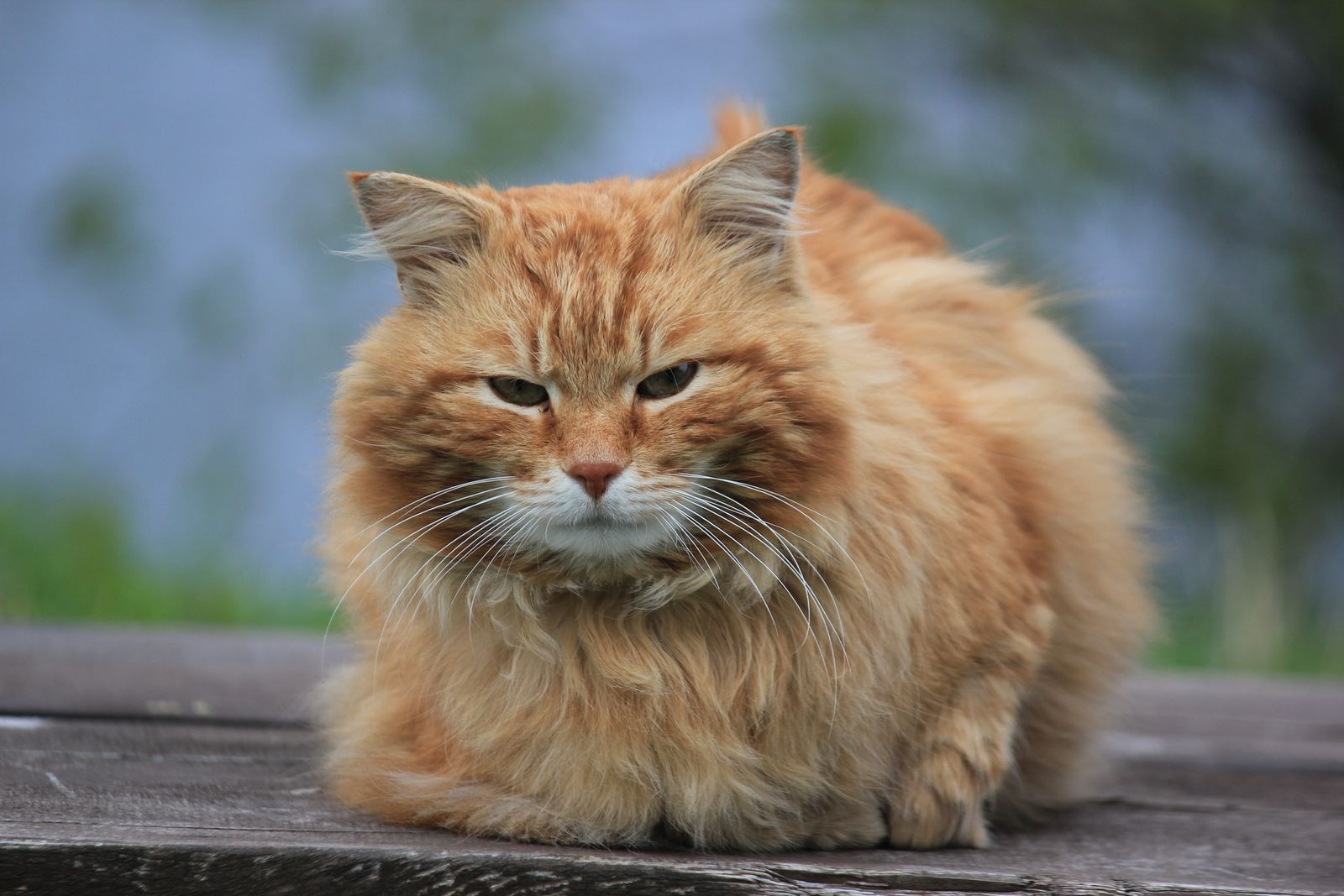
Siberian snapshot
The Cat Fanciers' Association, known as the CFA, describes the Siberian as Russia's native forest cat, first appearing in recorded history around the year 1000 and shaped by the unforgiving climate of Siberia. The CFA standard calls it a medium to medium large, strong, triple coated cat with surprising heft for its size, and it sums up the breed's look in one line: the general impression is one of roundness and circles, rather than rectangles and triangles. That roundness is the practical way to tell a Siberian from its two forest cat cousins. The Maine Coon is the rectangular one, with a longer body and more pronounced ear tips. The Siberian is built in curves, with a rounder head, rounder ears, and a barrel shaped body. The International Cat Association, known as TICA, sets out the same cat in its own standard: a medium-large, semi-longhaired cat from Russia, slow to mature, with a weatherproof triple coat.
| Size | Medium to medium large, strong, with substantial boning and musculature. Females are generally smaller than males, and the CFA standard says size is secondary to type. |
|---|---|
| Maturity | Extremely slow to mature. The CFA standard says the breed can take as long as five years to finish maturing, and the TICA standard gives the same slow, multi year development. |
| Body | Medium in length and well muscled, with the back arched slightly higher than the shoulders and a barrel shaped, firm belly that gives the sensation of solid weight. Big, rounded feet, with toe tufts desirable. |
| Coat | A triple coat, moderately long to long. A tight undercoat that thickens in cold weather, an abundant full collar ruff in adults, and hair that may thicken on the belly and the back legs. All colors and combinations are accepted, with or without white. |
| Temperament | The CFA standard requires an unchallenging temperament, and its general description stresses strength, presence, and alertness softened by a sweet facial expression. |
| Eyes | Medium to large and almost round, set more than one eye's width apart. Eye color can be shades of green, gold, green gold, or copper, with blue eyes in the pointed cats and blue or odd eyes possible in white cats. |
Two snapshot facts shape the insurance picture. The first is the slow maturity, shared with the Maine Coon but carried in a rounder, slightly smaller frame. A policy bought for a Siberian kitten has to make sense for a heavy adult cat that is still filling out years later, and the early record has to stay clean across a long kittenhood. The second fact is where this breed's paper comes from. Siberian kittens often arrive with two kinds of breeder documents that sound similar and are not: allergen test results, which describe how much Fel d 1 a cat produces and matter only to allergic people, and health screening records, which describe the heart and the blood and matter to vets and insurers. The next sections keep those two piles of paper firmly apart.
Health tendencies in Siberian cats
The conditions below start with the two that have a documented, breed specific link at a primary veterinary source: the heart disease Cornell names this breed for, and the inherited blood condition UC Davis recommends screening this breed for. The rest are conditions that are not unique to Siberians, and this guide says so on each card. They are here because they are the claims a sturdy, indoor, slow maturing cat is realistically likely to meet, and because each one tests a different line of policy wording. These are tendencies, not predictions about an individual cat. Many Siberians will never develop most of them.
This section is general information about conditions a breed can be prone to. It is not veterinary advice and it is not a diagnosis of any cat. Signs listed here are possible signs owners may notice, and many of them have several causes. Only a veterinarian who examines your cat can say what a sign means.
The hypoallergenic claim, separated from the health file
This breed earns its own honesty section, because the claim attached to it is the reason many people buy a Siberian in the first place, and because it is routinely stated more strongly than the evidence allows. The claim concerns Fel d 1, a protein cats produce in saliva and in skin glands, and the major allergen behind most cat allergy. A Siberian grooms like any other cat, spreads that protein over a large triple coat, and sheds it into the home. The question the research actually studied is narrower: whether Siberians, as a breed, produce less of it, or a less reactive form of it.
| The claim as marketed | What the evidence actually shows | What to do with it |
|---|---|---|
| Siberians are hypoallergenic, so an allergic person will be fine with one. | No cat is allergen free. Every cat produces Fel d 1, and the amount varies by individual cat. One Siberian can produce far less than another Siberian from the same breeder. | Judge the individual cat, not the breed label. Time spent with the specific kitten or cat, before committing, tells an allergic person more than any breed claim. |
| The breed's genes make its allergen weaker. | A peer reviewed study from the University of Turin, published in Veterinary Sciences in 2017, was the first survey of the two genes that code for Fel d 1 in Siberian cats. It found a considerable number of mutations, and some of them sit in gene regions where they could affect the allergen's properties. The authors recommended further investigation to find out whether those mutations actually reduce allergen production. | Read the study as a lead, not as proof. It examined the genes in a small number of Siberian cats. It did not establish that Siberians as a breed produce a weaker allergen. |
| A breeder's allergen test result settles the question for a kitten. | A lab result describes the sample that was tested, from that cat, at that age. It is not a health record, it is not a diagnosis, and it says nothing about the cat's heart, blood, kidneys, or teeth. | Keep allergen paperwork in a separate folder from the health file. Never let it substitute for the parents' heart screening or DNA results when you are reading breeder documents. |
| A low allergen cat is a lower risk cat, so insurance should treat it differently. | Allergen output is a trait of interest to people. It is not an illness, not a symptom, and not a category any policy prices or covers. | Choose the policy on the health file in the rest of this guide. If a seller links the allergen claim to insurance value, that link does not exist. |
The practical takeaway is simple. Allergic households should test their reaction to the individual cat, ideally over repeated visits, and should treat any breeder statement as a starting point for that test rather than a conclusion. Siberian owners as a whole should file the allergen story where it belongs, in the household folder, and build the cat's insurance decision on the medical record that starts below.
Hypertrophic cardiomyopathy (HCM)
What it is
A disease of the heart muscle in which the muscular walls of the heart thicken, most importantly the left ventricle, the heart's main pumping chamber. The Cornell Feline Health Center calls hypertrophic cardiomyopathy the most common heart disease of cats, and it names the Siberian directly in its list of breeds where the condition is more prevalent, a list that also includes the Maine Coon, the Ragdoll, and the Norwegian Forest Cat. Cornell explains that the thickened wall leaves less room inside the chamber and relaxes poorly, so the heart works less efficiently, and that the disease is generally progressive, meaning it commonly worsens over time. Cornell also notes that mutations of several heart genes have been identified in some cats with this disease, which suggests genetics plays a role, without naming a single Siberian mutation or a breed DNA test for it.
Signs owners may notice
- Often, nothing at all. Cornell notes that many cats with this disease do not appear to be ill, which is why routine exams and screening carry so much weight in this breed.
- Labored or rapid breathing, open mouth breathing, and unusual tiredness, which Cornell lists as signs of congestive heart failure, the stage where fluid builds up in or around the lungs.
- A murmur or an abnormal rhythm heard by the vet at a routine exam, in a cat that seems completely well at home. This is a finding, not a home sign, and it is one of the most common doors into diagnosis.
- Sudden pain or weakness in the back legs, which can signal a blood clot that has traveled from the heart and blocked blood flow to the hind limbs.
How vets usually evaluate and treat it
The diagnosis is made by echocardiography, called an echocardiogram or echo for short. That is an ultrasound scan that creates an image of the heart, and in a cat with this disease it shows the thickened walls and the smaller chamber. Cornell stresses that similar thickening can also be caused by high blood pressure and by an overactive thyroid, and that those conditions must be ruled out before the diagnosis is made, so blood pressure measurement and bloodwork are often part of the same workup. Chest X-rays and an electrocardiogram, a recording of the heart's electrical activity, may also be recommended. Cornell is clear that the disease has no known cure. Care is a specialized plan built around controlling heart rate, easing lung congestion if heart failure develops, and reducing the chance of blood clots, with medication given by mouth to stable cats. Because the scan is a picture of the heart on one day, and because a slow maturing breed keeps developing for years, a normal early scan is a starting point for a screening rhythm, not the end of the heart story. The calendar in the checklist section of this guide lays that rhythm out.
Pyruvate kinase deficiency (PK deficiency)
What it is
An inherited blood condition, and the one condition in this guide with a breed named DNA test behind it. Pyruvate kinase is an enzyme, a protein that helps red blood cells make the energy they need to survive. The UC Davis Veterinary Genetics Laboratory explains that when there is not enough activity of this enzyme, red blood cells become unstable and are lost too quickly, producing a hemolytic anemia. Anemia means the blood carries fewer red cells than the body needs. UC Davis lists the Siberian among the breeds found to be at higher risk for this mutation, and it recommends genetic screening for the mutation in those breeds. The condition is inherited as an autosomal recessive trait, a term that means a cat must inherit the variant from both parents to be affected, while a cat with one copy is a healthy carrier.
Signs owners may notice
- Severe tiredness and weakness that come and go, because UC Davis describes the anemia in this condition as intermittent, with a variable age of onset.
- Weight loss and a reduced appetite during an anemia episode.
- Jaundice, a yellowing that owners may notice in the skin inside the ears, the whites of the eyes, or the gums.
- A swollen or enlarged belly, which UC Davis lists among the possible signs of this anemia.
When it can be urgent
A cat that is very weak, will not eat, breathes fast at rest, or has pale or yellow gums during a suspected anemia episode needs prompt, same day care. Anemia reduces the oxygen the blood can carry, and a fast worsening episode is not a wait and see situation.
How vets usually evaluate and treat it
Evaluation usually centers on blood tests that confirm whether the cat is anemic, how severe the anemia is, and whether the body is replacing red cells, alongside an exam and a search for other causes of anemia. A DNA test can identify whether the cat carries the mutation, which explains the cause, but UC Davis notes that for a cat with two copies the severity of symptoms cannot be predicted, so the blood results and the cat in front of the vet guide care. Treatment categories are monitoring over time, supportive care during anemia episodes, and emergency care in severe episodes, all directed by the treating vet. For the owner, the useful habit is a dated one: every blood result, normal or not, goes into the record calendar, because an intermittent condition is proved over time, not in one visit.
Lower urinary tract disease and urinary blockage
What it is
A group of conditions affecting the bladder and the urethra, the tube that carries urine out of the body. This is not a Siberian specific condition, and this guide does not present it as one. It is on this page because it is the most time critical emergency in ordinary cat ownership, Siberian households included, and because a large male cat straining in a litter box is a scene no owner should have to interpret under pressure. The Merck Veterinary Manual explains that lower urinary tract signs in cats can come from several causes, including bladder stones, urinary tract infections, and urethral plugs, and that most cats with these signs have feline idiopathic cystitis, a bladder inflammation whose underlying cause is unknown and which is diagnosed by excluding the other causes. In male cats the urethra is longer and narrower, and a plug or stone can block it completely. A blocked cat cannot pass urine at all, and that is a life threatening emergency.
Signs owners may notice
- Straining to urinate, and frequent trips to the litter box that produce only small amounts, which the Merck Veterinary Manual lists among the characteristic signs of this disease group.
- Blood in the urine, or urine passed outside the litter box, also on Merck's list of characteristic signs.
- Crying or restlessness in the litter box, repeated licking under the tail, and a cat that keeps posturing with nothing coming out.
- In a blocked cat, a hard and painful belly, loss of appetite, tiredness, and vomiting as the emergency deepens.
How vets usually evaluate and treat it
Merck describes diagnosis by exclusion, using some combination of urinalysis, urine culture, X-rays, and ultrasound to separate bladder inflammation from stones, infection, and plugs. A blocked cat is treated as an emergency first: the blockage is relieved, usually with a urinary catheter placed under sedation, fluids are given, and the cat is monitored in hospital while the kidneys and the blood chemistry recover. Cats whose signs come from idiopathic cystitis are managed differently, with pain relief and changes aimed at lowering the severity and frequency of episodes, including stress reduction, litter box management, and dietary adjustments. Recurrence is a real feature of this disease group, which is why the first episode's paperwork matters so much.
Chronic kidney disease (CKD)
What it is
The persistent loss of kidney function over time. The Cornell Feline Health Center describes chronic kidney disease as one of the most prevalent diseases in older cats, and it is direct about the risk picture: the only known risk factor for the disease in cats is age. That framing matters for an honest Siberian guide. This is not an inherited Siberian condition. It is the senior stage condition of cats generally, and it belongs in this breed's file because a slow maturing cat with a long adult life spends many years in exactly the age range where kidney monitoring earns its keep. Healthy kidneys filter the blood, make urine, and help regulate blood pressure, and Cornell explains that as that function fades, waste products the kidneys would normally remove can build up in the bloodstream.
Signs owners may notice
- Drinking more water and urinating in greater volumes, as the kidneys lose the ability to concentrate urine. Cornell describes this as an early change, often before a cat looks ill at all.
- Loss of appetite and weight loss over time, and a cat that looks unkempt or unusually tired in the later stages.
- Pale gums or new weakness in a senior cat, which can reflect the anemia Cornell links to kidney disease, because the kidneys normally help signal the body to make new red blood cells.
- Sudden changes in vision or behavior in a cat with known kidney disease, which Cornell raises as possible effects of the high blood pressure that can accompany it.
When it can be urgent
Kidney disease itself usually develops slowly. A senior cat that stops eating, becomes dehydrated, vomits repeatedly, or changes suddenly in vision or alertness needs prompt care, because those turns can signal that a managed condition has moved.
How vets usually evaluate and treat it
Cornell describes evaluation built on blood tests and urine analysis together, looking at waste products such as urea, creatinine, and SDMA, at how concentrated the urine is, and at whether protein is being lost in the urine, with blood pressure measurement as part of the same picture. No single test gives the whole answer, and Cornell notes that vets prefer to read results from more than one sample taken while the cat is stable and well hydrated. The International Renal Interest Society, known as IRIS, staging system then groups the results to guide care. Cornell is clear that the disease has no definitive cure and is progressive. Care aims to slow it down and protect quality of life: dietary change, hydration support, and treatment of linked problems such as high blood pressure, anemia, and protein loss, with monitoring on a regular rhythm for the rest of the cat's life.
Gingivostomatitis and dental disease
What it is
A debilitating dental disease marked by severe, long lasting inflammation of the gums and the mucosa, the moist lining of the mouth. Cornell's Feline Health Center explains that the immune system becomes overly reactive to plaque, the thin coating of bacteria that builds up on teeth, and that the inflammation can spread well beyond one tooth to the back of the mouth and under the tongue. One honesty note matters here. Cornell says it does not see a strong predisposition for this disease among the various breeds, so this guide does not present it as an inherited Siberian condition. It is on this page for the same reason it appears in the other breed guides on this site: it is one of the most painful mouth conditions a cat can develop, its treatment can be extensive, and dental wording is where policies differ most sharply. A Siberian's full ruff also hides the mouth from casual view, so mouth problems in this breed are easy to miss until eating itself changes.
Signs owners may notice
- Swollen, ulcerated, or bleeding gums, and signs of extreme mouth pain.
- A cat that seems eager to eat but then cannot, or that loses interest in food and loses weight.
- Excessive drooling, sometimes with blood in the saliva, bad breath, and pawing at the mouth.
When it can be urgent
A cat that cannot eat because of mouth pain needs prompt care, not a long wait. Cornell warns that if the condition remains untreated it can become so painful that a cat is unable to take in food at all. A cat that has stopped eating entirely should be seen quickly, whatever the cause turns out to be.
How vets usually evaluate and treat it
A vet examination looks at the whole mouth. Cornell describes lesions under the tongue and on the lips, in the back and on the roof of the mouth, and around teeth, especially the back teeth, and notes that a tissue biopsy is sometimes needed for a conclusive diagnosis. A full look inside a painful mouth, and any dental X-rays, usually require sedation or anesthesia. Cornell describes two broad treatment paths, used alone or together: medical management, with drugs that calm the immune response and control bacteria in the mouth, and surgical management, which is likely to involve removal of teeth, in serious cases all of them. Owners are often surprised that cats can thrive after full mouth extraction, and Cornell explains why: removing the teeth removes the surfaces where the plaque that drives the reaction collects.
Weight gain and diabetes
What it is
Diabetes mellitus is a condition in which the body cannot properly produce or respond to insulin, the hormone that moves blood sugar into cells, so sugar builds up in the blood instead. The Cornell Feline Health Center explains that cats most commonly develop the form in which the body's cells do not respond appropriately to insulin, and it names the risk factors plainly: obesity, increasing age, physical inactivity, and male sex are the important ones. That list is why this card sits in a Siberian guide. This is a breed built with surprising heft under a very large coat, kept indoors by most owners, and still maturing for years. Weight creeps on under that coat without being seen, and the difference between a solid, barrel shaped Siberian in good condition and an overweight one is genuinely hard to judge by eye or by picking the cat up.
Signs owners may notice
- Weight loss despite a good appetite, one of the two home signs Cornell says owners notice most, because cells that cannot take in sugar push the body to break down its own fat and protein instead.
- Increased thirst and increased urination, the other classic home sign, as high blood sugar spills into the urine and pulls water with it.
- A heavy cat whose weight keeps rising between vet visits, with less interest in play and climbing than a younger Siberian showed.
- In rare, uncontrolled cases, a changed way of standing or walking on the back legs, flat on the hocks, which Cornell links to nerve damage from long standing high blood sugar.
When it can be urgent
A diabetic cat that becomes weak, stops eating, vomits, or seems unsteady or unresponsive may be developing a dangerous low blood sugar episode from treatment, or ketoacidosis from uncontrolled disease. Cornell treats both as emergencies that need veterinary care right away.
How vets usually evaluate and treat it
Cornell describes diagnosis as persistently elevated sugar in both blood and urine, together with matching signs, and notes that a single clinic reading can mislead, because stress alone can push a cat's blood sugar up temporarily. A longer window test, the fructosamine test, can help separate a stressed cat from a diabetic one. Treatment is built on restoring normal blood sugar, stopping weight loss, and calming the thirst and urination, traditionally with insulin given by injection at home and a diet low in carbohydrates, with newer oral medications an option for some newly diagnosed cats. Monitoring is part of the treatment, not an extra: weight, water intake, and appetite tracked at home, and blood sugar curves checked with the vet on a rhythm, because insulin needs change over time. Cornell also notes that many cats treated early and monitored closely enter remission, a period where blood sugar stays normal without insulin, which makes the first months of records unusually valuable.
Policy decisions that matter for a Siberian cat
For a Siberian, a policy is judged on records and on time: a kitten whose file starts with breeder screening paperwork, a heart that may need scanning more than once across a long, slow maturity, a blood condition whose anemia can come and go, and a senior stage where kidney monitoring runs for years. Read these rows with that whole timeline in mind.
| Policy feature | Why it matters for a Siberian | Stronger wording looks like | Watch out for |
|---|---|---|---|
| Hereditary condition coverage | The breed's documented inherited file is short and specific: a heart disease with a genetic role, and pyruvate kinase deficiency with a named DNA test. | Hereditary and congenital conditions are covered on the same terms as other illnesses. | Hereditary exclusions, or breed specific exclusions that quietly name heart or blood conditions in cats. |
| Cardiology diagnostics | A murmur becomes a referral, and a referral becomes an echocardiogram, before any treatment begins. | Specialist exams and echocardiography are covered categories for a covered heart concern. | Wording that covers heart medication but leaves the scan that diagnoses the disease outside the covered categories. |
| Screening versus diagnosis | This breed is screened more than most: breeder heart scans on the parents, a DNA test for the blood condition, and follow up scans on your own cat. | The policy states clearly how a scan or test ordered after a clinical finding is treated, and how breeder records are viewed. | All heart scans treated as elective screening and denied, even when a vet ordered one to investigate a murmur. |
| Repeat monitoring at renewal | Heart disease, kidney disease, and diabetes in this breed are managed over years, with scans, blood tests, and medication continuing long past the first claim. | A condition covered in one term stays covered in later terms, including its monitoring, while enrollment continues. | Renewal wording that caps a chronic condition, ends it at renewal, or reclassifies it as pre-existing. |
| Intermittent condition counting | The anemia of pyruvate kinase deficiency improves and returns. How episodes are counted decides what the policy actually pays across a lifetime. | The policy counts a returning inherited condition as one ongoing condition, stated in writing. | Episode counting that restarts the deductible, or treats a return of the same anemia as a new, separately limited condition each time. |
| Urinary emergency and recurrence | A blocked male cat is treated the night it happens, and this disease group has a real recurrence pattern. | Emergency care is covered without preapproval, and later episodes are judged on their own facts under clear recurrence wording. | Wording that folds every later urinary episode into the first one as pre-existing, including a new blockage. |
| Dental illness terms | Gingivostomatitis care can involve anesthesia, dental imaging, medication, and removal of teeth. | Dental illness is included, with anesthesia and extractions for a painful mouth condition covered. | Dental disease excluded entirely, dental cover limited to injury only, or a cleaning history requirement you have already failed. |
| Deductible type | Repeat heart scans, blood monitoring, kidney checks, and dental care produce steady claims across a year, every year. | An annual deductible that is met once, after which eligible claims across conditions are reimbursed. | A per-condition deductible that restarts the counting for the heart, the blood, the kidneys, and the mouth separately. |
Life stages: kitten, adult, and senior
Kitten
The kitten stage is when the record is cleanest and when this breed's paperwork is most often misunderstood. Read the breeder's documents in two piles. In the health pile go the parents' heart scan reports and the parents' pyruvate kinase deficiency DNA results: they describe risk in the line, and the comparison logic is the same as in the Maine Coon guide, a DNA result answers a gene question and a scan answers a heart question, and neither is a record of your kitten. In the household pile goes any allergen test result: interesting to an allergic family member, and of no use to a vet or an insurer. Enrolling before the first murmur note, the first anemia episode, or the first litter box problem exists is the single most valuable move a Siberian owner makes, and the screening and vet record calendar in the checklist section starts in this stage.
Adult
Adulthood arrives slowly in a Siberian. The breed can take as long as five years to mature, so a three year old that looks finished may still be filling out its frame and its coat. This is the stage where a routine exam can turn up a murmur in a cat that seems perfectly well, where weight settles quietly under the triple coat, and where a male cat's litter box habits deserve real attention. The insurance work of this stage is habits: weigh the cat and write it down, keep every scan and blood result with its date, file claims as they happen, and at each renewal confirm that any condition the cat now has is still described as covered.
Senior
A senior Siberian carries the accumulated version of the file: a heart that may have been monitored for years, kidneys that need scheduled blood and urine checks, a mouth that needs watching, and a weight and blood sugar picture that should already be a habit, not a surprise. Review the policy for age based changes, premium increases, and any reduction in coverage at advanced ages. Check whether the monitoring rhythm built up over the cat's adult life, the repeat heart scans, kidney panels, and blood tests, is still reimbursable on the same terms. A plan that quietly thins out exactly when a long monitored cat needs it most fails the purpose it was bought for.
A claim, step by step: a murmur that becomes a heart diagnosis
The example below is hypothetical. It is not a real cat, a real claim, or a guarantee of how any insurer will decide. It follows an adult Siberian from a murmur heard at a routine exam, through a cardiology referral and an echocardiogram, to a diagnosis of hypertrophic cardiomyopathy, medication, and repeat monitoring through renewal, because that full arc is what Siberian heart coverage has to handle. Pet insurance generally reimburses after you pay the vet, as explained in how pet insurance works.
A murmur at a routine exam
At an annual wellness visit, the vet listens to the chest of a Siberian that seems completely well and hears a heart murmur, an extra sound made by turbulent blood flow. The vet records the date, describes the murmur, and recommends follow up rather than panic, because a murmur is a finding, not a diagnosis. The owner keeps the full visit record, and enters the date in the screening and vet record calendar. That single page, showing when the murmur was first heard relative to the policy dates, becomes the anchor document for everything that follows.
The rule out workup at the general practice
Before anyone names a heart disease, the vet checks the look alike causes. Blood pressure is measured, and bloodwork includes a check of thyroid function, because Cornell explains that high blood pressure and an overactive thyroid can also thicken the heart wall and must be ruled out first. The results come back normal. The owner pays the clinic, keeps the itemized invoice and the complete results, and now has a record that shows the general practice did its part of the investigation in the right order.
Checking the waiting period and the record
On paper, the insurer will line the murmur date up against the policy dates. In this example the policy was started when the cat was a kitten, the illness waiting period ended long ago, and no earlier record mentions a murmur, an abnormal rhythm, breathing changes, or a heart concern of any kind. The breeder's paperwork in the file, the parents' scan reports and DNA results, sits behind that timeline as background. It is not the cat's own record, and in a clean file like this one it does not need to be. Contrast it with the harder version of the same story, where a kitten exam note says a soft murmur was heard and would be rechecked, and nobody rechecked it. That one old line is the kind of record that turns a later heart claim into an argument about pre-existing signs.
Referral to cardiology and the echocardiogram
The general vet refers the cat to a veterinary cardiologist, a heart specialist. The cardiologist performs an echocardiogram, the ultrasound scan of the heart. The scan shows thickening of the wall of the left ventricle, the main pumping chamber, with a smaller chamber volume. The owner pays the specialist directly and collects the scan report itself, not only the invoice, because the measurements and findings in that report are the diagnostic core of the claim. If the policy requires preapproval for specialist referrals, that step is handled before this visit, not discovered after it.
The diagnosis and the first claim
With the look alike causes ruled out and the scan showing the characteristic thickening, the diagnosis recorded is hypertrophic cardiomyopathy. The claim is filed with the general practice records, the blood pressure and bloodwork results, the referral note, the cardiology report, and the invoices, with the murmur date stated clearly. Daily heart medication begins, prescribed by the cardiologist. The owner starts a simple home log of resting breathing and energy, and adds the scan date and the next recommended recheck to the record calendar, which becomes genuinely useful evidence at every later monitoring claim and every medication review.
Medication, monitoring, and how reimbursement works
Ongoing care settles into a rhythm: medication at home, recheck visits, bloodwork when the cardiologist wants it, and repeat echocardiograms at intervals the cardiologist sets, because this disease is progressive and a scan is a snapshot, not a verdict for life. Each eligible bill moves through the same mechanics described in what pet insurance costs and why. Charges count against the deductible first, the policy's reimbursement rate applies to eligible charges after that, and totals are tracked against the annual limit. With an annual deductible already met by the workup, the later monitoring bills in that year are no longer reduced by it. With a per-condition design, the counting works differently, which is why deductible type was flagged in the policy table above.
Renewal, repeat claims, and where they get denied
At renewal, the decisive question is whether the heart condition is still a covered condition or has been reclassified. Under wording that keeps covered chronic conditions covered, the medication refills, rechecks, and the next echocardiogram are filed the same way, referencing the original diagnosis date and the scan history. The denial pressure points in this breed story are a murmur in the record from before enrollment, a scan denied as elective screening when it was ordered to investigate a finding, a referral denied because a preapproval step was missed, and renewal wording that caps or ends a named chronic condition. Each of those is a clause question, and each can be asked in writing before you buy, not after the cardiologist visit.
What drives a Siberian premium
No responsible guide will name a price for your cat, because the quote depends on the cat, the address, and the settings chosen. What can be explained is the shape of Siberian pricing and the choices that move it. The full mechanics are in what pet insurance costs and why.
Breed risk profile. Insurers see a medium large, heavily built cat whose documented inherited file includes a prevalent heart disease that involves specialists and repeat scanning, plus a DNA testable blood condition whose anemia can recur across a lifetime. That profile prices differently from a small, short lived, low intervention cat. Note what is not in the profile: the allergen reputation. Fel d 1 output is a human comfort trait, and it does not make a Siberian cheaper or dearer to insure.
Size and heft. A Siberian is a solid patient for its frame. Medication doses, anesthesia, and imaging all scale with the animal on the table, and a sturdy cat's bills for the same procedure tend to run larger than a small cat's. That relative scale is built into breed pricing. It is also why the monitoring rhythm matters in this breed: repeat scans and rechecks add up over years, and a policy that reimburses them reliably is worth more than the same policy would be for a cat with no monitoring needs.
Age curve and slow maturity. Premiums generally rise with age, and this breed spends years still maturing before it reaches its adult frame. The total cost of insuring a Siberian is therefore a long horizon calculation, stretching from a kitten window when the record is cleanest, through a long adult stage when the heart can change and weight can creep, into senior years with kidneys and heart together. A slightly cheaper policy with chronic condition caps can cost more over that span than a stronger policy, because the caps bite at every renewal of a lifelong heart or kidney condition.
Location and plan settings. Vet prices in your area set the bill sizes the insurer expects, and specialist cardiology availability varies widely by region, which affects both price and how care actually unfolds. Your deductible, reimbursement rate, and annual limit choices trade premium against claim returns. For this breed, deductible type deserves the same attention as deductible size, because an annual deductible and a per-condition deductible produce very different results across heart monitoring, blood episodes, and a urinary emergency in the same year.
Pre-purchase checklist for a Siberian policy
- Confirm hereditary conditions are covered, including hypertrophic cardiomyopathy and pyruvate kinase deficiency.
- Check that a cardiology referral and an echocardiogram ordered after a murmur are covered as diagnosis, not dismissed as elective screening.
- Confirm repeat echocardiograms, bloodwork, and medication for a covered heart condition stay reimbursable at every renewal.
- Ask how the anemia of pyruvate kinase deficiency is counted when it improves and returns, and keep the answer in writing.
- Confirm emergency urinary care is covered without preapproval, and ask how a second urinary episode is treated after a first.
- Confirm dental illness coverage in plain terms, including anesthesia, dental imaging, and tooth removal for gingivostomatitis.
- Read the murmur wording in the pre-existing definitions, and think about what is already in your kitten's early exam records.
- Choose between an annual and a per-condition deductible using this breed's pattern of steady monitoring claims.
- Enroll as a kitten, before a murmur, an anemia episode, a urinary note, or a mouth finding enters the medical record.
- Start the screening and vet record calendar below on the day the policy starts, and keep the breeder's health screening in the same file, with the allergen paperwork kept separate.
The Siberian screening and vet record calendar
This calendar is the breed's tool. It is not a medical schedule, and your vet sets the real intervals. It is a record keeping rhythm: what to write down, and when, so that the file an insurer reads years later is complete, dated, and in order. Keep it with the policy, on paper or in a notes file, and update it at every visit.
| Stage | Record to create or update | Why it matters at claim time |
|---|---|---|
| Arrival, as a kitten | File the breeder's health pile by date: the parents' heart scan reports and pyruvate kinase deficiency DNA results. Note the kitten's own first exam, including whether any murmur was heard. Keep allergen test paperwork in a separate household folder. | Separates line risk from your cat's own record from day one, and fixes the clean starting point every later claim is measured against. |
| First year | Every kitten visit note, vaccine and weight entries, and any note about appetite, energy, litter box habits, or mouth health, each with its date. | Early notes are the ones pre-existing arguments are built from. A complete first year file protects the claims that come later. |
| Young adult, still maturing | Annual exam notes with weight recorded, any murmur note with its date and the vet's recommendation, and the report of any echocardiogram a vet orders, not only the invoice. | The heart story in this breed is written across the slow maturity years. Dated scan reports are the diagnostic core of a heart claim. |
| Adult | Bloodwork results as they are run, dental exam notes at each visit, weight at every visit, and a home note of any litter box change, breathing change, or tired spell, with dates. | Blood, dental, and weight trends are how the intermittent and chronic conditions in this guide are proved over time, not in a single visit. |
| After any diagnosis | The diagnosis date, the specialist report, the medication list as it changes, and the next recheck date the vet sets, entered as soon as it is given. | Renewal and monitoring claims are filed against the original diagnosis and the recheck rhythm. A calendar that shows both keeps those claims straightforward. |
| Senior | Kidney blood and urine results on the rhythm the vet sets, blood pressure readings, heart monitoring reports, and weight and appetite notes from home. | Senior monitoring is a stream of smaller claims across years. Dated results show a managed condition, which is what chronic renewal wording is read against. |
| Every renewal | A one line summary for the year: conditions diagnosed, claims filed, scans done, and the policy wording you confirmed for the year ahead. | Catches a silent change in how a covered condition is treated at renewal, while there is still time to ask about it in writing. |
Questions to ask an insurer, in writing
- Once hypertrophic cardiomyopathy is diagnosed and covered, will it and its monitoring stay covered at every renewal while I stay enrolled?
- Is an echocardiogram ordered because a vet heard a murmur treated as covered diagnosis, or as excluded screening?
- How do you count pyruvate kinase deficiency when its anemia improves and later returns: one ongoing condition, or a new episode each time?
- If my male cat is blocked and treated as an emergency at night, is that care covered without preapproval, and how is a second urinary episode treated later?
- Is dental illness covered, including anesthesia and tooth removal for gingivostomatitis, and what dental history do you require?
- Does a breeder's allergen test result, or the parents' screening records, play any part in how you judge my cat's own claims?
Questions Siberian owners ask
Does pet insurance cover hypertrophic cardiomyopathy in Siberian cats?
An accident and illness policy can cover hypertrophic cardiomyopathy when hereditary conditions are included, the illness waiting period has passed, and no murmur, abnormal rhythm, or heart concern was recorded before enrollment. Cornell lists the Siberian among the breeds where this heart disease is more prevalent. Check that the cardiology referral and the echocardiogram itself are covered categories, and that repeat echocardiograms and heart medication for a covered condition stay covered at renewal, because monitoring is part of living with this disease.
Are Siberian cats really hypoallergenic, and does that change their insurance?
No cat is allergen free. The Siberian claim rests on Fel d 1, the main cat allergen. A peer reviewed study of the genes that code for Fel d 1 in Siberian cats found many gene variants, some in positions that could affect the allergen, and its authors said more research is needed. Levels vary by individual cat, so one Siberian can affect an allergic person very differently from another. The claim is about people, not about the cat's health, and it changes nothing in a policy. What decides a Siberian's claims is the screening and vet record, not an allergen label.
The breeder gave me heart screening and a DNA result for my kitten's parents. What should I keep?
Keep all of it, and file it by date. Keep the parents' echocardiogram reports and the pyruvate kinase deficiency DNA results, because they describe risk in the line. Then build your own cat's record on top: every exam note, any murmur note with its date, your cat's own heart scan reports if a vet orders one, bloodwork, and dental notes. An insurer judges a claim on your cat's own medical record, so the kitten file you start now is the file a claim will be read from years later.
How is pyruvate kinase deficiency treated at claim time when the anemia comes and goes?
UC Davis describes the anemia of pyruvate kinase deficiency as intermittent, with a variable age of onset and variable signs. Ask the insurer in writing how an intermittent inherited condition is counted: as one ongoing condition, or as a new episode each time the anemia returns. That counting interacts with the deductible and with renewal wording. Also confirm that repeat blood monitoring for a covered blood condition is reimbursable, and that emergency care during a severe episode is covered on the same terms.
My male Siberian is straining in the litter box and producing almost nothing. Is that an emergency, and is it covered?
Treat it as an emergency and go the same day. The Merck Veterinary Manual lists straining, frequent small urinations, blood in the urine, and urinating outside the litter box as the characteristic signs of feline lower urinary tract disease, and a male cat that cannot pass urine may have a blockage, which is life threatening. Emergency care for a covered illness is the kind of event an accident and illness policy is built for, subject to the waiting period and the record. Save the emergency clinic's full notes and imaging, because a second episode will be judged against the first one's record.
When is the best time to enroll a Siberian cat?
As a kitten, before a murmur, a heart scan finding, an anemia episode, or a urinary or dental note enters the medical record. Siberians mature slowly and can take years to reach full size, so a kitten policy has to fit a much larger adult cat later. Enrolling young clears the waiting periods while the record is clean, and it makes the hereditary coverage, the screening record, and the chronic renewal wording worth reading from day one.
Sources and further reading
- Cat Fanciers' Association, Siberian breed standard for Russia's native forest cat, the medium to medium large triple coated build, the impression of roundness and circles, eye colors, and maturity taking as long as five years.
- The International Cat Association, Siberian breed standard for the medium-large, semi-longhaired cat originating in Russia, its barrel shaped body, rounded head and ears, triple coat, and slow development across three to five years.
- Cornell Feline Health Center, Hypertrophic cardiomyopathy for heart muscle thickening, the breeds where it is more prevalent including the Siberian, its signs, diagnosis by echocardiography, and treatment goals.
- UC Davis Veterinary Genetics Laboratory, Erythrocyte pyruvate kinase deficiency for the inherited hemolytic anemia, its intermittent course and variable signs, recessive inheritance, and the Siberian among the breeds at higher risk where screening is recommended.
- Sartore and colleagues, Polymorphism analysis of Ch1 and Ch2 genes in the Siberian cat, Veterinary Sciences, 2017, via PubMed Central for the first survey of the genes that code for the Fel d 1 allergen in this breed, the mutations found in regions that could affect the allergen, and the authors' call for further investigation.
- Merck Veterinary Manual, Lower urinary tract disease in cats for the characteristic signs of the disease group, feline idiopathic cystitis as the most common cause, diagnosis by exclusion, and treatment aimed at lowering the severity and frequency of episodes.
- Cornell Feline Health Center, Chronic kidney disease for age as the only known risk factor in cats, the early drinking and urination changes, blood and urine testing with IRIS staging, and management aimed at slowing a progressive disease.
- Cornell Feline Health Center, Gingivostomatitis for severe inflammation of the gums and mouth lining, the lack of a strong breed predisposition, its signs of oral pain, drooling, and weight loss, and medical and surgical management including tooth removal.
- Cornell Feline Health Center, Feline diabetes for insulin and blood sugar in plain terms, obesity, age, inactivity, and male sex as the important risk factors, the thirst, urination, and weight loss signs, and insulin, diet, monitoring, and remission.