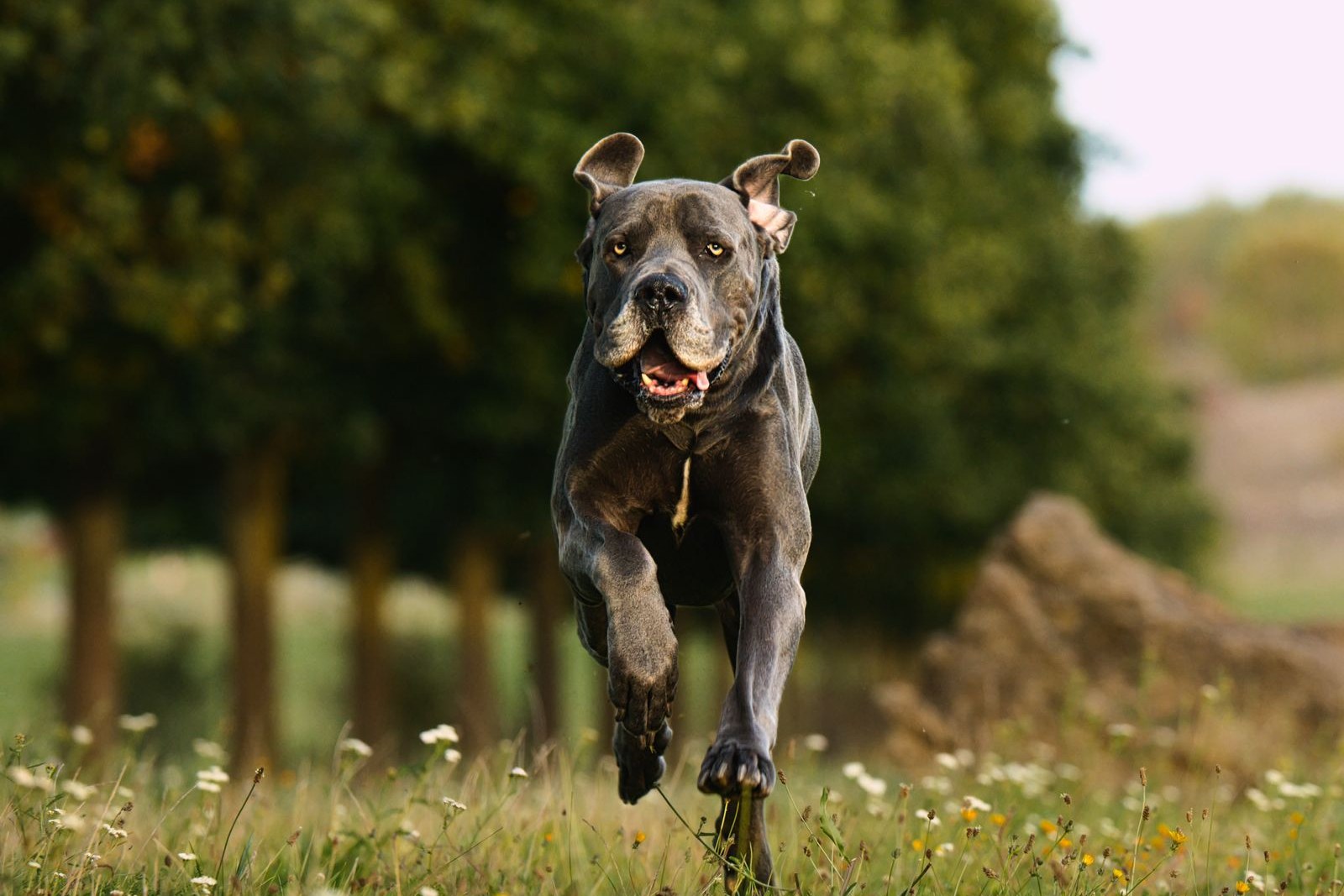
Cane Corso snapshot
The American Kennel Club describes the Cane Corso as smart, trainable, and of noble bearing, an assertive and confident dog it calls a peerless protector. The breed's name roughly translates from the Latin as bodyguard dog, and the dog was built for that work. The Corso is an Italian mastiff type, but an athletic one. It is muscular and large boned, with a broad head and tighter skin than the heavily wrinkled mastiffs, and it moves with an ease that heavily built guardian breeds often do not. The breed ranked No. 14 in AKC registrations for 2024, which makes it one of the most commonly owned giant breeds in the country.
| Height | Males 25 to 27.5 inches at the shoulder. Females 23.5 to 26 inches. |
|---|---|
| Weight | The AKC breed standard does not publish a weight range for this breed. It states that weight should be proportionate to height, so a correct Corso is heavy in proportion to a very large frame rather than heavy to a fixed number. |
| Lifespan | 9 to 12 years, as listed by the AKC. |
| Coat | A short, stiff, shiny coat, dense, with a light undercoat that thickens in cold weather. Colours in the standard include black, shades of gray, shades of fawn, and red, with brindling allowed. |
| Temperament | Intelligent, assertive, and confident, affectionate and docile with its own family, and a natural guardian of property and people. |
| Energy and exercise | A working guardian breed that needs daily exercise, training, and socialisation, with growth and body weight watched closely while the skeleton is still developing. |
Two snapshot facts shape the insurance picture. The first is the frame. A dog built at this size loads its hips, elbows, and knees with forces a smaller dog never produces, and it does so from the age of a few months, while those joints are still forming. The second is the chest. The Corso is deep chested as well as heavy, and that shape carries the bloat risk covered below. Size explains the orthopedic half of this guide. Shape explains the emergency half.
Health tendencies in Cane Corsos
The Cane Corso Association of America, the breed's parent club, runs its screening program through the Canine Health Information Center, or CHIC, program at the Orthopedic Foundation for Animals. That program names hip dysplasia, elbow dysplasia, cardiac evaluation, and patellar luxation evaluation, plus DNA tests for neuronal ceroid lipofuscinosis and dental skeletal retinal anomaly. The AKC breed page lists the wider health concerns seen in the breed, including hip dysplasia, idiopathic epilepsy, bloat, and eyelid abnormalities. The six cards below cover the conditions that most shape an insurance decision for this breed. They are tendencies, not predictions about an individual dog, and a well screened line lowers some of the risk without erasing any of it.
One AKC listed concern does not get a card below: demodectic mange, a skin condition caused by mites that normally live in hair follicles, seen mainly in young dogs whose immune systems are still maturing. It is usually found with a skin scraping and managed medically. A widespread case in an adult dog deserves a workup of its own, because it can point to an underlying immune problem, but it does not drive the policy decision in this breed the way joints, a twisting stomach, eyelids, and seizures do. It is named here so the health list on this page is complete against the AKC's list, not silently shorter than it.
This section is general information about conditions a breed can be prone to. It is not veterinary advice and it is not a diagnosis of any dog. Signs listed here are possible signs owners may notice, and many of them have several causes. Only a veterinarian who examines your dog can say what a sign means.
Hip dysplasia
What it is
An inherited looseness of the hip joint. The ball and socket fit poorly, the joint wears unevenly, and arthritis follows over time. Cornell's Riney Canine Health Center describes hip dysplasia as a common inherited orthopedic condition in which laxity leads to arthritis, pain, and discomfort, and notes that it can be made worse by overfeeding and rapid growth in puppies. Hip evaluation is the first item on the breed club's screening list for the Corso, done as an OFA radiographic evaluation or a PennHIP evaluation. In a giant breed, the joint in question is carrying far more load than the same joint in a medium dog, which is why mild looseness on a screening film matters here.
Signs owners may notice
- Stiffness after rest, trouble rising, or reluctance on stairs and jumps.
- A swaying gait, or bunny hopping with both back legs moving together at a run.
- Slowing down on exercise the dog used to enjoy, or shifting weight onto the front legs.
- Loss of muscle over the hips and thighs in a dog that is moving less.
When it can be urgent
Hip dysplasia is a slow condition and a routine appointment problem. A dog that suddenly cannot bear weight on a back leg, or cries out during movement, may have an injury rather than arthritis, and that change deserves prompt care.
How vets usually evaluate and treat it
Evaluation combines a hands on joint exam, including a palpation test for looseness, with hip X-rays taken under sedation or anesthesia so the joint can be positioned correctly. The screening evaluations used for breeding dogs grade or measure the joint itself. Cornell notes that OFA grades hips from radiographs taken after a dog is two years old, while the PennHIP method measures laxity directly and can be used in younger dogs. In a pet dog with signs, treatment usually starts with weight control, controlled low impact exercise, pain and anti-inflammatory medication, and physical therapy. Surgery is a category for dogs whose pain does not respond to medical management. Cornell describes total hip replacement as the more common surgical route in large breed dogs, which is the size class this breed sits in.
Elbow dysplasia
What it is
A group of inherited developmental problems inside the elbow joint of the front leg. The OFA elbow program covers the main forms: a fragmented medial coronoid process, in which a small piece of bone and cartilage inside the joint breaks loose; osteochondritis dissecans of the humeral condyle, in which a flap of cartilage fails to attach properly; and an ununited anconeal process, in which a growth centre that should fuse to the ulna during puppyhood never does. The forms differ, but the ending is shared. An elbow that does not fit together cleanly develops arthritis, often early in life. Elbow evaluation by OFA is the second item on the breed club's screening list, and front leg lameness in a growing giant puppy is this condition until a vet shows otherwise.
Signs owners may notice
- Front leg lameness that appears in a young, still growing dog, often after exercise.
- Stiffness in the front legs after rest that eases as the dog warms up.
- A short, choppy front stride, or turning a front foot outward to unload the elbow.
- Swelling at the elbow, or reluctance to fully bend or straighten the leg.
When it can be urgent
Elbow dysplasia usually develops over weeks and is a prompt appointment, not an emergency. A young dog that suddenly will not put any weight on a front leg at all, or a leg that is hot, swollen, or painful after a fall or a collision, needs same day care, because a fracture has to be ruled out before dysplasia is assumed.
How vets usually evaluate and treat it
Evaluation starts with a gait and joint exam, then elbow X-rays. The OFA screening view is a strongly flexed side view of the elbow, because early arthritic change shows first at the back of the joint. Some fragments and cartilage flaps hide on plain X-rays, so a vet may recommend a CT scan or arthroscopy, a camera procedure inside the joint, to see the damage directly. Treatment categories run from weight control, controlled exercise, and pain medication for milder cases, to arthroscopic removal of a loose fragment or surgery on the joint in dogs whose lameness persists. Arthritis, once established, is managed rather than reversed, which is why the age at which this condition is first recorded matters so much to a claim.
Cruciate ligament disease
What it is
A weakening and eventual tearing of the cranial cruciate ligament, one of the main stabilisers inside the knee, called the stifle, of the back leg. The American College of Veterinary Surgeons explains that in dogs this is usually not a single traumatic snap in a healthy ligament. The ligament degenerates slowly over time, partial tearing is common, and a partial tear almost always progresses to a full tear. The ACVS lists the factors that combine to cause it, including aging of the ligament, obesity, poor physical condition, genetics, and conformation, and it names mastiff types among the breeds with a higher incidence. A Corso adds one more factor the list implies: body weight. Every step loads the ligament of a giant dog harder than the same step loads a small dog's.
Signs owners may notice
- Limping on a back leg, sometimes only after long periods of rest at first.
- Difficulty rising from a sit, or sitting with the sore leg stuck out to the side.
- Trouble jumping into a car, and a drop in the dog's willingness to play.
- Swelling or thickening at the knee, a clicking sound from the joint, or loss of muscle in the affected leg.
When it can be urgent
A cruciate tear is painful and needs a prompt appointment, and a dog that suddenly will not bear any weight on a back leg should be seen the same day. It is not usually a middle of the night emergency on its own. A knee that swells rapidly after a specific incident, or a leg held at an odd angle, raises the possibility of a different injury and also needs same day care.
How vets usually evaluate and treat it
Vets can often diagnose a cruciate tear on a hands on examination alone, by feeling abnormal forward movement of the shin bone, a finding called the cranial drawer sign. Sedation may be needed in a large, tense, muscular dog so the joint can be relaxed and felt properly, and X-rays help confirm swelling and arthritic change and plan surgery. The ACVS states that surgical treatment is typically the best treatment, because it is the only way to permanently control the instability in the joint. For large, active dogs, surgeons often prefer the osteotomy techniques, operations that cut and reposition the top of the shin bone and hold it with a plate and screws, followed by several weeks of restricted activity and rehabilitation. In a Corso, that recovery is a logistics problem as much as a medical one. The dog cannot be carried, stairs and slippery floors have to be managed, and a sling or harness support plan is part of the treatment, not an extra.
Bloat (gastric dilatation and volvulus, GDV)
What it is
A life threatening emergency in which the stomach fills with gas and can twist on itself, trapping its contents and cutting off blood flow. The American College of Veterinary Surgeons describes GDV as rapidly progressive and requiring immediate medical attention, and lists the associations studies have found: a deep chest, being fed a single large meal once a day, being older, and being related to other dogs that have had the condition. The Corso's deep chest puts this breed in the shape category, and the AKC breed page lists bloat among the breed's health concerns. There is no home treatment and no watchful waiting with this condition.
Signs owners may notice
- Repeated retching that produces nothing, or only foam and saliva.
- A belly that looks swollen or feels tight, often high behind the ribs.
- Restlessness, pacing, drooling, standing and stretching, and an inability to settle.
- Rapid breathing, pale gums, weakness, or collapse as shock develops.
How vets usually evaluate and treat it
Emergency teams usually stabilise the dog first, with intravenous fluids and oxygen, decompress the stomach, and confirm the twist with an abdominal X-ray. An electrocardiogram is commonly run because abnormal heart rhythms are a frequent complication. Treatment is surgery to untwist and inspect the stomach, remove any tissue that has died, and tack the stomach to the body wall, a procedure called gastropexy, so it cannot twist again. The spleen is sometimes damaged and may need to be removed. Some owners discuss a preventive gastropexy with their vet before any emergency, often at the time of a spay or neuter. The ACVS notes that many veterinary surgeons recommend prophylactic gastropexy for breeds at risk. That preventive version is an elective surgery decision, and it is separate from the emergency operation.
Eyelid conditions (entropion, ectropion, and cherry eye)
What it is
Three related problems of eyelid shape and position, all listed among this breed's concerns because the Corso's head conformation loads the dice. Entropion is an inward rolling of the eyelid, so lashes and hair rub against the surface of the eye with every blink. Ectropion is the opposite, an outward sagging of the lower lid that exposes the inner lining and stops tears draining and spreading normally. Cherry eye is different in structure but similar in kind. Cornell's Riney Canine Health Center explains that the third eyelid, the membrane at the inner corner of the eye, holds an important tear producing gland, and that when the gland pops out of position it appears as a smooth pink or red mass at the corner of the eye. The AKC breed page lists eyelid abnormalities among the health concerns in this breed.
Signs owners may notice
- Squinting, tearing, or a dog that paws at one eye or rubs its face on the floor.
- A lower lid that visibly rolls in against the eye, or sags away from it.
- Redness, discharge, or a cloudy patch on the surface of the eye.
- A smooth pink or red lump appearing at the inner corner of the eye, sometimes in a young dog, in one eye or both.
When it can be urgent
A cherry eye that is comfortable and clear is a prompt appointment rather than an emergency, but it should not be left unassessed for weeks, because the exposed gland becomes inflamed and its tear production suffers. Squinting with the eye held shut, a cloudy or blue surface, thick yellow or green discharge, or obvious pain is a same day problem in any of these conditions, because a corneal ulcer, a wound on the surface of the eye caused by the rubbing lid, can deepen quickly.
How vets usually evaluate and treat it
Evaluation is an eye examination, often including a tear production test and a stain test that shows up damage to the corneal surface. Entropion and ectropion that cause symptoms are usually corrected with surgery that reshapes the lid, and in growing puppies a vet may place temporary tacking stitches first and time the permanent correction once the head has finished growing. Cherry eye is treated by surgical replacement of the gland, putting it back where it belongs. Cornell is explicit that the gland should not simply be removed, because dogs that lose it are at high risk of chronic dry eye, a lifelong condition needing daily medication. That single distinction, replacement rather than removal, is worth confirming with any vet who proposes the simpler operation.
Idiopathic epilepsy
What it is
A seizure disorder with no identifiable underlying cause. Cornell's Riney Canine Health Center defines idiopathic epilepsy as recurrent seizures in which no structural or metabolic cause is found, explains that a seizure is abnormal, excessive activity of brain cells, and notes that a genetic component is known in some breeds and suspected in others. The AKC breed page lists idiopathic epilepsy among this breed's health concerns, and the breed club's health page urges anyone with a Cane Corso that suffers seizures of unknown cause to submit samples to the Canine Epilepsy Project, the research effort collecting DNA from affected dogs. Read those two facts together. The breed recognises the condition, and there is still no test that can screen a puppy for it.
Signs owners may notice
- A generalised seizure: loss of consciousness, stiffening, and paddling movements of the legs.
- Excessive drooling, involuntary urination or defecation, or unusual vocalisation during an episode.
- Subtler focal episodes, such as repetitive uncontrollable movement in one group of muscles, or behaviour like snapping at an imaginary fly.
- Confusion, disorientation, wobbliness, or unusual clinginess or appetite in the recovery period after an episode.
How vets usually evaluate and treat it
Idiopathic epilepsy is a diagnosis of exclusion, which means the workup exists to rule out everything else. Cornell describes blood work and urinalysis to check for body wide illness, and, often through a referral to a veterinary neurologist, MRI imaging of the brain and analysis of the fluid around the brain and spinal cord to rule out structural causes such as inflammation or a tumour. Cornell notes that dogs with idiopathic epilepsy typically begin having seizures between six months and six years of age. Once a pattern is established, management is anti-seizure medication, often for life, with regular blood tests to keep drug levels in the helpful range and watch for side effects. A seizure log, with dates, durations, and what happened before and after, is part of the treatment, because dose decisions are made from it.
The giant-breed screening and records checklist
This breed's screening program is short enough to hold in one hand and specific enough to check line by line. The Cane Corso Association of America program, run with the OFA Canine Health Information Center, or CHIC, program, lists six screening items for breeding dogs. A CHIC number means a dog was screened under the breed protocol and the results were made public. It does not mean every result was normal. Read the results themselves, and keep them. Use this checklist when you talk to a breeder, and keep the completed file with your policy documents for the life of the dog.
- Hip evaluation for both parents, recorded with OFA. The evaluation is either an OFA radiographic evaluation or a PennHIP evaluation. Record the grade or the laxity score and the date, not only the breeder's summary of it.
- Elbow evaluation for both parents, recorded with OFA. This is an OFA radiographic evaluation of the elbow joint. Ask for the result for each elbow, because the two sides are graded separately.
- Cardiac evaluation for both parents, recorded with OFA. This is the OFA cardiac evaluation. Ask what form the examination took, because a listening examination and an ultrasound examination of the heart answer different questions.
- Patellar luxation evaluation for both parents, recorded with OFA. This is a hands on veterinary examination of the kneecaps, checking whether a kneecap slips out of its groove.
- DNA test results for neuronal ceroid lipofuscinosis, called NCL, from an approved laboratory. NCL is an inherited disease of the nervous system, and the DNA result is the screening record for it.
- DNA test results for dental skeletal retinal anomaly, called DSRA in the club's listing, from an approved laboratory. This inherited condition affects the teeth, the skeleton, and the retina, and like NCL it is screened by DNA rather than by examination.
- Each parent's CHIC number, verified by you in the OFA database. Confirm the results behind the number match what the breeder told you.
- An eye history for the parents and the line, asked about directly. Eyelid conditions are not a CHIC screening item in this breed, so no registry result answers for them. Ask whether entropion, ectropion, or cherry eye surgery appears anywhere in the close family, and note the answer with a date.
- A seizure history for the line, also asked about directly. There is no DNA test or examination that screens for idiopathic epilepsy. The breeder's honest answer, and the age of the relatives it covers, is the only screening evidence that exists.
- Your own puppy's growth record, started the day the puppy comes home. Weigh regularly, keep the weights and dates, and keep every vet note about gait, joints, and eyes. In a giant breed that grows fast, this record is the baseline every later orthopedic claim is read against.
| The file can show | The file cannot show |
|---|---|
| Hip and elbow structure of both parents, graded or measured on dated OFA recorded evaluations. | Whether your puppy's own joints will stay comfortable under a giant adult frame. |
| A cardiac evaluation result and a kneecap examination result for each parent, on the dates they were done. | What a heart or a kneecap will do years later, in either parent or in your dog. |
| DNA results for NCL and DSRA, or clear by parentage records, for the two inherited conditions on the program that have a DNA test. | Any prediction about idiopathic epilepsy, which has no DNA test and no screening examination. |
| What the breeder answered, in writing, about eyelid surgery and seizures in the line. | A registry guarantee about either one. Neither answer comes with a certificate. |
| Your puppy's own dated weight and gait record from the first weeks at home. | A clean start once signs appear. The record helps most when it begins before anything is wrong. |
Read the checklist honestly, in both directions. A complete file is real evidence of careful breeding, and it covers more ground in this breed than in most, because the club program reaches from hips to DNA. It cannot rule out the two problems with no test at all, epilepsy and eyelid conformation, and it cannot promise that screened parents produce comfortable joints in a dog that outweighs many adults. Screening is why this breed's owners can plan with better information than most. It is also why the policy still matters, because the conditions screening cannot exclude are surgical, lifelong, or both.
Policy decisions that matter for a Cane Corso
For a Cane Corso, the policy table is about joints, pairs, and one emergency. Most of the breed list is hereditary, three of its conditions arrive two at a time because the anatomy is paired, and one condition gives you no time to think at all. The clauses below are the ones that decide whether the policy holds up under a giant dog.
| Policy feature | Why it matters for a Cane Corso | Stronger wording looks like | Watch out for |
|---|---|---|---|
| Hereditary condition coverage | Hip dysplasia, elbow dysplasia, eyelid conditions, and epilepsy make up most of the breed list, and all of them are hereditary or developmental in kind. | Hereditary and congenital conditions are covered on the same terms as other illnesses. | Hereditary exclusions, or breed specific exclusions aimed at conditions like these. |
| Orthopedic waiting periods | Elbow signs can appear while a giant puppy is still growing, and hip and cruciate problems have their own timelines. A long orthopedic waiting period is a real exposure window in this breed. | The policy states each waiting period plainly, illness, orthopedic, and cruciate, so the uncovered window is known on day one. | A separate, longer cruciate or orthopedic waiting period buried in definitions, discovered after a limp appears. |
| Bilateral condition rule | Hips, elbows, knees, and eyelids all come in pairs, and cruciate disease in one knee is commonly followed by the other, per the ACVS. | Each side is judged on its own record, with clear terms for the second side. | Wording that treats the second joint or eye as pre-existing after the first is diagnosed. |
| Pre-existing condition definitions | A giant puppy's early limp, a puppy eye note, or a single unexplained episode can each be read later as the first sign of a lifelong condition. | A clear definition tied to signs a vet recorded, with a stated route for conditions that were treated and resolved. | Broad wording that lets any early note anchor a denial for a diagnosis made years later. |
| Diagnostics coverage | The breed's diagnoses are test driven: hip and elbow imaging, CT and arthroscopy for elbows, MRI and spinal fluid analysis for seizures. | Lab work, imaging, advanced imaging, and specialist procedures are covered categories for a covered condition. | Medication only thinking, where the tests that establish the diagnosis are excluded or separately capped. |
| Specialist and surgical coverage | Orthopedic surgery at this size is specialist work, and ophthalmology and neurology referrals are routine stops in this breed, not exotic ones. | Referral visits, specialist examinations, and the surgical techniques the specialist recommends are covered without a separate penalty. | Policies that limit specialist care, exclude specific joint operations, or require approval steps that are hard to complete before a needed visit. |
| Emergency surgery terms | Bloat surgery happens at night, in a dog that may need two people and a ramp to reach the hospital at all. | Emergency care is covered on the policy's normal terms, with any notice requirement set after the dog is stable. | Pre-approval requirements that an emergency cannot meet, or emergency care carved out by breed or by chest shape. |
| Preventive procedure classification | A preventive gastropexy sits near the line between preventive care and treatment, and it is commonly discussed in this breed at spay or neuter time. | The policy states plainly which preventive procedures it pays for, and which it does not. | Assuming a stomach tack is covered because emergency treatment of bloat itself is covered. |
Waiting periods only protect you if you know the dates yours end. When you enroll, copy the periods from your own policy documents into a record like this one and keep it with the screening file. If a limp or an eye note appears later, this table is what tells you whether you are inside a covered period or still inside a waiting one.
| Period | Applies to | Ends on (your date) |
|---|---|---|
| General illness waiting period | Illness claims, including epilepsy and eyelid conditions when they are covered illnesses. | __________ |
| Orthopedic waiting period | Joint conditions, including hip and elbow dysplasia when the policy sets a separate orthopedic period. | __________ |
| Cruciate specific waiting period, if any | Cruciate ligament disease, when the policy sets its own longer period for this condition. | __________ |
| Emergency notice deadline, if any | How soon the insurer must be told about an emergency such as GDV surgery, counted from the event. | __________ |
Life stages: puppy, adult, and senior
Puppy
The puppy stage is when this breed grows at its fastest and its joints are at their most vulnerable. Collect the screening evidence for both parents before or when the puppy comes home, using the checklist above, and verify the CHIC numbers yourself. Feed and exercise for steady growth rather than maximum size, and keep the dated weight record the checklist calls for. Watch front leg gait as seriously as back leg gait, because elbow signs belong to this stage. Enroll in this stage, while the record is a growth chart and not a list of symptoms, and let the general and orthopedic waiting periods run while the puppy is well.
Adult
Adulthood is when the breed list tends to declare itself. Cruciate disease builds slowly in a heavy adult dog and then announces itself as a limp. Epilepsy, per Cornell, typically begins between six months and six years of age, so the seizure years are the adult years. Arthritis from hips or elbows that were screened in the parents a generation earlier starts to set the dog's pace. The insurance work of this stage is discipline. File claims as they happen, keep every imaging report, keep the seizure log if one is ever started, and watch the renewal documents each year for changes to the conditions your dog now has.
Senior
A senior Corso is a dog whose joints have carried a giant frame for most of a decade, and it shows. Arthritis management, weight control, ramps instead of stairs and jumps, and non slip footing at home become the daily work. Bloat risk does not retire with age, and the ACVS lists being older among its associations, so the night plan stays in force for the life of the dog. Review the policy for age based changes and premium increases. A plan that thins out exactly when a heavy, arthritic dog needs it most fails the purpose it was bought for.
A claim, step by step: a bloat emergency at night
The example below is hypothetical. It is not a real dog, a real claim, or a guarantee of how any insurer will decide. It follows an adult Cane Corso through one night of bloat, from the first unproductive retch to the renewal questions that follow, because this breed's most dangerous claim is also its fastest, and the steps that protect it are mostly taken before the night ever happens. Pet insurance generally reimburses after you pay the vet, as explained in how pet insurance works.
The signs, and the decision that cannot wait
Late in the evening the dog is restless. It paces, drools, stands and stretches, and retches repeatedly without bringing anything up. The belly looks fuller than it should, high behind the ribs. There is no test to run at home and nothing to watch overnight. In a deep chested giant breed, this pattern is treated as bloat until an emergency hospital proves it is not, and the clock that matters starts now.
Getting a giant dog to the hospital
This is the step other breed guides do not have to write. The dog is too heavy to carry and too distressed to jump into a vehicle. The second adult in the house helps with a ramp or a blanket stretcher, the way the household planned in advance, and someone calls the emergency hospital from the car so the team knows a possible GDV is coming. The transport plan was made months earlier, on a calm day, which is the only reason it works tonight.
Stabilisation and confirmation
At the hospital the team moves quickly. Intravenous fluids and oxygen come first, the stomach is decompressed, and blood work is drawn. An abdominal X-ray confirms the stomach has twisted, and a heart tracing is run because abnormal rhythms are a known complication of this condition. The records created in this first hour, the exam findings, the X-ray, the tracing, and the blood results, are the evidence base of the entire claim, and they are created whether or not anyone is thinking about insurance.
Surgery, and what is found
With the dog stabilised, surgery follows. The stomach is untwisted and inspected, any tissue that has lost its blood supply is removed, and the stomach is tacked to the body wall so it cannot twist again. The spleen is checked and, in this example, is bruised but kept. The dog stays in hospital for monitoring over the following days, with repeat heart monitoring, because rhythm problems can appear after the surgery as well as before it. Keep the surgical report and the discharge summary with the claim. They are the pages that say what was done and why.
Checking the policy against the night
On paper, the insurer lines the event up against the policy. The dog was enrolled as a puppy, the waiting periods ended long ago, and there is no stomach note anywhere in the earlier record. The questions an insurer can still ask are procedural ones. Did the policy require notice within a set time, and was it given once the dog was stable. Is emergency care covered on normal terms. This is why the emergency wording was worth reading before enrollment. Nothing about it can be renegotiated from a hospital corridor.
Submitting the claim, and how reimbursement works
The claim is filed with the emergency invoice, the stabilisation records, the X-ray report, the surgical report, and the discharge summary, filed as one story rather than as fragments. Each eligible charge then moves through the same mechanics described in what pet insurance costs and why. Charges count against the deductible first, the policy's reimbursement rate applies to eligible charges after that, and totals are tracked against the annual limit. The bill from this single night is the kind of spike the annual limit exists for, which is why the limit chosen at enrollment matters more in this breed than the small print owners usually read first.
Recovery, renewal, and where claims get denied
Recovery at home is exercise restriction, several small meals a day instead of one large one, and watching for any return of dilatation, which can still happen even though the stomach can no longer twist. At renewal, the questions are whether the gastropexy creates any exclusion around the stomach, and whether follow up care for this event stays inside the same claim story. Denial pressure points in a bloat claim are a notice deadline missed during the emergency, an insurer treating the preventive tack done during emergency surgery as an elective extra, and any earlier record of stomach signs being read as a pre-existing start. Each of those is a clause question, and each can be asked in writing before you buy.
What drives a Cane Corso premium
No responsible guide will name a price for your dog, because the quote depends on the dog, the address, and the settings chosen. What can be explained is the shape of Corso pricing and the choices that move it. The full mechanics are in what pet insurance costs and why.
Breed risk profile. Insurers see a giant breed whose likely claims are orthopedic surgery, one life threatening abdominal emergency, eye surgery, and possibly lifelong seizure medication with specialist monitoring. That is a surgical and chronic profile at the same time, and it prices differently from a breed with one dominant risk.
Size. Size is the multiplier on almost every line of care. Medication doses, anesthesia, imaging, and surgery all scale with weight, and the surgical techniques used in large, active dogs involve implants sized for that load. Rehabilitation and recovery support for a dog that cannot be lifted take more equipment and more help at home. The same knee condition simply involves more, of everything, in a Corso than in a small breed.
Age curve. Premiums generally rise with age, and the expensive years in this breed are not only the senior ones. Elbow disease can bill in the first year of life, cruciate disease and epilepsy in the middle years, and arthritis care across all of them. A policy bought for a puppy has to hold its shape across every one of those stages, which is why chronic and bilateral wording matters more here than a low starting premium.
Location and plan settings. Vet prices in your area set the bill sizes the insurer expects, and your deductible, reimbursement rate, and annual limit choices trade premium against claim returns. One honest note for this breed. A strong screening file from your breeder is valuable evidence and good breeding practice, but do not expect it to lower a quote. Insurers price the breed and the dog's own record, not the parents' test results.
Pre-purchase checklist for a Cane Corso policy
- Collect the breeder screening evidence first, using the screening checklist in this guide, and verify both parents' CHIC numbers in the OFA database.
- Confirm hereditary conditions are covered, including hip dysplasia, elbow dysplasia, eyelid conditions, and epilepsy.
- Write down every waiting period that applies to this dog: general illness, orthopedic, and any specific cruciate period, and note the date each one ends.
- Read the bilateral clause for hips, elbows, knees, and eyes, because this breed's anatomy files its claims in pairs.
- Check that the diagnostic routes are covered as a group: hip and elbow imaging, CT and arthroscopy, MRI and spinal fluid analysis, and specialist eye examination.
- Confirm orthopedic, ophthalmology, and neurology referral visits are covered categories.
- Ask how emergency GDV surgery is handled, including any notice deadline, and separately how a preventive gastropexy is classified.
- Make the night transport plan for a dog you cannot lift, and keep the nearest emergency hospital's address where the whole household can find it.
- Enroll as a puppy, after the screening file is collected and before any joint, eye, or stomach note enters the medical record.
Questions to ask an insurer, in writing
- What waiting periods apply to hip dysplasia, elbow dysplasia, and cruciate ligament disease in this breed, and are they different from each other?
- If one hip, elbow, knee, or eye is treated, how is the same condition on the other side handled when it appears later?
- Are CT imaging and arthroscopy covered for an elbow dysplasia workup, and MRI and spinal fluid analysis covered for a seizure workup?
- Are eyelid surgeries covered, including entropion correction and surgical replacement of a prolapsed third eyelid gland, or are conformation conditions treated separately?
- How is emergency GDV surgery handled, is there a notice deadline during an emergency, and how is a preventive gastropexy classified?
- Once epilepsy is diagnosed and covered, will the medication and the monitoring blood tests remain covered at every renewal while I stay enrolled?
Questions Cane Corso owners ask
Does pet insurance cover hip and elbow dysplasia in Cane Corsos?
An accident and illness policy can cover hip and elbow dysplasia when hereditary conditions are included, the orthopedic waiting period has passed, and no signs were recorded before enrollment. Both conditions are on this breed's own screening program, so insurers expect them in this breed. Read the bilateral clause as well, because hips and elbows come in pairs, and wording that treats the second joint as pre-existing after the first is diagnosed changes what the policy is worth.
What health testing should a Cane Corso breeder show me?
The breed club screening program for a CHIC number covers a hip evaluation by OFA or PennHIP, an elbow evaluation by OFA, a cardiac evaluation, a patellar luxation evaluation, and DNA test results for neuronal ceroid lipofuscinosis and dental skeletal retinal anomaly, all recorded through OFA. Ask for the actual results and each parent's CHIC number, and verify them in the OFA database yourself. A CHIC number means the tests were done and published. It does not mean every result was normal.
Does pet insurance cover cruciate ligament surgery for a dog this size?
It can, when cruciate disease is a covered condition, any specific cruciate waiting period has passed, and the lameness was not recorded before enrollment. Size is the practical issue. The surgical techniques surgeons prefer for large, active dogs involve cutting and replating bone, and recovery means weeks of controlled activity in a dog too heavy to carry. Check the cruciate waiting period and the bilateral wording, because the American College of Veterinary Surgeons notes that cruciate disease in one knee is often followed by the same problem in the other.
Does pet insurance cover bloat surgery, and a preventive stomach tack?
Emergency surgery for gastric dilatation and volvulus is the kind of sudden, life threatening event accident and illness policies are built around, provided the signs did not predate the policy. A preventive gastropexy, the stomach tack done before any emergency, is treated differently by many policies and may be classed as preventive care that a standard policy does not pay for. Ask in writing how each is handled, and talk to your vet about gastropexy on its own merits, because in a deep chested giant breed it is a real medical conversation, not only an insurance one.
Are eyelid surgeries covered for Cane Corsos?
Surgery for entropion, ectropion, or a prolapsed third eyelid gland can be covered as treatment for an illness or a hereditary condition when eye conditions are not excluded and the signs were not present before enrollment or during the waiting period. These are conformation conditions in this breed, so read the hereditary and congenital wording with eyes in mind, and ask whether a condition noted at a puppy's first eye examination counts as pre-existing for a later surgery.
When is the best time to enroll a Cane Corso?
As a puppy, after you have collected the breeder screening records and before any joint, eye, or stomach note is in the medical record. Elbow signs can appear while a giant puppy is still growing, cruciate disease and epilepsy tend to arrive in adult years, and bloat can happen at any age. Enrolling early clears the general and orthopedic waiting periods while the dog is well, and it keeps the first recorded sign of a lifelong condition inside the policy period instead of before it.
Sources and further reading
- American Kennel Club, Cane Corso breed page for size, lifespan, coat, temperament, breed character, and the health concerns the AKC lists for the breed, including hip dysplasia, idiopathic epilepsy, bloat, and eyelid abnormalities.
- Cane Corso Association of America, AKC Canine Health Foundation and CHIC page for the breed's CHIC screening list: hip, elbow, cardiac, and patellar evaluations, NCL and DSRA DNA test results, and the club's direction to submit samples from Corsos with unexplained seizures to the Canine Epilepsy Project.
- Orthopedic Foundation for Animals, CHIC program requirements for the Cane Corso for how the breed's screening results are recorded and made public.
- Orthopedic Foundation for Animals, Elbow dysplasia for the forms of elbow dysplasia, the flexed radiographic view used in evaluation, and how abnormal elbows are graded.
- Cornell Riney Canine Health Center, Canine hip dysplasia for joint looseness leading to arthritis, the roles of growth and feeding, OFA and PennHIP evaluation, and treatment categories including total hip replacement in large breed dogs.
- American College of Veterinary Surgeons, Cranial cruciate ligament disease for the degenerative nature of cruciate disease, its risk factors including breed and body weight, diagnosis by the drawer sign, surgical options for large active dogs, and disease in the second knee.
- American College of Veterinary Surgeons, Gastric dilatation volvulus for the deep chest and feeding associations, signs, stabilisation and surgery, and prophylactic gastropexy in at risk breeds.
- Merck Veterinary Manual, Disorders of the stomach and intestines in dogs for gastric dilatation and volvulus, its signs, and why it is an emergency.
- Cornell Riney Canine Health Center, Cherry eye in dogs for the prolapsed third eyelid gland, its effect on tear production, surgical replacement of the gland, and why removal risks chronic dry eye.
- Cornell Riney Canine Health Center, Idiopathic epilepsy in dogs for seizure signs, the emergency thresholds for long and cluster seizures, diagnosis by exclusion including MRI and spinal fluid analysis, and lifelong medication with monitoring.
Sources checked on November 6, 2026.