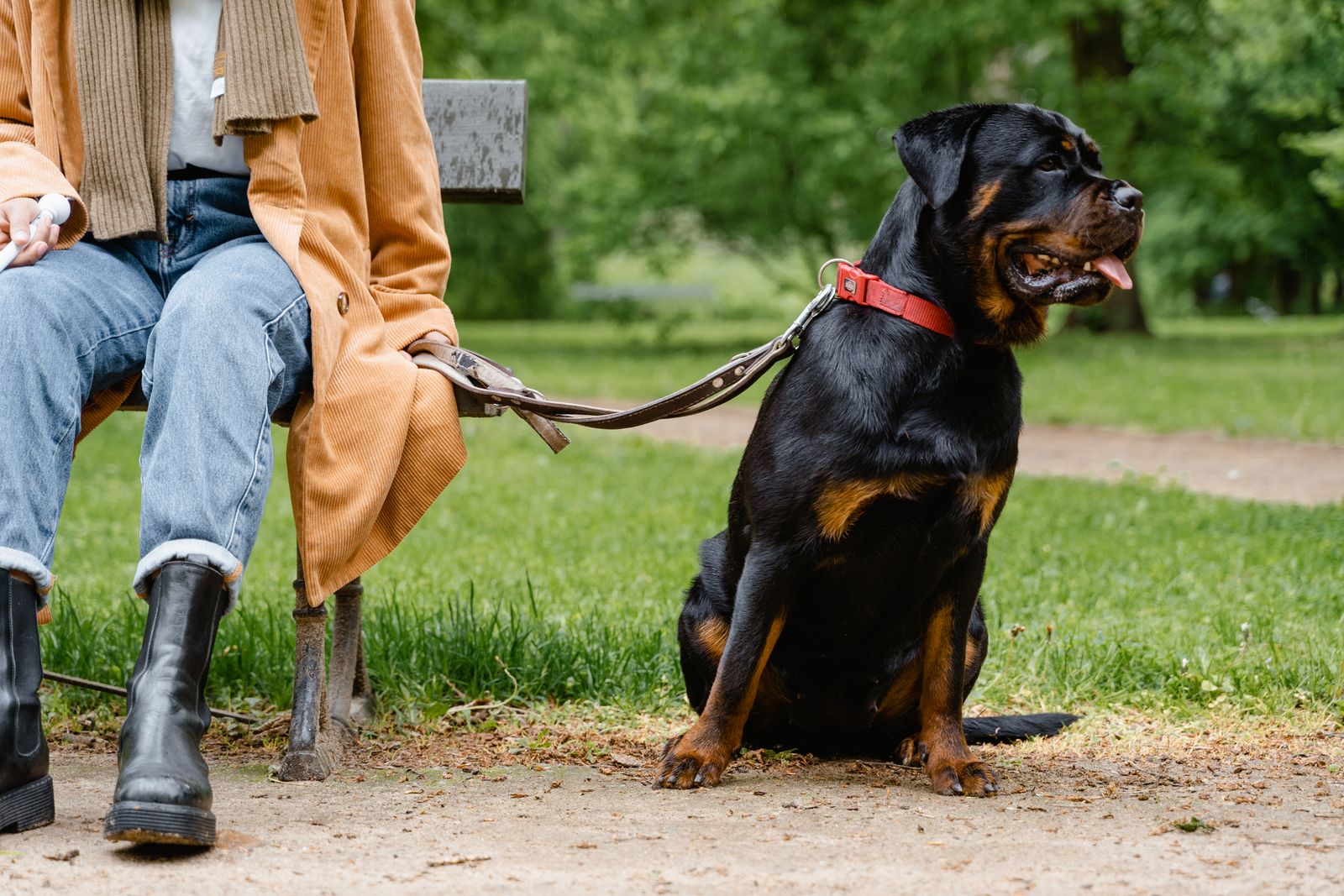
Rottweiler snapshot
The American Kennel Club describes the Rottweiler as a robust working breed of great strength, descended from the mastiffs of the Roman legions. The AKC calls the breed a gentle playmate and protector inside the family circle, and a dog that watches the outside world with a self assured aloofness. That calm, confident, and courageous temperament needs early training and socialization, and it needs a job for its mind. This is not a dog that thrives on being left to invent its own work.
| Height | Males 24 to 27 inches at the shoulder. Females 22 to 25 inches. |
|---|---|
| Weight | Males 95 to 135 pounds. Females 80 to 100 pounds. |
| Lifespan | 9 to 10 years, as listed by the AKC. |
| Coat | A short, dense, straight double coat, black with clearly defined rust to mahogany markings. |
| Temperament | Loyal, protective, and confident, calm and courageous with its own people and reserved with strangers. |
| Energy and exercise | A working breed that needs daily exercise, training, and mental work, with growth and weight watched closely while it is young. |
Two snapshot facts shape every insurance decision in this guide. The first is weight. A dog in this size range costs more to anesthetize, to image, and to operate on than a small dog with the same condition. The second is growth. A Rottweiler puppy gains size quickly, and Cornell notes that rapid growth and overfeeding can worsen an inherited hip tendency in a predisposed puppy. How the puppy is fed and exercised in the first year is part of the insurance story, not a separate topic.
The breed also has a documented screening culture. The American Rottweiler Club requires breeding dogs in its mandatory program to complete hip, elbow, eye, and cardiac evaluation, plus DNA testing for juvenile laryngeal paralysis and polyneuropathy, a serious inherited nerve condition, and to earn a CHIC number through the Orthopedic Foundation for Animals once the results are public. Ask a breeder for those records by name, keep copies with your policy, and read the actual grades rather than treating a CHIC number alone as a clean bill of health.
Health tendencies in Rottweilers
The list below follows the breed club health program, the AKC, and the veterinary references in the Sources section. Two conditions lead it. Cruciate disease fills the orthopedic side, and osteosarcoma fills the oncology side. Hips, elbows, heart, and stomach complete the list. None of these conditions is certain in an individual dog. They are tendencies, and they are the reason the policy wording in the next sections matters more for this breed than the headline price.
This section is general information about conditions a breed can be prone to. It is not veterinary advice and it is not a diagnosis of any dog. Signs listed here are possible signs owners may notice, and many of them have several causes. Only a veterinarian who examines your dog can say what a sign means.
Cruciate ligament disease (knee)
What it is
A weakening and tearing of the cranial cruciate ligament, one of the main stabilizers inside the knee, called the stifle in dogs. The American College of Veterinary Surgeons explains that the ligament prevents the knee from moving back and forth too much, and that rupture is one of the most common reasons for hind limb lameness, pain, and knee arthritis in dogs. The ACVS lists the Rottweiler among the breeds with a higher incidence, and it stresses the mechanism that matters for insurance. In most dogs the ligament fails through subtle, slow degeneration over time, shaped by aging of the ligament, body weight, physical condition, genetics, and the shape of the leg. A sudden trauma to an otherwise healthy ligament is very rare. Partial tearing is common, and a partial tear almost always progresses to a full tear over time.
Signs owners may notice
- Limping on a back leg, of variable severity, sometimes noticed mainly after rest.
- Difficulty rising from a sit, or difficulty sitting down squarely, and trouble jumping into a car.
- Less activity, less willingness to play, stiffness, and pain that shows as a limp that does not go away.
- Thinning muscle on the affected back leg, reduced range of motion in the knee, a clicking or popping sound, or firm swelling on the inside of the shin bone.
When it can be urgent
A cruciate problem is usually a prompt appointment rather than a midnight emergency. A dog that suddenly cannot bear any weight after a fall or collision, a knee that swells fast, or lameness paired with a leg held at a strange angle can involve a fracture or another injury, and that combination needs same day care. A limp that keeps returning in a large breed should not be watched at home for months either, because the joint is unstable while you wait.
How vets usually evaluate and treat it
Vets can often diagnose a cruciate tear with a hands on exam alone, feeling for forward movement of the shin bone or a thrust motion in the knee, sometimes with mild sedation so the muscles relax, and with X-rays to look for arthritis and swelling and to plan surgery. The ACVS states that surgical treatment is typically the strongest treatment, because it is the only way to permanently control the instability in the joint. Surgical categories include bone cut procedures that change the forces on the knee, often preferred for large and active dogs, and suture based procedures that mimic the ligament. Non surgical care combines pain medication, strict activity restriction, weight control, and rehabilitation, which the ACVS notes can speed recovery and improve the final outcome after surgery. Long term, arthritis can still progress, and many dogs that develop cruciate disease in one knee later develop the same problem in the other knee.
Bone cancer (osteosarcoma)
What it is
A malignant cancer of bone, formed by abnormal production of the cells that create and break down bone. Cornell's Riney Canine Health Center calls osteosarcoma one of the most common types of bone cancer in dogs, and names Rottweilers among the large and giant breeds where it is often diagnosed. The tumor commonly grows on the long bones of the front or back limbs, destroys normal bone as it grows, and can make the bone likely to break. Cornell describes it as a very aggressive tumor that often spreads to the lungs early in the disease, and notes there is likely a genetic component given the pattern in certain large breeds. It is more common in older dogs, around seven years of age in Cornell's summary, though a smaller number of dogs develop it as young adolescents.
Signs owners may notice
- Lameness, or reluctance to walk, that does not settle the way a strain should.
- A firm, localized swelling, most commonly on a limb.
- Loss of muscle mass on the affected limb.
- Less specific signs that can follow pain, such as loss of appetite or a change in behavior.
How vets usually evaluate and treat it
Diagnosis usually combines the history, a physical exam, and X-rays of the affected limb or swelling, which often show a characteristic appearance. Cornell is direct that a biopsy is the only way to diagnose this cancer definitively, and a fine needle sample may be recommended in some cases. Staging comes with it. Bloodwork, urine testing, and chest X-rays look for spread and check overall health, and referral to a veterinary oncology specialist is a standard step. Cornell frames treatment around pain and quality of life. Categories include pain medication, surgery to remove the limb when the tumor is in a limb, chemotherapy after surgery to delay spread, and, when surgery is not an option, palliative radiation or other specialist pain care. Limb sparing surgery and focused radiation exist through specialists, though not every dog is a candidate. Cornell is also honest that there is no cure. The insurance question is whether the policy funds the full diagnostic and treatment path while you and your vet make hard decisions on a short clock.
Hip dysplasia
What it is
An inherited orthopedic condition in which the hip joint forms incorrectly, so the ball and socket fit loosely instead of snugly. Cornell explains that the looseness wears the joint unevenly over time, arthritis develops, and pain and loss of mobility follow. Cornell names Rottweilers among the medium and large breeds where the condition is common. The tendency is genetic, and Cornell notes it can be made better or worse by environment, especially nutrition and growth rate. Overfeeding and rapid growth in puppies can worsen the condition in a predisposed dog. The breed club program screens hips for exactly this reason, with an OFA radiographic evaluation after the dog reaches the adult screening age the program sets.
Signs owners may notice
- Difficulty getting up, stiffness after rest, or limping in the back legs.
- A bunny hopping run, where both back legs move together, or a swaying motion in the hips when walking.
- Reduced activity, unwillingness to jump, and shifting weight forward onto the front legs.
- Decreased muscle mass in the hind limbs over time.
When it can be urgent
Hip dysplasia usually develops slowly, and some dogs show few signs early while others show signs as young puppies or not until later in life. A dog that suddenly cannot rise, cries out, or will not bear weight may have an injury or a different problem on top of the joint disease, and that change deserves same day care.
How vets usually evaluate and treat it
Diagnosis combines X-rays, taken with specific positioning and usually with sedation, with a physical exam and hands on testing of the hip. Cornell describes two common radiographic methods by name, the PennHIP method that measures hip looseness and the OFA method that grades hips from radiographs taken at adult age, and notes that a physical exam must accompany the imaging. Treatment depends on severity, age, and response. Many cases are managed medically, with healthy weight control, pain and anti-inflammatory medication with monitoring, regular low impact exercise such as walking and swimming, and physical therapy. Dogs with severe disease that responds poorly to medical care may be referred to a surgeon. Surgical categories include total hip replacement, which Cornell notes is the more common major option for large breed dogs, and salvage or early joint preserving procedures that only work inside specific age windows in puppies.
Elbow dysplasia
What it is
A group of developmental problems in the elbow joint of the front leg, where the bones that form the elbow do not grow and fit together cleanly. Cornell describes elbow dysplasia as a common cause of elbow lameness in dogs, notes that Rottweilers are among the breeds where it is seen often, and explains that abnormal loading damages the joint and leads to arthritis. It often affects both elbows. The breed club program screens elbows alongside hips, with an OFA radiographic evaluation, which tells you how central this front leg joint is in a breed most people only associate with hip problems.
Signs owners may notice
- Front leg lameness in a young, growing dog, often worse after exercise and not fully settled by rest.
- A head bob when walking, where the head lifts as the sore leg lands, or a shortened stride when both elbows hurt.
- Walking with a paw turned inward and the elbow held out from the body, to shift weight off the sore part of the joint.
- Refusing exercise, a clear drop in activity, and reduced range of motion in the elbow.
When it can be urgent
Elbow dysplasia tends to declare itself as a limp that keeps returning. In a young large breed dog, that limp deserves an early workup rather than months of watching, because Cornell stresses that early intervention gives the strongest outcome and arthritis, once present, progresses. Sudden non weight bearing lameness, a swollen joint, or lameness after a fall needs prompt care, because fractures and other injuries can look similar at home.
How vets usually evaluate and treat it
Diagnosis usually starts with a thorough lameness exam and X-rays of both elbows, including bent views that can show defective areas and early arthritis. A CT scan and a camera look inside the joint can guide diagnosis and treatment in cases that need more detail. Cornell notes that elbow dysplasia cannot be cured, and that it can be well managed, with a good long term outlook for many dogs when surgery and medical management are combined well. Surgical categories include removing damaged tissue or fragments, and more extensive procedures to realign a badly formed joint in moderate to severe cases. Medical categories include rest and controlled exercise, weight control, pain medication, and rehabilitation.
Subaortic stenosis (heart narrowing)
What it is
A narrowing below the aortic valve that interferes with blood flowing out of the heart. The Merck Veterinary Manual explains that fibrous tissue inside the outflow path of the left ventricle can reduce flow, that this subaortic form is the most common form of aortic stenosis in dogs, and that it is usually seen in large breed dogs. Merck names Rottweilers among the breeds most frequently affected, alongside Boxers, Golden Retrievers, German Shepherds, and Newfoundlands. The narrowing makes the heart muscle thicken as it works harder, and Merck notes that poor blood flow through the heart muscle is a factor in dangerous heart rhythm problems. The breed club program includes a cardiac evaluation in its required screening, preferably by a board certified cardiologist and preferably with an echocardiogram.
Signs owners may notice
- Many dogs show no signs at home at all. The first clue is often a heart murmur heard by a vet at a routine exam.
- Tiring with exercise, or not keeping up the way a young dog should.
- Fainting or collapse, which Merck lists among the histories seen with this defect.
- Shortness of breath, difficulty breathing, or coughing in more advanced heart disease.
How vets usually evaluate and treat it
Evaluation usually includes a physical exam, electrocardiography to record the electrical activity of the heart, X-rays, and echocardiography, which is ultrasound of the heart. Merck notes that these steps allow diagnosis and an assessment of severity, and that Doppler echocardiography is valuable in judging how severe a stenosis is. Treatment depends on severity. Mildly affected dogs commonly need no treatment and can do well. Medication can help with exercise intolerance or fainting, and heart rhythm monitoring over a full day may be used when a dog faints often. Surgery exists, and Merck describes it as costly and sometimes risky, so cardiology guidance drives that decision. Dogs with this condition should not be bred.
Bloat (gastric dilatation volvulus, or GDV)
What it is
An emergency in which the stomach fills with gas and fluid and then twists on itself. The Merck Veterinary Manual describes the twist as cutting off the stomach entry and exit and interfering with blood flow, so the dog can slide into shock. Large, deep chested dogs carry the higher risk, and a Rottweiler build fits that shape. Simple gas and a twisted stomach can look alike at home, and only imaging at a hospital can tell them apart.
Signs owners may notice
- Repeated retching or trying to vomit with little or nothing coming up.
- A belly that looks swollen, tight, or rounder than usual, with restlessness or pacing.
- Heavy drooling, rapid or labored breathing, and signs of belly pain.
- Pale gums, weakness, or collapse as shock sets in.
How vets usually evaluate and treat it
Emergency teams usually stabilize first, with an exam, treatment for shock and pain, bloodwork, and an abdominal X-ray to confirm whether the stomach has twisted. Treatment is emergency surgery to decompress and untwist the stomach, check the stomach wall and spleen for damaged tissue, and usually tack the stomach to the body wall, a procedure called gastropexy, so it cannot twist again. Hospital monitoring follows, because rhythm and circulation problems can appear after the surgery itself.
Policy decisions that matter for a Rottweiler
For a Rottweiler, the policy table is the double exposure written as clauses. The orthopedic rows decide the cruciate, hip, and elbow claims. The cancer and limit rows decide the oncology claim. The emergency row decides the one night nobody plans for. Read these rows in the actual policy wording, before the dog is limping, because waiting periods and pre-existing definitions are fixed at enrollment.
| Policy feature | Why it matters for a Rottweiler | Stronger wording looks like | Watch out for |
|---|---|---|---|
| Hereditary and congenital coverage | Hip dysplasia, elbow dysplasia, cruciate tendency, and subaortic stenosis all run through the breed and its screening program. | Hereditary and congenital conditions are covered on the same terms as other illnesses. | Hereditary exclusions, breed specific exclusions, or a short named list that leaves out this breed's conditions. |
| Orthopedic waiting period | Cruciate, hip, and elbow claims are exactly the claims a young, fast growing Rottweiler is most likely to bring early. | A defined orthopedic waiting period, stated up front, that a documented vet exam can shorten or waive where the policy allows it. | Long special waiting periods for ligament or orthopedic conditions buried in definitions, discovered only at the first limp. |
| Bilateral condition rule | Knees, hips, and elbows come in pairs, and cruciate disease in one knee is often followed by the same problem in the other. | Each side is judged on its own record, with clear terms for when the second side is covered. | Wording that treats the second side as pre-existing once the first side is diagnosed or treated. |
| Annual limit | One oncology year, or one major joint surgery on a dog of this weight, can consume a small limit in a single course of care. | A high annual limit, or no annual cap, that resets each policy year. | Low annual limits, and per-condition caps that split one course of cancer or joint care into several capped buckets. |
| Cancer coverage in full | Osteosarcoma care is a path, not a visit. Staging, biopsy, surgery, chemotherapy, radiation, and pain care arrive in sequence. | Cancer diagnosis and treatment are covered as illness care, with specialist visits and follow up imaging included. | Cancer exclusions, separate low cancer caps, or chemotherapy and radiation carved out of coverage. |
| Diagnostics and specialist coverage | A murmur needs an echocardiogram. A leg swelling needs imaging and biopsy. An elbow may need a CT scan. The diagnosis is the claim before the treatment is. | Advanced imaging, specialist exams, and biopsy are covered categories for a covered condition. | Policies that pay for treatment but exclude or separately cap the imaging and specialist work that establishes the diagnosis. |
| Chronic condition renewal terms | Arthritis from dysplasia, heart monitoring, and post cancer rechecks are managed across many renewals. | A condition covered in one policy term stays covered in later terms while enrollment continues. | Per-year condition caps, or renewal wording that reclassifies a managed condition as pre-existing. |
| Emergency care terms | Bloat happens at night, often at a hospital that is not your usual clinic, with no time to call anyone first. | Emergency treatment at any licensed hospital is covered without prior approval. | Requirements to call for authorization first, or reduced coverage for out of hours or emergency hospitals. |
Life stages: puppy, adult, and senior
Puppy
The puppy stage carries unusual weight in this breed, because growth itself is a risk factor owners can influence. Cornell notes that overfeeding and rapid growth can worsen hip dysplasia in a predisposed puppy, so steady growth on a diet made for large breed puppies, controlled exercise rather than forced running or repeated jumping, and a lean body condition are health decisions with insurance consequences. Elbow signs can appear while a Rottweiler is still young, and a heart murmur can be heard at an early exam. Enroll in the first months, start the growth stage orthopedic record described in the checklist section, keep the breeder screening records for both parents, and let the waiting periods run while the puppy is healthy. A limp noted before enrollment can follow the dog for years.
Adult
Adulthood is when the orthopedic story usually declares itself. A cruciate knee that weakens, a hip or elbow that moves from an imaging finding to a treatment plan, and the monitoring that follows a heart diagnosis. Keep the record boring and complete. File claims as they happen, keep invoices and imaging reports together, update the orthopedic record after every lameness episode even when it settles, and note which joint and which side were involved. Side matters later, when the bilateral rule is applied to the other leg. Keep weight lean too, because extra weight loads every joint on this page.
Senior
With an AKC lifespan of 9 to 10 years, a Rottweiler is a senior sooner than owners expect, and the senior stage is where the second claim story lives. Cornell places osteosarcoma most often around seven years of age, so a new limp or a firm leg swelling in an older Rottweiler should be imaged promptly rather than assumed to be arthritis. Arthritis care, heart monitoring, cancer rechecks, and pain management overlap in these years. Review the policy at renewal for premium changes, limit changes, and any age based reduction in coverage.
A claim, step by step: a cruciate knee
The example below is hypothetical. It is not a real dog, a real claim, or a guarantee of how any insurer will decide. It follows an adult Rottweiler through a weakening cruciate knee, because that single story tests the orthopedic waiting period, the bilateral rule, and the surgery and rehabilitation categories at once. Pet insurance generally reimburses after you pay the vet, as explained in how pet insurance works.
The limp, and the record that starts the file
Over a few weeks, the dog starts favoring a back leg after walks, sits with that leg out to the side, and is slow to rise in the morning. The owner writes the dates, which leg it is, and when the limp is worst in the growth stage orthopedic record, and books a vet visit rather than waiting for it to resolve. That dated note matters. It shows the first sign fell inside the policy period, and it gives the vet a timeline instead of a guess.
The vet visit and the hands on diagnosis
At the clinic, the vet watches the dog walk, feels the knee for the forward movement that signals a cruciate problem, and takes X-rays that show swelling and early arthritis changes. The diagnosis recorded is cranial cruciate ligament disease, with a partial tear that is expected to progress. The records from this visit, the exam findings, the imaging, and the treatment options the vet lays out, are the diagnostic core of the claim.
Checking the waiting period and the bilateral file
On paper, the insurer lines the diagnosis up against the policy dates. The policy was started in puppyhood, the orthopedic waiting period ended long ago, and the record shows no earlier knee note on either side. That clean file makes this a straightforward orthopedic claim. The owner also asks, in writing, how a future problem in the other knee will be treated under the bilateral rule, and saves the answer with the policy.
The treatment decision, and paying as you go
The vet explains that, for a large and active dog, surgery is typically the way to permanently control the instability, and lays out the surgical categories and the non surgical path with its limits. The owner chooses surgery, pays the clinic directly, and collects the itemized invoice and the complete surgical report. Activity restriction begins at home the same day, because the weeks of controlled recovery after a knee procedure are part of the treatment, not an afterthought.
Submitting the first claim
The claim is filed with the invoices, the exam and imaging records, and the surgical report, with the date the limp was first noted stated clearly and matched to the orthopedic record. Keeping the general vet records and the surgical records together matters, because the insurer reads the knee story as one file, from first limp to operation.
Rehabilitation, monitoring, and how reimbursement works
Recovery settles into controlled walks, rehabilitation sessions to rebuild muscle around the knee, pain medication as prescribed, and recheck visits. Each eligible bill moves through the same mechanics described in what pet insurance costs and why. Charges count against the deductible first, the reimbursement rate in the policy applies to eligible charges after that, and totals are tracked against the annual limit. The owner keeps updating the orthopedic record through recovery, including how the other knee is doing, because that record is now the baseline for any second knee claim.
Where claims like this get denied or reduced
Denial pressure points in this breed story are an orthopedic waiting period that had not finished when the limp began, an earlier note of hind leg lameness that the insurer reads as the same condition starting before enrollment, rehabilitation or imaging classified outside the covered categories, and a second knee later treated as pre-existing under a bilateral clause the owner never read. Each of those is a clause question that can be asked in writing before you buy, and a record question that the growth stage orthopedic record is built to answer.
What drives a Rottweiler premium
No responsible guide will name a price for your dog, because the quote depends on the dog, the address, and the settings chosen. What can be explained is why this breed sits where it does in insurer pricing, and which choices move the quote. The full mechanics are in what pet insurance costs and why.
Breed risk profile. Insurers see a large working dog with a documented orthopedic list and a named place on the bone cancer breed list. That combination, joint surgery on one side and oncology care on the other, is a heavier expected claim profile than most breeds carry, and breed pricing reflects it before any individual dog is considered.
Size. Weight multiplies almost every line of care. Anesthesia, medication amounts, imaging, surgery time, and handling all scale up in a dog of this size, and rehabilitation and recovery support for a heavy dog take more work at home as well. The same knee condition simply costs more to treat in a Rottweiler than in a small breed.
Age curve and lifespan. Premiums generally rise with age, and this breed's expensive conditions cluster in the adult and early senior years, from cruciate and dysplasia care to an oncology workup around the age Cornell names for bone cancer. A lifespan of 9 to 10 years concentrates that illness into a shorter span rather than spreading it out, so the middle years of a Rottweiler policy do most of the financial work.
Location and plan settings. Vet prices in your area set the bill sizes the insurer expects, and emergency and specialist care is priced very differently by region. Your deductible, reimbursement rate, and annual limit choices then trade premium against claim returns. For this breed, cutting the annual limit to lower the premium is the setting most likely to be regretted, because the defining claims, a knee operation, an oncology course, or one emergency night, are single large courses of care.
Pre-purchase checklist for a Rottweiler policy
- Confirm hereditary and congenital conditions are covered, including hip dysplasia, elbow dysplasia, cruciate disease, and subaortic stenosis.
- Find the orthopedic waiting period for cruciate and joint claims, note the date it ends for your dog, and ask whether a vet exam can shorten it.
- Read the bilateral clause for knees, hips, and elbows, and ask in writing what happens to the second side after the first is treated.
- Confirm cancer care in full: imaging, biopsy, specialist visits, surgery, chemotherapy, radiation, and pain care, with no separate cancer cap.
- Choose an annual limit that can hold one major course of care on a very large dog, or a plan with no annual cap.
- Check that echocardiography, CT imaging, and cardiology and oncology referrals are covered, not only surgery.
- Confirm emergency care at any hospital is covered without prior approval, and ask how emergency and preventive gastropexy are each classified.
- Ask a breeder for both parents hip, elbow, eye, and cardiac screening results and the nerve condition DNA result, and keep copies with the policy.
- Enroll as a puppy, before a first limp, a murmur workup, or a leg swelling enters the medical record, and start the orthopedic record below on day one.
Tool: the growth stage orthopedic record
Keep one simple record from puppyhood to senior years, in a notebook or a phone note, and bring it to every vet visit. Rottweiler claims are decided on dates, sides, and first signs, and memory does not hold those details across years. The record below is the breed specific tool for this guide. One row per event is enough. What matters is that the row exists, is dated, and names the leg and the joint.
| What to record | What to write down | Why it helps the vet and the claim |
|---|---|---|
| Growth stage and weight | The date, the dog's age stage (puppy, adolescent, adult, senior), and its weight at each vet visit, plus any change in food or feeding amount. | Growth rate and weight are part of the hip, elbow, and cruciate story in this breed, and a dated weight line shows steady, controlled growth rather than rapid gain. |
| Lameness notes | Any limp, stiffness, sitting change, or reluctance to jump, with the date it started, which leg, and whether it followed exercise, rest, or a fall. | First sign dates decide pre-existing questions. A dated home note that matches the vet record is the strongest simple evidence an owner can keep. |
| Joint and imaging dates | Every joint exam, X-ray, CT scan, echocardiogram, and screening result, with the date, the joint or test, and where the report is filed. | Insurers ask for complete records. A list of what exists and where it sits turns a record hunt into a short task at claim time. |
| Treatment and recovery | Medication, surgery, rehabilitation sessions, and activity restrictions, with start and end dates and how the dog responded. | Recovery notes support follow up claims for the same condition, and they create the baseline the other knee, hip, or elbow will be judged against. |
| Screening file | Both parents hip, elbow, eye, and cardiac results, the nerve condition DNA result, and your own dog's screening or murmur workup results. | Screening records show the diligence behind the puppy you chose, and your dog's own cardiac and joint results belong in the same file as the policy. |
Questions to ask an insurer, in writing
- What orthopedic waiting period applies to cruciate ligament disease in a Rottweiler, and can a vet exam shorten it?
- If one knee is treated, how is the other knee handled under your bilateral condition rule?
- Are hip dysplasia and elbow dysplasia covered for this breed, including CT imaging and rehabilitation?
- Is bone cancer covered in full, including biopsy, surgery, chemotherapy, radiation, and repeat chest imaging?
- Is subaortic stenosis covered as a congenital condition, including echocardiography and cardiology visits?
- Is emergency bloat surgery covered at an emergency hospital without prior approval, and how is gastropexy treated in that repair?
Questions Rottweiler owners ask
Does pet insurance cover cruciate ligament disease in Rottweilers?
An accident and illness policy can cover cruciate disease when orthopedic conditions are included, the orthopedic waiting period has passed, and no lameness or knee note was recorded before enrollment. Because the ligament usually weakens over time rather than tearing in one accident, an accident only policy is a poor match for this breed. Read the cruciate wording by name, and ask whether a documented vet exam can shorten the waiting period.
Does pet insurance cover bone cancer treatment in a Rottweiler?
Cancer is an illness, so an accident and illness policy that has passed its waiting period can cover the diagnostic path and treatment categories the policy includes, such as imaging, biopsy, surgery, chemotherapy, radiation, and pain care. The limits decide how far that help goes. Check the annual limit, any separate cancer cap or exclusion, and whether specialist oncology visits and repeat chest imaging are covered, before a diagnosis forces the question.
If one knee, hip, or elbow is treated, is the other side covered?
That depends on the bilateral rule, and it is one of the most important sentences in a Rottweiler policy. Some policies judge each side on its own record. Others treat the second side as pre-existing once the first side is diagnosed, or apply a separate waiting period to it. Cruciate disease in particular often appears in the second knee later. Ask in writing how the second knee, hip, and elbow are handled after the first side is treated.
When is the best time to enroll a Rottweiler?
As a puppy, before any limp, joint note, heart murmur workup, or swelling is in the record. Rottweilers grow fast and large, and elbow and hip signs can appear while a dog is still young. Enrolling early lets the illness and orthopedic waiting periods run while the dog is least likely to need orthopedic care, and it keeps the growth stage record clean for the claims that may come years later.
My breeder screened the parents. Do I still need to worry about dysplasia coverage?
Yes. Screening lowers risk, and the American Rottweiler Club requires hip, elbow, eye, and cardiac screening plus a DNA test for a nerve condition in breeding dogs. Screening does not remove risk from an individual puppy, because dysplasia is inherited in a complex way and growth and weight also play a part. Keep the parents screening records in your file, and still confirm that hereditary joint conditions are covered for your dog.
Is emergency bloat surgery covered for a Rottweiler?
Bloat with a twisted stomach is an illness emergency, so an accident and illness policy past its illness waiting period will generally treat it like other covered emergencies, subject to the deductible, reimbursement rate, and annual limit. A preventive stomach tacking operation in a healthy dog is different, and many policies exclude preventive procedures. Ask in writing how gastropexy is treated in an emergency repair and as a preventive operation.
Sources and further reading
- American Kennel Club, Rottweiler breed page for size, lifespan, coat, temperament, and breed character.
- American Rottweiler Club, Rottweiler breed health for the mandatory screening program for breeding dogs, including hip, elbow, eye, and cardiac evaluation and the DNA test for juvenile laryngeal paralysis and polyneuropathy, and for cancers including osteosarcoma among the breed's common conditions.
- American College of Veterinary Surgeons, Cranial cruciate ligament disease for the Rottweiler among the higher incidence breeds, slow degeneration as the usual mechanism, signs, diagnosis, surgical and non surgical care, rehabilitation, and the second knee risk.
- Cornell Riney Canine Health Center, Osteosarcoma in dogs for bone cancer in Rottweilers and other large breeds, its signs, biopsy as the definitive diagnosis, staging, and treatment categories centered on pain and quality of life.
- Cornell Riney Canine Health Center, Canine hip dysplasia for joint looseness leading to arthritis in Rottweilers and other breeds, the role of growth and nutrition, PennHIP and OFA evaluation, and medical and surgical care.
- Cornell Riney Canine Health Center, Elbow dysplasia for front leg lameness, paw inward and elbow outward gait, diagnosis with X-rays, CT, and joint camera, and surgical and medical management.
- Merck Veterinary Manual, Congenital and inherited disorders of the cardiovascular system in dogs for subaortic stenosis in Rottweilers and other large breeds, fainting and sudden death in the history, and diagnosis with electrocardiography, X-rays, and echocardiography.
- Merck Veterinary Manual, Disorders of the stomach and intestines in dogs for gastric dilatation volvulus, its signs, and emergency surgical treatment including gastropexy.