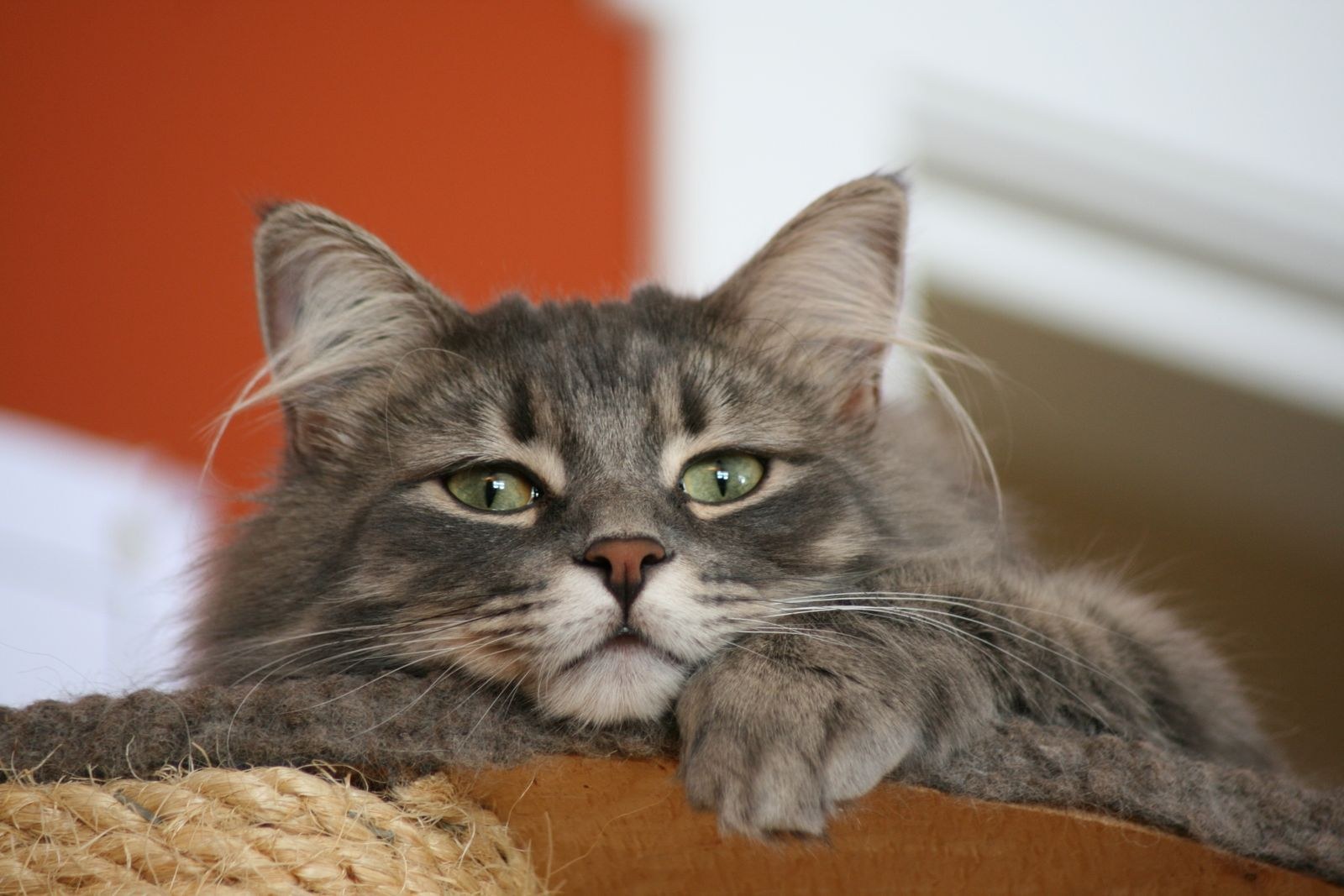
Norwegian Forest Cat snapshot
The Cat Fanciers' Association, known as the CFA, describes a sturdy cat with a distinguishing double coat, and calls it a slow maturing breed that attains full growth at approximately five years of age. The International Cat Association, known as TICA, tells the same story in its breed introduction: a healthy, robust natural breed that developed over hundreds of years of natural selection in a harsh climate, and that may take up to five years to reach full maturity. TICA traces the breed through Scandinavian history, traveling with the Vikings and known in Norway as the Skogkatt. This is a cat built by winter, and the registries describe it that way.
| Size | Large. The TICA standard calls the males large and imposing, often weighing 12 to 15 pounds or more, and says the females can be considerably smaller. The CFA standard calls the body solidly muscled and well balanced, with substantial bone structure, a broad chest, and considerable girth without being fat. |
|---|---|
| Body | Medium long and substantial, in the TICA standard, with hind legs higher than the front legs and large, round, well tufted feet. The CFA standard adds heavily muscled thighs and a long, bushy tail whose desirable length is equal to the body from the base of the tail to the base of the neck. |
| Head and profile | An equilateral triangle, where all sides are of equal length. The nose profile is straight from the brow ridge to the tip of the nose without a break in the line, in the CFA wording, and long and straight with no stop, in the TICA wording. The TICA standard penalizes a round or square head and a profile with a break. A square muzzle is a disqualifying fault in the CFA standard. |
| Eyes | Large and almond shaped. The CFA standard says the eyes are set at a slight angle, with the outer corner higher than the inner corner. The TICA standard says large, wide, almond shaped, and set on an oblique tilt. Eye color should be shades of green, gold, greengold, or copper, in the CFA standard, with blue or odd eyes allowed in white cats and cats with white. |
| Coat | A distinguishing double coat. The CFA describes a dense undercoat covered by long, glossy, smooth, water-resistant guard hairs, with a bib in three sections and full britches on the hind legs, and notes the coat is fuller in winter than in summer. TICA describes the undercoat as dense and woolly, covered by a smooth, water-repellent upper coat, with a full ruff in a fully coated cat. |
| Temperament | Intelligent, independent, and interactive. TICA calls the breed intelligent and resourceful, mild-mannered, and adaptable, and describes an interactive, playful, loving member of the household. The TICA standard lists the temperament as intelligent and independent. |
| Health profile | A screening profile, documented in the sources for this guide. Cornell lists this breed among those in which HCM is more prevalent. UC Davis offers a DNA test specific to this breed for GSD IV. A UC Davis led study recommends pyruvate kinase testing for this breed. PawPeds runs health programmes for this breed in HCM ultrasound, hip dysplasia, pyruvate kinase deficiency, and GSD IV. |
Two snapshot facts shape the insurance picture. The first is the slow maturity. A breed that is not fully developed until about five years of age stretches the young stage across years, not months, and decisions made for a kitten have to hold up across that whole runway. The second fact is the build. Heavy cats put heavy loads through their hip joints, and Cornell makes the weight connection directly in its hip dysplasia account, noting that obesity significantly increases the pressure on the hip's supporting structures. In this breed, the scale at every visit is part of the joint record and part of the diabetes record, and it is worth keeping.
The head shape does one more job on this page. It is how you know the cat in a photograph is this breed and not its famous lookalike, the Maine Coon. The forest cat's profile runs in one straight line from brow to nose tip, its head is a triangle, and its eyes are almond shaped and set at an angle. The CFA standard disqualifies a square muzzle. The photos on this page were chosen and checked against those markers.
Health tendencies in Norwegian Forest Cats
The conditions below fall into three honest groups. The first is breed linked and testable: HCM, GSD IV, and pyruvate kinase deficiency, each with a named source that ties it to this breed and a named test. The second is breed relevant and structural: hip dysplasia, where the link is the breed's size and weight, a breed health programme that records radiographs, and a general feline account from Cornell. The third is the slow background every cat faces: diabetes, which a major veterinary reference ties to this breed by name, and chronic kidney disease, which Cornell ties to age alone. These are tendencies to plan around, not predictions.
This section is general information about conditions a cat can develop. It is not veterinary advice and it is not a diagnosis of any cat. Signs listed here are possible signs owners may notice, and many of them have several causes. Only a veterinarian who examines your cat can say what a sign means.
Which test answers which question
Owners meet this breed's health file as a pile of test names, and the tests are not interchangeable. A DNA test gives an answer that does not change over the cat's life. An echocardiogram images the heart as it is on that day, and its answer can change with age. A radiograph images the hip joints. Blood and urine tests are repeated because their answer is a trend, not a verdict. The table below is the map for the condition cards that follow, and for the record card in the checklist section.
| Tool | Condition it answers | Kind of answer | Repeated over time? |
|---|---|---|---|
| DNA test for the GSD IV variant | Glycogen storage disease type IV | Clear, carrier, or affected for this breed-specific variant, settled for life | No. One result, kept with the cat's papers |
| DNA test for pyruvate kinase deficiency | Pyruvate kinase deficiency, an inherited anemia | Genotype for the mapped variant, settled for life | No. One result, kept with the cat's papers |
| Echocardiogram, an ultrasound scan of the heart | Hypertrophic cardiomyopathy | The thickness and function of the heart walls on the scan date | Yes. Scans repeat, because the condition can develop or progress with age |
| Hip radiographs, X-ray images of the hip joints | Hip dysplasia | How the ball and socket are formed and fitted | Sometimes. A breeding or diagnostic image, repeated if signs or breeding decisions require it |
| Blood and urine tests, including blood sugar and kidney values | Diabetes and chronic kidney disease monitoring | How the organs are working at that visit | Yes. The value is in the series of results, not in any single one |
Hypertrophic cardiomyopathy (HCM)
What it is
A condition that causes the muscular walls of the heart to thicken, decreasing the heart's efficiency. Cornell calls HCM the most common heart disease of cats, and lists the Norwegian Forest Cat by name among the breeds in which the condition is more prevalent, alongside the Maine Coon, Ragdoll, British Shorthair, and others, noting that mutations of several cardiac genes have been identified in some cats with the disease and that genetics appears to play a role. Cornell describes the thickened left ventricle relaxing abnormally and beating rapidly, and explains that less efficient pumping can back blood up toward the lungs, contributing to congestive heart failure or to blood clots forming in the heart. Cornell is also clear that the disease is generally considered progressive, meaning the thickening and its signs commonly worsen over time. There is no known cure.
Signs owners may notice
- Often nothing. Cornell notes many cats with HCM do not appear ill.
- Labored or rapid breathing, and open-mouthed breathing, which Cornell lists as signs of congestive heart failure when fluid accumulates in or around the lungs.
- Lethargy, a cat that tires, hides, or stops joining the household's routines.
- Sudden hind limb pain, weakness, or paralysis, which can signal a blood clot that has traveled and blocked blood flow to the hind limbs, a consequence Cornell describes as serious and potentially life threatening.
How vets usually evaluate and treat it
HCM is diagnosed by echocardiography, a technology that uses sound waves to create an image of the heart. In a cat with HCM, Cornell explains, the images reveal the thickened walls and the constricted volume of the left ventricle. Similar thickening can also be caused by high blood pressure and by hyperthyroidism, an overactive thyroid, and Cornell says those diseases must be ruled out before HCM is diagnosed. A vet may also recommend chest radiographs, which are X-rays, and electrocardiography, a recording of the heart's electrical activity. Cornell notes that new genetic tests may help identify increased risk, and warns that those results should be interpreted carefully with a veterinary professional, since not all cats with the mutations will develop the condition. That warning is the heart of this breed's screening story. PawPeds runs an HCM ultrasound programme for this breed, with scans recorded over time, because the scan series, not a single DNA result, is the record that tracks this condition. Treatment goals, in Cornell's account, are controlling the heart rate, alleviating lung congestion, and preventing blood clots.
Glycogen storage disease type IV (GSD IV)
What it is
An inherited error in how the body stores glycogen, which is the stored form of sugar the body keeps for energy. The UC Davis Veterinary Genetics Laboratory explains that Norwegian Forest Cats can inherit a defective glycogen branching enzyme, called GBE, that causes a severe error in glycogen storage in cells. Abnormal glycogen accumulates in muscle, liver, and neurons, the nerve cells, causing progressive organ dysfunction. The laboratory calls the outcome plainly: GSD IV leads to progressive organ dysfunction, generalized muscle atrophy, which is the wasting of muscle, and eventual death in affected cats. It also states that its test is specific for the GSD IV genetic defect that has been identified in Norwegian Forest Cats. This is the one condition in this guide that belongs to this breed in that direct, test-built-for-the-breed way, and it is the clearest example on this site of a DNA result doing real work.
Signs owners may notice
- In most affected kittens, signs at or soon after birth. UC Davis notes that affected kittens may die at or soon after birth, likely from an inability to produce energy.
- In the few affected kittens that appear normal at first, a change at about five months of age, when normal development ceases.
- A persistent fever that does not settle.
- Muscle tremors, progressing to generalized muscle atrophy, in UC Davis's description of the later signs.
When it can be urgent
This condition declares itself in kittenhood, not in the senior years, and its course in an affected kitten is a veterinary matter from the first signs. A young kitten that fails to develop, runs a persistent fever, or develops tremors needs prompt veterinary care, whatever the cause turns out to be. For most owners, though, the practical moment for GSD IV is earlier and quieter: it is the breeder's test result, read before the kitten comes home.
How vets usually evaluate and treat it
Evaluation here is the DNA test itself. UC Davis describes the inheritance as autosomal recessive, which means two affected copies are necessary for the disease to appear. A cat with no copies will not have the disease and cannot pass the variant on. A cat with one copy will not have the disease, but is a carrier. A cat with two copies will have GSD IV, a fatal condition. The laboratory notes that testing can help breeders identify carriers and select mates to avoid producing affected kittens. There is no treatment path in the UC Davis account that changes the outcome for an affected cat, which is exactly why the test, and the record of the test, carry the weight they do in this breed. Ask for the parents' results, or the kitten's own result, in writing, and keep that paper for the life of the cat.
Pyruvate kinase deficiency (PK deficiency)
What it is
An inherited hemolytic anemia. Hemolytic means the red blood cells break down, and anemia means the cat has too few working red blood cells to carry oxygen well. The condition takes its name from an enzyme, pyruvate kinase, that red blood cells need to produce energy for their survival. A study led by researchers at the UC Davis School of Veterinary Medicine and its Veterinary Genetics Laboratory, published in a peer-reviewed veterinary journal, explains that erythrocyte pyruvate kinase deficiency is an inherited hemolytic anemia caused by insufficient activity of that enzyme, which results in instability and loss of red blood cells. The same study mapped the mutation, in a gene called PKLR, across many breeds, and its conclusion names this breed directly: PK testing is recommended for Norwegian Forest Cats, in addition to Abyssinians and Somalis and several other breeds. PawPeds also carries pyruvate kinase deficiency information and result reporting for this breed, a second sign that breeders treat this as a Norwegian Forest Cat test.
Signs owners may notice
- Lethargy and weakness, which the UC Davis led study lists among the signs of the anemia, in severe form as severe lethargy.
- Pale mucous membranes, meaning pale gums, which the study lists among the typical clinical symptoms.
- Loss of appetite, poor coat quality, and weight loss.
- Jaundice, a yellowing the study calls icterus, and, occasionally, an enlarged abdomen linked to an enlarged spleen, which the study calls splenomegaly.
When it can be urgent
The study describes this anemia as chronic and intermittent, meaning it comes and goes, with high variability in onset and severity. In the cohort the study describes, signs first appeared as early as six months and as late as five years of age. A cat that is suddenly very weak, collapses, breathes fast at rest, or has very pale or yellow gums needs prompt, same day care, because a deep dip in red blood cells is not a routine visit problem, whatever its cause.
How vets usually evaluate and treat it
Evaluation works on two levels. Blood work shows the anemia itself, and the study notes that blood chemistry may reveal anemia, raised counts of young red blood cells as the body tries to replace losses, and raised globulin, bilirubin, and liver enzyme values. The DNA test shows the genotype, and it settles the inherited question in a way a single blood count cannot, because an intermittent anemia can read as normal on a good day. The study is honest about outcomes: some affected cats died or required euthanasia, while others maintained an adequate quality of life. Care is therefore management, built around monitoring the blood and treating the anemia's effects as they arise. For a buyer, the practical step mirrors the GSD IV step. Ask whether the breeder tests for PK deficiency, ask for the result in writing, and file it on the record card.
Hip dysplasia in a large, heavy cat
What it is
A genetically inherited malformation of the ball-and-socket joint that connects the thigh bone, the femur, to the hip. Cornell explains the anatomy plainly. The ball is the knobby top end of the thigh bone, and the socket is a cup-shaped cavity in the hip bone. In a cat with hip dysplasia, the ball and socket are misaligned and loose, and they knock and grind against each other instead of gliding smoothly. Over time, the socket becomes shallow, the ball becomes worn and misshapen, and the constant trauma is likely to foster osteoarthritis, the gradual destruction of the cartilage that cushions the bone ends. Cornell also states the limits of what is known: no specific cause identified, a genetic component widely thought likely, and obesity significantly increasing the pressure on the hip's supporting structures. The breed link on this page is stated exactly that carefully. PawPeds runs a hip dysplasia health programme for this breed, with radiographs recorded through its system, and this is a large, heavy breed, the body type in which hip fit and hip load matter most. Cornell does not name this breed in its hip account, and this guide does not pretend otherwise.
Signs owners may notice
- Limping, or other apparent difficulties in walking, in Cornell's list of clinical signs.
- Avoidance of physical activity, in a breed TICA describes as a natural climber. A forest cat that stops jumping up, hesitates at height, or chooses the floor is showing a change worth recording.
- Expression of pain if the hip is touched, and persistent licking or chewing at the hip area.
- A slow, quiet version of all of the above. Cats hide joint pain well, and a heavier, older forest cat that simply does less may be telling a joint story quietly.
When it can be urgent
Hip dysplasia itself develops slowly, and Cornell notes that its signs are a matter of pain and mobility, not of sudden crisis. A cat that suddenly cannot bear weight on a hind leg, cries out, or stops eating has a problem that needs prompt care, but that sudden picture is more likely an injury than dysplasia declaring itself in a day. The dysplasia work is the slow work: notice the change, record when it started, and get the hips imaged.
How vets usually evaluate and treat it
A definitive diagnosis can be achieved by an X-ray of an apparently painful hip joint, in Cornell's words. There is no DNA test for this condition, which is why the PawPeds programme for this breed is built on radiographs, and why a breeder's hip paper is an image report, not a genotype. Management, in Cornell's account, is keeping the cat from becoming overweight and encouraging exercise to keep the hip muscles strong. A veterinarian may recommend anti-inflammatory drugs and supplements containing glucosamine and chondroitin. Surgical options exist for advanced cases: a micro total hip replacement, in which the joint is replaced with an artificial device, and an operation that removes the ball part of the joint without replacing it, after which the muscles hold the leg and the painful bone-on-bone contact is gone, with an almost normal range of motion.
Diabetes mellitus and weight
What it is
A chronic disorder of carbohydrate metabolism, meaning the handling of sugars, due to relative or absolute insulin deficiency. Insulin is the hormone that lets the body use blood sugar for energy. That definition is the Merck Veterinary Manual's, and Merck gives this breed a direct mention. Its account lists the cat breeds that appear predisposed to diabetes mellitus, and the Norwegian Forest Cat is one of the breeds named, alongside the Tonkinese, Burmese, Russian Blue, and Abyssinian. Merck adds that obesity predisposes cats to insulin resistance, a state in which the body responds poorly to its own insulin. Put together honestly, the story is the same one the hip card tells from the other side. In a big cat, weight is a medical variable, and the food bowl is one of the few risk factors an owner controls.
Signs owners may notice
- The classic signs Merck lists: urinating more, drinking more, eating more, and losing weight. Merck notes that some cats instead eat less.
- Weakness and lethargy that are new for the cat.
- Recurring or slow-to-clear infections, because Merck notes that diabetic animals have decreased resistance to bacterial and fungal infections.
- Gradual weight gain earlier in the story, visible at the scale before it is visible under this breed's heavy coat. The coat hides the change. The scale does not.
When it can be urgent
Diabetes has a decompensated form. Merck describes diabetic ketoacidosis as a state in which cells use fatty acids for energy because insulin deficiency blocks their access to glucose, and ketoacids build up in the blood, with signs that include vomiting and loss of appetite on top of dehydration. Merck calls those metabolic disturbances profound and potentially life threatening. A diabetic, or possibly diabetic, cat that is vomiting, will not eat, is deeply lethargic, or breathes with effort needs emergency care the same day.
How vets usually evaluate and treat it
Merck bases the diagnosis on persistent high blood sugar and sugar in the urine, and notes a cat-specific wrinkle: stress can raise a cat's blood sugar temporarily, so multiple blood and urine samples may be required to confirm the diagnosis, and a test called fructosamine can help separate stress effects from true diabetes. Treatment in cats centers on insulin, dietary management, and frequent monitoring, which Merck says is often best performed at home, alongside weight loss for an overweight cat. Merck also notes that when diet change and insulin are combined, many cats achieve diabetic remission, meaning they no longer need insulin treatment. That possibility is real and hopeful, and it is a reason steady early management matters. It is not a promise for an individual cat, and it raises an insurance question of its own, covered in the clause box below.
Chronic kidney disease (CKD) in the senior years
What it is
The persistent loss of kidney function over time. This card is a general cat card, not a breed card, and it is labelled that way on purpose. Cornell calls chronic kidney disease one of the most prevalent diseases in older cats, and says the only known risk factor for its development in cats is age. Healthy kidneys filter the blood, make urine, and help regulate blood pressure, and Cornell explains that as function is lost, waste products the kidneys normally remove can build up in the bloodstream. The disease is progressive, and Cornell is clear that it has no definitive cure. Care aims to slow progression and protect quality of life. A slow-maturing breed will, in the ordinary course of a long ownership, spend real years as a senior cat, and senior cat care is where this condition lives.
Signs owners may notice
- Often nothing at all in the early stages. Cornell notes that cats commonly show no obvious signs early, because the body compensates.
- Urinating greater volumes and drinking more water, as the kidneys lose the ability to concentrate urine.
- Loss of appetite, and a cat that appears lethargic and unkempt and loses weight as waste products build up.
- Pale or white gums and marked tiredness in a cat whose kidneys are producing less of the hormone that drives red blood cell production, a sign of anemia linked to this disease.
When it can be urgent
Kidney disease itself usually develops slowly. Sudden vision changes, disorientation, or marked weakness in a cat known to have kidney disease can signal the high blood pressure Cornell links to this condition, and those changes deserve prompt, same day advice. A cat that stops eating or becomes suddenly much more unwell also needs to be seen quickly, whatever the underlying cause.
How vets usually evaluate and treat it
Cornell describes evaluation built on blood tests and urinalysis, a microscopic analysis of a urine sample. The blood tests measure waste products the kidneys normally filter, including blood urea nitrogen, creatinine, and symmetric dimethyl arginine, known as SDMA. Cornell notes that SDMA rises earlier in the disease than creatinine. The urinalysis looks at how concentrated the urine is, because poorly concentrated urine can be one of the earliest indicators. Blood pressure measurement is part of the evaluation, and Cornell describes a staging system from the International Renal Interest Society, called IRIS, that categorizes the disease to guide treatment. Management includes a therapeutic kidney diet, maintaining hydration, sometimes with fluids given under the skin at home under veterinary guidance, and medication for related problems such as high blood pressure and anemia.
Policy decisions that matter for a Norwegian Forest Cat
For this breed, a policy is judged against a screening record. The DNA results are settled early and should never be the argument. The arguments, when they come, come from dates: the date of a murmur note, an echocardiogram, a hip image, a kidney value first moving. Read these rows with that record in mind, and with what pet insurance covers open beside them.
| Policy feature | Why it matters for a Norwegian Forest Cat | Stronger wording looks like | Watch out for |
|---|---|---|---|
| Hereditary condition coverage | HCM, GSD IV, and pyruvate kinase deficiency are all inherited stories, and hip dysplasia is widely thought to have a genetic component. If hereditary conditions sit outside the policy, this breed's core file sits outside the policy. | Hereditary and congenital conditions are covered as illness, on the same terms as any other illness. | A hereditary exclusion, a breed exclusion list, or hereditary cover that applies only to a short named list that leaves this breed's conditions out. |
| Pre-existing definition and genetic results | This breed arrives with test results on paper, and owners will add more. How the policy reads a recorded DNA result, a murmur note, or an early blood value decides whether screening paper helps or hurts. | The definition turns on signs, symptoms, and diagnoses, stated plainly, and the insurer answers in writing how a clear, carrier, or affected genetic result is treated. | Wording that counts any recorded test result, sign, or investigation as pre-existing, even when no condition was diagnosed. |
| Echocardiogram and cardiology coverage | HCM is diagnosed and followed by ultrasound scans, and the PawPeds programme for this breed is built on scans recorded over time. The scan is not an optional extra in this breed. It is the tool. | Echocardiograms, cardiology referrals, and repeat scans for a covered heart condition are reimbursable, at diagnosis and at follow-up. | Diagnostics covered only when a claim is already accepted, specialist care excluded, or screening and monitoring scans classed as routine and never reimbursable, even for a diagnosed condition. |
| Orthopedic waiting period and bilateral rule | Hip dysplasia can affect both hips, develops slowly, and is exactly the kind of condition separate waiting periods are written for. | Any separate orthopedic waiting period is short and stated plainly, and a condition affecting the second hip is treated on clear, covered terms. | A long separate wait for hereditary or orthopedic conditions, or a bilateral rule that pays for one hip and excludes the other as related. |
| Chronic condition renewal wording | Kidney disease, diabetes, and a managed heart condition are all measured in years of monitoring, not in single visits. | A condition covered in one term stays covered in later terms, including its monitoring, while enrollment continues. | Renewal wording that caps a chronic condition, ends it at renewal, or reclassifies it as pre-existing each year. |
| Monitoring and diagnostics | Almost every condition in this guide is followed by measurement: repeat scans, repeat blood counts, repeat kidney values, and repeat blood sugar checks. | Diagnostics and monitoring for a covered condition are covered categories, at renewal as well as in the first year. | Wording that covers medication but leaves the tests that guide it outside the covered categories. |
| Anemia workup breadth | Pyruvate kinase deficiency is intermittent. A single normal blood count does not close the file, and a workup can take repeat testing. | Repeat blood work and specialist referral for an undiagnosed, ongoing illness are covered while the vet is still investigating. | Wording that pays only once a named diagnosis exists, leaving the investigation outside the claim. |
| Deductible type | A senior forest cat can generate steady claims across a year for more than one condition at once: heart scans, kidney monitoring, and joint medication in the same term. | An annual deductible that is met once, after which eligible claims across conditions are reimbursed. | A per-condition deductible that restarts the counting for the heart, the hips, the blood, and the kidneys separately. |
Life stages: kitten, adult, and senior
Kitten
The kitten stage in this breed is a paperwork stage, and it lasts longer than in most breeds. Ask the breeder, before the kitten comes home, for the screening that this breed's health programmes are built on: the GSD IV results for the parents or the kitten, the pyruvate kinase deficiency results, the parents' echocardiogram dates and results, and any hip radiograph reports for the parents. PawPeds runs programmes in exactly those four areas for this breed, so a breeder who screens can show records in a form that already exists. A breeder who cannot show any of it has told you something. Enroll early, while the record is clean, and file every document with the policy. Keep the weights from every visit. In a heavy breed, the weight series is a health record.
Adult
Adulthood is where the repeat tools earn their place. The echocardiogram is the adult rhythm for a breed Cornell names in its HCM account: a murmur heard at a routine visit, a scan booked, a result filed with its date, and a next scan planned rather than forgotten. The hips are the adult watch on the ground: a climber that stops climbing, a jumper that starts hesitating, a cat that licks at a hip or objects to being handled there. Record the date you first noticed the change, because claim histories are built from those dates. Weight is the adult habit that touches two cards at once, the hips and diabetes. Weigh the cat regularly and treat a steady climb as a vet conversation. File claims as they happen, and keep scan reports, radiograph reports, and blood results together on the record card.
Senior
The senior stage is where the monitoring conditions collect. Kidney values, urine concentration, and blood pressure join the heart scans in the regular rhythm, and diabetes, if it appears, appears most often in middle-aged to older cats, in Merck's description. Review the policy at this stage for age based changes and any reduction in coverage at advanced ages. Confirm that a chronic condition diagnosed years earlier is still covered on the same terms, with its monitoring still reimbursable. A plan that quietly thins out exactly when a slow-maturing cat reaches the years of steady measurement fails the purpose it was bought for. The record card built across the earlier years is what lets you check that quickly, instead of arguing from memory.
A claim, step by step: a murmur, a scan, and an HCM diagnosis
The example below is hypothetical. It is not a real cat, a real claim, or a guarantee of how any insurer will decide. It follows an adult Norwegian Forest Cat from a murmur at a routine visit, through an echocardiogram and an HCM diagnosis, to treatment, follow-up scans, and the renewal question, because that full arc is what heart wording has to handle in this breed. Pet insurance generally reimburses after you pay the vet, as explained in how pet insurance works.
A murmur at a routine visit
At a routine adult visit, the vet listens to the cat's chest and hears a heart murmur that was not in the earlier record. The cat seems well. He eats, climbs, and breathes normally at home. The vet recommends an echocardiogram, an ultrasound scan of the heart, and explains why: Cornell identifies echocardiography as the way HCM is diagnosed, and a murmur is a sound, not a diagnosis. The owner books the scan, and writes the date of this visit on the screening record card. That date, and the fact that the policy was started when the cat was a kitten, are the two facts the later claim stands on.
Checking the policy dates, before the scan
Before the scan appointment, the owner checks the timeline. In this example the policy began in kittenhood, the illness waiting period ended long ago, and no earlier record mentions a murmur, breathing changes, or any heart finding. The screening file holds GSD IV and pyruvate kinase results from the breeder, both clear or carrier, and no earlier echocardiogram, because none had been recommended before. That clean, dated file is what a straightforward claim looks like in this breed. Contrast it with the harder version, where a kitten visit note mentions a soft murmur that was never followed up. That old line can turn a later heart claim into an argument about pre-existing signs.
The echocardiogram, and ruling out the lookalikes
At the scan, the images show a thickened left ventricle wall, the pattern Cornell describes for HCM. Following the path Cornell sets out, the vet also checks blood pressure and thyroid status, because high blood pressure and hyperthyroidism can cause similar thickening and must be ruled out before HCM is diagnosed. Those results come back normal, and the diagnosis on paper is hypertrophic cardiomyopathy. The owner keeps the full scan report, the blood pressure record, and the thyroid result together, because together they show not only what was found, but what was properly excluded.
The first claim
The claim is filed with the routine visit record that found the murmur, the echocardiogram report, the blood pressure and thyroid results, and the itemized invoices, with the date the murmur was first heard stated clearly. Each eligible bill moves through the same mechanics described in what pet insurance costs and why. Charges count against the deductible first, the policy's reimbursement rate applies to eligible charges after that, and totals are tracked against the annual limit. Whether the scan itself is reimbursable turns on the diagnostics wording flagged in the policy table above.
Treatment and the follow-up rhythm
The cat starts a care plan aimed at the goals Cornell lists: controlling the heart rate, watching for lung congestion, and reducing clot risk. The practical work becomes rhythm. Medication on schedule, breathing watched at rest, and follow-up echocardiograms booked at the intervals the vet sets, because Cornell describes HCM as generally progressive and a single scan cannot track a moving condition. Each new scan report goes onto the record card beside its date. The series is the point.
An emergency night
Months later, the owner notices the cat breathing faster than usual in the evening, with his mouth slightly open. Remembering Cornell's signs, labored or rapid breathing and open-mouthed breathing as signs of congestive heart failure, the owner does not wait until morning. At the emergency clinic the cat is examined, given medication by injection, in line with Cornell's account of treatment in more serious situations, and kept for monitoring until his breathing settles. The claim that follows is filed with the emergency record. The paperwork question the owner asks afterward is whether emergency care for a covered heart condition needs any approval step that cannot be completed at night. That answer, too, goes on the record card.
Renewal, and where heart claims get denied
At renewal, the decisive question is whether the diagnosed heart condition stays covered, with its scans and medication, on the same terms. Under wording that keeps a covered chronic condition covered, the follow-up year is filed the same way as the first. The denial pressure points in this breed story are a murmur note in the record from before enrollment, a scan classed as screening and excluded even after a diagnosis exists, a chronic condition capped or reclassified at renewal, and diagnostics paid only for the visit that produced the diagnosis and not for the monitoring that followed. Each of those is a clause question, and each can be asked in writing before you buy, not after the first murmur is heard.
What drives a Norwegian Forest Cat premium
No responsible guide will name a price for your cat, because the quote depends on the cat, the address, and the settings chosen. What can be explained is the shape of this breed's pricing and the choices that move it. The full mechanics are in what pet insurance costs and why.
Breed risk profile. Insurers see a large, natural breed with a named heart condition in the veterinary literature, a breed-specific genetic disease, and a heavy body that loads its joints. That profile prices differently from a small breed with a clean hereditary file. Do not overread the DNA side of it. A clear GSD IV result settles one variant. It does not change the price of a heart scan series, a hip operation, or years of kidney monitoring, and insurers price the whole cat, not the panel.
Age curve and slow maturity. Premiums generally rise with age, and this breed stretches the early end of the curve. A cat that is not fully developed until about five years of age spends years young, and then real years as a senior, when kidney, heart, and metabolic monitoring collect. The total cost of insuring one is a long horizon decision. A slightly cheaper policy with chronic condition caps can cost more over that span than a stronger policy, because the caps bite at every renewal of a condition that is managed, not cured.
Weight is not priced directly, but it is real. An insurer does not weigh your cat at enrollment and set the premium by the result. The risk still moves. Cornell ties obesity to pressure on the hip's supporting structures, and Merck ties obesity to insulin resistance. A lean, active forest cat is simply less likely to generate the joint and diabetes claims that a heavier one may. In this breed, measured food and real climbing and play are the closest thing to a premium reduction an owner controls directly, paid in health rather than in price.
Location and plan settings. Vet prices in your area set the bill sizes the insurer expects, and access to a veterinary cardiologist for echocardiograms varies widely by region. Your deductible, reimbursement rate, and annual limit choices trade premium against claim returns. For this breed, deductible type deserves the same attention as deductible size, because an annual and a per-condition deductible produce very different results across heart scans, kidney monitoring, and joint care in the same year.
Pre-purchase checklist for a Norwegian Forest Cat policy
- Confirm hereditary conditions are covered as illness, including heart, blood, and joint conditions, with no breed exclusion that names this breed.
- Ask, in writing, how a recorded DNA result is treated under the pre-existing definition: clear, carrier, and affected, for GSD IV and for pyruvate kinase deficiency.
- Confirm echocardiograms, cardiology referrals, and repeat follow-up scans for a covered heart condition are reimbursable.
- Check for a separate orthopedic or hereditary waiting period, and ask how the bilateral rule treats a condition that affects both hips.
- Confirm chronic conditions, including HCM, kidney disease, and diabetes, stay covered at every renewal, with their monitoring included.
- Check that repeat blood counts, chemistry panels, kidney values, and blood sugar testing for a covered condition are reimbursable, including testing done while a diagnosis is still being investigated.
- Ask how diabetes that enters remission and later returns is counted, and whether insulin and monitoring are covered categories.
- Choose between an annual and a per-condition deductible using this breed's pattern of several monitored conditions at once in the senior years.
- Enroll as a kitten, before a murmur, a lameness note, a blood value, or a weight concern enters the medical record, and file the breeder's screening records with the policy.
The screening record card: one page for the life of the cat
Other breed guides on this site hand you a worksheet for comparing policies. This breed hands you a record to keep, because its health story is a dated series of results. Start this card when the kitten comes home, using the breeder's records, and add a line at every relevant visit. Keep the card with the policy. When a claim is questioned, this card is the difference between a dated history you can show and one you are trying to remember. Scan each original report as well. The card is the index, not a replacement for the reports.
| Record | What to write on the card | Why it matters |
|---|---|---|
| GSD IV DNA result | Result (clear, carrier, or affected), date, laboratory, and whose result it is: the kitten's, or each parent's | Settled for life. This is the breed-specific test, and the paper a buyer asks for first |
| Pyruvate kinase deficiency DNA result | Result, date, laboratory, and whose result it is | Settled for life. It separates an inherited anemia risk from an anemia that still needs investigating |
| Echocardiogram log | One line per scan: date, who performed it, result in plain words, and the next scan date the vet set | HCM is tracked over time. The series of dated scans is the heart record a claim is judged against |
| Hip radiograph record | Date, which hips were imaged, the reported result, and whether the image was for breeding screening or for investigating signs | There is no DNA answer for hips. The image report is the whole record |
| Weight log | Date and weight at every visit, in one unbroken series | Weight feeds the hip story and the diabetes story, and this breed's coat hides change that the scale catches |
| Blood and urine log | Date, and the kidney values, blood sugar, and urine results the vet flags, with any IRIS stage the vet records for kidney disease | Kidney and diabetes care are trends. A single value argues. A series explains |
| Policy notes | Enrollment date, the date each waiting period ended, and the insurer's written answers to the questions below | Dates decide claims. Written answers outlast phone calls |
Questions to ask an insurer, in writing
- Are hereditary conditions covered for a Norwegian Forest Cat, including hypertrophic cardiomyopathy, glycogen storage disease type IV, pyruvate kinase deficiency, and hip dysplasia?
- How is a recorded DNA test result treated under your pre-existing condition definition, if the result is clear, if it is carrier, and if it is affected?
- Are echocardiograms and cardiology referrals covered, including repeat scans to monitor a diagnosed heart condition?
- Is there a separate waiting period for hereditary or orthopedic conditions, and how does your bilateral rule treat a condition that affects both hips?
- Once HCM, chronic kidney disease, or diabetes is diagnosed and covered, will it and its monitoring stay covered at every renewal while I stay enrolled?
- Is diagnostic testing covered while my vet is still investigating an unexplained anemia, weight loss, or lameness, before a named diagnosis exists?
Questions Norwegian Forest Cat owners ask
Does pet insurance cover HCM in a Norwegian Forest Cat?
An accident and illness policy can cover hypertrophic cardiomyopathy, the thickening of the heart muscle walls, when the illness waiting period has passed and no murmur, breathing sign, or heart finding was recorded before enrollment. Cornell lists the Norwegian Forest Cat among the breeds in which this condition is more prevalent, and it is diagnosed by echocardiography, an ultrasound scan of the heart. Ask in writing whether echocardiograms, cardiology referrals, and follow-up scans for a covered heart condition are reimbursable. A DNA result does not settle this condition in this breed, so do not let a genetic panel substitute for the scan wording.
What does a GSD IV DNA test result mean for insurance?
The UC Davis Veterinary Genetics Laboratory explains that a cat with two copies of the GSD IV variant will have glycogen storage disease type IV, a fatal condition, while a cat with one copy is a carrier that will not have the disease. The result belongs on the cat's screening record card, with the date and the laboratory name. For insurance, the honest point is timing. A known affected result recorded before enrollment is exactly the kind of record a pre-existing condition clause is written about, while a clear or carrier result is useful paper that shows this breed-specific risk was checked. Ask the insurer how a recorded genetic result is treated before you rely on it either way.
Is there a DNA test for HCM in Norwegian Forest Cats?
There is no breed-specific DNA answer that replaces the scan in this breed. Cornell notes that new genetic tests may help identify whether a cat has an increased risk of HCM, and warns that the results should be interpreted carefully with a veterinary professional, since not all cats that have these mutations will develop the condition. HCM itself is diagnosed by echocardiography. PawPeds, the pedigree cat health programme, runs an HCM ultrasound programme for this breed, built on scans recorded over time. For insurance, keep every echocardiogram report with its date, because a series of dated scans is the record a heart claim will be judged against.
Does pet insurance cover hip dysplasia treatment in a Norwegian Forest Cat?
An accident and illness policy can cover hip dysplasia when the policy treats hereditary and congenital conditions as covered illness, the illness waiting period has passed, and no limping, pain, or hip finding was recorded before enrollment. Cornell explains that a definitive diagnosis is made with an X-ray of the hip joint, and that care ranges from weight management and anti-inflammatory medication to surgery in advanced cases. Ask in writing whether hereditary orthopedic conditions are covered, whether there is a separate waiting period or a bilateral rule for a condition that can affect both hips, and whether X-rays taken to investigate lameness are reimbursable.
Does pet insurance cover diabetes in a Norwegian Forest Cat?
An accident and illness policy can cover diabetes mellitus when chronic conditions are included, the cat was enrolled before raised blood sugar, sugar in the urine, or unexplained weight loss was recorded, and the condition stays covered at renewal. The Merck Veterinary Manual lists the Norwegian Forest Cat among the breeds that appear predisposed to diabetes, and notes that obesity predisposes cats to insulin resistance. Diabetes care is insulin, dietary management, and frequent monitoring over time, so ask whether insulin, monitoring visits, and repeat blood and urine testing for a covered condition stay reimbursable year after year.
When is the best time to enroll a Norwegian Forest Cat?
As a kitten, before any murmur, breathing sign, lameness note, blood value, or weight concern enters the medical record, and before any screening result is on file that a pre-existing clause could be read against. Enrolling young clears the waiting periods while the record is clean. It also means the policy is already in place across the long, slow growth of this breed, which the registries say is not fully developed until about five years of age, and across the adult and senior years when heart, kidney, and metabolic conditions are most likely to appear. File the breeder's screening records with the policy from the start.
Sources and further reading
- Cat Fanciers' Association, Norwegian Forest Cat breed standard for the sturdy, slow maturing breed attaining full growth at approximately five years of age, the equilateral triangle head, the nose profile straight from the brow ridge to the tip of the nose without a break, the large almond shaped eyes set at a slight angle, the solidly muscled body with substantial bone structure, the double coat, and the square muzzle listed as a disqualifying fault.
- The International Cat Association, Norwegian Forest Cat breed introduction for the healthy, robust natural breed, slow maturity of up to five years, the Skogkatt name and Viking history, the first breeding pair imported into the United States in nineteen seventy-nine, and the large, muscular body with a water-resistant, semi-long coat.
- The International Cat Association, Norwegian Forest Cat breed standard for males often weighing 12 to 15 pounds or more, with females considerably smaller, full development at five years of age, the triangular head, the long, straight profile without a break or stop, the large almond shaped eyes set on an oblique tilt, the dense, woolly undercoat, and the penalties for a round or square head and round eyes.
- Cornell Feline Health Center, Hypertrophic cardiomyopathy for HCM as the most common heart disease of cats, the Norwegian Forest Cat among the breeds in which it is more prevalent, its signs and effects, diagnosis by echocardiography with high blood pressure and hyperthyroidism ruled out, the caution on genetic risk tests, and treatment goals. Updated May 2025.
- UC Davis Veterinary Genetics Laboratory, Glycogen storage disease type IV in Norwegian Forest Cats for the defective glycogen branching enzyme, the autosomal recessive inheritance, the outcomes for clear, carrier, and affected cats, the signs in affected kittens, and the statement that the test is specific for the GSD IV defect identified in Norwegian Forest Cats.
- Grahn and colleagues, Erythrocyte pyruvate kinase deficiency mutation identified in multiple breeds of domestic cats, BMC Veterinary Research, 2012 for PK deficiency as an inherited hemolytic anemia, its signs and variable onset, and the recommendation that PK testing is recommended for Norwegian Forest cats, in addition to Abyssinians, Somalis, and other named breeds.
- PawPeds, Norwegian Forest Cat breed page and health programmes for the breed-specific health programmes for this breed: HCM ultrasound, hip dysplasia and its HealthWeb system, pyruvate kinase deficiency, and GSD IV information, testing guidance, and result reporting.
- Cornell Feline Health Center, Hip dysplasia for the inherited malformation of the hip joint, obesity as a factor that significantly increases pressure on the hip's supporting structures, the clinical signs, definitive diagnosis by X-ray, weight and exercise management, and the surgical options for advanced cases. Updated 2022.
- Merck Veterinary Manual, Diabetes mellitus in dogs and cats for diabetes as a chronic disorder of carbohydrate metabolism due to insulin deficiency, the Norwegian Forest Cat among the breeds that appear predisposed, obesity and insulin resistance, the classic signs, diagnosis, insulin and dietary treatment, remission, and diabetic ketoacidosis.
- Cornell Feline Health Center, Chronic kidney disease for the persistent loss of kidney function over time, age as the only known risk factor in cats, evaluation with blood tests including SDMA and urinalysis, IRIS staging, and management built on diet, hydration, and control of related problems. Updated January 2025.
Sources checked on November 6, 2026.