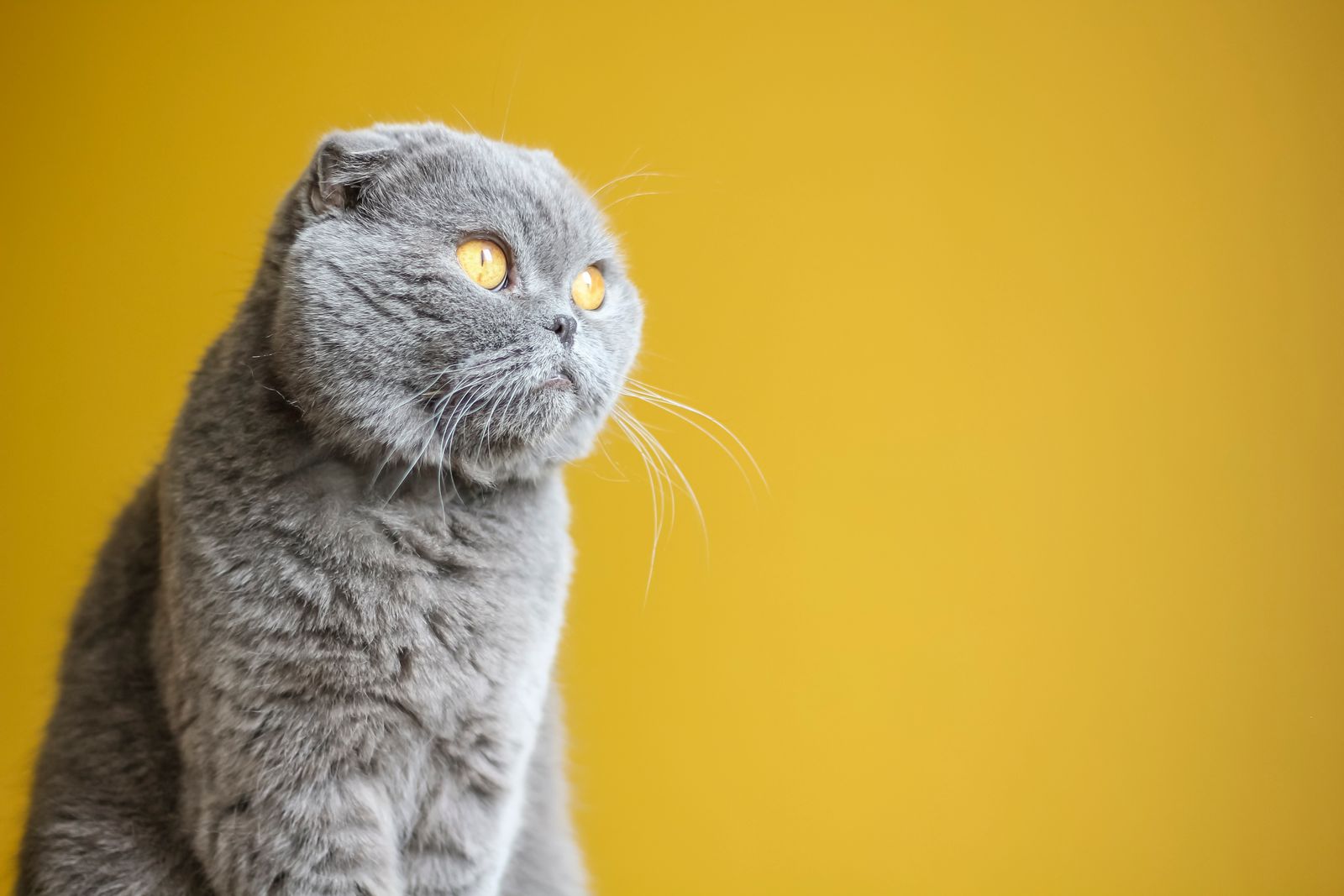
Scottish Fold snapshot
The International Cat Association, known as TICA, describes a cat defined by one feature: ears that fold forward and fit closely to the skull, giving a cap-like appearance and a look that TICA compares to an owl. Behind the ears, TICA describes big, round eyes opening up a rounded head, and a sturdy, padded, medium sized body with a solid feel. The breed began, in TICA's history, with a barn cat named Susie, found in Scotland in 1961 by shepherd William Ross, and every Scottish Fold today traces back to her. The Cat Fanciers' Association, known as the CFA, recognises the breed as well and allows any genetically possible color and pattern in its standard. Neither registry publishes a weight range or a lifespan for this breed in the material checked for this guide, so this snapshot does not invent one. What the registries and the genetics laboratory do publish, in unusual detail, is the inheritance behind the ears, and that is where this breed's snapshot has to spend its words.
| Size | Medium. TICA describes a medium sized cat with medium boning, and a sturdy body covered with padding that gives a solid feel. |
|---|---|
| Body | Round in every direction, in TICA's summary: round face, round eyes, and round body. The TICA breed standard calls the body medium and well rounded, and asks for an unchallenging, sweet tempered cat. |
| Ears | The breed marker. Folded forward and downward, small and tightly folded preferred in the standard, fitting close to the skull like a cap and exposing a rounded cranium. Straight ears in a kitten from a Fold litter mark a Scottish Straight, not a Fold. |
| Coat | Short hair and long hair varieties, in all colors and patterns. The shorthair coat in the TICA standard is plush, dense, and resilient. The CFA standard allows any genetically possible color and pattern, and any combination of them. |
| Eyes | Large, round, and wide open, with a sweet, open expression in the standard's words. TICA notes that all eye colors can be found and that copper is the most common. |
| Temperament | Sweet tempered and affectionate in the TICA standard. The TICA breed introduction describes an intelligent, inquisitive cat that is loyal to its family, follows people from room to room, and gets along with children and other family pets once properly introduced. |
| Health profile | Defined by one inherited trait. The fold variant affects cartilage throughout the body, not only in the ears, and produces osteochondrodysplasia with widely variable severity. Kidney cyst screening and heart screening sit behind the joint story. The genetics section below states the evidence exactly as the sources state it. |
Two snapshot facts shape everything that follows. The first is that the fold is not a surface feature. TICA calls the folded ear a spontaneous mutation carried by an incompletely dominant gene, meaning a gene whose single copy produces the visible trait while two copies produce a stronger effect. All Fold kittens are born with straight ears, and the ears of kittens that carry the variant begin to fold at around three to four weeks of age, in the UC Davis account. Roughly half of a litter from a folded parent and a straight-eared parent folds, in TICA's description, and the rest are Scottish Straights. The second fact is what that gene does beyond the ears, and it is important enough that this guide gives it its own section before the condition cards begin.
Health tendencies in Scottish Folds
Start with the genetics, because every later section depends on getting them right. The Universities Federation for Animal Welfare, known as UFAW, summarises the breed literature this way: osteochondrodysplasia is a developmental abnormality that affects cartilage throughout the body, it is what causes the abnormal ear shape in Scottish Folds, and its effects elsewhere in the body, especially in the limb bones, are much more serious. Gandolfi and colleagues identified the cause in 2016: a single base change, written c.1024G>T, in the TRPV4 gene, producing an amino acid substitution written p.V342F. TRPV4 encodes a calcium permeable ion channel involved in cartilage and bone development. The UC Davis Veterinary Genetics Laboratory, which offers the DNA test for the variant, states the results plainly. A cat with no copy, written N/N, has straight ears and cannot pass the variant on. A cat with one copy, written N/SF, has folded ears and may develop health issues related to cartilage and bone. A cat with two copies, written SF/SF, has folded ears and may have severe bone, cartilage, and joint issues. Inheritance is autosomal dominant, meaning one copy is enough for the trait, and UC Davis is explicit that a single copy is sufficient to affect cartilage development.
Severity is where honest variation lives, and this guide states it the way the sources do. UFAW, drawing on Malik and colleagues and the studies that followed them, records that all cats with folded ears develop osteochondrodysplasia to some extent. In cats with two copies, a progressive and crippling arthritis develops early in life, with bone abnormalities visible on X-rays from as young as seven weeks. In cats with one copy, the arthritis tends to progress more slowly, significant disease has been shown in some individuals from as young as six months, and the range runs from very mild disease to disease severe enough that a cat is euthanised for welfare reasons. UC Davis makes the same point in different words: the age of onset and the progression of the secondary effects are highly variable. Two kittens with the same genotype can live different joint stories. That is not a comforting fact or a frightening one. It is the reason this breed is planned around monitoring and wording rather than around a prediction.
The breeding and registry picture belongs in this section too, stated factually and without a verdict from this page. The CFA and TICA both recognise the breed and publish standards for it. The breeding recommendation recorded in the Gandolfi paper, and followed in the registries that recognise the breed, is to mate fold-eared cats only with normal-eared cats, to avoid producing kittens with two copies of the variant. Other bodies state a different position. UFAW records that the breed was excluded from the Governing Council of the Cat Fancy's list of recognised breeds by 1974, after crippling deformity of the limbs and tail was evident in the breed, and that the Fédération Internationale Féline does not recognise it either. UFAW also records the position in the underlying research, from Malik and colleagues onward, that cats with folded ears should not be bred from at all, whether they carry one copy or two. Those positions disagree with each other, and they are all on the record. An owner does not need this page to settle that debate. An owner does need to know it exists, because it explains why breeder records, genotype results, and registry papers for this breed carry more health information, and more gaps, than they do for most cats.
This section is general information about conditions a cat can develop. It is not veterinary advice and it is not a diagnosis of any cat. Signs listed here are possible signs owners may notice, and many of them have several causes. Only a veterinarian who examines your cat can say what a sign means.
Osteochondrodysplasia: the skeletal condition behind the fold
What it is
A developmental abnormality of cartilage and bone, inherited with the fold itself. Gandolfi and colleagues describe a dominantly inherited osteochondrodysplasia involving malformation in the distal forelimbs, the distal hindlimbs, and the tail, together with progressive joint destruction. Distal means the parts furthest from the body, the feet and lower legs. UFAW describes the mechanism in plain terms: cartilage forms the smooth surfaces of joints and plays a key role in bone growth in young animals, so abnormal cartilage development has far reaching effects on joint and bone formation. In severely affected cats, the tail bones are abnormally short and wide and can fuse together, the foot bones are distorted and widened, and new bone forms around the lower limb joints until a joint can fuse solid. This is the breed's defining condition, and it is present, to some degree, in every folded-ear cat.
Signs owners may notice
- A thick tail that feels stiff or inflexible, especially at its base, or a tail that is shorter than expected. Tail flexibility is the sign the breed literature returns to most often, because tail bones are among the first to change.
- Swollen wrist or ankle joints, feet that look small, wide, or misshapen, or toes that sit at odd angles.
- Lameness, an abnormal gait, or a cat that is reluctant to move, run, or jump.
- In a young kitten, slower or less confident movement than littermates, because severe disease can be present from the first months of life.
When it can be urgent
Osteochondrodysplasia itself usually progresses rather than striking suddenly. A cat that cannot walk, cries out when a limb or the tail is touched, or suddenly stops bearing weight on a leg needs prompt, same day veterinary care, whatever the underlying cause turns out to be. Sudden inability to use the back legs is an emergency presentation in any cat and should never be watched overnight.
How vets usually evaluate and treat it
In severely affected kittens, UFAW records that the bone abnormalities can be detected on X-rays from as young as seven weeks of age, well before an owner might read the signs at home, which is why breeder radiographs, where they exist, are worth asking for by name. UFAW states that the diagnosis can be confirmed with radiographs, which are X-rays, or with CT or MRI scans. Evaluation starts with a physical and orthopedic examination, feeling the tail and the lower limb joints and watching the cat move, and the radiographs show the bone shape and the new bone formation around the joints that characterise the condition. A DNA test for the TRPV4 variant can confirm how many copies of the fold mutation a cat carries, which informs risk, but it does not grade how severely an individual cat is affected. There is no cure. Care is the pain and mobility management described in the next card, with surgery recorded in the literature only in individual cases, such as procedures to fuse affected joints and remove bony growths, rather than as a general path.
Degenerative joint disease, osteoarthritis, and lifelong pain management
What it is
The joint disease that osteochondrodysplasia sets in motion. The Cornell Feline Health Center describes osteoarthritis, also called degenerative joint disease or DJD, as the most frequently diagnosed feline joint disorder, characterised by the erosion of cartilage, the smooth tissue that protects the ends of bones inside a joint. When that tissue wears away, bone ends come into contact, and the result is inflammation and pain of varying severity. In a general cat, DJD usually arrives with age, injury, or wear. In a Scottish Fold, UC Davis describes it as accelerated and progressive, driven by the abnormal cartilage and bone shape the fold variant produces. Malik and colleagues, in the account UFAW summarises, concluded that the abnormal forces created by the limb deformities produce secondary degenerative joint disease, with inflammation of the joint lining and abnormal bone development around the joint. The practical meaning is simple: for this breed, joint pain care is not a senior extra. It is a lifetime management task that can begin in a young adult cat.
Signs owners may notice
- Slowed down, reclusive behaviour. Cornell notes that an affected cat may seem lethargic and increasingly seek out comforting places to nap, and may hide its disability as a matter of instinct.
- Trouble hopping in and out of the litter box, and avoiding going up and down stairs.
- Apparent stiffness and a subtle reduction in activity as the earliest visible signs, with an altered gait as the disease progresses.
- Grooming less thoroughly, because joint pain makes the positions grooming requires uncomfortable, and in severe cases difficulty positioning to use the litter box at all.
When it can be urgent
Joint pain usually builds slowly, and its routine form is a scheduled vet visit, not an emergency. It becomes urgent when a cat stops eating, cannot get into the litter box, cannot walk, or shows a sudden marked worsening over hours rather than weeks. Those changes can also signal a different problem entirely, which is another reason they deserve same day advice.
How vets usually evaluate and treat it
Cornell describes a diagnosis built on a complete medical history and overall physical examination, followed by an orthopedic exam and X-rays of the joints, with the aim of confirming DJD and ruling out other causes of lameness. Cornell is direct that surgical procedures exist but that palliative treatment, relying largely on pain medication and attentive home care, is most often recommended, with the goal of relieving discomfort and providing a good quality of life. UFAW records the same shape of care for the Fold specifically: no cure, with pain relieving medication and chondroprotective treatments that may help alleviate pain, and a warning that long term use of pain medication can itself produce side effects in cats, which is why ongoing veterinary monitoring is part of the treatment rather than an optional extra. Weight matters here in a way owners control. Cornell notes that DJD is seen more frequently in overweight cats, because excess weight constantly exerts extra pressure on weight bearing joints, and a Fold's joints start with less margin than most.
Polycystic kidney disease (PKD)
What it is
An inherited disorder in which small, closed, fluid-filled sacs, called cysts, develop in the tissue of the kidney. Cornell explains that these cysts tend to multiply in number and grow in size over time, eventually overwhelming normal kidney tissue and often leading to kidney failure. The heritable form is caused by a variant in the PKD1 gene and is inherited as an autosomal dominant condition, so one copy is enough and there are no healthy carriers of that variant. It is most frequent in Persian cats and cats with Persian ancestry. The Scottish Fold enters this story through its breed history and through testing practice: the UC Davis Veterinary Genetics Laboratory lists the Scottish Fold explicitly among the breeds appropriate for PKD1 DNA testing, alongside the Persian and the Persian-derived breeds. That listing is the reason this card is on this page. It is a screening fact, and this guide states it as one, rather than as a claim that every Fold line carries the variant.
Signs owners may notice
- Often nothing for years. Cornell notes that the cysts are present at birth, though minuscule, and that clinical signs are most often recognised in cats of around seven years of age, sometimes younger or older.
- When signs arrive, they are the general signs of kidney disease: drinking and urinating more, diminished appetite and weight loss, nausea and vomiting, and lethargy.
- An unusually large kidney felt during a veterinary examination in advanced disease, when cysts have grown large and numerous.
When it can be urgent
PKD develops slowly, and a cyst finding is a monitoring plan, not an emergency. A cat with kidney disease that stops eating, vomits repeatedly, becomes suddenly weak or disoriented, or shows sudden vision changes needs prompt care, because those can signal the complications of failing kidneys rather than the cysts themselves.
How vets usually evaluate and treat it
Cornell is specific about the three records and what each one proves. A genetic test can show whether the cat carries the PKD1 variant, but it will not tell you how seriously the cat is affected. Ultrasound is the way to get a definitive diagnosis of cysts in the kidney itself, because cysts cannot be seen on a radiograph and usually cannot be felt individually. Kidney function is then followed with the blood and urine testing described in the kidney card pattern on this site: blood urea nitrogen, creatinine, and SDMA, urine concentration, and blood pressure. UC Davis adds the timing that makes screening useful: cysts in the heritable form present early, often before twelve months of age, while kidney failure usually occurs at a later age. There is no treatment that removes the cysts. Cornell describes management as the same approach used for kidney failure in general, a combination of diet control, fluid therapy, and medication prescribed by a veterinarian, with the goal of keeping the kidneys working as well as possible for as long as possible.
Hypertrophic cardiomyopathy (HCM): heart screening without a Fold DNA test
What it is
A condition that causes the muscular walls of the heart to thicken, decreasing the heart's efficiency. Cornell calls HCM the most common heart disease of cats, and this card is written with an honesty point stated up front. Cornell lists the breeds in which the condition is more prevalent, and the Scottish Fold is not on that list. The named cardiac gene mutations in Cornell's account belong to other breeds. There is no Scottish Fold HCM DNA test, and nothing in the primary sources for this guide supports selling you one. HCM belongs on this page for two narrower reasons. It occurs in cats generally, Folds included, and heart screening by echocardiogram is a routine part of the pre-breeding and health screening conversation for this breed. So the insurance question here is not a breed mutation question. It is a screening and chronic condition question, the same shape as in any cat, asked in a breed whose owners are already paying attention to inherited disease.
Signs owners may notice
- Often none at all. Cornell notes that many cats with HCM do not appear to be ill.
- Laboured or rapid breathing, open mouthed breathing, and lethargy, which occur when fluid accumulates in or around the lungs in congestive heart failure.
- Sudden hind limb pain or paralysis, when a blood clot formed in the heart blocks flow to the back legs.
How vets usually evaluate and treat it
HCM is diagnosed by echocardiography, an ultrasound of the heart, which in an affected cat shows the thickened walls and reduced volume of the left ventricle, the heart's main pumping chamber. Cornell adds that high blood pressure and hyperthyroidism, an overactive thyroid, can also thicken the heart wall and must be ruled out before HCM is diagnosed, and that chest X-rays and an electrocardiogram may also be recommended. There is no known cure. Cornell describes treatment goals as controlling heart rate, easing lung congestion, and preventing the blood clots that lead to thromboembolism, with medication given by mouth to stable patients or by injection in more serious situations. Many cats with no clinical signs live for years with only mildly compromised heart function, which is why a screening echocardiogram result and a symptomatic diagnosis are such different records.
Urinary stones, lower urinary tract disease, and blockage
What it is
Lower urinary tract disease is an umbrella term for disorders of the bladder and the urethra, the tube that carries urine out of the body. Cornell says surveys suggest it is the number one reason cats visit veterinary practices. It is a general cat condition, not a Fold condition, and it is on this page for a practical reason: a Scottish Fold with painful joints is a cat whose litter box habits deserve closer reading than most. Cornell notes that cats with joint pain may have trouble hopping in and out of the litter box, so a Fold that starts urinating outside the box may be showing joint pain, urinary pain, or both, and only an examination separates them. The dangerous end of this group is urethral obstruction, a blockage of the urethra, which Cornell calls a potentially life threatening condition and an absolute emergency. Its most common diagnosis at the non emergency end is feline idiopathic cystitis, a painful bladder inflammation whose cause is not identified after testing.
Signs owners may notice
- Difficult or painful urination, more frequent trips to the litter box, and crying out while urinating.
- Blood in the urine, urinating outside the litter box, and frequent licking of the genital area.
- With obstruction, repeated attempts that pass little or no urine, and a cat that becomes increasingly distressed.
- In a Fold, a change in how the cat enters the box at all: hesitating at a high sided box, or choosing a nearby floor spot, which can be a mobility sign wearing a urinary disguise.
How vets usually evaluate and treat it
Diagnosis begins with a physical examination and a urinalysis, a microscopic analysis of a urine sample, and can add blood work, X-rays, abdominal ultrasound, or a urine culture when the cause is unclear. Stones, also called uroliths, are diagnosed by X-ray or ultrasound. Cornell names the two most common types: struvite, which a special diet can sometimes dissolve, and calcium oxalate, which cannot be dissolved and more often needs flushing or surgery. Cornell also notes that cats that have formed stones are at increased risk of recurrence. An obstruction is usually relieved by catheterization, the passage of a narrow tube up the urethra under sedation or anesthesia, with intravenous fluids for dehydration and electrolyte imbalance, and hospitalisation that can range from a few days to longer in severe cases.
Dental disease: gingivitis, periodontitis, and tooth resorption
What it is
Diseases of the teeth and gums are common in cats of every breed, and Cornell names the three most common: gingivitis, periodontitis, and tooth resorption. Gingivitis is inflammation of the gums where they meet the teeth, beginning with plaque, a film that harbours bacteria. If gingivitis is not controlled, it can progress to periodontitis, in which the tissues that attach the tooth to the gums and bone are weakened and the damage cannot be reversed. Tooth resorption is a process in which tooth structure breaks down, and Cornell calls it the most common cause of tooth loss in cats, while noting that its cause is not known. None of this is Fold specific. It earns its card here because a cat already living with joint pain is a cat whose second, quieter source of pain is easy to miss, and because eating changes in a Fold are too often read as a joint or appetite story when the mouth is the problem.
Signs owners may notice
- Swollen, red, or bleeding gums where the gums meet the teeth, and bad breath.
- Hesitating to eat, turning the head unusually while eating, preferring soft food, or dropping food.
- Drooling, and a cat that stops eating or becomes irritable, which Cornell lists among the signs of dental pain, including pain from tooth resorption.
- A pinkish defect in a tooth at the gum line, which Cornell describes as the usual first visible sign of tooth resorption, in a tooth that is already significantly damaged.
When it can be urgent
Dental disease usually develops slowly, but a cat that cannot eat because of mouth pain needs prompt care rather than a long wait. Cornell notes that dental disease can cause a cat to stop eating, which leads to further health problems. A cat that has stopped eating entirely should be seen quickly, whatever the cause turns out to be.
How vets usually evaluate and treat it
Cornell explains that a complete evaluation of periodontitis involves probing the gums and examining X-rays of the head and jaw, which require anesthesia. The same is true for tooth resorption, where diagnosis involves examining and probing the lesions and reviewing X-rays under anesthesia. Treatment for periodontitis centres on removing plaque and mineral buildup by scaling and polishing the teeth while trying to save them, with extraction of teeth, sometimes numerous teeth, in extreme cases. For painful tooth resorption in which lesions extend into the crown of the tooth, Cornell says it is best to remove the tooth. Gingivitis itself is usually reversible, and Cornell identifies regular removal of plaque by tooth brushing, using only products designed for cats, as the way to prevent it.
Policy decisions that matter for a Scottish Fold
For most breeds, a policy is judged against a list of conditions. For a Scottish Fold, it is judged against one inherited condition and the decades of wording around it: whether the condition is covered at all, when the insurer says it began, and whether its care is still covered in year ten. Read these rows in that order. The first three rows decide more of this breed's insurance value than the other five combined.
One distinction runs through several rows and is worth naming before the table, because Fold owners meet it more often than most. A test ordered on a healthy cat with no recorded signs is screening: a genotype result, a kidney ultrasound done to look for cysts, an echocardiogram done to check a quiet heart. A test ordered because something was found, felt, heard, or logged is diagnosis. Most accident and illness policies treat those two categories differently, paying for diagnosis and treatment of illness while leaving screening to the owner or the breeder. The same radiograph, ultrasound, or heart scan can fall on either side of that line depending on the reason written in the record, so the reason matters. When a vet orders a test for your Fold, ask what prompted it and make sure that reason is in the notes.
| Policy feature | Why it matters for a Scottish Fold | Stronger wording looks like | Watch out for |
|---|---|---|---|
| Hereditary condition wording | Osteochondrodysplasia is inherited by definition. A hereditary exclusion is not a side clause in this breed. It is the main clause. | Hereditary and congenital conditions are covered, and osteochondrodysplasia is confirmed as a covered condition in writing when you ask by name. | A blanket exclusion of hereditary or congenital conditions, or a breed specific exclusion list that names cartilage, joint, or fold related conditions. |
| Pre-existing definition and start date | The cause of this breed's central condition is present from birth, and small signs can be recorded years before a diagnosis. When the insurer says the condition began decides almost every joint claim. | The definition turns on signs, symptoms, or diagnosis, is stated plainly, and the insurer confirms in writing how it would date osteochondrodysplasia in a cat enrolled as a kitten with a clean record. | Wording that reaches back to any note of stiffness, gait change, or tail finding before enrollment, or that treats a breed trait itself as a pre-existing condition. |
| Chronic pain care at renewal | Joint care here is medication, rechecks, and imaging across a lifetime, not a single treated episode. | A covered chronic condition stays covered at every renewal, including its medication, recheck visits, and monitoring imaging, while enrollment continues. | Renewal wording that caps a chronic condition, ends it at renewal, or reclassifies it as pre-existing each year, and per-condition limits a lifetime condition would exhaust early. |
| Diagnostics and imaging classification | Radiographs confirm the skeletal condition, ultrasound confirms kidney cysts and screens the heart, and each test can be classed as screening or as diagnosis depending on why it was ordered. | Imaging ordered to investigate recorded signs or to monitor a covered condition is covered as diagnostics, and the screening versus diagnostic line is stated in the policy. | Wording that treats every radiograph or ultrasound in this breed as screening, or that excludes imaging for hereditary conditions while covering the conditions themselves. |
| Screening records and breeder paperwork | A Fold kitten can arrive with a genotype result, parental PKD1 results, and screening reports. Those papers help the cat and can also be quoted at claim time. | The insurer explains, in writing, how breeder screening records supplied at enrollment are held and whether a clear screening result can ever be used against a later claim. | Silence on the point. File the papers, ask the question before you enroll, and keep the answer with the policy rather than discovering the rule during a kidney or joint claim. |
| Kidney and heart chronic wording | PKD, if cysts are found, and HCM, if it is diagnosed, are both managed and monitored for years rather than cured. | Chronic kidney and cardiac conditions, once covered, stay covered at renewal with repeat blood tests, urine tests, blood pressure checks, and echocardiograms reimbursable as monitoring. | Wording that covers a diagnosis visit but leaves the years of monitoring tests outside the covered categories, or caps one organ system separately. |
| Dental illness terms | Gingivitis, periodontitis, and tooth resorption are common in cats, and their care can involve anesthesia, dental X-rays, and removal of teeth. | Dental illness is included, with anesthesia and extractions for a painful tooth condition covered. | Dental disease excluded entirely, dental cover limited to injury only, or a cleaning history requirement you have already failed. |
| Deductible type | Steady joint monitoring produces claims across a year, every year, often alongside kidney, heart, or dental claims in the same year. | An annual deductible that is met once, after which eligible claims across conditions are reimbursed. | A per-condition deductible that restarts the counting for the joints, the kidneys, the heart, and the mouth separately, in a breed where all four can run at once. |
Life stages: kitten, adult, and senior
Kitten
The kitten stage carries more paper in this breed than in most. Ask the breeder for the kitten's own TRPV4 genotype result if one exists, and for both parents' results: a folded parent bred to a straight-eared parent is the pairing the breed literature recommends, and a kitten's copy count is real information about risk, even though it cannot predict severity. Ask for the parents' PKD1 results as well, because UC Davis lists this breed for that test, and for any joint radiographs or kidney ultrasound reports the breeder holds. File all of it. Enrolling in this stage, before any stiffness, gait, tail, kidney, or heart note exists in a veterinary record, is the single strongest paperwork decision available to a Fold owner. Keep every kitten visit record, including the weights and any comment about movement or tail flexibility, whether the comment is reassuring or not. Start the mobility log described below in this stage, while normal is easy to describe, because a baseline written when a kitten plays freely is what makes a later change visible.
Adult
Adulthood is where the variable onset in the sources becomes a household routine. The joint task is observation: stairs taken one at a time, jumps that get lower or get planned with a pause, play sessions that end sooner, a tail that seems thicker or less willing to bend, grooming that leaves the back and hips unfinished. Cornell's DJD account is the reading list for this stage, because its earliest signs are exactly these small reductions in activity rather than a dramatic limp. The insurance work of this stage is rhythm: keep the log, take dated phone video of your cat walking and jumping when something changes, bring the log to recheck visits, and file claims as they happen so that radiographs, medication, and monitoring build a continuous covered record rather than a scattered one. Weigh the cat regularly and write the weights down next to the mobility notes. Extra weight loads joints that already have less margin, and a documented stable weight is useful evidence of attentive care.
Senior
The senior stage is where the monitoring threads run together. Joint disease that began as stiffness is now managed daily, with medication, rechecks, and home adjustments such as low sided litter boxes, steps to favourite sleeping places, and food and water that do not require a jump to reach. Kidney monitoring joins the routine, with blood tests, urine tests, and blood pressure checks on a rhythm the vet sets, whether the cat carries a PKD1 finding or is simply an older cat. Dental needs accumulate. Review the policy at each renewal for premium increases, age based changes, and any reduction in coverage at advanced ages, and confirm at every renewal that the joint condition and its pain care are still covered on the same terms. A plan that quietly thins out exactly when a Fold needs steady, multi year care fails the purpose it was bought for.
A claim, step by step: stiffness that turns into a diagnosis
The example below is hypothetical. It is not a real cat, a real claim, or a guarantee of how any insurer will decide. It follows an adult Scottish Fold from the first small changes at home, through a veterinary examination and radiographs, to a diagnosis of osteochondrodysplasia with degenerative joint disease, a pain management plan, and the renewal questions that follow, because that full arc is what hereditary and chronic wording has to handle in this breed. Pet insurance generally reimburses after you pay the vet, as explained in how pet insurance works.
Small changes, written down at home
Over one autumn, the owner notices the cat pausing before jumping onto the bed, taking the stairs one step at a time, and leaving the fur along her back less well groomed than it used to be. None of it looks like an emergency, and all of it is in the mobility log with dates, because the log habit started in kittenhood. Cornell identifies exactly this pattern, stiffness and a subtle reduction in activity, as the earliest visible sign of degenerative joint disease. The log does not diagnose anything. It turns a vague feeling that she is slowing down into a dated record a vet can act on.
The examination and the radiographs
At the clinic, the vet takes a full history, performs a physical and orthopedic examination, and feels thickened, less flexible joints and a tail that does not bend as a normal tail bends. Radiographs of the lower limbs and tail show distorted, widened foot bones and new bone formation around the ankle joints. The record names osteochondrodysplasia with secondary degenerative joint disease. The owner keeps the full record, the radiograph report, and every invoice, because in this breed the wording of the first diagnostic record is what later claims stand on.
Checking the policy dates, and the hereditary question
In this example the policy was started when the cat was a kitten, the waiting periods ended long ago, and no earlier record mentions stiffness, gait, tail findings, or joint swelling. The hereditary wording was asked about in writing before enrollment, and the answer confirming that osteochondrodysplasia is a covered condition is filed with the policy. Contrast it with the harder version of the same story, where a routine kitten visit note from before enrollment reads tail slightly stiff, monitor. That one line is the kind of record that turns a later joint claim into an argument about when the condition began.
The pain plan, and the first claim
The vet builds a palliative plan, in Cornell's pattern: pain medication, attentive home care, weight control, and rechecks to watch both comfort and the side effects that long term pain medication can produce in cats. The claim is filed with the examination record, the radiograph report, and the itemized invoices, with the dates the home signs were first logged stated clearly. Each eligible bill moves through the same mechanics described in what pet insurance costs and why. Charges count against the deductible first, the policy's reimbursement rate applies to eligible charges after that, and totals are tracked against the annual limit.
Monitoring across the year
Care settles into rhythm: recheck visits, medication adjustments, a repeat radiograph when the vet wants to see whether the new bone formation has progressed, and log entries that show the cat jumping more comfortably after the plan starts. Each of those items is a wording test of its own. Monitoring imaging and long term medication for a covered chronic condition are the categories some policies reimburse and others quietly treat as routine care outside the cover. In this example they were confirmed as covered categories in the pre-purchase questions, and the confirmations are kept with the policy.
Renewal, progression, and where claims get denied
At renewal, the decisive question is whether a progressive condition stays covered on the same terms now that it is named in the record. Under wording that keeps a covered chronic condition covered, the next year's medication, rechecks, and imaging are filed the same way. The denial pressure points in this breed story are a hereditary exclusion discovered after the first claim, a pre-enrollment note about the tail or gait used to date the condition before the policy began, progression treated as a new condition with a new deductible, monitoring imaging denied as screening, and long term medication questioned at renewal. Each of those is a clause question, and each can be asked in writing before you buy, not after the first radiograph.
What drives the premium for a Scottish Fold
This page publishes no prices, because none of its primary sources do. What it can do is name the factors an owner can act on, and for this breed the first factor is the one most owners cannot change after the fact.
- Enrollment age and a clean joint record. In this breed, early enrollment is not a small timing refinement. A kitten enrolled before any stiffness, gait, tail, or joint note exists carries a clean record into the years when a progressive condition may appear. Waiting until the first limp means the condition most likely to need years of care may already be on file.
- Hereditary wording quality. A policy whose hereditary wording genuinely covers osteochondrodysplasia and its joint disease, with chronic care that survives renewal, protects the costs this breed actually generates. A cheaper looking policy with a hereditary exclusion protects against a different, smaller list.
- The age curve of a progressive condition. Premiums generally rise as cats age, and Fold joint care is built to grow with age at the same time. Judge a plan across the senior years, when medication, rechecks, imaging, kidney monitoring, and dental work can all run together, rather than by the kitten year alone.
- Home geography and care setting. Where you live, and whether joint, kidney, or heart monitoring happens at a general practice or a referral hospital, shape the bills a premium is priced against. Emergency urinary care adds a setting this breed's owners should not price at zero.
- Deductible type in a multi condition breed. An annual deductible is met once. A per-condition deductible restarts for the joints, the kidneys, the heart, and the mouth separately, and in a breed where several chronic threads can run in one year, that distinction changes the real value of the cover every year.
For the general mechanics behind these drivers, read what pet insurance costs and why, what pet insurance covers, and the comparison method in how to compare plans.
Before you enroll a Scottish Fold
Do this work while the cat is in front of you, healthy or not, because several items depend on paperwork that exists today and may not be easy to reconstruct later.
- Ask the insurer, in writing, whether osteochondrodysplasia is a covered condition under this policy, by that name, and whether the degenerative joint disease that follows it is covered as well.
- Ask how the policy dates the start of a condition whose genetic cause is present from birth, and how it would treat a note about stiffness, gait, tail flexibility, or joint swelling recorded before enrollment.
- Confirm that a covered chronic condition stays covered at every renewal, including its pain medication, recheck visits, and repeat imaging, and ask whether there is a per-condition limit.
- Ask how the policy classifies radiographs, ultrasound, and echocardiograms ordered for recorded signs or for monitoring a covered condition, versus the same tests ordered as screening on a healthy cat.
- Gather the breeder records before you buy or adopt: the kitten's TRPV4 genotype result if one exists, both parents' copy counts and pairing, both parents' PKD1 results, and any joint radiographs or kidney ultrasound reports. File them yourself rather than assuming they will be available later.
- Collect your cat's complete existing veterinary record, and read it for joint, tail, kidney, heart, urinary, and dental notes before you enroll, because the record is what a claim will be judged against.
- Confirm the exact waiting periods for illness, and in particular whether any longer orthopedic or joint waiting period applies, from waiting periods explained.
- Ask whether dental illness is covered, including anesthesia, dental X-rays, scaling, and removal of painful teeth, or whether dental cover is limited to injury.
- Start the joint comfort and mobility log today, while things are normal, and keep the insurer's written answers with the policy and the breeder file.
Practical tool: the joint comfort and mobility log
Scottish Folds do not announce joint pain. They subtract. A jump disappears, a staircase gets slower, a grooming routine quietly shortens, and each change is small enough to explain away on the day it happens. Cornell's account of degenerative joint disease makes the pattern explicit: the earliest visible sign is stiffness and a subtle reduction in activity, and affected cats may hide their disability as a matter of instinct. A written log defeats that subtlety, because a change that is deniable in memory is undeniable across four dated lines. Keep it on paper or in a notes app, one line a week in ordinary times and one line a day whenever something seems different, and bring it to every recheck. It is also the most useful claim document a Fold owner can own, because it dates the first sign honestly, from your own records, instead of leaving the date to be argued from a vet note.
| Date | Stairs | Jumping up and down | Play | Litter box | Grooming and handling | Notes for the vet |
|---|---|---|---|---|---|---|
| Week of (date) | Normal / slower / one step at a time / avoiding | Normal / lower targets / hesitates / stopped jumping down | Normal / shorter sessions / less interest | Steps in easily / hesitates / accidents beside the box | Full groom / back and hips unfinished / resists tail being lifted or touched | Anything new: a thicker feeling tail, a warm or swollen joint, a change in gait, weight this week |
| Week of (date) | ||||||
| Week of (date) |
Three entries matter most. The first is the baseline, written while the cat is young and moving freely, because without it there is nothing to compare against. The second is the first change, however small, because that date is the honest start of the story a vet and an insurer will later ask about. The third is the entry after any treatment starts, because a log that shows a cat jumping more comfortably on a pain plan is evidence that the plan is working, and evidence that it needs to continue. Add a dated phone video of your cat walking, climbing, and jumping once a month. Thirty seconds of video shows a gait change more clearly than any sentence in this guide or in your log.
Copy-ready questions to ask an insurer about a Scottish Fold
Paste these into an email or chat with the insurer, and keep the written answers with the policy.
- Is osteochondrodysplasia, the inherited cartilage and bone condition of the Scottish Fold, a covered condition under this policy? Is the degenerative joint disease that follows it covered as well?
- How does this policy date the start of a condition whose genetic cause is present from birth? Would a record of folded ears, or a note about tail flexibility or stiffness from a kitten examination, make the condition pre-existing?
- If my cat is diagnosed with a covered chronic joint condition, do the pain medication, recheck visits, and repeat X-rays for that condition stay covered at every renewal, for as long as I stay enrolled?
- How are radiographs, kidney ultrasound, and echocardiograms classified when a veterinarian orders them for recorded signs or to monitor a covered condition, and how does that differ from the same tests ordered as screening?
- Is there a per-condition limit or a per-condition deductible that a lifelong joint condition would be charged against separately from kidney, heart, urinary, or dental claims?
- How would breeder screening records I provide at enrollment, such as a TRPV4 genotype result and the parents' PKD1 results, be used if I later file a joint or kidney claim?
Questions Scottish Fold owners ask
Does pet insurance cover osteochondrodysplasia in a Scottish Fold?
It can, and the deciding words are the hereditary and congenital wording and the pre-existing definition in the sample policy. Osteochondrodysplasia is inherited, it is present from early life, and its signs can be recorded years before a claim. A policy that excludes hereditary conditions, or that treats any sign noted before enrollment as the start of the condition, can leave the breed's central condition outside the cover. Ask in writing whether osteochondrodysplasia and the degenerative joint disease that follows it are covered conditions, and how the policy dates the start of a condition whose cause is present from birth.
Is osteochondrodysplasia pre-existing in every Scottish Fold, since every folded cat carries the gene?
The gene is present from birth in every folded-ear cat, and the veterinary sources are clear that all folded cats develop the condition to some extent. Whether an insurer treats that as pre-existing is a wording question, not a medical one, and policies answer it differently. Some definitions turn on signs or symptoms recorded before enrollment, and others turn on when a condition was diagnosed or reasonably known. That is why the question has to be asked in writing, for this breed and this condition by name, before you pay a premium.
Will a policy pay for pain medication and repeat X-rays over my Fold's whole life?
That is the renewal and chronic care question, and it matters more in this breed than in almost any other. Joint care in a Scottish Fold is not one claim. It is medication, recheck visits, and repeat imaging across years. Confirm that a covered chronic condition stays covered at every renewal, that ongoing pain medication for a covered condition is a reimbursable category, and that follow-up X-rays ordered to monitor a covered joint condition are covered as diagnostics rather than denied as routine care.
Does pet insurance cover PKD screening for a Scottish Fold kitten?
Usually not as screening, and the distinction matters. The UC Davis Veterinary Genetics Laboratory lists the Scottish Fold among the breeds appropriate for PKD1 DNA testing, and ultrasound can show kidney cysts directly. Most accident and illness policies pay for diagnosis and treatment of illness, not for screening tests on a healthy cat, and breeder screening is normally the breeder's record to hand over, not a claim. Ask for the parents' PKD1 results and any kidney ultrasound reports before you buy a kitten, keep them with the policy, and ask the insurer how a cyst finding after enrollment would be treated.
My Scottish Fold seems comfortable and playful. Why think about insurance now?
Because comfort today is exactly what the sources describe in young heterozygous cats, and it is not a promise about later years. The UC Davis Veterinary Genetics Laboratory notes that the age of onset and the progression of the fold mutation's effects on cartilage and bone are highly variable. Signs can be subtle when they arrive, and a single vet note about stiffness, a thick tail, or reduced jumping can become the date an insurer uses. Enrolling while the record is clean, and keeping a dated mobility log from kittenhood, protects both the cat's care options and the paperwork those options depend on.
When is the best time to enroll a Scottish Fold?
As a kitten, before any note about stiffness, gait, tail flexibility, jumping, or joint swelling enters the medical record, and before any kidney cyst or heart finding is written down. In most breeds, early enrollment is a general precaution. In this breed it is the central timing decision, because the condition the policy most needs to cover is inherited, progressive, and documented in small signs long before it is diagnosed by name. Enrolling young clears the waiting periods while the record is clean and puts the policy in place before the first radiograph is ever taken.
Sources and further reading
Sources checked on November 6, 2026. Breed facts are drawn from the registries named in the text. Clinical descriptions come from the veterinary sources listed here. Where the sources disagree or stay silent, the guide says so in the text rather than filling the gap.
- The International Cat Association, Scottish Fold breed introduction: the owl-like folded ear, Susie and the breed's 1961 origin, outcross history, temperament, and the proportion of a litter that folds.
- The International Cat Association, Scottish Fold breed standard (revised April 2024): ears folded forward and downward with a small, tightly folded ear preferred; sweet tempered, affectionate character; tail and body disqualifications that reflect the breed's skeletal risks.
- Cat Fanciers' Association, Scottish Fold breed page: registry recognition and the colour standard allowing any genetically possible color and pattern.
- UC Davis Veterinary Genetics Laboratory, Scottish Fold test: the TRPV4 variant, the N/N, N/SF, and SF/SF result meanings, onset and progression variability, and the signs of the condition in young kittens.
- UC Davis Veterinary Genetics Laboratory, PKD1 test (cats): the heritable PKD1 form, its breed list including the Scottish Fold, cyst timing, and result meanings.
- Universities Federation for Animal Welfare, Scottish Fold osteochondrodysplasia: the condition's mechanism and signs, the evidence that all folded cats develop it, the severity range, and the registry and breeding positions recorded in the literature.
- Gandolfi B, et al. "A dominant TRPV4 variant underlies osteochondrodysplasia in Scottish fold cats." Osteoarthritis and Cartilage, 2016: identification of the c.1024G>T variant in TRPV4, the skeletal phenotype, and the recommendation to mate fold-eared cats only with normal-eared cats.
- Cornell Feline Health Center, Is Your Cat Slowing Down?: degenerative joint disease as the most frequently diagnosed feline joint disorder, its subtle signs, diagnosis, and palliative care.
- Cornell Feline Health Center, Polycystic Kidney Disease: cyst development, the signs of kidney failure, ultrasound as the definitive diagnosis, and management.
- Cornell Feline Health Center, Chronic Kidney Disease: the blood, urine, and blood pressure testing used to stage and monitor kidney function.
- Cornell Feline Health Center, Hypertrophic Cardiomyopathy: HCM as the most common heart disease of cats, its breed list, echocardiographic diagnosis, clot risk, and treatment goals.
- Cornell Feline Health Center, Feline Lower Urinary Tract Disease: urinary signs, the two common stone types, and obstruction as an absolute emergency.
- Cornell Feline Health Center, Feline Dental Disease: gingivitis, periodontitis, and tooth resorption, their signs, and their evaluation and treatment under anesthesia.