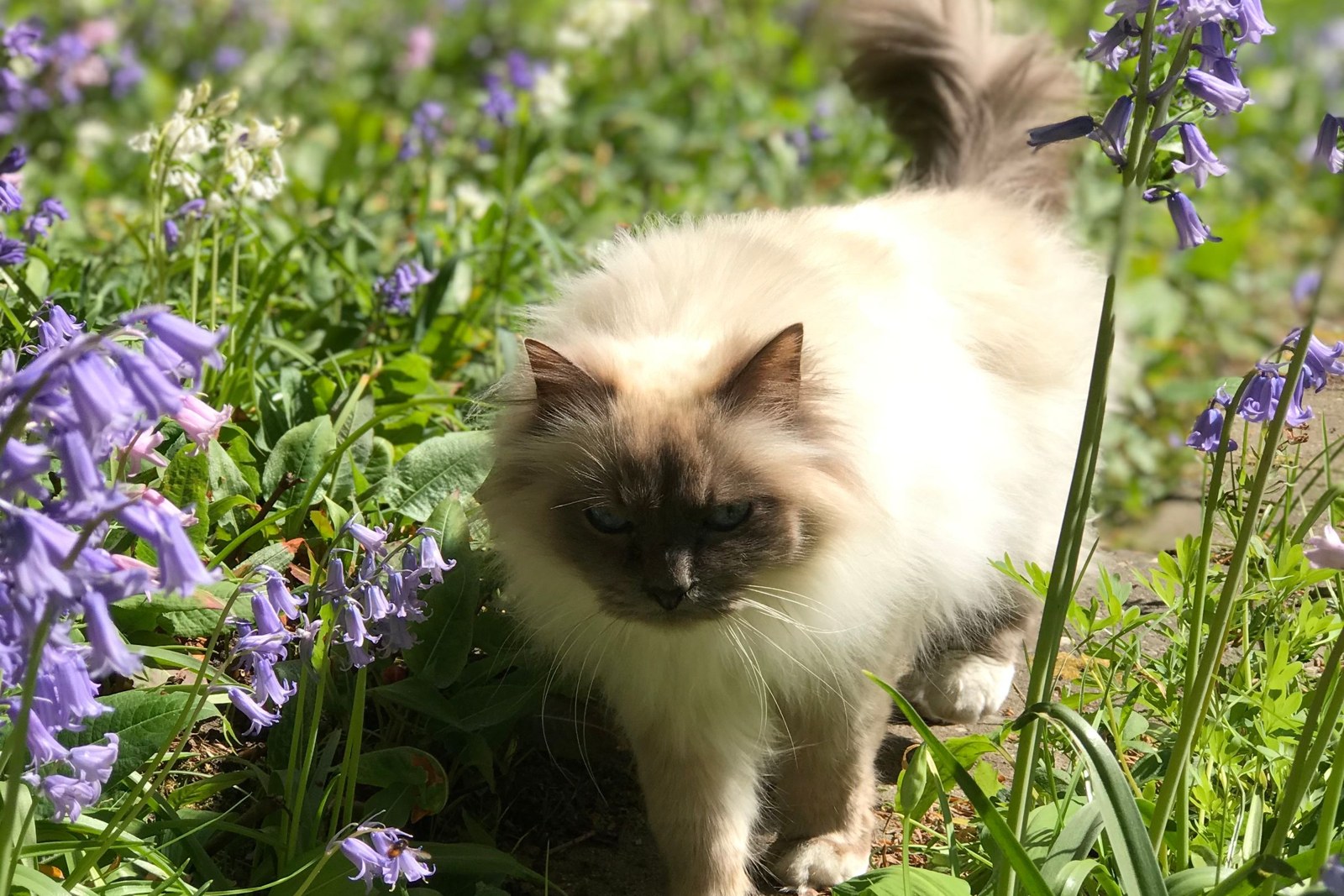
Birman snapshot
The International Cat Association, known as TICA, describes the Birman as a gentle, affectionate, playful cat, a semi-longhaired pointed cat with white feet that tends to follow its people from room to room. The CFA's breed history traces the modern Birman to France, where the breed was first recognized in the 1920s, and records its arrival in the United States in the 1960s. Both registries describe the same physical cat: medium to large, long and heavily boned, somewhat stocky, with males larger than females, a broad rounded head, a medium length Roman nose, and eyes that are always blue, with the deeper blue preferred.
| Size | Medium to large. TICA describes a medium to large, long, heavily boned cat, somewhat stocky in build, with males larger than females. |
|---|---|
| Body | Strong and substantial rather than elegant. The CFA calls the ideal Birman a large, long, stocky cat, with a broad, rounded head and a distinctive medium length Roman nose. |
| Coat | Semi-long, silky, and single, with a texture that tends not to mat or tangle. The body coat is pale with a golden hue, and the points carry the colour. |
| Color | Pointed, in seal, chocolate, blue, lilac, and other pointed colours depending on the registry. All four feet are white: gloves on the front feet and laces that extend up the back of the hind legs. The chin is the colour of the mask, never white. |
| Eyes | Always blue, and the deeper the blue the better, in TICA's description. The CFA describes blue, almost round eyes on a strong, broad head. |
| Temperament | Gentle, affectionate, and people oriented. TICA calls the Birman a quiet cat that loves people and follows them around, and the CFA describes a middle of the road temperament, neither extreme nor aloof. |
| Lifespan | TICA's breed material notes that Birmans are generally healthy and can live up to 15-plus years. A long life means a long senior stage, which is where the kidney monitoring in this guide does its work. |
| Health profile | A screening profile rather than a disease list. UC Davis names the breed among those at increased risk of hypertrophic cardiomyopathy. The documented Persian outcross in the breed's rebuilding raises the polycystic kidney disease screening question. A long term study found a significantly higher FIP risk than in mixed breed cats. Type B blood is comparatively common in the breed. |
Two snapshot facts shape the insurance picture. The first is the identification fact, because it decides which breed's health file you are even reading. A Birman and a Ragdoll are both blue eyed colourpoint cats with soft coats, and they are confused constantly, in photos, in adverts, and in paperwork. The CFA's guidance on pointed cats is exact: a Ragdoll has a white chin, while a Birman's chin is the same colour as its mask, and a white chin spot on a Birman is a disqualification. The white gloves complete the check. A cat with a white chin and no gloves is not this breed, whatever a listing calls it, and its insurance comparison should be read in the Ragdoll guide instead, because the two breeds carry different health files.
The second fact is the bottleneck in the breed's history. The CFA records that after the Second World War, possibly only one breeding pair of Birmans remained, and that outcrosses were necessary to rebuild the breed, almost certainly to Persians. TICA's breed material tells the same story. A rebuilt breed is not a defective breed, and the registries describe today's Birman as generally healthy. But the outcross is the reason a kidney question that belongs most famously to the Persian is asked, honestly and without exaggeration, in this guide. It is also why the screening and records card later in this guide asks for the breeder's kidney screening paperwork by name.
Health tendencies in Birmans
The conditions below are the ones the primary sources for this guide actually support for this breed, and each card says which kind of support it has. Two are named breed risks in university sources: hypertrophic cardiomyopathy, where UC Davis lists the Birman directly, and feline infectious peritonitis, where a peer-reviewed breed study names it. One is a screening question raised by the breed's documented history rather than a proven prevalence: polycystic kidney disease, inherited from the Persian side of the breed's rebuilding. Two are the general conditions of older cats and of the male urinary tract, included because a cat that can live past fifteen will meet the senior risks on schedule. The last card is not a disease at all. It is the breed's blood type quirk, and it is here because it changes what should be written in the cat's file long before any emergency. These are tendencies and questions to plan around, not predictions about an individual cat.
This section is general information about conditions a cat can develop. It is not veterinary advice and it is not a diagnosis of any cat. Signs listed here are possible signs owners may notice, and many of them have several causes. Only a veterinarian who examines your cat can say what a sign means.
A note on what is not claimed here, because the limits are part of the information. No primary source for this guide publishes a Birman prevalence figure for polycystic kidney disease, and none is quoted on this page: the PKD card is a screening question grounded in the breed's documented Persian outcross, and it is labelled that way in the card itself. No source names a Birman genetic mutation for hypertrophic cardiomyopathy or offers a Birman DNA test for it, so this guide recommends imaging and records, not a swab. The FIP finding comes from one hospital's records over sixteen years, and it is carried as a study result, not as a rate for your cat. And other websites' longer Birman disease lists were checked against these sources and left out where the sources did not support them. If your own cat is diagnosed with any condition, that diagnosis governs that cat's care and claims, whatever any breed list says.
Hypertrophic cardiomyopathy (HCM)
What it is
A disease in which the muscle of the heart wall, particularly the main pumping chamber, thickens and stiffens, so the heart fills and pumps less efficiently. The UC Davis School of Veterinary Medicine calls hypertrophic cardiomyopathy the most common cardiac disease in cats, and names the Birman among the breeds at increased risk, alongside breeds such as the Maine Coon and the Ragdoll. UC Davis also sets the limit of the genetic story honestly: breed specific genetic mutations have been identified in only a small number of breeds, and in the vast majority of cats the genetic cause is unknown. There is no Birman DNA test in the sources for this guide that settles whether an individual cat will develop this disease, which is why the screening tool for this breed is imaging, not a swab.
Signs owners may notice
- Often none at all in the early and middle stages. The Cornell Feline Health Center notes that many cats with this disease show no outward signs, and a heart murmur heard at a routine examination is frequently the first indication.
- Rapid or laboured breathing, and breathing with visible effort at rest, as fluid builds up when the heart begins to fail.
- Lethargy, reduced appetite, and a cat that withdraws from its usual routines.
- Sudden pain and weakness or paralysis in the hind legs, which can follow a blood clot thrown from the heart, and which Cornell describes as an acute event.
How vets usually evaluate and treat it
The Cornell Feline Health Center describes the workup as a physical examination including careful listening to the heart, with chest imaging and blood pressure measurement as supporting steps, and UC Davis confirms that the definitive diagnosis is made by echocardiography, an ultrasound scan of the heart that measures the thickness of its walls directly. There is no cure. Treatment is supportive and is aimed at helping the heart work with less strain, controlling fluid build up, and reducing clot risk, with medication choices and monitoring intervals set by the treating vet or a veterinary cardiologist. For the insurance file, the important artefact is the echocardiogram report itself, dated, because it is the document every later heart claim will be read against. Our dedicated guide to HCM in cats covers the condition in full.
Polycystic kidney disease (PKD): the screening question
What it is
An inherited disorder in which fluid filled cysts form in the kidneys, present from birth and enlarging over time, gradually replacing working kidney tissue. Read this card at the level the evidence supports. The Cornell Feline Health Center describes polycystic kidney disease as occurring most frequently in Persians, and occasionally in a small number of other named breeds, and Cornell does not name the Birman. The UC Davis Veterinary Genetics Laboratory describes the heritable form as commonly seen in Persians and in cats with Persian ancestry, and adds the sentence this card rests on: any breed that has used Persians in its foundation or propagation should have concerns for the PKD1 form of the disease. The Birman has exactly that history, documented by both registries. So this is not a claim that PKD is common in Birmans. It is the narrower, honest claim that the screening question is a reasonable one to ask a breeder and a vet, and an unreasonable one to skip on the assumption that it belongs only to Persians.
Signs owners may notice
- Usually none while the cat is young. Cornell notes the cysts are present at birth but the signs, when they come, usually resemble kidney disease in general.
- Increased drinking and increased urination as kidney function declines.
- Reduced appetite, weight loss, and lethargy in a middle aged or older cat.
- Signs most often become recognizable in midlife rather than in kittenhood, which is why the screening conversation happens years before any sign would.
How vets usually evaluate and treat it
Cornell is direct that the only way to reach a definitive diagnosis is ultrasound, which can identify cysts in a young cat, in some cases as young as six months. A PKD1 DNA test exists through laboratories such as the UC Davis Veterinary Genetics Laboratory, and Cornell adds the caution that matters for how much weight a result can carry: a genetic test identifies the mutation, but it will not tell you how severe the disease will be, and the laboratory's own list of breeds appropriate for the PKD1 test does not include the Birman. In practice the screening record for this breed is therefore usually an ultrasound report, with any DNA paperwork filed alongside it. There is no treatment that removes the cysts. Management follows the pattern Cornell describes for the resulting kidney disease: dietary control, fluid therapy, and medications as the vet directs. See also our guide to kidney disease in cats.
Feline infectious peritonitis (FIP)
What it is
A viral disease that develops when certain strains of feline coronavirus, a common and usually mild intestinal virus of cats, mutate inside an individual cat and trigger a severe inflammatory disease. This card is written carefully because the evidence needs care. In a peer-reviewed study of sixteen years of records at a university teaching hospital, published in the Journal of Feline Medicine and Surgery, Birmans were among a small group of breeds found to be at significantly higher risk of FIP than mixed breed cats, with young cats at the highest risk. That is a population finding from one hospital's records, not a statement that any individual Birman is likely to develop FIP, and this guide carries it at exactly that weight: a reason for awareness and for reading one policy clause closely, not a reason for alarm.
Signs owners may notice
- The first signs are nonspecific, in Cornell's description: loss of appetite, weight loss, depression, and a fever that does not settle.
- In the wet, or effusive, form, fluid builds up in the abdomen or the chest, producing a swollen belly or laboured breathing.
- In the dry form, inflammatory lesions develop in organs including the eyes and the nervous system, so eye changes or unsteady, abnormal movement can be the presenting signs.
- A kitten or young adult cat that fails to thrive, with a recurring fever and a declining appetite, is the pattern owners should have examined promptly rather than watched.
How vets usually evaluate and treat it
The Cornell Feline Health Center is candid that there is currently no definitive test to diagnose FIP. The diagnosis is presumptive, built by the vet from the cat's history, the physical examination, and laboratory results, including analysis of any fluid that has collected, taken together. That single fact drives both halves of this card: the medical half, because owners should expect a workup rather than one confirming test, and the insurance half, because a claim built on a presumptive diagnosis tests wording that many owners never read. Treatment has historically been supportive, and any specific therapy is a decision for the treating vet based on the cat's presentation and current evidence.
Chronic kidney disease (CKD)
What it is
The persistent loss of kidney function over time, as the Cornell Feline Health Center defines it, and the defining senior condition of a long lived cat. Cornell notes that the only known risk factor in cats is age, which is why this card belongs in a breed guide whose registries describe a cat that can live past fifteen. This is the condition the PKD card can develop into on paper and the condition ordinary ageing produces on its own, and in a senior Birman the two stories meet in the same blood panel. The insurance significance is not any single visit. It is that kidney care, once it starts, is a monitoring rhythm measured in years.
Signs owners may notice
- Early stages often show no signs at all, and the first evidence is frequently a blood or urine result at a routine senior examination.
- Increased drinking and increased urination, with larger volumes of urine in the litter box.
- Reduced appetite, gradual weight loss, and a coat that loses its condition.
- Lethargy and reduced interest in food and company as the disease advances, with high blood pressure and anemia among the complications Cornell names.
How vets usually evaluate and treat it
Cornell describes diagnosis through blood tests, including urea, creatinine, and SDMA, a marker that rises earlier than creatinine, together with a urinalysis that shows how well the kidneys are concentrating urine, and blood pressure measurement. Vets stage the disease using the IRIS system, and the stage guides the plan. There is no cure. Management is a therapeutic kidney diet, hydration support, and treatment of the related problems, including blood pressure and anemia, that the staging identifies. For the claim file, the pattern to notice is repetition: the same panel, run on a rhythm, year after year. Our guide to kidney disease in cats follows that rhythm in detail.
Urinary blockage and lower urinary tract disease
What it is
A general cat emergency rather than a Birman tendency, included because the breed is long lived, commonly kept indoors, and male Birmans share the narrow male urethra that makes obstruction possible. The Cornell Feline Health Center groups the causes under feline lower urinary tract disease: bladder inflammation, sometimes with no cause found, urinary stones, and urethral plugs, any of which can narrow or block the urethra, the tube that carries urine out of the body. A complete blockage is the emergency version of this story, and it is the one night in this guide where hours are the unit that matters.
Signs owners may notice
- Frequent trips to the litter box, straining, and passing only small amounts of urine, or none.
- Crying out while trying to urinate, and blood in the urine.
- Urinating outside the litter box, and frequent licking of the genital area.
- Restlessness, hiding, and a firm, painful belly in a male cat that cannot pass urine.
How vets usually evaluate and treat it
Evaluation starts with an examination and a urinalysis, and may add blood work, X-rays, abdominal ultrasound, or a urine culture, depending on what the first results show. A complete obstruction is relieved by passing a urinary catheter under sedation or anesthesia, followed by fluids and hospitalization while urine flow and blood values are monitored. Longer term management depends on the cause found, and can include a prescription urinary diet, medication, and changes to water access and routine at home.
Blood type B: the record that belongs in the file
What it is
Not a disease, but a breed fact with practical consequences. Cats have a major blood group system with types A, B, and the rare AB, and the UC Davis Veterinary Genetics Laboratory explains the asymmetry that makes type matter: type B cats carry naturally occurring antibodies against type A blood at high concentration, so type A blood given to a type B cat can provoke a serious transfusion reaction. Published breed surveys of cat blood types have repeatedly found the Birman among the breeds in which type B occurs at a comparatively high share, and current international transfusion guidance for cats names the breed on the same basis. A Birman's blood type is therefore worth knowing before it is needed, and the DNA test that identifies the B and AB variants is a routine laboratory test.
When owners meet it
- During emergency treatment, when severe anemia, major blood loss, or surgery makes a transfusion part of the plan and compatible blood has to be found quickly.
- Before a planned procedure with a meaningful bleeding risk, when the clinic asks what is already known about the cat.
- At breeding, where the stakes are highest and least known: a type B queen mated to a type A or AB tom can produce kittens that suffer neonatal isoerythrolysis, a potentially lethal reaction when the newborn kittens take in their mother's antibodies with her first milk.
- At the first adult vet visit, which is simply the cheapest moment to add the result to the record, long before any of the above.
How vets usually evaluate and handle it
Blood typing is performed in clinic or by a laboratory, and a DNA based test through a genetics laboratory identifies the variants behind type B and type AB. Clinics record the result in the cat's file, and transfusion decisions are then made against that record, with cross matching used where the situation allows. For a pet owner, the whole task is administrative: have the cat typed once, keep the dated result with the screening records described later in this guide, and make sure any emergency clinic treating the cat can see it.
Policy decisions for this breed
A Birman policy is bought against findings, not against certainties. The realistic claim stories in this breed begin as a murmur note, a screening ultrasound, a set of kidney values, or a presumptive diagnosis built from several tests at once. Each of those beginnings tests a different clause, and the table below puts the eight decisions that matter most for this breed in one place. The general comparison framework is in how to compare plans, and the timing vocabulary is in waiting periods. What follows is the Birman specific layer on top of both.
| Policy feature | Why it matters for a Birman | Stronger wording looks like | Watch out for |
|---|---|---|---|
| Hereditary and congenital condition wording | The breed's two named questions, kidney cysts and heart muscle disease, are exactly the categories this wording governs. | Inherited and congenital conditions are covered on the same terms as other illness, with no breed specific carve outs for this breed. | A hereditary exclusion, a list of covered inherited conditions that omits kidneys and heart, or breed exclusions that appear only in the full policy document. |
| Heart diagnostics and cardiology referral | The HCM story runs through a murmur, a referral, and an echocardiogram, and the scan is the decisive document in the file. | Specialist referral and echocardiography for a recorded concern are covered diagnostics, including repeat scans ordered to monitor a covered condition. | Diagnostics capped so tightly that one heart workup exhausts them, or wording that pays for treatment while excluding the scan that establishes the diagnosis. |
| Screening performed before enrollment | Birman kittens arrive with breeder screening, and owners are advised to screen. What that paperwork does to the file must be known in advance. | Documented normal screening results are filed at enrollment, and the insurer states in writing how screening findings affect later claims. | Silence on the point, which leaves a cyst or a murmur found on a pre-enrollment scan to be argued as pre-existing at the first related claim. |
| Presumptive diagnosis wording | FIP, the breed's documented young cat risk, has no definitive test, in Cornell's plain statement, so its diagnosis is built from combined evidence. | A condition diagnosed by a vet on clinical and laboratory grounds is treated as diagnosed for claim purposes. | Wording that requires a single confirming test, or exclusions for viral conditions that can be pointed at a coronavirus disease after the fact. |
| Chronic condition renewal wording | Kidney disease and heart disease in this breed are managed for years, across many renewals, once they appear. | A condition covered in one term stays covered in later terms, including its monitoring, while enrollment continues. | Renewal wording that caps a chronic condition, ends it at renewal, or reclassifies it as pre-existing each year. |
| Emergency urinary coverage | A blocked male cat is the emergency most likely to test this policy at night, and it does not wait for office hours. | Emergency care for a urinary obstruction is covered, with no preapproval step that must be completed before treatment starts. | Wording that requires advance approval for emergency care, or that treats a blockage as a routine illness claim with routine timing. |
| Blood work, typing, and transfusion categories | This breed's file includes a blood type worth recording, and its emergencies can include a transfusion, where compatibility is decided by that record. | Typing, cross matching, and transfusion given during covered treatment are reimbursable categories. | Wording that classes blood products or laboratory typing as excluded supplies, discovered for the first time on an emergency invoice. |
| Deductible type | Senior Birman care produces steady monitoring claims across a year, often for the kidneys and the heart at once. | An annual deductible that is met once, after which eligible claims across conditions are reimbursed. | A per-condition deductible that restarts the counting for the kidneys, the heart, and the urinary tract separately. |
Life stages: kitten, adult, and senior
Kitten
The kitten stage is where this breed's paperwork is made. Ask the breeder, in writing, what kidney screening stands behind the kitten: whether the parents were examined by ultrasound for cysts, whether any PKD1 testing was done and on which cats, and whether the results can be copied into your file. Ask the same directness of the heart: whether the breeding cats have had echocardiograms, and what those reports showed. Not every breeder will have every document, and an honest gap is better information than a confident general assurance. At the first vet visits, establish the baseline this breed is read against: a full examination with the heart listened to carefully, baseline blood work when the vet advises it, and a blood typing result filed while the cat is healthy and the test is a formality. Enroll in this window, before any murmur, cyst, or fever enters the record, and keep the kitten weights and visit notes with the policy.
Adult
Adulthood is the monitoring stage. The heart check is a habit, not an event: the murmur question is asked at every routine examination, and an echocardiogram is booked when the vet's findings say so, not when a symptom forces it. The kidney story in an adult Birman is mostly laboratory: blood work and a urinalysis on the rhythm the vet sets, watched as a trend rather than as single results, because the screening question from the kitten stage is answered over time. The FIP risk of the breed study concentrates in young cats, so the adult stage's fever rule is simple: a fever that does not settle, with appetite loss, gets a workup, not a wait. File every report, dated, in one place. The adult file is what the senior claims will be judged against, and a trend line with dates is worth more than a drawer of undated invoices.
Senior
The senior stage is where a long lived breed spends its insurance value, and the Birman's senior file is a kidney file and a heart file at once. Kidney monitoring becomes routine, with blood tests including SDMA, urine tests, and blood pressure checks on the vet's rhythm, and a therapeutic diet and hydration support if the staging calls for them. Heart monitoring, if HCM has been diagnosed, runs in parallel, with repeat echocardiograms and medication reviews. Review the policy at this stage for age based changes, premium increases, and any reduction in coverage at advanced ages, and confirm that the monitoring rhythm built across the adult years is still reimbursable on the same terms. A plan that quietly thins out exactly when a cat that can live past fifteen needs steady monitoring fails the purpose it was bought for. The blood type recorded in kittenhood stays in the file throughout, because senior surgeries and anemias are where transfusions are most often considered.
A claim, step by step: a murmur becomes a heart file
The example below is hypothetical. It is not a real cat, a real claim, or a guarantee of how any insurer will decide. It follows a young adult Birman from a murmur heard at a routine examination, through a referral echocardiogram and an HCM diagnosis, to the first claim, the monitoring years, and the renewal questions, because that full arc is what heart coverage has to handle in this breed. Pet insurance generally reimburses after you pay the vet, as explained in how pet insurance works.
A murmur at a routine examination
At an annual wellness visit, the vet listens to the cat's chest and hears a heart murmur that was not in last year's record. The cat is eating, playing, and breathing normally. The vet explains what UC Davis states plainly: in this breed the murmur earns an echocardiogram, because hypertrophic cardiomyopathy is a named Birman risk and the scan is the definitive test. The owner books the referral. Nothing about this step is an emergency, and that is exactly why it is the step where insurance paperwork is won or lost: the record now contains a dated murmur note, and every later heart claim will be read from this date forward.
Checking the policy dates, before the scan
In this example the policy was started when the cat was a kitten, the illness waiting period ended long ago, and the breeder's screening paperwork and the kitten blood type result are already filed with it. The enrollment predates the murmur by years, so the heart file opens as a new condition rather than as a pre-existing argument. Contrast the harder version of the same story, where the murmur is heard at a free kitten check two weeks before a policy is bought, and the scan happens after enrollment. In that version the murmur note sits before the policy start date, and the insurer's pre-existing wording, not the diagnosis, decides the claim.
The echocardiogram and the diagnosis on paper
At the referral practice, a cardiologist performs the echocardiogram, an ultrasound examination of the heart that measures the wall thickness of the pumping chamber directly. The report in this example confirms hypertrophic cardiomyopathy of moderate degree, with no fluid build up and no clot found. The owner collects the full cardiology report, not only the invoice, because the report's measurements and staging language are the documents the claim, and every monitoring claim after it, will stand on. The cat comes home with a medication and monitoring plan set by the cardiologist.
The first claim
The claim is filed with the wellness visit record that first noted the murmur, the referral letter, the echocardiogram report, and the itemized invoices, with the date the murmur was first heard stated clearly. The eligible charges move through the mechanics described in what pet insurance costs and why: the deductible is applied first, the policy's reimbursement rate applies to eligible charges after that, and totals are tracked against the annual limit. The screening question from the policy table is answered in practice here. The scan followed a recorded clinical concern, which is the version of an echocardiogram most policies treat as a covered diagnostic, rather than as preventive screening of a cat with no findings.
The monitoring years
Care settles into a rhythm: recheck examinations, repeat echocardiograms at the intervals the cardiologist sets, blood pressure checks, and medication, adjusted as the measurements move. Each visit generates the same paperwork pattern, a dated report and an itemized invoice, and each is filed the same way. This is the stage the chronic condition wording was bought for. Under wording that keeps a covered condition covered at renewal, including its monitoring, the rhythm is reimbursable year after year. Under wording that caps or reclassifies chronic conditions at renewal, the same rhythm becomes an annual argument.
Renewal, and where claims get denied
At renewal, the decisive questions are the ones this guide flagged before enrollment. The denial pressure points in this breed's heart story are a murmur recorded before the policy began, an echocardiogram denied as screening because the referral note was never filed with it, cardiology care questioned because a referral approval step was skipped, and monitoring denied at renewal under chronic condition wording nobody read in the kitten year. Each of those is a clause question with a written answer available before purchase. The care itself was never the argument. The paperwork order was, and the paperwork order is the part an owner controls.
What drives a Birman premium
No responsible guide will name a price for your cat, because the quote depends on the cat, the address, and the settings chosen. What can be explained is the shape of Birman pricing and the choices that move it. The full mechanics are in what pet insurance costs and why.
Breed risk profile. Insurers see a medium to large, generally healthy colourpoint cat with a short, specific file: a named heart risk in a university source, a kidney screening question inherited from its own history, and a documented young cat FIP finding in one long study. That profile prices differently from a breed with no named risks, and differently again from a breed built around a single progressive condition with a required testing schedule. Do not overread the difference in either direction. The honest comparison for this breed is not breed against breed. It is the premium against the bills this cat can genuinely generate: a cardiology workup, years of kidney monitoring, one emergency night.
Age curve and a long life. Premiums generally rise with age, and a breed that can live past fifteen stretches the calculation across a long senior stage, which is the stage of kidney monitoring, heart monitoring, and dental work. The total cost of insuring a Birman is therefore a long horizon decision. A slightly cheaper policy with chronic condition caps can cost more over that span than a stronger policy, because the caps bite at every renewal of a condition that is managed, not cured.
Screening habits are not priced, but they are real. An insurer does not read your breeder's ultrasound reports at enrollment and set the premium by the result. The risk still moves. A cat whose heart and kidneys are checked on a rhythm produces findings early, when they are cheapest to manage and easiest to claim for, and a cat whose blood type is already on file reaches transfusion decisions faster in an emergency. In this breed, the screening and records card below is the closest thing to a premium reduction an owner controls directly, paid in outcomes rather than in price.
Location and plan settings. Vet prices in your area set the bill sizes the insurer expects, and access to a veterinary cardiologist varies widely by region, which affects both price and how the murmur story actually unfolds. Your deductible, reimbursement rate, and annual limit choices trade premium against claim returns. For this breed, deductible type deserves the same attention as deductible size, because an annual deductible and a per-condition deductible produce very different results across kidney monitoring, heart monitoring, and a urinary emergency in the same year.
Pre-purchase checklist for a Birman policy
- Confirm inherited and congenital conditions are covered for a Birman, and ask specifically about polycystic kidney disease and hypertrophic cardiomyopathy in writing.
- Ask how a vet recommended echocardiogram is treated after a recorded murmur, and how the same scan is treated as screening with no recorded sign.
- Ask how breeder screening paperwork and any pre-enrollment ultrasound or test results affect the file, and file normal results at enrollment.
- Ask whether a presumptive diagnosis, built from combined clinical and laboratory findings where no definitive test exists, is accepted for claims.
- Read the viral disease and vaccine related exclusions with FIP in mind, and ask how they would apply to a coronavirus condition.
- Confirm chronic kidney disease and heart disease stay covered at every renewal, with their monitoring, while you stay enrolled.
- Check that repeat blood tests including SDMA, urine tests, blood pressure checks, and repeat echocardiograms for a covered condition are reimbursable.
- Confirm emergency care for a urinary obstruction is covered, with no preapproval step that must be finished before treatment begins.
- Ask whether blood typing, cross matching, and transfusion during covered treatment are reimbursable categories.
- Enroll as a kitten, before the first murmur note, kidney value, ultrasound finding, or fever workup enters the medical record.
The Birman screening and records card
Other breed guides on this site hand you a comparison worksheet. This breed hands you a file to build, because the Birman's insurance value is decided by documents that exist before anything goes wrong. Keep these records together, dated, from kittenhood onward, and copy the whole set to any insurer at enrollment and to any emergency clinic that treats the cat.
| Record to keep | What exactly to file | Why it matters |
|---|---|---|
| Breeder kidney screening | The breeder's written statement of what kidney screening stands behind the kitten: parental ultrasound examinations for cysts, any PKD1 test results, with dates and the cats identified. | It is the primary evidence on the breed's PKD question, and it exists only if you collect it before the kitten comes home. |
| Kidney ultrasound report | Any abdominal ultrasound report on your own cat that comments on the kidneys, with the imaging date and the practice identified. | Ultrasound is the definitive route to a cyst diagnosis, so this report is the document kidney claims are read against. |
| Echocardiogram report | The cardiology report with wall measurements and staging language, plus the referral note or visit record that shows why the scan was ordered. | The scan is the definitive HCM document, and the referral note is what separates a covered diagnostic from a denied screening claim. |
| Blood type result | The dated typing result, whether from a clinic test or a DNA test through a genetics laboratory, recorded as type A, B, or AB. | Type B is comparatively common in this breed, and a type on file removes a step between an emergency and a compatible transfusion. |
| Baseline blood work and urinalysis | The first adult blood panel and urine results, and each senior panel after them, kept as a dated series rather than single sheets. | Kidney disease is diagnosed and staged on trends, including SDMA, and a dated baseline is what makes a later change provable. |
| Vaccination and fever workup notes | Routine vaccination records, and the full record of any fever workup in a young cat, with the findings and the vet's assessment. | FIP is diagnosed on combined evidence, so a complete early record is what a presumptive diagnosis claim will be assembled from. |
Questions to ask an insurer, in writing
- Are polycystic kidney disease and hypertrophic cardiomyopathy covered for a Birman under this policy's hereditary and congenital wording? Please point me to the clause.
- My vet heard a murmur and recommended an echocardiogram. Is that scan a covered diagnostic, and what paperwork do you need to treat it as one?
- My kitten's breeder screened the parents' kidneys by ultrasound, and the results were normal. Can I file that paperwork at enrollment, and how do screening results affect later claims?
- If my cat is diagnosed with FIP on combined clinical and laboratory grounds, with no single definitive test, will you accept the diagnosis for a claim? Do any viral or vaccine related exclusions apply?
- Once chronic kidney disease or heart disease is diagnosed and covered, will it and its monitoring stay covered at every renewal while I stay enrolled?
- Are blood typing, cross matching, and a transfusion reimbursable when they are part of covered emergency or surgical treatment?
Questions Birman owners ask
Does pet insurance cover heart screening for a Birman?
It depends on why the test is done, and the distinction matters. An echocardiogram, an ultrasound scan of the heart, ordered because a vet heard a murmur or because a screening program flagged a concern is a diagnostic test, and diagnostics for a suspected condition are a covered category in many accident and illness policies once waiting periods have passed. A scan ordered purely as routine screening of a healthy cat, with no sign and no vet concern behind it, is more likely to be treated as preventive care, which standard illness policies often exclude. Ask the insurer, in writing, how it treats a vet-recommended echocardiogram for a breed with a named heart risk, and keep the referral note that shows why the scan was ordered.
Should my Birman be screened for polycystic kidney disease before I enroll?
That is a question to work through with your vet and, for a kitten, with the breeder, and this guide does not answer it for you. What can be said is what the screening consists of and why the question exists for this breed. The Birman was rebuilt after the Second World War with outcrosses that the registries describe as almost certainly Persian, and polycystic kidney disease is the inherited kidney disorder of Persians. Screening is an abdominal ultrasound, which Cornell describes as the only route to a definitive diagnosis, or a PKD1 DNA test where the vet judges it appropriate. Whatever is done, keep the dated result with the policy records, and ask any insurer how documented screening results are treated before you assume a normal result helps or a finding hurts.
Is FIP covered by pet insurance for a Birman?
Feline infectious peritonitis, or FIP, is an illness like any other under most accident and illness policies, provided it was not present, and no signs of it were recorded, before enrollment or during the waiting period. Read two wording points closely. Cornell is clear that there is currently no definitive test that diagnoses FIP, so the diagnosis is built from history, examination, and laboratory and fluid findings together. Ask how the policy treats a condition diagnosed presumptively, without a single confirming test. Then check whether the policy excludes viral conditions, conditions linked to a named virus, or illnesses a vaccine exists for, because wording of that kind is where an FIP claim can be argued over.
Why does my Birman's blood type matter for insurance?
Blood type itself is not an illness and is not claimed for. It matters because the Birman is one of the breeds in which type B blood is comparatively common, and type B cats carry strong natural antibodies against type A blood. If your cat ever needs a transfusion, for example during emergency surgery or treatment for severe anemia, the blood given has to be compatible, and a blood type already on file saves time when time is shortest. Breeding is the second reason: a type B mother bred to a type A or AB father can produce kittens at risk of neonatal isoerythrolysis, a potentially lethal reaction in newborn kittens. Ask whether blood typing and a transfusion given during covered treatment are reimbursable categories, and file the typing result with your cat's records either way.
Does pet insurance cover kidney disease in a senior Birman?
An accident and illness policy can cover chronic kidney disease when chronic conditions are included, the cat was enrolled before kidney values or urine changes were recorded, and the condition stays covered at renewal. Kidney care is monitoring over years: repeat blood tests including SDMA, urine tests, and blood pressure checks, with a therapeutic diet and hydration support as the vet directs. The renewal wording and the rule for ongoing monitoring therefore matter more than any single visit. Confirm that a covered chronic condition is not capped, ended, or reclassified as pre-existing when the policy renews, and ask whether the monitoring rhythm itself is reimbursable.
When is the best time to enroll a Birman?
As a kitten, before the first murmur note, kidney value, ultrasound finding, or fever workup enters the medical record. This breed's insurance story is screening and early findings, and early findings are exactly what pre-existing condition wording is built on. Enrolling young clears the waiting periods while the record is clean, and it means the policy is already in place when the breeder screening questions, the first heart check, and the baseline kidney bloodwork happen. Keep the breeder's screening paperwork, the blood type result, and every early test report with the policy, because those dated documents are what later claims are judged against.
Sources and further reading
- Cat Fanciers' Association, Birman breed article for the ideal Birman as a large, long, stocky cat, the silky non matting coat with its golden cast, the symmetrical white gloves and hind laces, the middle of the road temperament, recognition in France in 1925 and CFA championship status in 1967, and the record that after the Second World War possibly one breeding pair remained and outcrosses, almost certainly Persians, were necessary.
- The International Cat Association, Birman breed page and breed introduction for the medium to large, heavily boned build, the pale body with a golden hue, the white gloved feet, the always blue eyes, the gentle and affectionate temperament, and the note that Birmans are generally healthy and can live up to 15-plus years.
- Cat Fanciers' Association, Pointed cats for the identification rule used in this guide: the Ragdoll has a white chin, the Birman's chin is the colour of its mask, and a white chin spot on a Birman is a disqualification.
- UC Davis School of Veterinary Medicine, Hypertrophic cardiomyopathy for HCM as the most common feline cardiac disease, the Birman among the breeds at increased risk, breed specific mutations identified in only a few breeds, echocardiography as the definitive diagnosis, and supportive treatment with no cure.
- Cornell Feline Health Center, Hypertrophic cardiomyopathy for the absence of signs in many cats, heart failure signs, thromboembolism causing acute hind limb pain and paralysis, and diagnosis and treatment categories.
- Cornell Feline Health Center, Polycystic kidney disease for the inherited disorder occurring most frequently in Persians, cysts present from birth, ultrasound as the only route to a definitive diagnosis, the limit that a genetic test will not predict severity, and management by diet, fluids, and medication.
- UC Davis Veterinary Genetics Laboratory, PKD1 test for the heritable disease in Persians and cats with Persian ancestry, the autosomal dominant pattern, and the statement that any breed that has used Persians in its foundation or propagation should have concerns for PKD1.
- Pesteanu-Somogyi, Radzai and Pressler, Prevalence of feline infectious peritonitis in specific cat breeds, Journal of Feline Medicine and Surgery, 2006 for the sixteen years of teaching hospital records in which Birmans were among the breeds at significantly higher risk of FIP than mixed breed cats, with the highest prevalence in young cats.
- Cornell Feline Health Center, Feline infectious peritonitis for the wet and dry forms of the disease, the nonspecific first signs, and the statement that there is currently no definitive test to diagnose FIP, so diagnosis is presumptive and built from combined findings.
- Cornell Feline Health Center, Chronic kidney disease for the persistent loss of kidney function over time, age as the only known risk factor in cats, blood and urine testing including SDMA, blood pressure measurement, IRIS staging, and management by diet, hydration, and control of related problems.
- Cornell Feline Health Center, Feline lower urinary tract disease for the signs of lower urinary tract disease, its causes including stones and idiopathic cystitis, and urethral obstruction as a life threatening emergency requiring immediate treatment.
- UC Davis Veterinary Genetics Laboratory, AB blood group test for the feline AB blood group system, the strong natural anti-A antibodies of type B cats, the DNA test for the B and AB variants, and neonatal isoerythrolysis when a type B queen is bred to a type A or AB tom.
Sources checked on November 6, 2026.