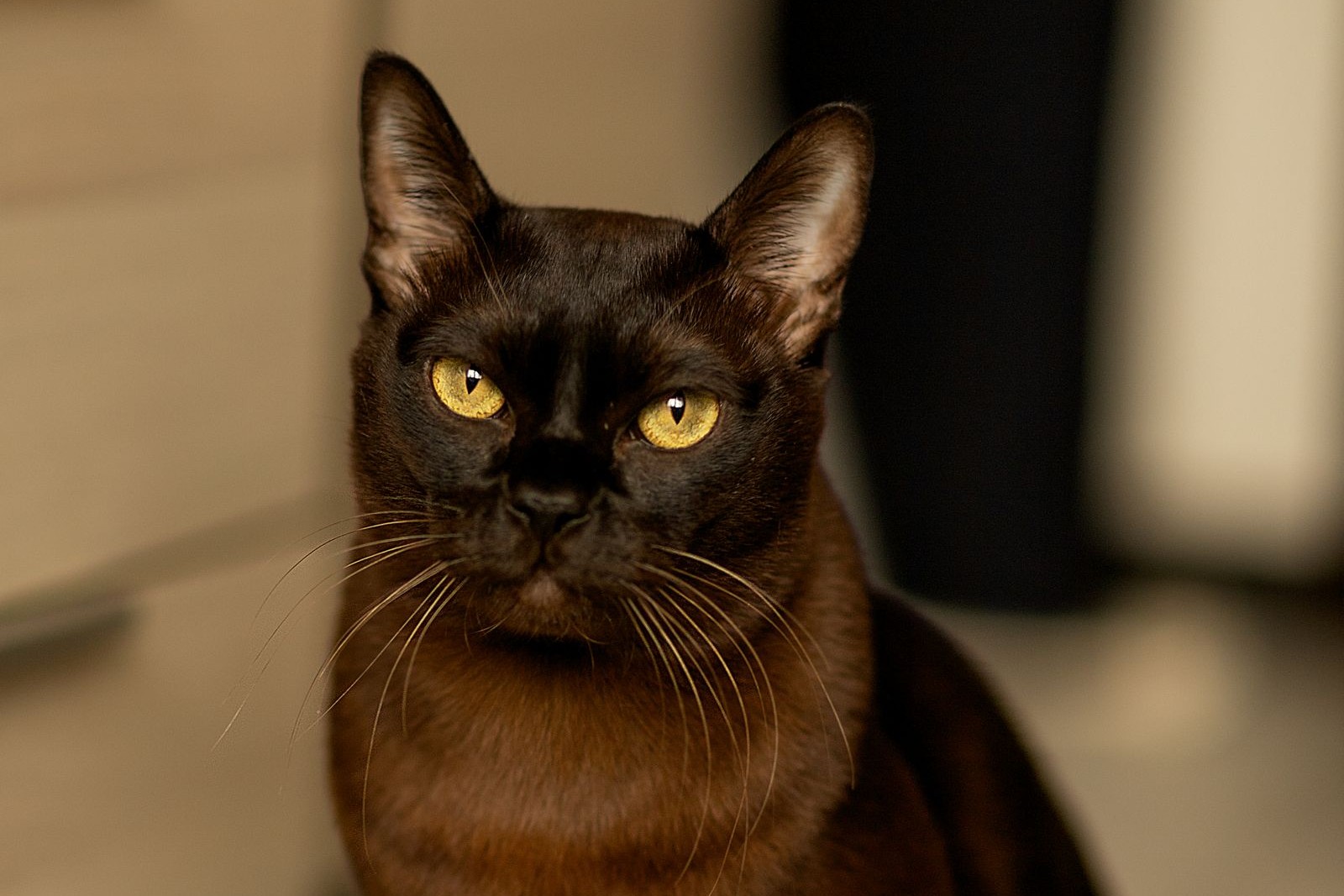
Burmese snapshot
The International Cat Association, known as TICA, traces the modern Burmese to a single cat. In 1930 a sailor brought a small brown cat named Wong Mau from the Orient to Dr. Joseph G. Thompson of San Francisco. TICA describes her as fine boned but more compact than a Siamese, with a rounded, short muzzled head, and notes that the dark brown offspring of her breeding program founded the breed. The Cat Fanciers' Association, known as the CFA, sets out the cat that program produced: a medium sized cat with substantial bone structure, good muscular development, and a surprising weight for its size, with a rounded head, expressive eyes, and a sweet expression.
| Size | Medium. The CFA standard describes a cat of medium size with substantial bone structure and good muscular development. TICA calls the Burmese a medium sized, compact cat, and both registries stress the same surprise: this cat is heavier than it looks. |
|---|---|
| Body | Compact and muscular. The CFA asks for an ample, rounded chest and a back that is level from shoulder to tail, with excellent muscle tone expected and no evidence of obesity, weakness, or apathy. TICA's description, a sturdy cat like a little bulldog, makes the same point in fewer words. |
| Coat | Short and close lying, with a satin-like texture. The CFA calls the coat fine and glossy. TICA describes a short, silky, single coat that hugs the muscular body and needs little maintenance. |
| Color | The CFA accepts four colors. Sable is a rich, warm, sable brown. Champagne is a warm honey beige. Blue is a medium blue with warm fawn undertones. Platinum is a pale, silvery gray with pale fawn undertones. TICA recognizes a wider range, adding chocolate, lilac, red, cream, and tortoiseshell patterns. |
| Eyes | Large, set far apart, with a rounded shape. In the CFA standard the eye color ranges from yellow to gold, and the greater the depth and brilliance the better. TICA describes deep gold eyes. |
| Temperament | Extremely people oriented. The CFA describes a curious, clever, and friendly cat that adores its people, follows them from room to room, learns games such as fetch, and is known for being good with children. TICA describes a very social cat that thrives on company and can be lonely if left alone for long periods. |
| Health profile | Metabolic and genetic, in that order. The CFA calls the Burmese a relatively healthy natural breed that can live very long lives, notes a possible genetic predisposition to diabetes in older cats while calling the heritability research not yet conclusive, and records that a past pattern of feline infectious peritonitis has largely been bred out. The UC Davis Veterinary Genetics Laboratory lists three DNA testable inherited conditions for the breed, covered in the health section below. |
Two snapshot facts shape the insurance picture. The first is the build. A compact, muscular cat with substantial bone is supposed to feel heavy when you pick it up, and the CFA standard says so in plain words. That makes weight judgment by eye and by hand unreliable in this breed. A Burmese can gain real weight while still looking like the solid cat the standard describes, and weight connects directly to the diabetes card below, because the Merck Veterinary Manual states that obesity predisposes cats to insulin resistance. The scale at the veterinary clinic, recorded over time, is the honest measure here, and the log in this guide includes a place for it.
One more distinction belongs in the snapshot, because it changes what the DNA paperwork means. The UC Davis laboratory lists the Burmese and the European Burmese as separate breeds for testing, and its head defect page places that mutation in the contemporary lines of Burmese from the United States, while noting that the separate midline defect appears more common in European lines and has no genetic test at this time. If your cat comes from European lines, the hypokalemia and GM2 tests still apply, in the laboratory's breed lists. The head defect conversation is different, and a breeder of European lines should be asked what screening they can actually show you, rather than handed a result for a different condition.
The second fact is the lifespan shape, stated carefully. Neither registry page we used for this guide publishes a lifespan figure for the Burmese, so this guide does not print one. What the CFA does say is that Burmese are a relatively healthy natural breed and can live very long lives with proper care. A long life means a long senior stage, and the senior stage is where kidney disease and dental disease do most of their work in cats. A policy bought for a Burmese kitten is really two policies in one: cover for the metabolic and genetic questions of the early and middle years, and cover for the monitoring years at the end of a long life.
Health tendencies in Burmese cats
The conditions below are the ones the primary sources for this guide actually support for this breed. Diabetes and the three DNA testable conditions are Burmese specific in the sources named. Kidney disease and dental disease are general cat conditions, included because the breed's long senior stage makes them central rather than incidental. These are tendencies, risks to plan around, not predictions about an individual cat. Many Burmese will never develop most of them.
This section is general information about conditions a cat can develop. It is not veterinary advice and it is not a diagnosis of any cat. Signs listed here are possible signs owners may notice, and many of them have several causes. Only a veterinarian who examines your cat can say what a sign means.
A note on the condition that is not a card here, because honesty about this breed's history matters. The CFA records that in years past Burmese were known to have an above average number of cases of feline infectious peritonitis, a disease the CFA describes as having a strong genetic component. The same CFA passage states that through careful selective breeding this disease has largely been eliminated, and currently occurs no more often in Burmese than in any other breed. A guide that sold you insurance wording on the back of that history would be selling you a risk the breed's own registry says is resolved. It is recorded here as history, and it does not appear in the policy table.
Diabetes mellitus
What it is
A chronic disorder of carbohydrate metabolism, meaning the handling of sugars, due to relative or absolute insulin deficiency. That is the Merck Veterinary Manual's definition. Insulin is the hormone that lets the body use blood sugar for energy. Merck lists the cat breeds that appear predisposed to the disease, and the Burmese is one of the breeds named, alongside the Tonkinese, Norwegian Forest Cat, Russian Blue, and Abyssinian. The association is supported beyond a single reference. The VetCompass research from the Royal Veterinary College, published in the Journal of Veterinary Internal Medicine in 2025, compared cats with a confirmed diabetes diagnosis against a random sample of cats without one in United Kingdom primary care records, and found that Burmese cats had increased odds of a diagnosis. The CFA adds the breed registry's own cautious version of the same point: some sources indicate that older Burmese may have a genetic predisposition to diabetes, but research on the heritability of the condition is not yet conclusive. Merck also states that obesity predisposes both dogs and cats to insulin resistance, a state in which the body responds poorly to its own insulin, and that heavier cats seem to have diabetes more commonly than lighter cats. In a compact breed that is supposed to feel heavy, that combination deserves attention rather than alarm.
Signs owners may notice
- The classic signs Merck lists: urinating more, drinking more, eating more, and losing weight. The weight loss alongside a good appetite is the combination owners most often describe at the first visit.
- A cat that eats less instead. Merck notes that some cats with diabetes have a decreased appetite, so a Burmese that goes off its food is not ruled out by the appetite change alone.
- Tiredness, and weakness that Merck associates with diabetic neuropathy, nerve damage linked to diabetes, which mainly affects cats.
- Recurring or slow-to-clear infections, because Merck notes that diabetic animals have reduced resistance to bacterial and fungal infections, including bladder infections.
When it can be urgent
Diabetes itself usually develops slowly, over weeks to months in Merck's description. It has an emergency form. Merck describes diabetic ketoacidosis as a decompensated state in which the body burns fatty acids for energy and ketoacids build up in the blood, and calls the resulting disturbances profound and potentially life threatening, with signs that include vomiting and loss of appetite on top of dehydration. A diabetic or possibly diabetic cat that is vomiting, will not eat, breathes with effort, or collapses needs emergency care the same day.
How vets usually evaluate and treat it
Merck bases the diagnosis on persistent high blood sugar and sugar in the urine, and notes a cat-specific wrinkle: stress can raise a cat's blood sugar temporarily, so multiple blood and urine samples may be required to confirm the diagnosis, and a test called fructosamine can help separate the stress effect from true diabetes. Treatment in cats centers on insulin, dietary management, and frequent monitoring, which Merck says is often best performed at home. Merck describes a high-protein, low-carbohydrate diet as part of treatment in cats, alongside weight loss for an overweight cat. Merck also notes that when diet change and insulin are combined, many cats achieve diabetic remission, meaning they no longer need insulin treatment. That possibility is real and hopeful, and it is a reason early, steady management matters. It is not a promise for an individual cat.
Burmese hypokalemia (familial episodic hypokalaemic polymyopathy)
What it is
This is the breed's named muscle weakness condition, and the word episodic is the heart of it. The UC Davis Veterinary Genetics Laboratory describes Burmese hypokalemia as an inherited disorder characterized by episodes of low serum potassium levels and high levels of creatine phosphate kinase, an enzyme that indicates muscle damage. Potassium is a mineral the muscles need to work, and serum potassium is the amount of it measured in the blood. During an episode, the laboratory explains, affected cats show skeletal muscle weakness that can affect the whole animal or only certain muscles. The weakness is most obvious in the neck muscles, but sometimes occurs in just the limbs, so affected cats may have trouble walking and holding their heads correctly. The condition is inherited as an autosomal recessive defect, meaning a cat needs two copies of the variant to be affected, and the laboratory identifies the cause as a mutation in the WNK4 gene. The same laboratory page offers the reassurance that belongs beside the worry: the disease is not typically fatal, and affected cats usually can be managed by adding potassium supplements to their diet, under a veterinarian's direction.
Signs owners may notice
- An episode of weakness, most visibly in the neck, in a cat that cannot hold its head up in its usual position.
- Trouble walking during an episode, or weakness that seems limited to the limbs.
- A cat that recovers from the episode and seems normal again afterward, which is the pattern that makes owners delay reporting it, and the pattern this guide's episode log exists to capture.
When it can be urgent
The laboratory describes this condition as not typically fatal, and that framing is honest. An episode still deserves same day veterinary advice the first time it happens, because weakness has many causes and only an examination and blood work during or near the episode can sort them. A cat that cannot walk, cannot lift its head, or seems distressed should be seen promptly rather than watched at home, whatever the cause turns out to be.
How vets usually evaluate and treat it
Two records answer two different questions, and keeping them separate is the practical skill in this card. Blood work during an episode answers what is happening in this cat today: the laboratory's description names low serum potassium and high creatine phosphate kinase as the episode pattern. A DNA test answers the inherited question once and for life: the UC Davis laboratory's test reports whether a cat carries none, one, or two copies of the WNK4 variant. A carrier, with one copy, will not have Burmese hypokalemia, in the laboratory's wording, but can pass the variant to offspring. Management of an affected cat usually centers on potassium supplements added to the diet, as the laboratory describes, with the dose and the monitoring set by the veterinarian.
GM2 gangliosidosis
What it is
A degenerative, fatal neurological disease, in the UC Davis Veterinary Genetics Laboratory's words, characterized by severe muscle tremors and loss of motor control. The laboratory explains that in Burmese cats the disease is caused by a mutation that disrupts a neuron's ability to remove metabolic waste products from the cell, and that the accumulation of those waste products results in permanent damage. It is inherited as an autosomal recessive disorder, caused by a deletion in the HEXB gene, and the laboratory's DNA test detects that specific Burmese mutation. This card is short because the honest facts are short. The laboratory notes that the condition in affected kittens is first observed at 6 to 8 weeks of age, beginning with mild tremors and leading to difficulty eating and lack of coordination, and that owners may elect humane euthanasia as the disease progresses, often culminating in an inability to walk or eat. There is no treatment path in the laboratory's description to summarize, and this guide does not invent one.
Signs owners may notice
- Mild tremors in a young kitten, which the laboratory notes are more evident when the kitten moves with intent than when it is at rest.
- Loss of coordination, and difficulty eating, as the condition progresses.
- A kitten that falls behind its littermates in movement and control rather than in size or appetite at first.
When it can be urgent
This condition progresses rather than striking suddenly, so its urgency is about promptness, not minutes. A kitten showing tremors or loss of coordination should be examined promptly, both for its own care and because an early, clear diagnosis is what the breeder conversation and any claim will stand on. A kitten that cannot eat or walk needs same day care and a frank conversation about quality of life.
How vets usually evaluate and treat it
Evaluation starts with a neurological examination of the kitten and its history, including what is known about the parents. The DNA test answers the inherited question directly for this mutation: the laboratory reports results as clear, carrier, or affected, and a carrier cat will not have Burmese GM2 gangliosidosis but can pass the variant on. Because affected kittens show signs in the first weeks of life, the meaningful screening record is usually the parents' results, collected by the breeder before the litter existed. Care of an affected kitten is supportive and honest: comfort, help with eating while that is still possible, and a euthanasia decision made with the veterinarian when the disease takes walking and eating away.
Burmese head defect (congenital frontonasal dysplasia)
What it is
This card is deliberately brief, and it is here for records rather than for treatment. The UC Davis Veterinary Genetics Laboratory describes Burmese head defect as an inherited defect characterized by improper development and subsequent malformation of the skull and facial features, caused by a deletion in the ALX1 gene, a gene the laboratory describes as significant for facial development. The laboratory states that the mutation is common in the contemporary lines of Burmese from the United States. Its inheritance pattern is not the simple recessive pattern of the two cards above. One copy of the variant does not cause the craniofacial defect, but may produce a shortened facial structure. Two copies produce the severe defect, and the laboratory is direct that kittens with it may be stillborn, or born live but unable to survive for long. For a pet owner, the practical meaning is narrow and important: this is a breeder screening question, not a condition your kitten is likely to be treated for. A cat with one copy is a cat with a somewhat shorter face, not a cat with the defect.
Signs owners may notice
- In a pet cat, usually nothing at all. A shortened facial structure in a cat with one copy is a shape, not a symptom.
- The defect itself is a birth event in a breeding program, not a sign an owner watches for at home.
How vets and breeders usually handle it
By testing before breeding. The laboratory explains that testing assists owners and breeders in identifying carrier cats, so that matings that could produce affected kittens can be avoided. If you are buying a kitten from contemporary lines, asking whether the parents carry head defect results, and filing whatever the breeder can show you, is the whole of the owner's role. The UC Davis laboratory also notes a separate condition called midline defect, which can present with head malformation in European lines and is under investigation, with no genetic test available at this time. The two are not the same condition, and a clear head defect result says nothing about the other.
Chronic kidney disease (CKD) in a long-lived cat
What it is
The persistent loss of kidney function over time. The Cornell Feline Health Center calls chronic kidney disease one of the most prevalent diseases in older cats, and says the only known risk factor for its development in cats is age. That sentence is the reason this card is on a Burmese page. A breed the CFA describes as able to live very long lives does not avoid kidney disease. It lives long enough to meet it. Healthy kidneys filter the blood, make urine, and help regulate blood pressure, and Cornell explains that as function is lost, waste products the kidneys normally remove can build up in the bloodstream. The disease is progressive, meaning it worsens over time, and Cornell is clear that it has no definitive cure. Care aims to slow progression and protect quality of life.
Signs owners may notice
- Often nothing at all in the early stages. Cornell notes that cats commonly show no obvious signs early, because the body compensates.
- Urinating greater volumes and drinking more water, as the kidneys lose the ability to concentrate urine. In this breed, owners should read that sign alongside the diabetes card, because increased drinking and urination belong to both conditions, and only testing separates them.
- Loss of appetite, and a cat that appears lethargic and unkempt and loses weight as waste products build up.
- Pale or white gums and marked tiredness in a cat whose kidneys are producing less of the hormone that drives red blood cell production, a sign of anemia linked to this disease.
When it can be urgent
Kidney disease itself usually develops slowly. Sudden vision changes, disorientation, or marked weakness in a cat known to have kidney disease can signal the high blood pressure Cornell links to this condition, and those changes deserve prompt, same day advice. A cat that stops eating or becomes suddenly much more unwell also needs to be seen quickly, whatever the underlying cause.
How vets usually evaluate and treat it
Cornell describes evaluation built on blood tests and urinalysis. The blood tests measure waste products the kidneys normally filter, including blood urea nitrogen, creatinine, and symmetric dimethyl arginine, known as SDMA. Cornell notes that SDMA rises earlier in the disease than creatinine, which generally does not rise until much of kidney function is already lost. The urinalysis looks at how concentrated the urine is, because poorly concentrated urine can be one of the earliest indicators. Blood pressure measurement is part of the evaluation, and Cornell describes a staging system from the International Renal Interest Society, called IRIS, that categorizes the disease to guide treatment. Management categories include dietary modification with a therapeutic kidney diet, maintaining hydration, sometimes with fluids given under the skin at home under veterinary guidance, and medication for related problems such as high blood pressure, anemia, and protein loss in the urine.
Dental disease: gingivitis, periodontitis, and tooth resorption
What it is
Diseases of the teeth and gums are common in cats of every breed, and Cornell names the three most common: gingivitis, periodontitis, and tooth resorption. Gingivitis is inflammation of the gums where they meet the teeth, beginning with plaque, a film that harbors bacteria. If gingivitis is not controlled, Cornell explains, it can progress to periodontitis, in which the tissues that attach the tooth to the gums and bone are weakened and the damage cannot be reversed, leading to loose teeth and tooth loss. Tooth resorption is a process in which the tooth structure breaks down, and Cornell calls it the most common cause of tooth loss in cats, while noting that its cause is not known. None of this is Burmese specific. It is on this page because a long-lived, people oriented cat that lives closely with its owners will have its mouth noticed, because dental pain changes exactly the behaviors this breed is loved for, eating with enthusiasm and staying in the room with its people, and because dental wording is where policies differ most sharply.
Signs owners may notice
- Swollen, red, or bleeding gums where the gums meet the teeth, and bad breath.
- Hesitating to eat, turning the head unusually while eating, preferring soft food, or dropping food.
- Drooling, and a cat that stops eating or becomes irritable, which Cornell lists among the signs of dental pain, including pain from tooth resorption.
- A pinkish defect in a tooth at the gum line, which Cornell describes as the usual first visible sign of tooth resorption, in a tooth that is already significantly damaged.
When it can be urgent
Dental disease usually develops slowly, but a cat that cannot eat because of mouth pain needs prompt care rather than a long wait. Cornell notes that dental disease can cause a cat to stop eating, which leads to further health problems. A cat that has stopped eating entirely should be seen quickly, whatever the cause turns out to be.
How vets usually evaluate and treat it
Cornell explains that a complete evaluation of periodontitis involves probing the gums and examining X-rays of the head and jaw, which require anesthesia. The same is true for tooth resorption, where diagnosis involves examining and probing the lesions and reviewing X-rays under anesthesia. Treatment for periodontitis centers on removing plaque and mineral buildup by scaling and polishing the teeth while trying to save them, with extraction of teeth, sometimes numerous teeth, in extreme cases. For painful tooth resorption in which lesions extend into the crown of the tooth, Cornell says it is best to remove the tooth. Gingivitis itself is usually reversible, and Cornell identifies regular removal of plaque by tooth brushing, using only products designed for cats, as the way to prevent it.
Policy decisions that matter for a Burmese
For this breed, a policy is judged on three kinds of wording at once. Hereditary wording decides the three DNA conditions. Episode and chronic wording decides the conditions that come back: hypokalemia episodes across a life, and diabetes and kidney care across years. Dental and congenital wording decides the rest. Read these rows with that whole span in mind, and use the guide to comparing plans alongside them when you hold two sample policies side by side.
| Policy feature | Why it matters for a Burmese | Stronger wording looks like | Watch out for |
|---|---|---|---|
| Hereditary condition wording | Three conditions in this breed are inherited and DNA testable, so the hereditary clause is not boilerplate here. It is the clause the kitten claims stand on. | Inherited conditions are covered on the same terms as other illness, with no breed specific hereditary exclusion that names this breed's conditions. | A hereditary exclusion list, a reduced limit for inherited conditions, or wording that treats a known DNA result as a diagnosis on its own. |
| DNA results and screening | Breeders test for hypokalemia, GM2, and head defect, and a result sheet often exists before the kitten is insured. How the policy reads that sheet decides later arguments. | The policy states plainly how a genetic test result is treated, and distinguishes a carrier result, which is not a disease, from an affected result. | Wording that counts any recorded genetic finding, including a carrier result, as a pre-existing condition, or that refuses claims because a screening test existed. |
| Episode counting | Hypokalemia is defined by episodes of weakness that resolve and can return, so the counting rule is applied again and again across the cat's life. | Recurring episodes of one covered condition are handled on stated terms, with the deductible and limit treatment written down. | A rule that restarts the deductible for every episode, or that pays for a first episode and treats later episodes of the same condition as excluded. |
| Chronic condition renewal wording | Diabetes and kidney disease are managed for years once they appear, and this breed's senior stage can be long. | A condition covered in one term stays covered in later terms, including its monitoring, while enrollment continues. | Renewal wording that caps a chronic condition, ends it at renewal, or reclassifies it as pre-existing each year. |
| Monitoring and diagnostics | Diabetes and kidney care are mostly measurement: repeat blood tests, urine tests, fructosamine checks, and blood pressure checks, often over years. | Diagnostics and monitoring for a covered condition are covered categories, at renewal as well as in the first year. | Wording that covers medication but leaves the tests that guide it, or home monitoring supplies, outside the covered categories. |
| Remission wording | Merck notes that many diabetic cats achieve remission with diet change and insulin, and a condition that can switch off and back on tests the policy's counting rules directly. | The policy states how a condition in remission is treated if it returns, and the answer is written in the sample policy. | Silence on remission, which leaves a returning diabetes claim to be argued as either a continuation or a new condition after the fact. |
| Congenital condition wording | The head defect and GM2 present at or near birth, so the line a policy draws between hereditary and congenital conditions decides kitten claims. | Hereditary and congenital are defined separately and readably, and the treatment of each is stated before you buy. | A congenital exclusion that quietly swallows the hereditary cover the breed was bought for, or kitten claims denied on an enrollment age technicality. |
| Deductible type | Senior monitoring and recurring episodes produce steady claims across a year, every year, often for more than one condition at once. | An annual deductible that is met once, after which eligible claims across conditions are reimbursed. | A per-condition deductible that restarts the counting for diabetes, the kidneys, the mouth, and each weakness episode separately. |
Life stages: kitten, adult, and senior
Kitten
The kitten stage in this breed is a paperwork stage, and the paperwork starts before the kitten comes home. Ask the breeder for the parents' DNA results, or the kitten's own, for the three UC Davis tests: hypokalemia, GM2 gangliosidosis, and head defect. Two of the three follow a recessive pattern, so two carrier parents can produce an affected kitten while looking perfectly healthy themselves, and the parents' results are the record that answers the question. GM2 is the reason timing matters: its signs appear in the first weeks of life, so a kitten's early tremors or loss of coordination are a veterinary visit, not a wait and see. Enrolling early clears the waiting periods while the record is clean, and filing the DNA sheets with the policy means the hereditary conversation later starts from documents, not from memory.
Adult
Adulthood is where the metabolic story and the episode story both live. The adult habits that matter are measurements. Weigh the cat at veterinary visits and write the weights into the log, because this breed's solid build hides gain that a scale catches. Watch the water bowl and the litter box with the diabetes signs in mind: drinking more, urinating more, eating well, and still losing weight is a pattern to report, not to monitor quietly for months. If a weakness episode happens, note the date, what the cat could and could not do, how long it lasted, and how the cat recovered, and get blood work done near the episode if the veterinarian advises it. Those dated notes are the raw material of every episode claim that follows.
Senior
The senior stage is long in this breed, and its insurance work is monitoring. Kidney checks become routine, with blood tests, urine tests, and blood pressure measurement on a rhythm the veterinarian sets. Diabetes, in Merck's description, appears most often in middle aged to older cats, so the metabolic watch does not retire when the cat does. Dental needs accumulate in a mouth that has had years of plaque. Review the policy for age based changes, premium increases, and any reduction in coverage at advanced ages. Confirm that the monitoring rhythm built up over the cat's adult life is still reimbursable on the same terms, because a plan that quietly thins out during the longest stage of this breed's life fails the purpose it was bought for.
A claim, step by step: a diabetes diagnosis in an adult Burmese
The example below is hypothetical. It is not a real cat, a real claim, or a guarantee of how any insurer will decide. It follows an adult Burmese from the first changes at the water bowl, through the testing that separates true diabetes from a stress response, to insulin, home monitoring, and the remission question at renewal, because that full arc is what metabolic coverage has to handle in this breed. Pet insurance generally reimburses after you pay the vet, as explained in how pet insurance works.
More water, more urine, and a lighter cat
Over several weeks, the owner notices the water bowl emptying faster and the litter box wetter, while the cat eats with its usual Burmese enthusiasm and still feels lighter when picked up. That combination is the classic diabetes pattern Merck lists: urinating more, drinking more, eating more, and losing weight. The owner books a routine appointment and writes down when the changes were first noticed, because that date will be asked for later, by the veterinarian and by the insurer.
The first tests, and the stress question
At the clinic, blood and urine tests show high blood sugar and sugar in the urine. The veterinarian does not stop there, and neither should the paperwork. Merck notes that stress can raise a cat's blood sugar temporarily, so repeat samples and a fructosamine test are used to confirm that this is diabetes and not a frightened cat at a clinic. The owner keeps the first result, the repeat result, and the fructosamine report together. A diagnosis built on confirmed, persistent results is far harder to argue with than one built on a single stressed sample.
Checking the policy dates, after care is underway
In this example the policy was started when the cat was a kitten, the illness waiting period ended long ago, and the record holds the breeder's DNA sheets and years of ordinary visit notes with no mention of increased drinking, weight loss, or high blood sugar. That clean timeline makes this a straightforward claim. Contrast it with the harder version of the same story, where a visit note from the previous year mentions a high blood sugar reading that was put down to stress and never rechecked. That old line is the kind of record that turns a diabetes claim into an argument about when the condition began.
Insulin, diet, and the learning weeks
Treatment starts with insulin and a diet change, following the pattern Merck describes for cats: insulin as the treatment of choice, a high-protein, low-carbohydrate diet, and weight loss if the cat is overweight. The owner learns to give injections at home and keeps every invoice and every instruction sheet. The claim is filed with the visit records, the confirming test results, and the itemized invoices, with the date the signs were first seen at home stated clearly and matched to the log the owner kept.
Monitoring becomes the claim pattern
After the first weeks, diabetes care settles into measurement: recheck visits, repeat blood and urine testing, and monitoring at home under the veterinarian's direction. Each eligible bill moves through the same mechanics described in what pet insurance costs and why. Charges count against the deductible first, the policy's reimbursement rate applies to eligible charges after that, and totals are tracked against the annual limit. Whether insulin, monitoring supplies, and prescription food are reimbursable categories is a wording question, and it was one of the questions flagged in the condition cards above.
Remission, and the question it leaves behind
Months later, this cat's blood sugar stabilizes on diet management and the veterinarian steps the insulin down and then stops it: diabetic remission, which Merck describes as the outcome for many cats when diet change and insulin are combined. The owner keeps the remission visit record with the same care as the diagnosis record. The paperwork question is now a future one. If the diabetes returns, is it the same condition continuing, or a new condition with a new waiting period and a new deductible? That answer lives in the remission wording row of the policy table, and it can be asked in writing at renewal, before it is ever needed.
Renewal, and where claims get denied
At renewal, the decisive fact is that a covered chronic condition stays covered, with its monitoring, on the terms the policy promised. The denial pressure points in this breed story are an early high blood sugar note in the record from before enrollment, a carrier DNA result misread as a diagnosis, a returning post-remission claim counted as a brand new condition, and monitoring tests denied as routine when they were ordered to manage a covered condition. Each of those is a clause question, and each can be asked in writing before you buy, not after the diagnosis.
What drives a Burmese premium
No responsible guide will name a price for your cat, because the quote depends on the cat, the address, and the settings chosen. What can be explained is the shape of Burmese pricing and the choices that move it. The full mechanics are in what pet insurance costs and why.
Breed risk profile. Insurers see a medium sized cat with a named metabolic association and a documented set of inherited conditions. That profile prices differently from a breed with no named risks at all, and differently again from a breed built around a progressive structural disease. Do not overread either direction. A named diabetes association raises one input to the price. It does not predict your cat, and it does not change what years of insulin, monitoring, and senior kidney care add up to if they arrive. The honest comparison for this breed is the premium against the chronic bills this cat can genuinely generate.
Age curve and a long life. Premiums generally rise with age, and a long-lived breed stretches the calculation across many senior years, which are the years of kidney monitoring, dental procedures, and metabolic care. The total cost of insuring a Burmese is therefore a long horizon decision. A slightly cheaper policy with chronic condition caps can cost more over that span than a stronger policy, because the caps bite at every renewal of a condition that is managed, not cured.
Weight is not priced at enrollment, but it is real. An insurer does not weigh your cat at enrollment and set the premium by the result. The risk still moves. Merck states that obesity predisposes cats to insulin resistance, and a lean Burmese is simply less likely to generate the diabetes claims that a heavier one may. In a breed whose standard build already feels surprisingly heavy, the recorded clinic weights in the log are how an owner tells real gain from breed build, and that distinction is the closest thing to a premium reduction an owner controls, paid in health rather than in price.
Location and plan settings. Vet prices in your area set the bill sizes the insurer expects. Your deductible, reimbursement rate, and annual limit choices trade premium against claim returns. For this breed, deductible type deserves the same attention as deductible size, because an annual deductible and a per-condition deductible produce very different results across diabetes monitoring, kidney checks, a dental claim, and a weakness episode in the same year.
Pre-purchase checklist for a Burmese policy
- Collect the breeder's DNA records before you buy: both parents' results, or your kitten's own, for hypokalemia, GM2 gangliosidosis, and head defect, with names, laboratory, and dates on each sheet.
- Confirm inherited conditions are covered, and ask how a carrier result, an affected result, and a clear result are each treated in the policy's definitions.
- Confirm diabetes and other chronic metabolic conditions are covered, with insulin and monitoring included, at renewal as well as in the first year.
- Ask, in writing, how recurring hypokalemia episodes are counted: new claim, continuation, or one condition under one limit, and which deductible treatment applies.
- Ask how a condition that enters remission and later returns is counted, and get the answer in writing.
- Read the hereditary and congenital definitions side by side, and ask what the policy does for a kitten with a congenital condition.
- Confirm chronic kidney disease stays covered at renewal, including repeat blood tests, urine tests, and blood pressure checks.
- Confirm dental illness coverage in plain terms, including anesthesia, dental X-rays, and tooth removal for periodontitis or tooth resorption.
- Enroll as a kitten, before a weakness episode, a diabetes sign, a kidney value, or a mouth finding enters the medical record.
The Burmese screening and episode log
Other breed guides on this site hand you a comparison worksheet. This breed hands you a record to keep for the cat's whole life, because its claims turn on three kinds of paper: DNA results that never change, episodes that come and go, and weights and lab values that move slowly. Start the log when the kitten comes home. Keep it with the policy. A blank row is a prompt, not a failure: it marks the result or the record you have not collected yet.
| Log entry | What to write | Why it matters at claim time |
|---|---|---|
| Hypokalemia DNA result | Cat tested, laboratory, date, and result: clear, carrier, or affected. Or both parents' results, if the kitten was not tested. | Separates a carrier, which is not a disease, from an affected result, and dates the knowledge before or after enrollment. |
| GM2 gangliosidosis DNA result | Parents' results, or the kitten's own, with laboratory and date. | This condition shows signs in the first weeks of life, so the parents' record is usually the screening record that exists. |
| Head defect DNA result | Parents' results, with laboratory and date, and a note that one copy can shorten the face without causing the defect. | Prevents a carrier note from being misread later as a diagnosis of the defect itself. |
| Weakness episode log | For every episode: the date, what the cat could not do, how long it lasted, how recovery looked, whether a veterinarian was seen, and any potassium or enzyme results from blood work near the episode. | Episode counting is applied to this record. A dated log turns a vague history into a timeline an insurer and a veterinarian can both read. |
| Weight record | The clinic weight and date at every visit, from kittenhood onward. | This breed is supposed to feel heavy. Recorded weights separate breed build from real gain, and weight sits behind the diabetes story. |
| Water and appetite diary | Brief dated notes when drinking, urination, or appetite changes, and how long the change lasts before you report it. | The diabetes signs are changes over weeks, and owners notice them before any test does. Dated home notes give the veterinarian a start date and give the claim a timeline that does not rest on memory. |
| Metabolic record | Any blood sugar or fructosamine result, with its date and the veterinarian's note on whether stress was suspected. | A single high reading with no follow-up is the record diabetes claims are argued over. Confirmed results, dated, are the defense. |
| Senior monitoring record | Kidney values, urine results, and blood pressure readings, with dates, as the senior checks become routine. | Kidney claims are judged against trends. A dated series shows when values first moved, relative to enrollment and renewals. |
Questions to ask an insurer, in writing
- My kitten's breeder gave me DNA results for hypokalemia, GM2 gangliosidosis, and head defect. How does this policy record a carrier result, and how does it record an affected result?
- If my cat has an episode of muscle weakness from hypokalemia, and later has another, how exactly is the second episode treated under this policy?
- Once diabetes is diagnosed and covered, will insulin, monitoring, and care during a diabetic emergency stay covered at every renewal while I stay enrolled?
- If diabetes goes into remission and later returns, is the return treated as the same condition or as a new one?
- How do your definitions of hereditary and congenital conditions differ, and which one applies to a kitten condition that is present at birth?
- Are DNA tests reimbursed when a veterinarian orders one to investigate signs my cat is showing, and are they treated differently from tests ordered for a healthy cat?
Questions Burmese owners ask
Does pet insurance cover diabetes in a Burmese?
An accident and illness policy can cover diabetes mellitus when the cat was enrolled before any increased drinking, increased urination, weight change, or high blood sugar was recorded, the illness waiting period has passed, and chronic conditions are included. Diabetes care runs for years, with insulin, diet management, and repeat monitoring, so the renewal wording matters as much as the first claim. Ask in writing whether insulin, monitoring visits and tests, and care during a diabetic emergency stay covered at every renewal.
Which DNA tests should a Burmese breeder be able to show me?
Three, based on the UC Davis Veterinary Genetics Laboratory test list for this breed. Burmese hypokalemia, the episodic muscle weakness condition, is autosomal recessive, so ask for both parents' results or your kitten's own result. GM2 gangliosidosis is also autosomal recessive, and the laboratory's test detects the Burmese mutation specifically. Burmese head defect follows a different pattern, and one copy of that variant can shorten the face without causing the defect itself. A result sheet with the cat's name, the laboratory, the date, and the result for each test is the record to file with the policy.
My Burmese has episodes of muscle weakness. How does insurance count them?
That counting is a clause question, and it is one of the most important ones in this breed. Burmese hypokalemia is defined by episodes, so ask the insurer in writing whether each weakness episode is treated as a new claim, as a continuation of one condition with one deductible, or as the same condition under a per-condition limit. Also ask whether the blood tests taken during an episode, and any potassium supplement a veterinarian prescribes for the condition, are covered categories. Keep a dated log of every episode, because that log is the record the counting is applied to.
Does pet insurance pay for the DNA tests themselves?
Ask before you order them, and get the answer in writing. Policies commonly treat a test ordered for a healthy cat with no signs as screening or preventive care rather than as diagnosis, and many do not reimburse screening. A test ordered by a veterinarian to investigate signs your cat is already showing, such as an episode of weakness, sits in a different category in many policies. The same DNA result can therefore be a breeder record you pay for yourself, or part of a diagnostic claim, depending on why and when it was ordered.
Does pet insurance cover chronic kidney disease in a senior Burmese?
An accident and illness policy can cover chronic kidney disease when chronic conditions are included, the cat was enrolled before kidney values or urine changes were recorded, and the condition stays covered at renewal. The Cat Fanciers' Association notes that Burmese can live very long lives, so a senior stage can be long, and kidney care across it is monitoring: repeat blood tests, urine tests, and blood pressure checks. Confirm that a covered chronic condition is not capped, ended, or reclassified as pre-existing when the policy renews.
When is the best time to enroll a Burmese?
As a kitten, with the breeder's DNA records already in your hands, and before any weakness episode, diabetes sign, kidney value, or mouth finding enters the medical record. This breed rewards early paperwork in both directions. Enrolling young clears the waiting periods while the record is clean, and collecting the parents' hypokalemia, GM2, and head defect results before you buy tells you which inherited risks are already answered and which ones the policy may one day be asked about. If a DNA result already shows your kitten is affected by a recessive condition, expect the insurer to treat that condition as known from the start, and ask how they record it.
Sources and further reading
Sources checked on November 6, 2026.
- Cat Fanciers' Association, Burmese breed page and standard for the medium size with substantial bone structure and surprising weight for its size, the rounded head and short muzzle, the fine, glossy, satin-like short coat, the four accepted colors of sable, champagne, blue, and platinum with yellow to gold eyes, the curious, clever, and friendly temperament of a cat that follows its people from room to room, the statement that this relatively healthy natural breed can live very long lives, the note that older cats may have a genetic predisposition to diabetes with heritability research not yet conclusive, and the record that feline infectious peritonitis once occurred above average in this breed and has largely been eliminated through selective breeding.
- The International Cat Association, Burmese breed introduction for the Wong Mau origin story from 1930, the medium sized, compact, strong and well-muscled body that is surprisingly heavy for its size, the short, silky, single coat, the wider TICA color range including chocolate, lilac, red, cream, and tortoiseshell, the deep gold eyes, and the extremely people oriented, social temperament.
- UC Davis Veterinary Genetics Laboratory, Burmese hypokalemia for the episodic pattern of low serum potassium and high creatine phosphate kinase, skeletal muscle weakness most obvious in the neck muscles with trouble walking and holding the head correctly, autosomal recessive inheritance and the WNK4 mutation, the result meanings for clear, carrier, and affected cats, and management by potassium supplements added to the diet under veterinary direction.
- UC Davis Veterinary Genetics Laboratory, GM2 gangliosidosis in Burmese for the degenerative, fatal neurological disease with severe muscle tremors and loss of motor control, signs first observed at 6 to 8 weeks of age, autosomal recessive inheritance and the HEXB gene deletion, and the test's specificity for the Burmese mutation.
- UC Davis Veterinary Genetics Laboratory, Burmese head defect for congenital frontonasal dysplasia as an inherited defect of skull and facial development, the ALX1 gene deletion common in contemporary lines from the United States, one copy producing a shortened facial structure without the defect, two copies producing a severe defect incompatible with life, and the separate midline defect note for European lines.
- Merck Veterinary Manual, Diabetes mellitus in dogs and cats for diabetes as a chronic disorder of carbohydrate metabolism due to insulin deficiency, the Burmese among the cat breeds that appear predisposed to the disease, obesity as a predisposing factor for insulin resistance, the classic signs, diagnosis by persistent high blood sugar and sugar in the urine with fructosamine helping to separate stress effects, insulin and diet treatment with home monitoring, remission in cats, and diabetic ketoacidosis as a life threatening complication.
- Waite and colleagues, Frequency, risk factors, and mortality for diabetes mellitus in cats under primary veterinary care in the United Kingdom in 2019, Journal of Veterinary Internal Medicine, 2025 (VetCompass, Royal Veterinary College) for Burmese and Burmilla cats having increased odds of a diabetes diagnosis, with male sex, neutering, and increasing age as further risk factors.
- Cornell Feline Health Center, Chronic kidney disease for the persistent loss of kidney function over time, age as the only known risk factor in cats, the blood and urine testing used to evaluate the kidneys including SDMA, IRIS staging, and management built on diet, hydration, and control of related problems.
- Cornell Feline Health Center, Feline dental disease for gingivitis, periodontitis, and tooth resorption as the three most common dental diseases in cats, their signs, diagnosis with probing and X-rays under anesthesia, and treatment by scaling, polishing, and removal of teeth that cannot be saved.