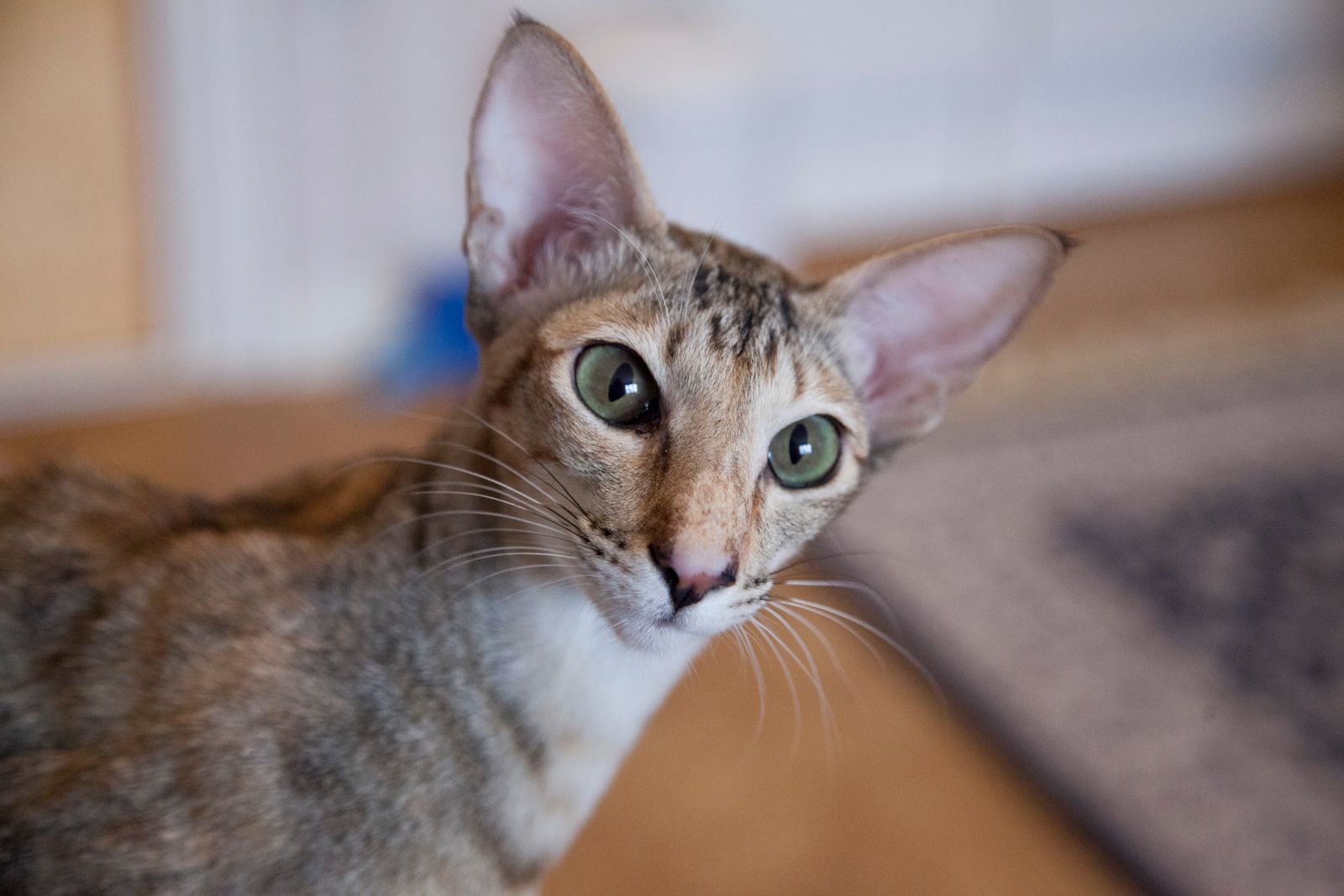
Oriental snapshot
The International Cat Association, known as TICA, describes the Oriental as a member of the Siamese breed group, alongside the Siamese, the Balinese, and the Oriental Longhair. Its breed introduction traces the breed to England in the 1950s, where Siamese cats were crossed with Russian Blues, British Shorthairs, Abyssinians, and ordinary domestic cats, and the non pointed offspring were crossed back to Siamese. All of the non pointed cats were grouped into one breed, and Orientals were imported into the United States in the 1970s. The CFA registers the same cat under the name Oriental, in a Shorthair Division and a Longhair Division, and its standard describes the ideal as a svelte cat with long, tapering lines, very lithe but muscular, and strong and lithe, neither bony nor flabby. This guide covers the Oriental Shorthair, the short coated form most owners meet.
| Size | Svelte and medium in overall balance. The CFA standard calls for a long and svelte body with a distinctive combination of fine bones and firm muscles. Neither registry source checked for this guide publishes a weight range, so this guide does not invent one. |
|---|---|
| Body | Long and tubular, even in width from shoulder to hip in the TICA description. Shoulders and hips continue the same sleek lines, the abdomen is tight, and the legs, tail, and even the toes are long and slender. |
| Head and ears | A long tapering wedge. The total wedge starts at the nose and continues in straight lines to the tips of the ears, forming a triangle. The ears are strikingly large, pointed, and wide at the base, and the muzzle is fine and wedge shaped. |
| Coat | Very short, fine textured, and glossy or satin like in the Shorthair Division, lying close to the body. TICA describes a very short, glossy, close lying coat with little grooming demand. |
| Colour | The widest palette in the cat fancy. The CFA standard states that the Oriental's reason for being is the coat colour, whether solid, shaded, smoke, parti-colour, bi-colour, pointed, or tabby patterned. TICA counts 281 different colours of Oriental, each in either coat length. |
| Eyes | Almond shaped, medium sized, and slanted towards the nose in harmony with the wedge. The CFA standard gives the eye colour as green, with blue for pointed cats, and blue, green, or odd eyed for white and bi-colour cats. |
| Temperament | People centred, vocal, and busy. The CFA describes a very people centred breed that is as intelligent as its Siamese ancestors, can be fairly vocal and needy, follows its person's every move with interest, and may pine if the attention it needs is withdrawn. |
| Health profile | Most Orientals are healthy, in the CFA's words, and its breeders are working to address two named issues: progressive retinal atrophy, detectable by genetic testing, and amyloidosis, which causes liver and other issues and can be both genetic and acquired. |
Two snapshot facts shape the insurance picture. The first is that this breed's identity is colour, and colour tells you nothing about health. A solid ebony Oriental, a tabby, and a smoke all carry the same family file, because the file follows the Siamese body plan and its lines, not the coat. Owners shopping by colour sometimes assume a rarer colour means a rarer risk profile. It does not. The questions in this guide are the same for every colour in the palette. The second fact is the temperament. A cat this vocal and this attentive announces change early. Orientals comment on their world as a habit, which means a new cough, a quieter week, or a changed appetite stands out against a noisy baseline. Owners of this breed often hold better symptom evidence than they realise, if they write it down. The cough log in the record card below exists for exactly that reason.
One honest omission belongs in the snapshot. Neither the CFA standard nor the TICA breed introduction checked for this guide publishes a lifespan figure or a weight range for the Oriental, so this guide prints neither. General websites offer both numbers freely, but they do not trace to the registries, and a comparison guide should not borrow them. What the sources do support is a long lived family reputation in practical terms: the Siamese group is kept as a companion for many years, and the senior sections of this guide are written for a cat whose policy may need to perform across a long adult and senior span.
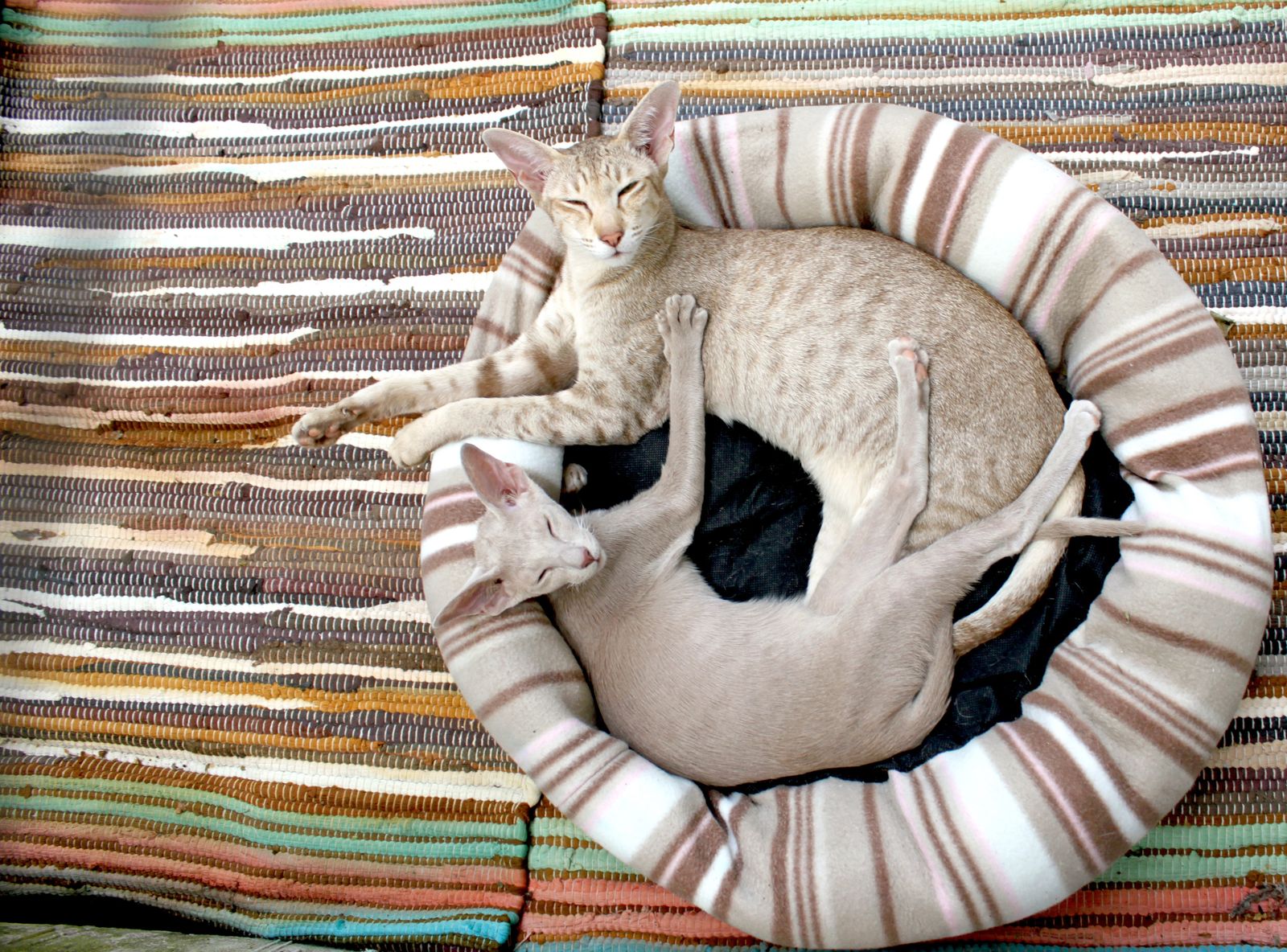
Health tendencies in Orientals
Read the labels on this section carefully, because this breed rewards precision. Two cards rest on breed level sources: the CFA names progressive retinal atrophy and amyloidosis for the Oriental itself. One card rests on a family level source: International Cat Care describes asthma as often seen in Siamese and related breeds, and the Oriental is a related breed in that group. Three cards cover well documented general cat conditions that belong in this breed's plan: dental disease, gut disease with its lymphoma differential, and chronic kidney disease in the senior years. Each card says which kind of claim it is making. These are tendencies and planning risks, not predictions about an individual cat. Many Orientals live long, active lives and meet few of them.
This section is general information about conditions a cat can develop. It is not veterinary advice and it is not a diagnosis of any cat. Signs listed here are possible signs owners may notice, and many of them have several causes. Only a veterinarian who examines your cat can say what a sign means.
A note on what is not in this section. You will find other websites listing heart conditions, blood conditions, and long disease inventories for the Oriental, often copied from Siamese pages or from each other. The primary sources checked for this guide do not support a longer breed list. The CFA names two issues for this breed. UC Davis adds testing precision for one of them. Cornell and International Cat Care support the airway, mouth, gut, and kidney cards as family or general risks. If your own cat is diagnosed with any condition, that diagnosis matters for that cat's care and claims, whatever breed lists say. But this guide does not sell hereditary wording on the back of conditions the breed record does not support.
Amyloidosis (amyloid protein deposition, mainly liver in this family)
What it is
A condition in which a misfolded protein called amyloid is deposited in body tissues, where it displaces normal cells and interferes with how an organ works. The Merck Veterinary Manual explains that amyloid can be deposited throughout the body or in one area, that some types are hereditary in cats, and that other types follow chronic infection, inflammation, or certain cancers. The CFA names amyloidosis directly for the Oriental, describing a disease that causes liver and other issues, and noting two facts that define the owner's position: it can be both genetic and acquired, and research to find genetic markers is still ongoing. A peer reviewed concise review of amyloidosis in animals adds the family pattern: familial amyloidosis is reported in Siamese and Abyssinian cats, the kidney is the main target organ in the Abyssinian, and the amyloid protein is mainly deposited in the liver in Siamese cats. Read that carefully. For an Oriental, think liver first, do not rule the kidneys out, and do not borrow the Abyssinian kidney version of the disease and apply it unchanged.
Signs owners may notice
- Often nothing, for a long time. Merck notes that the disease has a hidden onset, and deposits can be present before a cat looks ill.
- Loss of appetite, weight loss, and tiredness as liver function declines.
- Vomiting, increased thirst, or a cat that is simply less bright and less vocal than its usual self, which in this breed is a change owners can genuinely spot.
- Yellowing of the whites of the eyes or the gums in a cat whose liver is struggling, a sign that always needs prompt veterinary attention.
How vets usually evaluate and treat it
Merck notes that amyloidosis is difficult to diagnose because of its wide distribution and hidden onset, and that a veterinarian may suspect it when a cat with chronic infection or inflammation develops kidney or liver failure. Evaluation usually runs through bloodwork and urine testing that show how the liver and kidneys are functioning, imaging of the abdomen, and, for a definite answer, a biopsy, meaning a small tissue sample examined under a microscope with special stains that reveal amyloid. A liver biopsy in a cat whose liver may be fragile is a specialist judgement, not a routine step, and vets weigh that risk carefully. Merck states that no specific treatment can prevent the development of amyloidosis or promote the reabsorption of the deposits. Care focuses on supporting the affected organ, treating any underlying inflammation or infection that can be found, and monitoring. The CFA's breeder guidance is the practical owner version of the same point: breeders police their lines for relatives of affected cats, and it is best to inquire whether there is any history of the disease in a kitten's lines before you buy, because family history is currently a more useful tool than a gene test for this condition.
Progressive retinal atrophy (inherited retinal degeneration, CEP290 form)
What it is
An inherited disease in which the retina, the light sensitive layer at the back of the eye, degenerates over time. Retinal degeneration means the cells that detect light, called photoreceptors, break down and stop working. The UC Davis Veterinary Genetics Laboratory describes the form called rdAc, caused by a mutation in a gene called CEP290, and lists the Oriental Shorthair among the breeds appropriate for testing. The CFA names the same disease for the Oriental in plain terms: progressive retinal atrophy can cause blindness, it is a recessive gene, and it is detectable via genetic testing. Recessive means a cat needs two copies of the mutation, one from each parent, to be affected. A cat with one copy is a carrier. Carriers have normal vision, in the UC Davis description, and can pass the mutation to their kittens. The laboratory is clear about the course: affected cats have normal vision at birth, degeneration is first detected at about seven months of age, vision loss progresses slowly and is variable, and most affected cats become blind at about three to five years of age.
Signs owners may notice
- Reluctance to move around in dim light or at night, in a cat that is confident in bright rooms.
- Misjudging jumps, bumping into objects that have been moved, or startling when approached from the side.
- Pupils that stay wide and respond slowly to light, and eyes that seem to shine more in photographs.
- A gradual change in habits: less climbing, more caution on stairs, and staying close to familiar routes through the home.
When it can be urgent
This condition itself develops slowly and is not an emergency. Sudden blindness is a different presentation and needs prompt veterinary attention, because a rapid change can point to another cause, such as high blood pressure or a detached retina, which a vet will want to rule out. A blind cat also needs a home safety review: block open drops, keep furniture, food, water, and litter in consistent places, and introduce change slowly.
How vets usually evaluate and treat it
Evaluation is an eye examination, often with a veterinary ophthalmologist, which is an eye specialist, who can examine the retina directly and, in some settings, test retinal function electrically. The UC Davis laboratory notes that degeneration in this form is first detected by an electroretinographic exam, a test of the retina's electrical response, at about seven months of age. A DNA test, meaning a laboratory test of a cheek swab or blood sample, identifies whether a cat is clear, a carrier, or affected for the CEP290 variant, and the CFA notes that carriers can be removed from breeding or bred only to non carriers. There is no treatment that restores vision for this form, and UC Davis states that plainly. Care is practical: consistent furniture placement, safe routes, and patience with a cat that navigates by routine, sound, and its people. A vocal, people centred breed often adapts better than owners fear, because it already organises its world around voices and familiar laps.
Feline asthma and chronic bronchitis (lower airway disease)
What it is
A chronic inflammatory disease of the lower airways, meaning the small breathing tubes inside the lungs. The Cornell Feline Health Center explains that feline asthma is generally understood as an allergic reaction to inhaled particles. In a susceptible cat, that reaction brings immune cells into the airways, which promote inflammation, swelling, and reactive narrowing, and mucus can collect in the passages. Air then moves through with difficulty, especially on the way out. The breed link is a family link, and it is stated exactly as the sources state it. International Cat Care notes that asthma is often seen in Siamese and related breeds, so there may be an inherited component in some cats. Cornell holds the other half honestly: some studies suggest Siamese may be predisposed, while that link has not been definitively proven in large studies. The Oriental is a related breed in the Siamese group, so this card plans for airway sensitivity without pretending the evidence says more than it does. In a fine boned breed with a reactive temperament, the practical point stands either way: a cough in an Oriental deserves a workup, not a shrug.
Signs owners may notice
- Coughing in short bouts, often with the body crouched low and the neck stretched out. International Cat Care warns that this posture is easily mistaken for a cat trying to bring up a hairball.
- Wheezing, noisy breathing, or breathing that sounds effortful after play.
- Faster breathing at rest, or episodes where the cat stops mid play and breathes with its mouth open.
- Flare patterns an owner can log: worse after litter changes, cleaning sprays, candle or fireplace smoke, or in pollen season. Cornell lists tobacco smoke, dusty litter, household cleaning vapours, aerosols, pollen, mould, and dust mites among the suspected triggers.
How vets usually evaluate and treat it
There is no single test that proves asthma. Cornell explains that vets build the diagnosis by exclusion, ruling other causes out: a physical exam with a stethoscope, bloodwork that can show the white cells associated with an allergic response, chest X-rays that can show air trapping from air that cannot fully leave the lungs, and a fecal exam to rule out lungworm, a parasite that can live in the airways and cause similar signs. International Cat Care adds CT scans, heart evaluation, bronchoscopy, and airway washes to the test list used for breathing problems. Ruling other causes out is part of the diagnosis, not an extra. Chronic bronchitis, infections, parasites, and heart disease can produce similar signs. Treatment usually centres on corticosteroids, which are anti-inflammatory drugs, to reduce inflammation in the lungs, with or without bronchodilators, which are drugs that open the airways. Both come in oral, inhaled, and injectable forms. Inhaled treatment is given through a spacer device with a face mask, and International Cat Care notes that most cats learn to tolerate it well with slow training. Cornell is clear that asthma cannot truly be cured and that flare ups can range from mild to life threatening, so long term monitoring of breathing effort and coughing is part of the care.
Dental disease: gingivitis, periodontitis, and tooth resorption
What it is
Diseases of the teeth and gums are common in cats of every breed, and Cornell names the three most common: gingivitis, periodontitis, and tooth resorption. Gingivitis is inflammation of the gums where they meet the teeth, beginning with plaque, a film that harbours bacteria. Cornell notes that tooth crowding can contribute to plaque accumulation, which is one reason the mouth of a long, narrow, wedge shaped breed deserves deliberate checking rather than assumption. If gingivitis is not controlled, Cornell explains, it can progress to periodontitis, in which the tissues that attach the tooth to the gums and bone are weakened and the damage cannot be reversed, leading to loose teeth and tooth loss. Tooth resorption is a process in which the tooth structure breaks down, and Cornell calls it the most common cause of tooth loss in cats, while noting that its cause is not known. None of this is Oriental specific. It is on this page because it is common, it is painful, it often needs anesthesia to evaluate and treat properly, and dental wording is where policies differ most sharply.
Signs owners may notice
- Swollen, red, or bleeding gums where the gums meet the teeth, and bad breath.
- Hesitating to eat, turning the head unusually while eating, preferring soft food, or dropping food.
- Drooling, and a cat that stops eating or becomes irritable, which Cornell lists among the signs of dental pain, including pain from tooth resorption.
- A pinkish defect in a tooth at the gum line, which Cornell describes as the usual first visible sign of tooth resorption, in a tooth that is already significantly damaged.
When it can be urgent
Dental disease usually develops slowly, but a cat that cannot eat because of mouth pain needs prompt care rather than a long wait. Cornell notes that dental disease can cause a cat to stop eating, which leads to further health problems. A cat that has stopped eating entirely should be seen quickly, whatever the cause turns out to be.
How vets usually evaluate and treat it
Cornell explains that a complete evaluation of periodontitis involves probing the gums and examining X-rays of the head and jaw, which require anesthesia. The same is true for tooth resorption, where diagnosis involves examining and probing the lesions and reviewing X-rays under anesthesia. Treatment for periodontitis centres on removing plaque and mineral buildup by scaling and polishing the teeth while trying to save them, with extraction of teeth, sometimes numerous teeth, in extreme cases. For painful tooth resorption in which lesions extend into the crown of the tooth, Cornell says it is best to remove the tooth. Gingivitis itself is usually reversible, and Cornell identifies regular removal of plaque by tooth brushing, using only products designed for cats, as the way to prevent it.
Gastrointestinal disease: inflammatory bowel disease and small cell lymphoma
What it is
Two different diseases that can present as the same cat. Inflammatory bowel disease, often shortened to IBD, is a condition in which the gastrointestinal tract, meaning the stomach and intestines, becomes chronically irritated and inflamed. Cornell explains that inflammatory cells infiltrate the walls of the tract, thickening them and disrupting the ability to digest and absorb food. Small cell lymphoma, also called low grade gastrointestinal lymphoma, is a cancer of lymphocytes, a type of white blood cell, growing slowly within the gut wall. Cornell calls lymphoma the most frequently diagnosed type of feline cancer, and notes that it is now most often seen in the gastrointestinal tract. Cornell also states the uncomfortable core fact directly: the signs and diagnostics of gastrointestinal lymphoma are often indistinguishable from those of cats with inflammatory bowel disease. This card is a general cat card, labelled that way on purpose. It belongs on an Oriental page for a practical reason: this is a vocal breed whose owners can be tempted to normalise vomiting as personality, hairballs, or drama, and the gut is exactly where that habit costs time. The workup, and the policy wording behind the workup, is what separates the two endings of this story.
Signs owners may notice
- Vomiting that recurs over weeks, rather than a single hairball episode.
- Diarrhea, softer stools, or litter box changes that keep returning.
- Weight loss, sometimes while appetite looks normal, and sometimes with a decreased or, in some lymphoma cases, an increased appetite.
- A cat that eats eagerly and still loses condition, or that becomes picky in a breed that is usually enthusiastic about food and company at mealtimes.
When it can be urgent
Gut disease usually develops over weeks, but a cat that cannot keep water down, becomes dehydrated, collapses, or stops eating entirely needs same day care. Rapid weight loss in an older cat also deserves a prompt appointment rather than watchful waiting, because the list of causes includes conditions where early tissue diagnosis changes the plan.
How vets usually evaluate and treat it
Cornell describes an extensive workup, because many diseases share these signs. Baseline steps can include bloodwork, fecal examinations, imaging such as X-rays or abdominal ultrasound, and checks for metabolic disease, viral infection, parasitic or bacterial infection, hyperthyroidism, which is an overactive thyroid, and certain cancers. Levels of the B vitamins B12 and folate may be measured, because gut disease can hinder their absorption. A food trial using a hypoallergenic diet, meaning a diet built from protein and carbohydrate sources the cat has not eaten before, may be used to rule out a food reaction. Cornell is explicit that a definitive diagnosis of inflammatory bowel disease requires a biopsy of the intestinal tract and evaluation of the tissue under a microscope, obtained either by endoscopy, which passes a flexible camera through the mouth or the rectum, or by abdominal surgery, which is more invasive but can also sample the liver or pancreas when those organs are suspected too. That same biopsy process is how gastrointestinal lymphoma is diagnosed and split into small cell and large cell types, which behave very differently. Treatment for IBD then runs through diet change, parasite treatment where relevant, and medications that calm inflammation and the immune response, with vitamin supplementation where levels are low. For small cell lymphoma, Cornell describes treatment at home with a combination of a steroid and an oral chemotherapy drug, with regular monitoring, and describes the disease as indolent, meaning slow moving, compared with other forms. The insurance lesson is simple and practical: never let a policy make the biopsy feel optional. Without tissue, the cat has a label that may be wrong, and the claim has a name that may change.
Chronic kidney disease (CKD) in the senior years
What it is
The persistent loss of kidney function over time. Cornell calls chronic kidney disease one of the most prevalent diseases in older cats, and says the only known risk factor for its development in cats is age. Healthy kidneys filter the blood, make urine, and help regulate blood pressure, and Cornell explains that as function is lost, waste products the kidneys normally remove can build up in the bloodstream. The disease is progressive, meaning it worsens over time, and Cornell is clear that it has no definitive cure. Care aims to slow progression and protect quality of life. This card is a general senior cat card. It earns its place on an Oriental page for two reasons. The first is the long companion span this family is kept for, which gives kidney disease many senior years in which to appear. The second is specific to this breed's file: kidney values are part of the amyloidosis conversation above, because amyloid can involve the kidneys as well as the liver, and a vet, not a breed article, sorts out whether raised kidney values in an Oriental reflect ordinary chronic kidney disease, amyloid deposition, or both.
Signs owners may notice
- Often nothing at all in the early stages. Cornell notes that cats commonly show no obvious signs early, because the body compensates.
- Urinating greater volumes and drinking more water, as the kidneys lose the ability to concentrate urine.
- Loss of appetite, and a cat that appears lethargic and unkempt and loses weight as waste products build up.
- Pale or white gums and marked tiredness in a cat whose kidneys are producing less of the hormone that drives red blood cell production, a sign of anemia linked to this disease.
When it can be urgent
Kidney disease itself usually develops slowly. Sudden vision changes, disorientation, or marked weakness in a cat known to have kidney disease can signal the high blood pressure Cornell links to this condition, and those changes deserve prompt, same day advice. A cat that stops eating or becomes suddenly much more unwell also needs to be seen quickly, whatever the underlying cause.
How vets usually evaluate and treat it
Cornell describes evaluation built on blood tests and urinalysis. The blood tests measure waste products the kidneys normally filter, including blood urea nitrogen, creatinine, and symmetric dimethyl arginine, known as SDMA. Cornell notes that SDMA rises earlier in the disease than creatinine, which generally does not rise until much of kidney function is already lost. The urinalysis looks at how concentrated the urine is, because poorly concentrated urine can be one of the earliest indicators. Blood pressure measurement is part of the evaluation, and Cornell describes a staging system from the International Renal Interest Society, called IRIS, that categorises the disease to guide treatment. Management categories include dietary modification with a therapeutic kidney diet, maintaining hydration, sometimes with fluids given under the skin at home under veterinary guidance, and medication for related problems such as high blood pressure, anemia, and protein loss in the urine.
Policy decisions that matter for an Oriental
For this breed, a policy is judged against a record, not against a single dramatic surgery. One DNA result that must be handled fairly. One family history that cannot be tested away. One airway workup built from ruling other causes out. One gut diagnosis that only tissue can settle. Read these rows with that record in mind, and notice how many of them are about diagnostics and definitions rather than about treatment. That is the honest shape of Oriental insurance.
| Policy feature | Why it matters for an Oriental | Stronger wording looks like | Watch out for |
|---|---|---|---|
| Hereditary condition coverage | Progressive retinal atrophy and amyloidosis both come through family lines, and the CFA names both for this breed. | Hereditary and congenital conditions are covered on the same terms as other illnesses. | Hereditary exclusions, breed specific exclusions, or eye and liver carve outs that quietly remove the breed list. |
| Known DNA result wording | A CEP290 retinal atrophy result can exist before enrollment, and how the policy treats a known result decides whether testing helps or hurts the record. | The treatment of known genetic results is stated plainly, and a clear or carrier result is not counted as disease. | Wording that treats any known genetic finding, including a carrier result in a cat with normal vision, as a pre-existing condition. |
| Diagnostics and rule out workups | Asthma is diagnosed by exclusion, gut disease is diagnosed by biopsy, and amyloidosis is suspected from organ values and imaging. Testing is the medicine in this breed. | Imaging, bloodwork, specialist exams, endoscopy, and biopsy with its laboratory reading are covered categories for a covered condition. | Wording that covers treatment for a named diagnosis but disputes the workup that produced the name, especially tests that ruled other causes out. |
| Emergency breathing care | The breed's true emergency is breathing: an asthma crisis that cannot wait for office hours or approvals. | Emergency examination, stabilisation, oxygen, and hospitalisation for a covered condition are covered without a prior approval step that delays care. | Notification deadlines measured in hours, or stabilisation covered while the workup that follows it is disputed. |
| Inhaled medication and devices | Long term asthma control often runs on inhaled medication given through a spacer with a face mask, at home, for years. | Prescription medication for a covered condition is reimbursable in inhaled as well as oral form, and needed delivery supplies are treated clearly. | Wording that covers oral drugs but is silent or restrictive on inhaled drugs, spacers, refills, or the monitoring that keeps long term medication safe. |
| Cancer and claim reclassification | A gut claim can open as suspected inflammatory bowel disease and close as small cell lymphoma after biopsy, and its home treatment is an oral chemotherapy drug with a steroid. | Cancer, including oral chemotherapy given at home and its monitoring bloodwork, is covered as illness, and a reclassified claim keeps its history. | Cancer exclusions, chemotherapy carve outs, or a claim recounted as a new condition with a new deductible when the name changes after biopsy. |
| Chronic condition renewal wording | Asthma, gut disease, liver monitoring, and kidney disease are all managed for years once they appear. | A condition covered in one term stays covered in later terms, including its monitoring, while enrollment continues. | Renewal wording that caps a chronic condition, ends it at renewal, or reclassifies it as pre-existing each year. |
| Dental illness terms | Gingivitis, periodontitis, and tooth resorption are common in cats, and their care can involve anesthesia, dental X-rays, and removal of teeth. | Dental illness is included, with anesthesia and extractions for a painful tooth condition covered. | Dental disease excluded entirely, dental cover limited to injury only, or a cleaning history requirement you have already failed. |
Life stages: kitten, adult, and senior
Kitten
The kitten stage is when the Oriental record is built, and this breed's record has two paper pillars. The first is testable: ask whether the parents were tested for the CEP290 form of progressive retinal atrophy, and keep any result, for the parents and for your kitten if tested, with the medical record. Understand what each result means before you file it. Clear means the cat does not carry the variant. Carrier means one copy, normal vision, and a result that matters for breeding rather than for that cat's eyes. Affected means two copies and a cat expected to lose vision over the years UC Davis describes. The second pillar cannot be tested: ask the breeder, in writing, whether amyloidosis has appeared in the kitten's lines, because the CFA advises inquiring and no gene test answers that question yet. Enrolling in kittenhood clears the waiting periods, meaning the set days at the start of a policy when conditions are not yet covered, while the record is cleanest. It also means the first cough, the first vomiting pattern, and the first mouth finding, whenever they come, arrive inside the policy rather than before it.
Adult
Adulthood is when the family's internal list tends to declare itself. Cornell and International Cat Care both place chronic airway disease most often in adult cats, gut disease most often appears in middle aged and older cats in Cornell's description of inflammatory bowel disease, and amyloidosis can stay hidden until organ values move. The insurance work of this stage is disciplined follow through. Keep the cough log, and take a short video of any coughing bout, because International Cat Care notes that a video helps a vet separate a cough from a hairball attempt. File claims as they happen rather than saving them up. Keep imaging, lab, and biopsy reports together, because the story of one condition in this breed is often spread across a general practice, an imaging service, and a specialist. At each renewal, confirm in the policy documents that the conditions the cat now has are still described as covered.
Senior
The senior stage is where monitoring becomes the routine. Kidney values, urine concentration, and blood pressure belong on a rhythm the vet sets, and liver values deserve the same respect in a breed with an amyloid family history. A senior Oriental that goes quiet also deserves attention. This breed's baseline is conversation, so a cat that stops commenting may be telling you something a quieter breed would hide. Review the policy for age based changes, premium increases, and any reduction in coverage at advanced ages. Confirm that the monitoring rhythm built up over the cat's adult life is still reimbursable on the same terms. A plan that quietly thins out exactly when steady monitoring matters most fails the purpose it was bought for.
A claim, step by step: a cough that was not a hairball
The example below is hypothetical. It is not a real cat, a real claim, or a guarantee of how any insurer will decide. It follows an adult Oriental through a repeated cough first explained at home as hairballs, an asthma workup, an emergency breathing episode, and long term treatment claims, because that full arc is what Oriental respiratory coverage has to handle. Pet insurance generally reimburses after you pay the vet, as explained in how pet insurance works.
A cough, a crouch, and a phone video
Over several weeks, the owner notices the cat crouching low with its neck stretched out, coughing in short bouts, then recovering and asking for dinner. The episodes are easy to call hairballs, and nothing ever comes up. This time the owner films a bout and writes down the dates, the time of day, and what had just happened in the house: a litter change, a cleaned bathroom, a lit candle. International Cat Care describes exactly this posture, and warns that it is easily mistaken for a cat trying to be sick. The log and the video are the first claim documents, even though nobody knows yet that a claim is coming.
The first vet visit and the rule out workup
At the clinic, the vet takes the history, listens to the chest, and looks at the video. Because coughing has several causes, the workup is built to rule them out: bloodwork, a fecal test for parasites including lungworm, chest imaging to look at the airways and lungs, and consideration of heart disease and infection. The imaging shows an airway pattern the vet describes as consistent with lower airway inflammation, without proving asthma on its own, because no single test can. The records from this visit, the imaging report, and the lab results are the diagnostic core of the claim.
Checking the policy dates
The policy in this example was started when the cat was a kitten. The illness waiting period ended long ago, and the medical record contains no earlier mention of coughing, wheezing, or breathing problems, because the owner had genuinely believed the early bouts were hairballs and had never reported them. That clean timeline makes this a straightforward claim. Contrast it with the harder version of the same story, where a routine visit note from last year mentions an occasional cough, query hairballs, monitor at home. That single line, written before enrollment in the harder version, is the kind of record that turns a later asthma claim into an argument about pre-existing signs.
The night it became an emergency
Two months later, during a week of heavy pollen and a freshly cleaned house, the cat begins to breathe fast with its mouth open, its chest moving hard. The owner does not wait to see whether it settles. At the emergency clinic the cat receives oxygen and fast acting medication to open the airways and calm the inflammation, and it is hospitalised until its breathing is comfortable. The owner pays the clinic under its own payment terms and keeps every record: the emergency report, the medication list, and the discharge instructions. The claim now spans two clinics, which is normal in this breed's emergency story, and the paperwork habit from the first visit is what keeps it coherent.
Submitting the first claim
The claim is filed with the invoices and records from the general practice and the emergency hospital, the imaging and lab reports, and the date of the first logged cough stated clearly. The working diagnosis recorded is feline asthma, reached after the rule out workup. Treatment begins with an anti-inflammatory corticosteroid, first in oral form, with a plan to move to inhaled treatment through a spacer once the cat is trained to accept the mask. The owner keeps training notes with the log, because a cat that will not yet accept an inhaler is a real treatment fact, not a failure.
How reimbursement works on the follow up bills
Each eligible bill moves through the same mechanics described in what pet insurance costs and why. Charges count against the deductible first, the policy's reimbursement rate applies to eligible charges after that, and totals are tracked against the annual limit. In a story with an emergency hospitalisation, the deductible is usually met early, which means the rechecks, the medication refills, and the monitoring visits later in that policy year are no longer reduced by it. Whether the spacer device itself is reimbursable is a wording question, and it was one of the questions flagged in the condition cards above.
Renewal, repeat claims, and where they get denied
At renewal, the decisive question is whether asthma is still a covered condition or has been reclassified. Under wording that keeps covered chronic conditions covered, medication refills, rechecks, and flare claims in the new term are filed the same way, referencing the original diagnosis date. Denial pressure points in this breed story are an insurer reading the first cough as pre-existing because of an early hairball note, diagnostics disputed because the workup ruled out conditions the cat did not have, an inhaler or spacer treated as an uncovered supply, and emergency care questioned because no one sought approval during a breathing crisis. Each of those is a clause question, and each can be asked in writing before you buy, not on the night the cat cannot breathe.
What drives an Oriental premium
No responsible guide will name a price for your cat, because the quote depends on the cat, the address, and the settings chosen. What can be explained is the shape of Oriental pricing and the choices that move it. The full mechanics are in what pet insurance costs and why.
Breed risk profile. Insurers see a svelte, active cat with a named hereditary pair attached to its family file: an eye disease with a DNA test and a liver disease without one. That profile prices differently from a breed with a clean file, and differently again from a breed built around a single surgical condition. Do not overread either direction. A named breed file does not cap the size of a single emergency bill, and it does not change what years of airway or kidney monitoring add up to. The honest comparison for this breed is the premium against the diagnostic and chronic care bills this cat can genuinely generate.
Age and the long companion span. Premiums generally rise with age, and a breed kept as a close companion for many years stretches the calculation across many adult and senior years. Those are the years of kidney monitoring, dental procedures under anesthesia, and chronic airway management. The total cost of insuring an Oriental is therefore a long horizon decision. A slightly cheaper policy with chronic condition caps can cost more over that span than a stronger policy, because the caps bite at every renewal of a condition that is managed, not cured.
The home environment is not priced, but it is real. An insurer does not inspect your cleaning cupboard at enrollment and set the premium by the result. The risk still moves. A home with low dust litter, no indoor smoking, and few aerosol sprays is simply kinder to a reactive airway than one without those habits. In this breed, trigger control is the closest thing to a premium reduction an owner controls directly, paid in health rather than in price.
Location and plan settings. Vet prices in your area set the bill sizes the insurer expects, and emergency clinic availability varies widely by region, which affects both price and how a breathing crisis night actually unfolds. Your deductible, reimbursement rate, and annual limit choices trade premium against claim returns. For this breed, deductible type deserves the same attention as deductible size, because an annual deductible and a per-condition deductible produce very different results across an airway workup, a gut biopsy, and senior monitoring in the same year.
Pre-purchase checklist for an Oriental policy
- Confirm hereditary conditions are covered, including progressive retinal atrophy and amyloidosis, with no breed specific carve outs.
- Ask, in writing, how a known CEP290 DNA result is treated: clear, carrier, and affected, and whether testing before enrollment changes any answer.
- Confirm the asthma rule out workup is covered as a whole: imaging, bloodwork, parasite testing, heart evaluation, and airway sampling where performed.
- Ask whether inhaled asthma medication is covered the same way as oral medication, and whether the spacer device is a covered supply or your cost.
- Confirm emergency breathing care is covered without a preapproval step that must be finished before treatment begins.
- Confirm biopsy coverage in full: endoscopy or surgery, anesthesia, and the laboratory reading that separates inflammatory bowel disease from lymphoma.
- Ask how a claim reclassified from bowel disease to lymphoma after biopsy is counted, and whether oral chemotherapy at home is covered.
- Confirm dental illness coverage in plain terms, including anesthesia, dental X-rays, and tooth removal for periodontitis or tooth resorption.
- Confirm a condition covered in one term, including asthma, kidney disease, or liver monitoring, stays covered at every renewal while you stay enrolled.
The DNA and screening record card
Other breed guides on this site hand you a monitoring log or a comparison worksheet. This breed hands you a record card, because the Oriental file is decided by paper: one result a laboratory can give you, one history only a breeder can give you, and baselines only time can give you. Start the card when the kitten comes home, keep it with the policy, and bring it to every vet visit. A complete card turns the hardest claim conversations in this guide into document checks.
| Record | What to write | Why it matters for a claim |
|---|---|---|
| Retinal atrophy DNA result | The CEP290 result for your cat, clear, carrier, or affected, with the laboratory name and the test date. Add the parents' results if the breeder supplied them. | It separates a known inherited risk from a surprise finding, and it is the document the hereditary wording questions in this guide are about. |
| Amyloidosis family history | The breeder's written answer on whether amyloidosis has appeared in the kitten's lines, with the date you asked and who answered. | There is no gene test for this condition. A dated written answer is the strongest family history evidence an owner can hold. |
| Baseline liver and kidney bloodwork | The date of the first adult blood panel and where the report is filed. Note liver and kidney values were recorded, without copying numbers you do not understand. | Organ claims are judged against baselines. A normal early panel, filed and dated, is what later values are compared with. |
| Eye examinations | Each eye exam date, who performed it, and the finding in plain words. | A run of normal eye exams supports the timeline if vision changes are ever claimed, and it tracks the slow course UC Davis describes. |
| Cough and breathing log | Each coughing bout: date, time, what the cat was doing, possible triggers in the home, and whether a video exists. | Asthma claims stand on history. A dated log written at the time is worth more than a memory reconstructed after a diagnosis. |
| Dental examinations | Each dental exam or cleaning date and the finding, including any mention of gingivitis, resorption, or extractions. | Dental wording often turns on history and requirements. This row proves both, in order. |
| Weight and appetite notes | A weight at each visit, and a dated note when appetite, vomiting, or stools change for more than a few days. | Gut and kidney claims both turn on when change began. Dated notes beat estimates. |
Questions to ask an insurer, in writing
- Are hereditary conditions covered for an Oriental, including progressive retinal atrophy and amyloidosis, and are there any breed specific exclusions?
- How is a known CEP290 DNA result treated under this policy: clear, carrier, and affected? Does testing my kitten before enrollment change your answer?
- For a coughing cat, are chest imaging, bloodwork, parasite testing, and heart evaluation covered when they are used to rule out other causes of asthma like signs?
- Is inhaled asthma medication covered the same way as oral medication, and is the spacer device a covered supply or my cost?
- If a gut claim begins as suspected inflammatory bowel disease and a biopsy reclassifies it as small cell lymphoma, how is the claim counted and is oral chemotherapy at home covered?
- Once asthma, liver monitoring, or kidney disease is covered, will it remain covered at every renewal while I stay enrolled, and is the monitoring bloodwork for it reimbursable?
Questions Oriental owners ask
Does pet insurance cover asthma in an Oriental cat?
An accident and illness policy can cover feline asthma when respiratory and hereditary conditions are not excluded, the illness waiting period has passed, and no cough, wheeze, or breathing problem was recorded before enrollment. Asthma has no single test, so the workup matters as much as the medication. Check that imaging, bloodwork, and the tests used to rule out heart disease, infection, and parasites are covered categories, and ask whether inhaled medication and the spacer used to give it are treated as covered treatment.
Should I DNA test my Oriental for progressive retinal atrophy before I enroll?
Testing is worth discussing with your vet and your breeder, because the UC Davis Veterinary Genetics Laboratory lists the Oriental Shorthair among the breeds appropriate for testing for the CEP290 form of progressive retinal atrophy. Ask the insurer, in writing, how a known result is treated before you test or before you enroll. Some wording treats a known affected result as a pre-existing sign, while a clear or carrier result can support the record. The order in which you test, enroll, and share results can change what a later eye claim looks like, so get the answer in writing first.
Is there a DNA test for amyloidosis in Orientals?
No. The Cat Fanciers' Association explains that amyloidosis in this breed can be both genetic and acquired, and that research into genetic markers is still ongoing. There is no settled gene test an owner can file the way a retinal atrophy result can be filed. The practical tool today is family history. Ask the breeder, in writing, whether amyloidosis has appeared in the kitten's lines, and keep that answer with the medical record.
Are dental problems covered for Orientals?
Not automatically, and dental wording is one of the widest gaps between policies. Some accident and illness plans exclude dental disease entirely, some cover only dental injury, and some include dental illness with conditions attached. Cornell describes gingivitis, periodontitis, and tooth resorption as the most common dental diseases in cats, and their care can involve anesthesia, dental X-rays, and removal of teeth. Ask in writing whether dental illness, anesthesia, and extractions are covered for your cat, and what dental records or cleaning history the policy requires.
How are inflammatory bowel disease and small cell lymphoma told apart for a claim?
Often they cannot be told apart from signs, bloodwork, or ultrasound alone, because both can cause vomiting, diarrhea, appetite change, and weight loss, and both can thicken the gut wall. Cornell notes that a biopsy of the intestinal tract is required for a definitive diagnosis, and that biopsy work is also how gastrointestinal lymphoma is identified and typed. Check that endoscopy or surgical biopsy, anesthesia, and the lab reading of the tissue are covered, because the claim may start as one name and end as another.
When is the best time to enroll an Oriental?
As a kitten, before the first cough, the first vomiting pattern, the first mouth finding, or any liver or kidney value enters the medical record. Enrolling young clears the waiting periods while the record is clean, and it means the breeder paperwork this breed depends on, the retinal atrophy DNA result and the written amyloidosis family history, can be gathered and filed while it is still easy to get. Waiting until signs appear can turn the conditions this guide covers into pre-existing conditions under most wording.
Sources and further reading
Sources checked on November 6, 2026.
- Cat Fanciers' Association, Oriental breed page and standard for the svelte cat with long, tapering lines, the long tapering wedge and strikingly large ears, the short, fine, glossy Shorthair coat, coat colour as the breed's reason for being across solid, shaded, smoke, parti-colour, bi-colour, pointed, and tabby patterns, green eye colour with blue for pointed cats and blue, green, or odd eyed for white and bi-colour cats, the intelligent, vocal, people centred temperament, and the breed note naming progressive retinal atrophy and amyloidosis as the two issues breeders are addressing, with amyloidosis described as causing liver and other issues, as both genetic and acquired, and as best approached by inquiring about a kitten's lines.
- The International Cat Association, Oriental Longhair and Oriental Shorthair breed introduction (the TICA breed introduction document, read in full during this build) for the Oriental as a member of the Siamese breed group, the 1950s England origin in crosses of Siamese with Russian Blues, British Shorthairs, Abyssinians, and domestic cats, the grouping of all non pointed cats into one breed, importation into the United States in the 1970s, the fine bones and long tubular body, and 281 different colours of Oriental in either coat length.
- UC Davis Veterinary Genetics Laboratory, Progressive retinal atrophy (rdAc) for the CEP290 mutation, autosomal recessive inheritance, clear, carrier, and affected results, the Oriental Shorthair among the breeds appropriate for testing, normal vision at birth with degeneration first detected at about seven months of age, most affected cats blind at about three to five years of age, and no treatment available.
- Cornell Feline Health Center, Feline asthma: a risky business for many cats for asthma as an allergic airway reaction, the suspected inhaled triggers, the honest note that a Siamese predisposition has been suggested but not shown in large studies, the exclusionary diagnostic approach of exam, bloodwork, X-rays, and fecal testing, and corticosteroid and bronchodilator treatment in oral, injectable, and inhaled forms for an incurable but manageable condition.
- International Cat Care, Asthma and chronic bronchitis in cats for asthma being often seen in Siamese and related breeds with a possible inherited component, coughing in a crouched posture with the neck stretched out being mistaken for hairballs, asthma attacks as life threatening emergencies, the diagnostic test list including imaging, heart evaluation, bronchoscopy, and airway washes, and inhaled treatment through a spacer that most cats learn to tolerate.
- Merck Veterinary Manual, Amyloidosis in cats for amyloid as abnormally folded protein deposited in organs, hereditary and secondary types, hidden onset and difficult diagnosis, suspicion when kidney or liver failure follows chronic inflammation, and no specific treatment that prevents deposits or reabsorbs them.
- A concise review of amyloidosis in animals, Veterinary Medicine International for familial amyloidosis in Siamese cats, the liver as the main site of deposition in Siamese cats as distinct from the kidney in Abyssinian cats, and confirmation of amyloid by microscopic examination with Congo red staining.
- Cornell Feline Health Center, Feline dental disease for gingivitis, periodontitis, and tooth resorption as the three most common dental diseases in cats, tooth crowding as a contributor to plaque accumulation, their signs, diagnosis with probing and X-rays under anesthesia, and treatment by scaling, polishing, and removal of teeth that cannot be saved.
- Cornell Feline Health Center, Lymphoma for lymphoma as the most frequently diagnosed feline cancer, gastrointestinal lymphoma signs and diagnostics being often indistinguishable from inflammatory bowel disease, biopsy distinguishing small cell from large cell lymphoma, and small cell disease as indolent and treated at home with a steroid and an oral chemotherapy drug.
- Cornell Feline Health Center, Chronic kidney disease for the persistent loss of kidney function over time, age as the only known risk factor in cats, the blood and urine testing used to evaluate the kidneys including SDMA, IRIS staging, and management built on diet, hydration, and control of related problems.