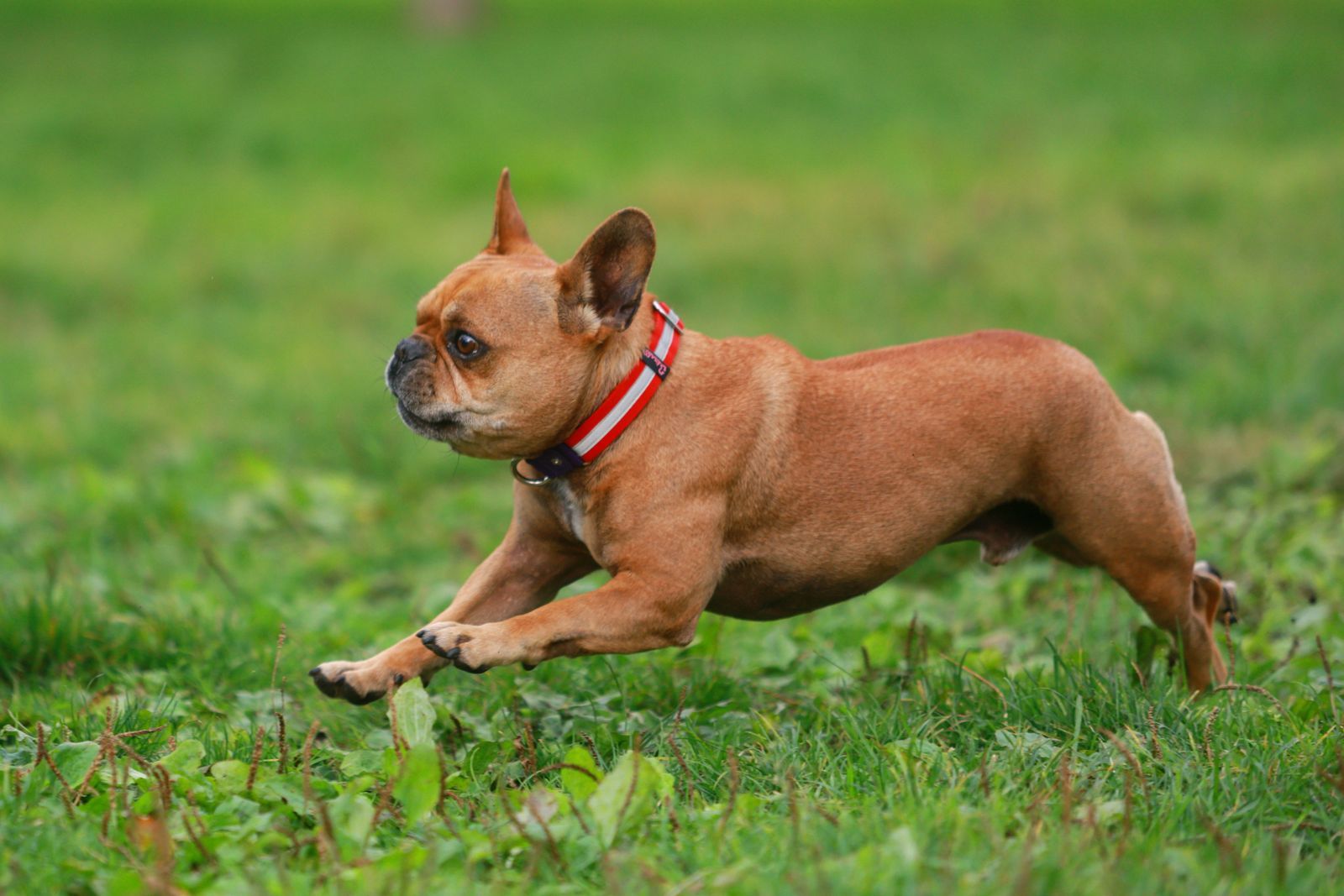
Breed snapshot
The French Bulldog was bred as a companion, and it still does that job with unusual intensity. Most Frenchies want to be near their people, follow the household routine, and settle close by once play is done. The breed is playful and adaptable, with a short coat that needs little grooming beyond regular cleaning of the facial folds and ears. Exercise needs are modest, and that is partly by necessity. A short muzzle makes hard exercise and hot weather genuinely risky, so short walks in cool parts of the day suit this breed better than long outings. The same build that makes a Frenchie charming also explains the health section that follows.
| Height | 11 to 13 inches |
|---|---|
| Weight | Under 28 pounds |
| Lifespan | 10 to 12 years |
| Coat | Short, smooth, fine, and easy to groom, with loose skin and folds on the face |
| Temperament | Adaptable, playful, and smart, with an even disposition and a strong attachment to people |
| Energy and exercise | Moderate to low. Short daily walks and indoor play, with care to avoid heat, humidity, and overexertion |
Health tendencies in French Bulldogs
No list can predict an individual dog. These are tendencies that breed clubs and veterinary references flag again and again for French Bulldogs. Some Frenchies will face several of them. Others will face few. The point of reading them before you shop is simple. You can match each tendency to the exact policy clause that would decide a claim for it.
This section is general information only. It is not veterinary advice, and it is not a diagnosis for any specific dog. Signs described here can have many causes. Only a veterinarian who examines your dog can say what is going on and what care is needed. If your dog is struggling to breathe, collapses, or cannot cool down, seek emergency care right away.
Breathing difficulty (brachycephalic obstructive airway syndrome, or BOAS)
What it is
Brachycephalic means short headed. In a French Bulldog the skull bones are compressed, but the soft tissues inside do not shrink by the same amount. Cornell describes several findings that can narrow airflow together. The nostrils may be small and may collapse inward as the dog breathes in. The soft palate at the back of the mouth may be long enough to block the entrance to the windpipe. Small pouches of tissue near the vocal cords can be pulled inward. Some dogs also have a windpipe that is narrower than expected. Working harder to breathe can swell throat tissue over time, which narrows the airway further. Heatstroke risk belongs in this same card, because a dog that cannot move air well also cannot cool well by panting. Heat, humidity, excitement, and extra weight all make the effort harder.
Signs owners may notice
- Noisy breathing, snoring while awake, snorting, or a raspy sound on walks
- Breathing that looks like hard work, with the chest and belly moving more than expected
- Tiring quickly, sitting down on walks, or avoiding exercise in warm weather
- Gagging, retching, or trouble swallowing, which Cornell notes can travel with airway problems
- Restless sleep, sleeping sitting up, or holding the chin lifted to breathe more easily
- Overheating signs such as heavy panting that does not settle, drooling, bright red gums, or wobbliness in heat
These signs are possibilities to discuss with a vet. They are not a diagnosis on their own, and quiet snoring alone does not prove how severe an airway problem is.
When it can be urgent
How vets usually evaluate and treat it
Evaluation usually starts with history and a physical exam. A vet can see narrowed nostrils on a routine exam. Looking at the soft palate and the tissues near the vocal cords usually needs light anaesthesia, and Cornell notes that chest and neck imaging can show windpipe size, with endoscopy or CT used in some cases. Mild cases are often managed with weight control, a harness instead of a neck collar, controlled activity, and strict avoidance of heat and humidity. More severe cases may be referred to a surgical specialist. Surgery can widen the nostrils, shorten a long soft palate, or remove everted tissue. There is no surgery for a narrow windpipe itself. Anaesthesia in this breed needs extra care, and swelling after surgery is a known risk that the care team plans for.
Allergies and skin fold dermatitis
What it is
French Bulldogs are prone to allergic skin disease, including atopic dermatitis, where the skin reacts to everyday substances in the environment. The Merck Veterinary Manual describes atopy as a chronic, itchy skin disorder with a genetic predisposition in many dogs, often starting in young adulthood. The feet, face, ears, front legs, and belly are common sites. Licking and scratching damage the skin barrier and invite secondary bacterial and yeast infections, and ear infections often travel with the skin picture. Skin fold dermatitis is a related but distinct problem. The deep folds on the face, around the tail, and in other creases trap moisture, warmth, and debris. That sheltered skin can become red, sore, and infected even in a dog whose main problem is not allergy at all. Many Frenchies have both patterns at once, which is why one course of care rarely ends the story.
Signs owners may notice
- Frequent scratching, paw licking or chewing, face rubbing, or head shaking
- Red, thickened, greasy, or flaky skin, hair loss, or a musty smell from the skin
- Redness, moisture, or discharge inside a facial fold, lip fold, or tail pocket
- Recurring ear redness, discharge, odour, or sensitivity when the ears are touched
- Hot spots or sores that return soon after they seem to heal
When it can be urgent
Most skin flare ups are not emergencies, but they should not wait for weeks either. Prompt care matters when the skin is rapidly swelling, oozing, bleeding, or very painful, when an ear is swollen shut or the dog cries when it is touched, or when scratching is keeping the dog from sleeping. A fold infection that spreads or a dog that stops eating because of discomfort also needs a same day call.
How vets usually evaluate and treat it
A vet will usually examine the skin and ears, look at material from the skin or ear under a microscope, and work through likely triggers. Merck notes that atopic dermatitis is diagnosed from age, breed, signs, and history rather than from a single test, and allergy testing is mainly used to plan long term immunotherapy after the clinical picture is clear. Food related reactions are usually explored with a structured elimination diet trial. Care is often layered and long term. It can include topical care and fold cleaning and drying, treatment for secondary infection, medicines that control itch and inflammation, flea control, diet trials, and immunotherapy in selected cases. Ear care and rechecks are part of the plan when ears are involved.
Back and spine problems (intervertebral disc disease and spinal malformations)
What it is
French Bulldogs are a chondrodystrophic breed. That term describes a body shape with shortened legs, linked to early changes in the discs between the spine bones. Cornell explains that in these breeds the soft centre of a disc can harden at a young age. A hardened disc can bulge or rupture through its outer layer and press on the spinal cord. That is intervertebral disc disease, often shortened to IVDD. Frenchies also carry congenital spinal malformations linked to the screw tail. Vertebrae can form in a wedge or butterfly shape, often called hemivertebrae. Many such findings are discovered by chance on imaging and never cause signs. In some dogs a malformed vertebra contributes to an uneven spine, cord pressure, or disc trouble nearby. The two problems are different, but owners meet them through the same doorway, which is back pain or a change in walking.
Signs owners may notice
- Reluctance to jump, climb, walk, or be lifted, or crying out when moving or when the back is touched
- A stiff neck, an arched back, trembling, or a hunched posture
- Wobbliness, knuckling or dragging of the paws, hind leg weakness, or loss of coordination
- Sudden reluctance to lower the head to eat or drink from a bowl on the floor
- Loss of bladder or bowel control in a severe episode
When it can be urgent
How vets usually evaluate and treat it
Evaluation starts with a physical and neurological exam to locate pain and grade any weakness. Plain imaging can be a first step in mild cases. Cornell notes that dogs with more than mild pain are often referred to a neurologist, where MRI or CT gives a clear picture of disc material and cord pressure and helps separate disc disease from other causes. Mild cases may be managed at first with strict rest, pain relief, and muscle relaxant medicines. Severe cases, or cases that worsen, may need surgery to remove disc material and take pressure off the cord. Recovery after surgery includes crate rest, help with toileting at first, monitoring for pressure sores, and a gradual rehabilitation program that can include laser therapy and underwater treadmill work.
Hip dysplasia
What it is
Hip dysplasia is abnormal development of the hip joint. The Merck Veterinary Manual describes it as joint laxity, meaning looseness in the joint, followed over time by degenerative joint disease and osteoarthritis. The ball and socket do not fit tightly, so the joint moves unevenly, cartilage wears, and pain and stiffness develop. Merck notes that the condition is most often discussed in large breeds but can affect small breeds and cats as well. French Bulldogs are a recognised example in a small, heavy bodied breed. Heredity matters, and growth, nutrition, exercise, and weight influence how the joint copes.
Signs owners may notice
- Stiffness after rest, trouble rising, or reluctance to climb stairs or jump into the car
- Limping in a back leg, worse after exercise, or a swaying or bunny hopping run
- Loss of muscle in the back legs, or pain when the hip is moved during an exam
- Slowing down on walks that an owner first puts down to laziness or heat
In a Frenchie, hip signs can be easy to confuse with back pain or simple reluctance to exercise in warm weather. That overlap is one more reason a vet exam matters instead of guessing at home.
When it can be urgent
Hip dysplasia itself usually develops gradually and is not an emergency. Sudden inability to bear weight, a fall, crying in pain, or a leg held in an odd position after trauma needs prompt care, because those signs point to an injury or another problem rather than slow joint change alone.
How vets usually evaluate and treat it
A vet will usually assess gait, muscle, pain, and hip movement, and use hip imaging to see joint looseness and any arthritis. Merck describes medical care built around weight control, activity modification, controlled physical therapy, and anti-inflammatory pain relief, with supplements discussed in some cases. Most dogs with hip dysplasia do not need surgery, according to Merck. When surgery is considered, options range from procedures in young dogs to total hip replacement in selected cases, usually through a specialist. Keeping a Frenchie lean is not cosmetic advice here. Less weight means less load on a loose joint on every single step.
Eye problems (cherry eye and corneal problems)
What it is
French Bulldog eyes sit prominently in a shallow, flat faced skull, which leaves the surface of the eye more exposed. Two problems come up again and again. Cherry eye is the prolapse, or slipping out of place, of the tear gland of the third eyelid. It appears as a pink or red swelling in the inner corner of the eye. That gland contributes to tear production, so preserving it matters. Corneal problems affect the clear front surface of the eye. A scratch, a foreign body, dryness, or hairs or eyelid edges rubbing on the surface can create a painful sore called a corneal ulcer. Eyelids that roll inward, often called entropion, can keep rubbing the cornea and make ulcers recur. Dry eye, where tear production falls short, can add further surface damage if it is not recognised.
Signs owners may notice
- A pink or red lump in the inner corner of one eye, which is the classic cherry eye picture
- Squinting, pawing at the eye, excessive tearing, or holding one eye partly closed
- A cloudy, bluish, or dull spot on the clear front of the eye
- Thick discharge, redness of the white of the eye, or light sensitivity
When it can be urgent
How vets usually evaluate and treat it
A vet will usually examine the eyelids and third eyelid, stain the cornea to reveal surface damage, check tear production, and look for hairs, foreign material, or eyelid rolling that keeps injuring the surface. Cherry eye is usually treated with surgery that repositions and secures the gland rather than removing it, because removal raises the later risk of dry eye. Corneal ulcers are treated according to depth and cause, with topical medicines, pain control, protection from rubbing, and close rechecks. Deep or melting ulcers and eyelid problems may need specialist eye surgery. Rechecks matter, because a Frenchie eye can change fast in either direction.
Policy decision table for a French Bulldog
Use this table as a reading order. Start at the top, because the first rows decide whether the rest of the policy is useful for this breed at all. All wording here is generic. Only the actual policy document for a specific plan can tell you what that plan does.
| Policy feature | Why it matters for a French Bulldog | Stronger wording looks like | Watch out for |
|---|---|---|---|
| Hereditary and congenital coverage | Breathing anatomy, hip dysplasia, spinal malformations, and cherry eye are inherited or present from birth. | Hereditary and congenital conditions are covered on the same terms as other illnesses. | Exclusions, low sublimits, or coverage that only starts after a long special waiting period. |
| Brachycephalic and airway wording | BOAS is the defining Frenchie risk, and airway surgery is a specialist procedure. | No breed based airway exclusion, and corrective surgery is a covered treatment when medically necessary. | Language that excludes conditions common to flat faced breeds, or that treats airway surgery as elective. |
| Bilateral condition rules | Hips, eyes, and ears all come in pairs, and Frenchies often develop a problem on both sides over time. | Each side is judged on its own history, or the rule is narrow and clearly defined. | A rule that makes the second side pre-existing because the first side was noted before coverage or during a waiting period. |
| Chronic condition handling at renewal | Allergies, ear disease, and joint pain can need care for years. | A covered condition stays covered in later policy years while you remain insured. | Annual resets that reclassify an ongoing condition, or per condition limits that run out and never refresh. |
| Waiting periods | A Frenchie puppy can show skin, eye, or breathing signs early, and timing decides whether they count as pre-existing. | Short, clearly listed waiting periods with no hidden breed specific extensions. | Long orthopedic or spinal waiting periods, or an airway waiting period buried in definitions. |
| Exam fees, specialists, and rehabilitation | Frenchie care often involves the exam itself, a surgical or eye specialist, imaging, and rehab after spine or hip care. | Exam fees, specialist visits, advanced imaging, and rehabilitation are covered services. | Exam fees excluded on every claim, or rehab covered only in narrow circumstances. |
| Prescription medicines and food | Allergy care can involve long term medicines and, in a diet trial, a prescription food. | Prescription medicines are covered, and the food position is stated plainly. | Assuming prescription food is covered when the policy is silent, or medicine sublimits that end mid treatment. |
| Annual limit and deductible structure | One airway, spine, or hip event can combine emergency care, imaging, surgery, and hospital days in a single year. | An annual limit with room for one major event plus routine illness care, and a deductible you understand. | A per condition deductible that restarts for every new Frenchie problem, or a limit sized only for minor illness. |
Life stages: puppy, adult, and senior
Puppy
The strongest insurance move for a Frenchie is early enrollment with a clean record. Puppies should have a first vet visit promptly, and owners often want coverage in place before that visit produces notes about noisy breathing, fold irritation, a red eye, or itchy skin. Read waiting periods as a calendar. A sign that appears during a waiting period is commonly treated in the same way as a sign that appeared before the policy started. Ask the breeder or rescue for any prior records, vaccine history, and notes about breathing, skin, eyes, or back, and keep them. If a puppy already has a cherry eye or a breathing finding, ask the insurer in writing how that specific history will be treated before you rely on the plan for it.
Adult
Adulthood is when the breed list tends to become real. Cornell notes that BOAS is most often diagnosed in young adult dogs, and allergy signs commonly begin in young adulthood as well. Weight control becomes central, because extra weight worsens breathing, loads the hips and spine, and hides inside a stocky frame where owners miss it. Keep dated photos and vet weight records, keep fold and ear care routine, and do not let a recurring itch become a long home experiment before it is recorded and treated. If you change insurers in adulthood, understand that the new policy will usually judge conditions from the record you already have. A gap in coverage can turn a manageable chronic condition into a pre-existing problem with the next carrier.
Senior
Older Frenchies often carry a combination rather than a single diagnosis. Stiff hips, an old disc episode, ongoing skin care, and eye surface problems can overlap, and anaesthesia decisions need more care because of the airway. Check whether your policy continues enrollment at older ages, how chronic medicines and rechecks are handled, and whether rehabilitation and pain control stay covered. Keep a simple home log of mobility, breathing comfort in heat, appetite, and sleep. That log helps a vet judge change over time, and it also creates the clear timeline that any claim review will look for.
A hypothetical claim, step by step: an airway evaluation that leads to corrective surgery
The walkthrough below is a hypothetical example for learning how a claim moves. It is not a promise that any real claim will be covered. Coverage always depends on the policy, the dates, the medical record, and the facts of the case.
Signs and records before the visit
Imagine an adult Frenchie whose breathing has grown louder over several months. Walks end early, sleep is restless, and a warm afternoon left the dog panting hard long after coming indoors. The owner writes down when the signs started, saves a short phone video of the breathing at rest, and lists prior vet notes. That timeline matters, because the insurer will later compare it with the policy start date and the waiting period.
The vet visit and the diagnosis record
The veterinarian examines the nostrils, listens to the airway, and records the findings. Because the soft palate cannot be assessed properly in an awake dog, the vet explains that a full airway evaluation would need light anaesthesia, possibly with imaging. The written record, with the exam findings and the reasoning for referral, becomes the backbone of the claim. Owners should ask for a copy before leaving.
Checking the waiting period and the policy wording
Before booking surgery, the owner checks three things. The policy start date and whether the illness waiting period had passed before the first sign. Whether any airway or brachycephalic waiting period or exclusion applies. And whether specialist care needs any advance step under the plan. A short written question to the insurer at this stage is worth more than an argument after the bill exists.
Paying the vet and collecting documents
Most pet insurance works on reimbursement. The owner usually pays the clinic, then submits the claim. In this example the evaluation proceeds, the specialist finds narrowed nostrils and a long soft palate, and corrective surgery is performed with planned monitoring for swelling. The owner collects the itemised invoice, the full medical records, the anaesthesia and surgery reports, and any discharge and recheck instructions. Missing pages are the most common avoidable delay.
Submitting the claim
The owner submits the claim form, the itemised invoice, and the complete records, including the first visit where breathing was discussed. Keeping a copy of everything submitted, with the date, makes follow up simple. If the insurer asks for earlier records, sending them promptly and completely is better than sending selected pages.
How reimbursement works in general
After the claim is accepted, the general mechanics are the same as in our guide to what pet insurance costs and why. You meet your deductible as the policy defines it. The plan then reimburses a portion of covered charges as its terms state, up to the annual or per condition limit that applies. Charges the policy excludes, such as an exam fee in some plans, stay with the owner. The exact outcome turns on definitions, not on how sympathetic the story is.
Common denial points for this condition
Airway claims for a Frenchie are most often challenged on timing and wording. A note about snoring, stertor, or breathing difficulty dated before coverage or during a waiting period. A brachycephalic exclusion the owner had not noticed. A finding described as congenital where the plan limits congenital conditions. Or incomplete records that leave the insurer unable to tell when signs began. Each of those risks is reduced by enrolling early, reading the airway clause, and keeping the full record.
What shapes the premium for a French Bulldog
There are no prices in this guide, on purpose. Premiums change by insurer, by place, and by the settings you choose, and a made up average would mislead you. What you can understand in advance is why a Frenchie is priced the way it is. Breed risk comes first. Insurers expect more frequent visits, more chronic care, and a real chance of specialist surgery over a Frenchie lifetime, and the premium reflects that expectation. Age comes next. Premiums generally rise as a dog ages and the chance of illness rises with it, so the quote for a puppy is not the price you will pay for the same dog at eight. Location matters because veterinary fees differ by area, and the same surgery is billed differently in different markets. Plan settings are the part you control. A higher annual limit, a lower deductible, or broader covered services will price differently from a leaner plan. Finally, small size does not rescue this breed on price. Medicines and surgical time may be lower than for a giant dog, but the Frenchie health list outweighs the size effect. For the full mechanics, read what pet insurance costs and why, then judge any quote against the policy table above rather than against the monthly number alone.
Pre-purchase checklist for a French Bulldog
- Confirm hereditary and congenital conditions are covered, and note any sublimit or special waiting period that applies to them.
- Get a written answer on BOAS and corrective airway surgery for a flat faced breed under the exact plan you are considering.
- Read the bilateral rule and picture it applied to hips, eyes, and ears over a full lifetime.
- Confirm allergies and other chronic conditions stay covered after renewal, and check how prescription medicines are handled.
- List every waiting period that could touch this breed, including illness, orthopedic, spinal, and any airway specific period.
- Check whether exam fees, specialist visits, advanced imaging, emergency hospital care, and rehabilitation are covered services.
- Ask how prescription food is treated if a veterinarian recommends an elimination diet trial.
- Choose an annual limit and deductible by picturing one airway or spine event plus a year of skin care in the same policy year.
- Enroll while the record is clean, and keep the breeder or rescue records, the first vet visit notes, and your written insurer answers together.
Questions to ask an insurer, in writing
- Is brachycephalic obstructive airway syndrome covered for a French Bulldog, and is corrective airway surgery a covered treatment?
- Are hemivertebrae and other congenital spinal malformations covered, or excluded as congenital conditions?
- If one hip, eye, or ear is treated, how does your bilateral rule affect the other side later?
- Do allergies that start while my dog is insured stay covered in later policy years?
- What waiting periods apply to spinal, orthopedic, and airway conditions, and what counts as a pre-existing sign during those periods?
- Are exam fees, specialist referrals, CT or MRI imaging, and rehabilitation covered, and are there sublimits on any of them?
Frequently asked questions
Is breathing surgery for a French Bulldog covered by pet insurance?
It depends entirely on the policy wording. Some accident and illness plans treat brachycephalic obstructive airway syndrome as a covered hereditary or congenital condition. Others limit it, apply a special waiting period, or exclude airway surgery for flat faced breeds. Ask the insurer that exact question in writing before you enroll, and keep the answer with your policy documents.
Why does hereditary and congenital coverage matter so much for this breed?
Most of the French Bulldog risk list sits in those two categories. Breathing anatomy, spinal malformations, hip dysplasia, and cherry eye are all linked to how the breed is built or inherited. A plan that excludes hereditary and congenital conditions can leave out the very problems a Frenchie owner is most likely to claim for.
If my Frenchie already snores loudly, is that a pre-existing condition?
It can be treated that way if noisy breathing, breathing difficulty, or an airway finding was noted in the medical record before the policy started or during a waiting period. Insurers read the record, not just formal diagnoses. Enrolling while the record is still clean, and avoiding casual notes about breathing before coverage begins, protects you better than waiting.
Are French Bulldog allergies covered for life or only in the first year?
That depends on how the policy handles chronic conditions at renewal. Some plans keep covering a condition that started while you were insured. Others reset limits each year or treat a condition from a prior year differently. Check the renewal wording for allergies specifically, because Frenchie skin care is often ongoing rather than a single visit.
What waiting periods should I check for a French Bulldog?
Check the general illness waiting period, any longer waiting period for orthopedic or spinal problems, and any breed specific or airway specific waiting period the policy names. A condition that starts during a waiting period is commonly treated as pre-existing, even if you had already paid for the policy.
Does pet insurance cover heatstroke in a French Bulldog?
Emergency care for an illness or accident is the core of most accident and illness plans, but the policy still controls. Check whether emergency care, hospitalization, and oxygen support are covered services, and whether any breed related exclusion could be applied. Prevention still matters most, because a Frenchie can overheat quickly even on a day that feels mild to people.
Sources and further reading
- American Kennel Club, French Bulldog breed page
- Cornell Riney Canine Health Center, Brachycephalic Obstructive Airway Syndrome (BOAS)
- Cornell Riney Canine Health Center, Intervertebral disc disease
- Cornell Riney Canine Health Center, Chondrodystrophy and intervertebral disc disease (CDDY/IVDD)
- Merck Veterinary Manual, Hip Dysplasia in Dogs
- Merck Veterinary Manual, Allergies in Dogs