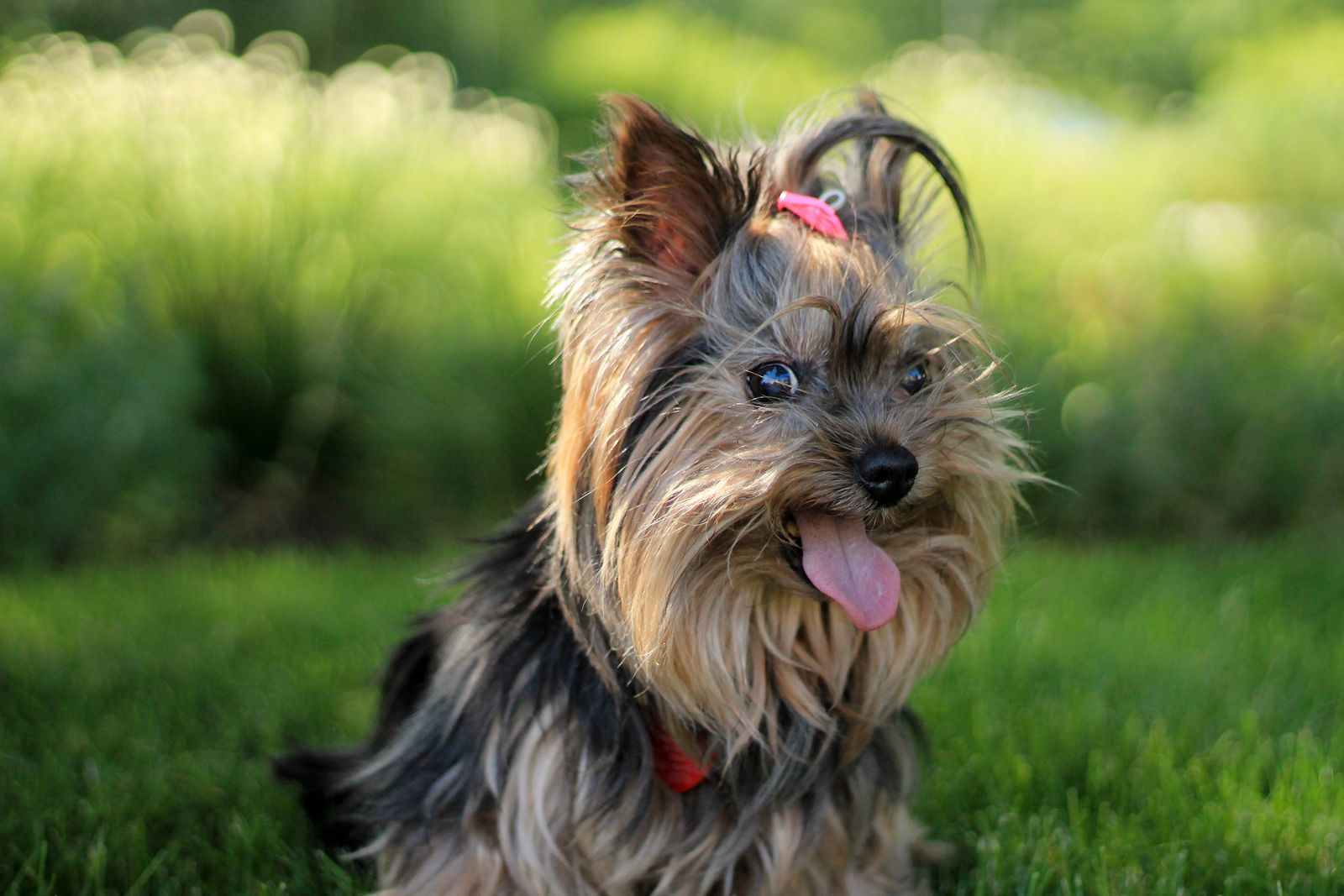
Yorkshire Terrier snapshot
The American Kennel Club describes the Yorkshire Terrier as a feisty, old-time terrier beneath a dainty, glossy, floor-length coat, a dog that earned its living as a ratter in mines and mills before it became a lapdog. That history explains the dog owners live with. A Yorkie is affectionate at home, brave and watchful well beyond its size, and busy in a way that surprises people who expected a quiet toy. Its size is the fact that shapes nearly everything in this guide, from the windpipe to the mouth.
| Height | 7 to 8 inches at the shoulder. |
|---|---|
| Weight | Not to exceed 7 pounds. |
| Lifespan | 11 to 15 years, as listed by the AKC. |
| Coat | Long, fine, and silky, in steel blue and tan. Puppies are born black and tan and change color as they mature. |
| Temperament | Affectionate and sprightly, with the confidence of the terrier it still is. |
| Energy and exercise | Moderately active for a toy breed. Needs daily play and short walks, with care around larger dogs and jumps from furniture, because the frame is small and the legs are fine boned. |
Two snapshot facts matter most for insurance. The first is the lifespan. A dog that lives into its mid teens spends years in the stages where tracheal collapse is managed and teeth need repeated attention. The second is the weight ceiling. At under 7 pounds, the windpipe is narrow, the mouth holds a full set of teeth in a tiny jaw, and the liver of a puppy with a shunt stays small because blood that should feed it goes around it. Small is the mechanism behind the breed list.
The Yorkshire Terrier sits at No. 11 in the AKC 2024 registration rankings. Insurers have deep experience with these claims, and their definitions for hereditary, congenital, and dental conditions are written with small breed files like this one in mind.
Health tendencies in Yorkshire Terriers
The breed club health program, run through the OFA Canine Health Information Center, known as CHIC, requires a patella evaluation and an eye examination, and the club health statement names liver shunt among the breed's other conditions, with bile acid testing described as a good indicator of liver health. These are tendencies, not predictions. The point of knowing the list is to know which clauses to read before you need them.
This section is general information about conditions a breed can be prone to. It is not veterinary advice and it is not a diagnosis of any dog. Signs listed here are possible signs owners may notice, and many of them have several causes. Only a veterinarian who examines your dog can say what a sign means.
Luxating patella (slipping kneecap), and its grades
What it is
A developmental condition in which the kneecap, the patella, slips out of the groove at the front of the knee that it should ride in, usually toward the inside of the leg. The Merck Veterinary Manual describes patellar luxation as displacement of the kneecap from its groove, often tied to the shape of the whole hind leg. Vets grade it during a hands-on exam, from a kneecap that can be pushed out but otherwise stays in place, to a kneecap that stays out and cannot be returned to the groove. The grade, not just the diagnosis, drives treatment, which is why the grade in the record matters so much. The breed club requires an OFA patella evaluation for CHIC, which reflects how central this joint is to the breed.
Signs owners may notice
- A sudden skip or hop on a back leg for a few steps, then normal walking again. Merck calls this intermittent, short lived lameness the characteristic sign.
- Holding a back leg up briefly, kicking it out behind, or stretching it before continuing.
When it can be urgent
A skipping gait is a book an appointment sign, not an emergency. A knee problem combined with a fall from furniture, a cry of pain, swelling, or a leg that will not bear weight could be a cruciate ligament injury or a fracture, and that combination needs prompt care the same day.
How vets usually evaluate and treat it
Vets usually diagnose and grade the kneecap by hand, sometimes with X-rays of leg alignment and arthritis. Merck notes that conservative care, meaning weight management, controlled exercise, physical therapy, and pain medication, suits mild cases, while surgery is usually considered for moderate to severe grades, persistent lameness, or a condition that is getting worse. Keeping a dog this small lean is a real part of the plan, because extra weight loads a loose knee heavily on a tiny frame.
Tracheal collapse (a weakening windpipe)
What it is
A progressive condition of the trachea, the windpipe, in which the C-shaped cartilage rings that hold the airway open weaken and flatten, narrowing the airway. Cornell's Riney Canine Health Center describes tracheal collapse as common in toy and small breed dogs such as Yorkshire Terriers, Pomeranians, and Toy Poodles, most often in middle aged or older dogs, and notes that a genetic component may be involved because small breeds are the ones most commonly affected. Cornell is direct that there is no cure, that the condition can worsen over time, and that ongoing medical management can improve signs and quality of life. Stress, excitement, heat, inhaled irritants such as smoke, and pressure on the neck can make coughing worse, which is why a harness instead of a neck collar is standard advice for this breed.
Signs owners may notice
- A persistent, harsh, dry cough, sometimes described as a goose honking cough. Cornell names this as the most common sign.
- Coughing fits set off by excitement, pulling on a collar, drinking, heat, or being picked up around the chest.
- In severe cases, difficulty breathing, gums or tongue turning blue, or fainting.
How vets usually evaluate and treat it
Evaluation usually starts with an exam and bloodwork, and Cornell notes that a cough can often be set off by gently feeling the throat. Confirming the diagnosis can take more, because a plain X-ray is a snapshot and the trachea may only flatten during one phase of breathing. Moving X-rays, called fluoroscopy, show the trachea during breathing, and a camera passed into the airway under anesthesia, called bronchoscopy, lets the clinician see the collapse directly. Treatment is usually medical first, with cough suppressants, sedative or anti-anxiety medication, corticosteroids, bronchodilators, and antibiotics when infection is present, plus weight control. Emergency care includes immediate attention and oxygen. A stent placed by a board certified surgeon is considered when medical management fails, and medication usually continues after surgery.
Portosystemic shunt (liver shunt) in a puppy
What it is
An abnormal blood vessel that lets blood from the digestive organs bypass the liver and go straight into the general circulation. The liver normally filters toxins such as ammonia out of that blood and takes up nutrients from it. When blood goes around the liver, toxins travel onward, including to the brain, and the liver itself stays small. The American College of Veterinary Surgeons notes that the single abnormal vessels outside the liver are the congenital pattern seen primarily in small breed dogs such as the Yorkshire Terrier, while shunts inside the liver are more typical of large breeds. The breed club health statement names liver shunt among the conditions that can affect the breed and describes bile acid testing as a good indicator of liver health. A related condition, in which many tiny vessels inside the liver work poorly rather than one vessel bypassing it, can produce similar signs and test results, and telling the two apart is part of the workup.
Signs owners may notice
- Poor growth. A puppy that stays the smallest, gains slowly, and builds little muscle compared with littermates.
- Episodes that come and go, often worse after eating. Staring into space, disorientation, circling, head pressing against a wall, wobbliness as if drunk, unusual quietness, or apparent blindness.
- Seizures in a young puppy, drooling, or a puppy that is slow and hard to rouse after a meal.
- Digestive and urinary signs. Vomiting, diarrhea, poor appetite, drinking and urinating more, straining to urinate, or bladder stones at an unusually young age.
How vets usually evaluate and treat it
The workup usually starts with routine bloodwork and a urine test. The American College of Veterinary Surgeons notes that dogs with a congenital shunt often show low blood urea nitrogen and low albumin, and that none of those changes alone proves a shunt. Liver function testing follows, most often bile acids measured after a fast and again after a meal. Bile acids are made by the liver and normally taken back up by it. When blood bypasses the liver, bile acids stay high in circulation. High bile acids can occur with other liver disease too, so imaging finds the vessel itself, using ultrasound, nuclear medicine scanning, or CT imaging, often at a referral center. Treatment has two arms. Medical management uses diet change and medication to reduce toxins reaching the brain. Surgical management, by a board certified surgeon, gradually closes the abnormal vessel so the liver can adjust. Follow up bloodwork is part of either path.
Dental disease in a tiny mouth, and retained baby teeth
What it is
Yorkshire Terriers carry a full set of adult teeth in a very small jaw, and crowding is the predictable result. Crowded teeth trap plaque, plaque hardens into tartar, and bacteria work under the gum line, producing periodontal disease, inflammation and damage in the tissues that hold the teeth in place. Cornell calls periodontal disease one of the most common health issues in veterinary medicine, notes that it is worse in smaller breeds and increases with age, and warns that it is usually not recognized until advanced, because much of the damage sits below the gum line. The breed club makes the same point, calling dental maintenance important in all toy breeds and recommending regular brushing. A second, earlier problem is specific to small puppies. Baby teeth that do not fall out when adult teeth come in, called retained or persistent deciduous teeth, crowd the mouth further and can push adult teeth into the wrong position.
Signs owners may notice
- Bad breath that goes beyond ordinary dog breath, which is often the first sign an owner can detect.
- Yellow or brown tartar along the gum line, red or bleeding gums, or gums pulling away from a tooth.
- Dropping kibble, chewing on one side, pawing at the mouth, preferring soft food, or new irritability when the face is touched.
- In a puppy, two teeth in the same spot, a baby fang sitting alongside the adult fang, or adult teeth coming in at an angle.
When it can be urgent
Most dental disease is a prompt routine visit, and its quiet progress is why it should not wait for pain to announce it. A swollen face or jaw, a dog that cannot close its mouth, drooling with blood, or a broken tooth needs same day care. A puppy whose retained baby teeth are pushing an adult fang into the gum also needs a timely appointment, because the bite is still forming.
How vets usually evaluate and treat it
Evaluation combines an awake mouth exam with, when disease is suspected, a full dental assessment under anesthesia, the only way to probe below the gum line and take dental X-rays. Treatment categories include professional scaling and polishing, extraction of teeth that are loose, infected, or too damaged to save, and removal of retained baby teeth, often planned at the same anesthesia as a spay or neuter when timing lines up. Home care is the other half of treatment. Cornell and the breed club both point to regular tooth brushing as the measure that slows plaque between cleanings. In a mouth this small, home care decides how many teeth a senior Yorkie still has.
Inherited eye conditions
What it is
The breed club requires an eye examination by a veterinary ophthalmologist as one of the two core CHIC health tests, alongside the patella evaluation, and notes that the breed has two definitive genetic tests, both for eye conditions, covering progressive retinal atrophy and primary lens luxation. Progressive retinal atrophy is a group of inherited diseases in which the light sensitive cells of the retina gradually deteriorate, affecting night vision first. Primary lens luxation is an inherited weakness of the fibers that hold the lens in place, which can let the lens slip. The club recommends screening be repeated over a dog's life, because some inherited eye changes appear with age.
Signs owners may notice
- For retinal disease: hesitation in dim light, bumping into furniture in a dark room, reluctance on stairs at night, or eyes that shine more than usual in photographs and low light.
- For a lens problem: a red, cloudy, or painful eye, squinting, tearing, a pupil that looks different from the other side, or a sudden change in vision.
How vets usually evaluate and treat it
Evaluation is a full eye exam, with referral to a veterinary ophthalmologist for screening and for any suspected inherited disease. The exam can include measuring pressure inside the eye and examining the retina. Genetic testing can identify dogs carrying the known mutations the club names, mainly a breeding and early knowledge tool rather than a treatment. Treatment depends on the condition. Retinal degeneration has no cure, and care focuses on safety and monitoring. A luxated lens is a surgical category in many cases, and pressure problems are treated with medication and, in advanced cases, surgery. Early detection is the practical value of screening, because outcomes are better when a condition is found before it becomes painful.
Low blood sugar (hypoglycemia) in toy puppies
What it is
Very small puppies have very small energy reserves. A Yorkshire Terrier puppy that misses meals, is stressed by a move, is chilled, or is fighting illness or parasites can use up its blood sugar faster than its body replaces it, and the brain feels that shortage first. Low blood sugar is not inherited the way a shunt or a kneecap problem is. It is a size and age risk, concentrated in the youngest puppies, and it is on this list because its signs overlap with the signs of a liver shunt. A wobbly, dull puppy may be low on sugar, may have a shunt, or may have both questions open, and only testing separates them.
Signs owners may notice
- Unusual sleepiness, weakness, or a puppy that is hard to wake and floppy when handled.
- Wobbliness, trembling, shivering that is not explained by cold, or a dazed, glassy eyed look.
- In severe cases, twitching or a seizure, or a puppy that collapses.
How vets usually evaluate and treat it
Evaluation is fast and focused. The team will usually measure blood glucose early, warm and stabilize the puppy, and give glucose by mouth if the puppy can swallow safely or into a vein when it cannot. Then the work turns to the cause, with a review of feeding, checks for parasites and infection, and broader bloodwork when episodes repeat or the puppy is not growing, which is where a liver shunt enters the same workup described above. Ongoing care is a feeding plan with regular small meals and clear instructions on which signs mean come back now. Most puppies outgrow the highest risk as they grow and eat reliably.
Policy decisions that matter for a Yorkshire Terrier
For a large breed, the policy table is often about one big surgery. For a Yorkshire Terrier it is about classification and records. Four of the six conditions above turn on how a policy defines hereditary and congenital, one turns on dental wording, and all of them turn on what the first puppy visits put in writing. Read these rows before the price, because a cheaper policy that classifies the breed list out of coverage is not cheaper in any sense that matters.
| Policy feature | Why it matters for a Yorkshire Terrier | Stronger wording looks like | Watch out for |
|---|---|---|---|
| Hereditary condition coverage | Kneecaps and inherited eye conditions are hereditary by nature, and tracheal collapse may involve a genetic component. | Hereditary conditions covered on the same terms as other illnesses. | Hereditary exclusions, or a named list that includes the conditions this breed is screened for. |
| Congenital condition coverage | A liver shunt is present from birth and often discovered months later. | Congenital conditions covered when signs come after enrollment and the waiting period. | Wording that excludes anything present at birth, which removes the shunt question in one line. |
| Orthopedic waiting period and bilateral rule | Kneecaps come in pairs, and a problem on one side raises the chance of the same grade on the other. | Each knee judged on its own record, with clear terms for the second side. | A long special waiting period, or wording that treats the second knee as pre-existing after the first is graded. |
| Dental wording | A tiny, crowded mouth makes periodontal disease a core risk, and retained teeth are a puppy decision with a deadline. | Dental disease treatment and extractions covered as illness, with cleaning and retained teeth described plainly. | Dental illness excluded, extractions classed as routine, or retained teeth denied as congenital without that being stated up front. |
| Chronic condition renewal terms | Tracheal collapse is progressive and managed for life once it appears. | A covered condition stays covered in later terms while enrollment continues. | Wording that caps a condition per year, ends its coverage at renewal, or reclassifies it as pre-existing. |
| Diagnostics and referral coverage | A shunt is found by bile acid testing and referral imaging, and a collapsing trachea may need moving X-rays. | Lab work, imaging, and specialist exams are covered categories for a covered condition. | Policies that cover treatment but exclude or separately cap the tests that establish the diagnosis. |
| Pre-existing sign definitions | First puppy visits record knee grades, liver values, growth, and teeth. Each note can be read later as an early sign. | Clear definitions of what counts as a sign. | Definitions so broad that a vague puppy note, such as small for age, is used against later claims. |
| Emergency care terms | A low blood sugar puppy and a dog in respiratory distress both go to whichever clinic is open. | Emergency care covered on the same terms, with approval steps waived for true emergencies. | Lower reimbursement at emergency clinics, or approval steps that cannot be completed during a breathing emergency. |
Life stages: puppy, adult, and senior
Puppy
The puppy stage carries more of this breed's insurance story than any other. A liver shunt usually declares itself in the first year, through poor growth, strange episodes after meals, or bloodwork that does not look right. Kneecaps are graded at early exams. Baby teeth that do not fall out need a removal decision while the adult bite is still forming. Low blood sugar risk is highest in the smallest puppies. Every one of those events writes something into the record, and the record is what an insurer reads. Enrolling before those notes exist, and keeping the complete record of every puppy visit, including normal findings, is the single most valuable move a Yorkie owner makes. A record showing normal knees, normal liver values, and a normal dental baseline is evidence in the owner's favor.
Adult
Adulthood is when the mouth and the windpipe take over. Periodontal disease builds quietly below the gum line, and a home brushing routine and professional cleanings decide how much of it arrives. Tracheal collapse most often appears in middle aged dogs, starting as a honking cough owners may first blame on a collar or excitement. Knees graded mild in puppyhood are rechecked, and most stay managed without surgery. The insurance work of this stage is steady. File claims as they happen, keep dental charts and dated cough notes, use a harness, keep the dog lean, and check at each renewal that any condition the dog now has is still described as covered.
Senior
A senior Yorkshire Terrier can be a senior for years, and the senior list is a combination. Advanced dental disease, a collapsing trachea needing daily management, arthritic knees, and vision changes can all overlap in the same small dog. Anesthesia decisions get more careful with age, which is one more reason earlier dental work serves the dog better. Review the policy for age based changes and any reduction in coverage at advanced ages. A plan that thins out when a long lived breed needs steady care fails the purpose it was bought for.
A claim, step by step: a liver shunt workup in a puppy
The example below is hypothetical. It is not a real dog, a real claim, or a guarantee of how any insurer will decide. It follows a young puppy through poor growth, bloodwork, bile acid testing, referral imaging, and a treatment decision, because that sequence, and the puppy record behind it, is what shunt coverage has to handle. Pet insurance generally reimburses after you pay the vet, as explained in how pet insurance works.
The puppy that is not keeping up, and the notes that start the file
The puppy was the smallest in the litter and stays small. At home the owner notices episodes after meals. The puppy stares, wanders in a circle, presses its head against a cushion, then sleeps and seems nearly normal again. The owner writes down the dates, the timing after food, and what each episode looked like, and takes a short video of one. That timeline matters, because episodes that follow meals point a vet toward the liver in a way that a vague report of acting strange does not.
The first bloodwork, and what it can and cannot say
The vet does a full exam, weighs the puppy against its growth curve, and runs bloodwork and a urine test. The results show some changes vets associate with a shunt, including low values tied to liver function. The vet explains that those changes raise the question rather than answer it, because other liver problems can look similar. The records from this visit are the clinical core of the claim. The first puppy visit, weeks earlier, recorded a bright, normally growing puppy with no liver concerns, and that contrast is part of the story.
Bile acids, and checking the policy dates
The next step is a bile acid test, with samples after a fast and again after a meal, to measure how well the liver takes bile acids back out of circulation. The results come back high, which fits a shunt and fits some other liver disease, so the vet refers the puppy to a specialist center for imaging. On paper, the insurer will line the sequence up against the policy dates. The policy was started soon after the puppy came home, the illness waiting period ended before any episode was noted, and there is no earlier record of poor growth or a liver concern. That clean timeline makes this a straightforward claim. A bile acid test run by a breeder before purchase and never shared with the owner is the kind of record that turns the same claim into an argument, which is why asking the breeder what testing was done belongs in the puppy file.
Referral imaging, and paying as you go
At the referral center, imaging finds a single abnormal vessel outside the liver, the pattern specialists expect in a small breed. The surgeon explains the two arms of treatment. Medical management, with diet change and medication to reduce toxins reaching the brain. And surgery that closes the vessel gradually, so the liver can take over at a pace it can handle. The owner pays each provider directly and collects the same two documents every time: the itemized invoice and the complete records, including imaging reports. Keeping the general vet and specialist records together matters, because the insurer reads the workup as one story.
Submitting the claim
The claim is filed with the invoices and records from both clinics, the episode timeline, and the bile acid and imaging results. The diagnosis recorded is a congenital portosystemic shunt. That word, congenital, is why the policy definitions were worth reading before enrollment. Under a policy that covers congenital conditions, the workup and treatment are assessed as a covered illness. Under a policy that excludes conditions present at birth, the same file can be denied on classification alone, with the medicine itself never in dispute.
Treatment, follow up, and how reimbursement works
Care settles into the path the specialist recommended, with follow up visits and repeat bloodwork, including bile acids, to check liver function. Each eligible bill moves through the same mechanics described in what pet insurance costs and why. Charges count against the deductible first, the policy's reimbursement rate applies to eligible charges after that, and totals are tracked against the annual limit. The follow up testing is not an optional extra. It is how the vet team knows whether the liver is recovering, and it should be filed with the same care as the surgery.
Renewal, and where shunt claims get denied
At renewal, the question is whether a condition diagnosed in the first term stays covered for its follow up in the next. Under wording that keeps covered conditions covered, rechecks and repeat bile acid tests are filed the same way, referencing the original diagnosis date. Denial pressure points are classification, with a congenital exclusion applied to a shunt. Timing, with an insurer reading an early note about slow growth as a pre-existing sign. And documentation, with a breeder side test result surfacing late. Each can be settled in writing before the episodes start, not after the referral.
What drives a Yorkshire Terrier premium
No responsible guide will name a price for your dog, because the quote depends on the dog, the address, and the settings chosen. What can be explained is the shape of Yorkshire Terrier pricing. The full mechanics are in what pet insurance costs and why.
Breed risk profile. Insurers see a toy breed whose serious conditions concentrate in specific systems. The knees, the windpipe, the liver in puppyhood, and the mouth across a lifetime. Two of those can involve referral centers and specialist surgery, even though the dog is tiny. Pricing reflects that mix of small body and specialist medicine.
Size. A dog under 7 pounds costs less to anesthetize and medicate than a large breed. That economy is incomplete, because imaging, specialist time, and dental work under anesthesia do not shrink in proportion to the dog. For this breed, the value question is less about the size of a single bill and more about whether the classification clauses let the breed's actual claims through at all.
Age curve and lifespan. Premiums generally rise with age, and a breed that lives 11 to 15 years spends a long time in the higher priced years. The puppy year carries the shunt and retained teeth questions, the middle years carry the teeth and the windpipe, and the senior years combine them. A policy chosen only on its puppy price is being judged on the one year when the least is known about it.
Location and plan settings. Vet prices in your area set the bill sizes the insurer expects, and referral centers are not priced like general practices. Your deductible, reimbursement rate, and annual limit choices trade premium against claim returns. An owner expecting a possible referral workup in the first year should weigh the annual limit and diagnostics wording with that scenario in mind.
Pre-purchase checklist for a Yorkshire Terrier policy
- Confirm hereditary conditions are covered, including luxating patella and inherited eye conditions.
- Confirm congenital conditions are covered, because a liver shunt is present from birth even when it is found later.
- Read the orthopedic waiting period and the bilateral clause for knees, and ask how a mild puppy knee grade is treated later.
- Separate the dental wording into cleaning, treatment of dental disease and extractions, and removal of retained baby teeth.
- Confirm a condition covered in one term, such as tracheal collapse, stays covered at renewal for as long as you stay enrolled.
- Check that bile acid testing, referral imaging, fluoroscopy, and specialist exams are covered categories for a covered condition.
- Ask what counts as a pre-existing sign, and how notes from the first puppy visit are used.
- Confirm emergency clinic care is covered on the same terms, for a low blood sugar puppy or a breathing emergency.
- Enroll as a young puppy, before a knee grade, a liver value, or a dental finding enters the record.
The puppy vet-record checklist: knees, liver values, dental baseline
This breed's claims are decided by a record mostly written in the first year. Use this checklist at the first puppy visits and keep it with the policy. Each item is a document an insurer, or a specialist, will ask for later.
| Record item | What to ask the vet to note | Why it belongs in the file |
|---|---|---|
| Knees | The patella finding for each hind leg at the first exams, including the grade if a kneecap can be slipped, or a plain note that both kneecaps track normally. | The starting point every later knee claim is measured against. |
| Growth and weight | A weight at every puppy visit, plotted against the puppy's own curve, with a note on appetite and muscle development. | Poor growth is an early shunt sign. A normal growth curve is evidence the puppy was thriving. |
| Liver values | The puppy blood panel results in full, and bile acid results if the test is run, kept as the actual lab report rather than a summary line. | Liver values and bile acids are the shunt workup. The baseline settles timing questions later. |
| Breeder testing | What health testing the breeder did on the parents, including the OFA patella evaluation and eye examination, and any bile acid testing done on the puppy before purchase, with copies. | Testing done before you owned the puppy can surface in a claim review. Holding copies removes the surprise. |
| Dental baseline | Which baby teeth have fallen out and which are retained as the adult teeth come in, the bite alignment, and a baseline note on gums and tartar at the first adult dental check. | Retained teeth have a removal window, and a clean baseline separates later disease from the starting point. |
| Episodes at home | A dated log of any strange episodes, with timing after meals, duration, and video when you can take one safely, covering staring, circling, head pressing, wobbliness, or unusual sleepiness. | Episodes after meals point toward the liver, and a dated log places the first sign accurately. |
Questions to ask an insurer, in writing
- Are congenital conditions covered, including a portosystemic shunt diagnosed months after enrollment in a puppy enrolled young?
- How is luxating patella classified, what orthopedic waiting period applies, and how is the second knee treated under your bilateral rule?
- If a puppy exam noted a mild knee grade with no treatment, does that note make later knee surgery pre-existing under your definitions?
- How is tracheal collapse classified for a Yorkshire Terrier, and will its management stay covered at every renewal?
- How do you handle dental care in three parts: routine cleaning, treatment of dental disease including extractions, and removal of retained baby teeth?
- Are bile acid testing, referral imaging, and specialist surgery covered categories for a liver condition diagnosed after the waiting period?
Questions Yorkshire Terrier owners ask
Which Yorkshire Terrier conditions do insurers treat as hereditary?
It depends on the policy definitions, and that is exactly why the definitions page matters for this breed. A slipping kneecap is commonly classed as a hereditary or developmental condition, a liver shunt present from birth is commonly classed as congenital, and inherited eye conditions are hereditary by definition. Tracheal collapse and dental disease are handled less consistently, so ask in writing how each of the conditions in this guide is classified before you enroll.
Is a liver shunt covered if my Yorkie was born with it?
It can be, when congenital conditions are covered and no signs, abnormal liver values, or bile acid results were recorded before enrollment or during the waiting period. Congenital wording is the clause to read, because a shunt is present from birth even when it is found months later. Ask in writing whether congenital conditions are covered, and whether a puppy blood panel that hinted at a liver problem counts as a pre-existing sign.
Does insurance cover kneecap surgery for a Yorkshire Terrier?
An accident and illness policy can cover surgery for a luxating patella when hereditary conditions are included, the orthopedic waiting period has passed, and the knee was not noted as loose before enrollment. Mild grades are often managed without surgery, and surgery is usually discussed for higher grades, persistent lameness, or a knee that keeps slipping. Read the bilateral clause too, because the other knee is often watched once one side is diagnosed.
Will tracheal collapse stay covered for the life of my dog?
It should, under a policy that keeps covered chronic conditions covered at renewal. Cornell describes tracheal collapse as progressive, with no cure and ongoing medical management that can improve signs and quality of life. That makes renewal wording central for this breed. Avoid wording that caps a condition each year or treats it as pre-existing again at renewal, and check that cough medication and recheck visits for an ongoing covered condition are reimbursable.
Does pet insurance pay for dental cleaning in a Yorkie?
Routine cleaning is usually treated as preventive care, which standard accident and illness policies generally do not cover unless a wellness add-on includes it. Treatment of dental disease itself is a separate question. Some policies cover extractions and treatment of diseased teeth as illness, and some exclude dental illness or limit it. Because a tiny, crowded mouth makes dental disease a core risk in this breed, ask in writing how dental disease, retained baby teeth, and extractions are each handled.
When is the best time to enroll a Yorkshire Terrier puppy?
As early as the policy allows, before a loose kneecap is graded, before puppy bloodwork raises a liver question, and before retained baby teeth or gum disease are written into the record. The first puppy visits create the baseline an insurer will read later, so keep the full records, including knee findings, liver values, and the dental notes. Enrolling early also lets the waiting periods run while the puppy is least likely to need treatment.
Sources and further reading
- American Kennel Club, Yorkshire Terrier breed page for size, weight, lifespan, coat, and temperament.
- Cornell Riney Canine Health Center, Tracheal collapse for weakened cartilage rings, the goose honking cough, diagnosis, and medical and surgical management in toy breeds including Yorkshire Terriers.
- Cornell Riney Canine Health Center, Periodontal disease for dental disease in dogs, its greater severity in smaller breeds, and its progress below the gum line.
- Merck Veterinary Manual, Patellar luxation in dogs and cats for the slipping kneecap, grading, and conservative versus surgical care.
- American College of Veterinary Surgeons, Portosystemic shunts for the vessel that bypasses the liver, signs in young dogs, bile acid testing, imaging, and management.
- Yorkshire Terrier Club of America, Health Statement (approved August 2019), for the CHIC patella and eye requirements, bile acid testing, genetic eye tests, and dental maintenance in toy breeds.
- Orthopedic Foundation for Animals, Canine Health Information Center (CHIC) breed requirements for the Yorkshire Terrier, for the patella and eye screening structure.
Sources checked on November 6, 2026.