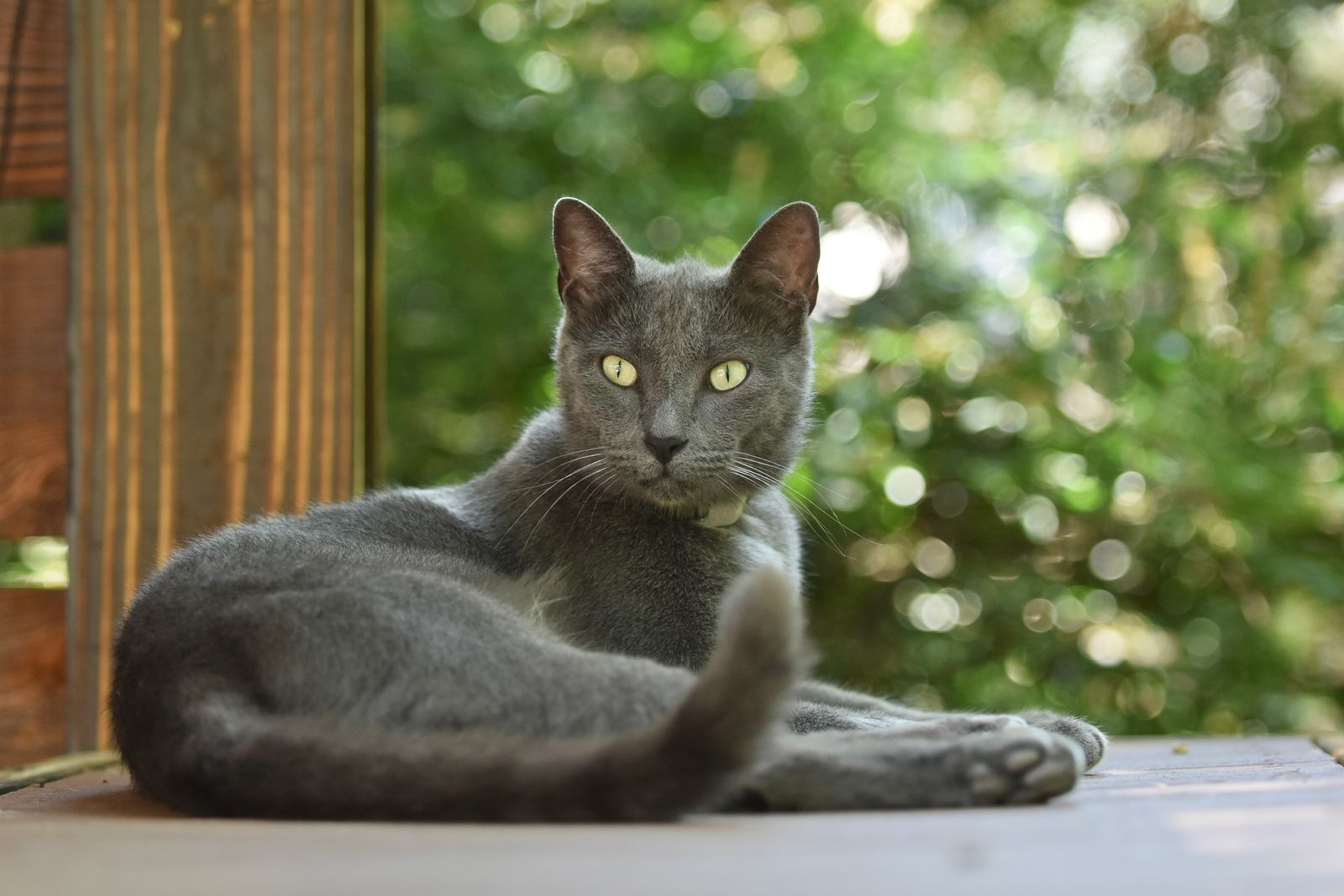
Russian Blue snapshot
The International Cat Association, known as TICA, traces the Russian Blue to the Russian port of Arkhangelsk on the White Sea, and notes that the cats are also called Archangel cats. TICA describes a medium sized cat with fine boning, large flared ears, and a graceful, lithe, muscular foreign body, meaning a long, elegant build rather than a round, heavy one. The Cat Fanciers' Association, known as the CFA, sets out the same cat in its breed standard: a fine boned, long, firm, and muscular body, long and fine boned legs, and a coat and color that define the breed at a glance.
| Size | Medium. TICA describes a medium sized cat with fine boning. The CFA standard calls the body fine boned, long, firm, and muscular, and lithe and graceful in outline. |
|---|---|
| Body | An elegant foreign build. Long legs, small and slightly rounded paws, and a long tail that tapers from a moderately thick base, in proportion to the body. |
| Coat | Short, dense, fine, and plush. It is a double coat that stands out from the body because of its density, with a soft and silky feel. |
| Color | Even bright blue throughout. The guard hairs are distinctly silver tipped, which gives the coat a silvery sheen. The CFA standard allows no color other than blue, and no tabby markings. |
| Eyes | Vivid green, in the words of the CFA standard. The eyes are set wide apart. TICA describes them as glowing emerald green, large, and almost round. |
| Temperament | Reserved with strangers, then devoted. TICA describes a cat that surveys a situation before joining in, and that is extremely affectionate once it decides a person is worthy of its attention. The CFA describes an intelligent, loving companion that is sensitive to its owner's moods and is best suited to quieter environments. |
| Health profile | Clean, by the primary sources. The CFA calls this a healthy, natural breed that is not known to have any specific genetic problems, and notes that a relatively small gene pool is a reason for general care, not a named disease list. |
Two snapshot facts shape the insurance picture, and neither is a disease. The first is longevity in practical terms. This is a breed owners keep for a long time, and a long life means a long senior stage. The conditions that dominate senior cat care, kidney decline, dental deterioration, and metabolic disease, get many years in which to appear. A policy bought for a Russian Blue kitten is really a policy for a cat that will spend a large share of its life as an older cat, and renewal wording matters accordingly. The second fact is the appetite. The CFA is unusually direct about it: Russians have large appetites, and without frequent, interactive exercise they are at risk of becoming obese, which can lead to many other health issues on its own. In a breed with few inherited risks, the food bowl and the activity level are two of the few risk factors an owner actually controls, and they connect directly to the diabetes and urinary sections below.
One more thing belongs in the snapshot, because owners meet it when they research this breed online. Many general websites list long disease inventories for the Russian Blue. When we checked the primary sources named for this guide, the CFA breed page, the TICA breed material, the Cornell Feline Health Center, and the Merck Veterinary Manual, that inventory did not hold up as breed-specific. What held up was a short, honest list: a named predisposition to diabetes in the Merck manual, a weight warning from the CFA itself, and the general conditions that affect cats of every breed. This guide is built on that shorter list, and it says so plainly wherever a condition is general rather than breed defining.
Health tendencies in Russian Blues
Read this section differently from the same section in other breed guides. With one exception, the conditions below are not presented as Russian Blue tendencies. They are the well documented general risks of cats, chosen because the breed profile makes them the relevant ones for this cat: an indoor life, a long lifespan, a strong appetite, and a male urinary tract that is narrow by anatomy. The exception is diabetes, where the Merck Veterinary Manual names this breed directly. These are tendencies in the broad sense, risks to plan around, not predictions about an individual cat. Many Russian Blues will never develop most of them.
This section is general information about conditions a cat can develop. It is not veterinary advice and it is not a diagnosis of any cat. Signs listed here are possible signs owners may notice, and many of them have several causes. Only a veterinarian who examines your cat can say what a sign means.
A note on what is not in this section, because honesty is the point of this page. You will find other websites listing heart conditions, kidney cyst conditions, and blood conditions as Russian Blue risks. The primary sources for this guide do not support those listings for this breed. The CFA states that the breed is not known to have any specific genetic problems. Cornell describes its inherited kidney cyst disorder primarily in Persian cats, not in Russian Blues. No source we checked names a Russian Blue heart mutation, a Russian Blue DNA screening panel, or a breed club health program with required tests for this breed. If your own cat is ever diagnosed with any condition, that diagnosis matters for that cat's care and claims, whatever breed lists say. But a comparison guide should not sell you hereditary wording on the back of conditions the breed record does not support, and this one does not.
Urinary stones (uroliths)
What it is
Rock-hard collections of minerals that form in the urinary tract. The Cornell Feline Health Center explains that these stones, also called uroliths, can irritate the bladder or the urethra, the tube that carries urine out of the body, and can obstruct either one. Cornell names the two most common stone types in cats: struvite, composed of magnesium, phosphorus, and ammonia, and calcium oxalate. This is a general cat condition, not a Russian Blue condition. It belongs on this page because Cornell also notes that lower urinary signs are seen most often in cats that match the typical Russian Blue life: middle aged, indoor, with limited exercise and modest water intake.
Signs owners may notice
- Difficult or painful urination, and more frequent trips to the litter box.
- Crying out while urinating, and blood in the urine.
- Urinating outside the litter box, and frequent licking of the genital area.
- Making repeated attempts and passing only small amounts of urine, which can mean a stone is moving toward obstruction.
How vets usually evaluate and treat it
Cornell describes an initial workup of a physical examination and a urinalysis, a microscopic analysis of a urine sample. When the cause is still unclear, the vet may add blood work, X-rays, abdominal ultrasound, or a urine culture. X-rays or ultrasound are the usual way stones themselves are diagnosed. Treatment depends on the mineral type. For struvite stones, a vet may prescribe a special stone-dissolving diet, and if that fails, surgical removal may be needed. Calcium oxalate stones cannot be dissolved with special diets, so flushing the bladder or surgery is more often the path. Cornell adds a fact that matters for insurance: cats that have formed stones are at increased risk of recurrence, and a vet may recommend medication or dietary changes to help prevent a repeat.
Lower urinary tract disease and urethral blockage
What it is
Lower urinary tract disease is an umbrella term for disorders of the bladder and urethra. Cornell says surveys suggest it is the number one reason cats visit veterinary practices. Its most common diagnosis is feline idiopathic cystitis, a painful bladder inflammation whose cause is not identified after testing. Idiopathic means of unknown cause. Cornell notes that stress seems to be an important factor in that condition, including changes in routine and in the household. That matters for a breed the CFA and TICA both describe as sensitive and reserved, and that notices changes in its people and its home. The dangerous end of this group of conditions is urethral obstruction, a blockage of the urethra. Cornell calls it a potentially life threatening condition, and notes that male and neutered male cats are at greater risk because their urethra is longer and narrower.
Signs owners may notice
- The same lower urinary signs as the stone card: straining, frequent attempts, crying, blood in the urine, and urinating outside the box.
- With idiopathic cystitis, signs that flare around a change at home, such as a move, a new animal, or a changed feeding schedule, and then settle.
- With obstruction, passing little or no urine despite repeated attempts, and a cat that becomes increasingly distressed and cries out in pain.
How vets usually evaluate and treat it
Diagnosis follows the same path as the stone card: examination, urinalysis, and then blood work, imaging, or culture as needed, because the causes overlap and can occur together. For idiopathic cystitis, Cornell explains that signs often resolve within a couple of weeks regardless of treatment, so care focuses on preventing recurrence, with environmental enrichment, a safe and clean place to urinate, and a consistent diet and feeding schedule. Treatment of an obstruction usually involves catheterization, the passage of a narrow tube up the urethra, usually under sedation or anesthesia. Intravenous fluids treat dehydration and electrolyte imbalance, and hospitalization can range from a few days to longer in severe cases. For cats that obstruct repeatedly despite proper management, Cornell describes a surgery called perineal urethrostomy, which creates a wider opening, and notes it is usually considered a last resort.
Chronic kidney disease (CKD) in a long-lived cat
What it is
The persistent loss of kidney function over time. Cornell calls chronic kidney disease one of the most prevalent diseases in older cats, and says the only known risk factor for its development in cats is age. That sentence is the whole reason this card is on a Russian Blue page. A breed with a clean inherited profile and a long life does not avoid kidney disease. It lives long enough to meet it. Healthy kidneys filter the blood, make urine, and help regulate blood pressure, and Cornell explains that as function is lost, waste products the kidneys normally remove can build up in the bloodstream. The disease is progressive, meaning it worsens over time, and Cornell is clear that it has no definitive cure. Care aims to slow progression and protect quality of life.
Signs owners may notice
- Often nothing at all in the early stages. Cornell notes that cats commonly show no obvious signs early, because the body compensates.
- Urinating greater volumes and drinking more water, as the kidneys lose the ability to concentrate urine.
- Loss of appetite, and a cat that appears lethargic and unkempt and loses weight as waste products build up.
- Pale or white gums and marked tiredness in a cat whose kidneys are producing less of the hormone that drives red blood cell production, a sign of anemia linked to this disease.
When it can be urgent
Kidney disease itself usually develops slowly. Sudden vision changes, disorientation, or marked weakness in a cat known to have kidney disease can signal the high blood pressure Cornell links to this condition, and those changes deserve prompt, same day advice. A cat that stops eating or becomes suddenly much more unwell also needs to be seen quickly, whatever the underlying cause.
How vets usually evaluate and treat it
Cornell describes evaluation built on blood tests and urinalysis. The blood tests measure waste products the kidneys normally filter, including blood urea nitrogen, creatinine, and symmetric dimethyl arginine, known as SDMA. Cornell notes that SDMA rises earlier in the disease than creatinine, which generally does not rise until much of kidney function is already lost. The urinalysis looks at how concentrated the urine is, because poorly concentrated urine can be one of the earliest indicators. Blood pressure measurement is part of the evaluation, and Cornell describes a staging system from the International Renal Interest Society, called IRIS, that categorizes the disease to guide treatment. Management categories include dietary modification with a therapeutic kidney diet, maintaining hydration, sometimes with fluids given under the skin at home under veterinary guidance, and medication for related problems such as high blood pressure, anemia, and protein loss in the urine.
Dental disease: gingivitis, periodontitis, and tooth resorption
What it is
Diseases of the teeth and gums are common in cats of every breed, and Cornell names the three most common: gingivitis, periodontitis, and tooth resorption. Gingivitis is inflammation of the gums where they meet the teeth, beginning with plaque, a film that harbors bacteria. If gingivitis is not controlled, Cornell explains, it can progress to periodontitis, in which the tissues that attach the tooth to the gums and bone are weakened and the damage cannot be reversed, leading to loose teeth and tooth loss. Tooth resorption is a process in which the tooth structure breaks down, and Cornell calls it the most common cause of tooth loss in cats, while noting that its cause is not known. None of this is Russian Blue specific. It is on this page because it is common, it is painful, it often needs anesthesia to evaluate and treat properly, and dental wording is where policies differ most sharply.
Signs owners may notice
- Swollen, red, or bleeding gums where the gums meet the teeth, and bad breath.
- Hesitating to eat, turning the head unusually while eating, preferring soft food, or dropping food.
- Drooling, and a cat that stops eating or becomes irritable, which Cornell lists among the signs of dental pain, including pain from tooth resorption.
- A pinkish defect in a tooth at the gum line, which Cornell describes as the usual first visible sign of tooth resorption, in a tooth that is already significantly damaged.
When it can be urgent
Dental disease usually develops slowly, but a cat that cannot eat because of mouth pain needs prompt care rather than a long wait. Cornell notes that dental disease can cause a cat to stop eating, which leads to further health problems. A cat that has stopped eating entirely should be seen quickly, whatever the cause turns out to be.
How vets usually evaluate and treat it
Cornell explains that a complete evaluation of periodontitis involves probing the gums and examining X-rays of the head and jaw, which require anesthesia. The same is true for tooth resorption, where diagnosis involves examining and probing the lesions and reviewing X-rays under anesthesia. Treatment for periodontitis centers on removing plaque and mineral buildup by scaling and polishing the teeth while trying to save them, with extraction of teeth, sometimes numerous teeth, in extreme cases. For painful tooth resorption in which lesions extend into the crown of the tooth, Cornell says it is best to remove the tooth. Gingivitis itself is usually reversible, and Cornell identifies regular removal of plaque by tooth brushing, using only products designed for cats, as the way to prevent it.
Weight gain, obesity, and diabetes mellitus
What it is
This is the one card in this guide with a direct breed link in a primary source, so it is stated exactly as the sources state it. The Merck Veterinary Manual describes diabetes mellitus as a chronic disorder of carbohydrate metabolism, meaning the handling of sugars, due to relative or absolute insulin deficiency. Insulin is the hormone that lets the body use blood sugar for energy. Merck lists the breeds that appear predisposed to the disease in cats, and the Russian Blue is one of the breeds named, alongside the Tonkinese, Norwegian Forest Cat, Burmese, and Abyssinian. Merck also states that obesity predisposes both dogs and cats to insulin resistance, a state in which the body responds poorly to its own insulin, and that cats above a modest body weight seem to have diabetes more commonly than lighter cats. The CFA's own breed page supplies the other half of the picture: this breed has a large appetite and, without frequent interactive exercise, is at risk of becoming obese. Put together honestly, the story is weight first and diabetes behind it, in a breed a major veterinary reference names directly.
Signs owners may notice
- Gradual weight gain in an indoor cat, visible in a rounder body and a coat that hides the change until the vet weighs the cat.
- For diabetes, the classic signs Merck lists: urinating more, drinking more, eating more, and losing weight. Merck notes that some cats instead eat less.
- Tiredness, and weakness that Merck associates with diabetic neuropathy, nerve damage linked to diabetes, which mainly affects cats.
- Recurring or slow-to-clear infections, because Merck notes that diabetic animals have reduced resistance to bacterial and fungal infections, including bladder infections.
When it can be urgent
Weight gain itself is a slow, routine-visit conversation. Diabetes has an emergency form. Merck describes diabetic ketoacidosis, a decompensated state in which the body burns fatty acids for energy and ketoacids build up in the blood, as profound and potentially life threatening, with signs that include vomiting and loss of appetite on top of dehydration. A diabetic or possibly diabetic cat that is vomiting, will not eat, breathes with effort, or collapses needs emergency care the same day.
How vets usually evaluate and treat it
Merck bases the diagnosis on persistent high blood sugar and sugar in the urine, and notes a cat-specific wrinkle: stress can raise a cat's blood sugar temporarily, so multiple blood and urine samples may be required to confirm the diagnosis, and a test called fructosamine can help separate stress effects from true diabetes. Treatment in cats centers on insulin, dietary management, and frequent monitoring, which Merck says is often best performed at home, alongside weight loss for an overweight cat. Merck also notes that when diet change and insulin are combined, many cats achieve diabetic remission, meaning they no longer need insulin treatment. That possibility is real and hopeful, and it is a reason early, steady management matters. It is not a promise for an individual cat.
Accidents and everyday emergencies in an active indoor cat
What it is
Not a disease at all, and included because a clean hereditary profile shifts the balance of what a policy is for. The CFA describes a highly intelligent cat with notable mechanical aptitude, one that treats closed cabinets, shut drawers, and sealed containers as challenges, and TICA describes a playful, quick, active companion that learns how to open containers holding favorite treats. A cat that climbs, fetches, investigates, and opens things meets a different risk set from a cat that sleeps all day: falls, household injuries, chewed or swallowed objects, and escapes through a door it worked out how to open. This card is general for all cats. Its breed angle is activity and curiosity, both documented in the registry sources above.
Signs owners may notice
- Limping, hiding, or sudden reluctance to jump after a fall or a misjudged landing.
- Vomiting, drooling, loss of appetite, or straining after chewing or swallowing something that was not food.
- A cut, a bite from another household animal, or a tail or paw injury from a closing door.
How vets usually evaluate and treat it
Evaluation starts with an examination focused on the injury or the suspected object, and imaging such as X-rays or ultrasound when the vet needs to see inside. Treatment categories range from wound care and medication, through monitoring while an object passes under veterinary direction, to surgery when an injury or a swallowed object requires it. The exact path depends entirely on what happened, which is why this card stays in general categories on purpose.
Policy decisions that matter for a Russian Blue
For a breed with a documented disease list, a policy is judged against that list. For a Russian Blue, it is judged against general life: one emergency night, years of senior monitoring, a mouth that needs work under anesthesia, and a metabolism that has to be managed if weight or diabetes enters the picture. Read these rows with that whole span in mind, and notice how few of them mention heredity at all. That is the honest shape of this breed's insurance.
| Policy feature | Why it matters for a Russian Blue | Stronger wording looks like | Watch out for |
|---|---|---|---|
| Emergency urinary coverage | A urethral blockage is the emergency most likely to test this policy, and it does not wait for office hours. | Emergency care for a urinary obstruction is covered, with no preapproval step that must be completed before treatment starts. | Wording that requires advance approval for specialist or emergency care, or that treats a blockage as a routine illness claim with routine timing. |
| Urinary recurrence rule | Stones can form again, bladder inflammation can flare again, and a second obstruction is a known pattern, not a surprise. | A later urinary episode is judged on clear terms stated in the policy, and covered on those terms. | A rule that makes any urinary problem after the first one pre-existing, or that pays for episode one and excludes the pattern it belongs to. |
| Chronic condition renewal wording | Kidney disease and diabetes are managed for years once they appear, and this breed lives long enough for both to matter. | A condition covered in one term stays covered in later terms, including its monitoring, while enrollment continues. | Renewal wording that caps a chronic condition, ends it at renewal, or reclassifies it as pre-existing each year. |
| Monitoring and diagnostics | Kidney and diabetes care are mostly measurement: repeat blood tests, urine tests, blood pressure checks, and follow-up imaging. | Diagnostics and monitoring for a covered condition are covered categories, at renewal as well as in the first year. | Wording that covers medication but leaves the tests that guide it outside the covered categories. |
| Dental illness terms | Gingivitis, periodontitis, and tooth resorption are common in cats, and their care can involve anesthesia, dental X-rays, and removal of teeth. | Dental illness is included, with anesthesia and extractions for a painful tooth condition covered. | Dental disease excluded entirely, dental cover limited to injury only, or a cleaning history requirement you have already failed. |
| General illness breadth | With no breed list to hide behind, the policy's value is how broadly it treats ordinary illness in an ordinary cat. | Illness coverage is broad, with exclusions that are few, named, and readable before you buy. | A long exclusion list for common conditions, or breed exclusions written so broadly that general illness wording shrinks in practice. |
| Waiting periods and timing | There is no kitten hereditary deadline in this breed, so timing is about having waiting periods finished before general risk arrives, which can be any month. | Accident and illness waiting periods are short, stated plainly, and finished early in the policy's life. | A long illness waiting period, or separate long waits for common categories, that leaves a new policy thin exactly when it is newest. |
| Deductible type | Senior monitoring produces steady claims across a year, every year, often for more than one condition at once. | An annual deductible that is met once, after which eligible claims across conditions are reimbursed. | A per-condition deductible that restarts the counting for the kidneys, the urinary tract, the mouth, and diabetes separately. |
Life stages: kitten, adult, and senior
Kitten
The kitten stage in this breed is quieter than in most guides on this site, and that quiet is real information. There is no early hereditary condition with a known age window, no required DNA panel to file, and no screening calendar to start. What the kitten stage does have is the cleanest medical record this cat will ever have. Enrolling now clears the waiting periods before any urinary note, mouth finding, or weight concern exists. Keep every kitten visit record, including the weights. In a breed whose adult risks include weight gain, a documented kitten and young adult weight history is genuinely useful paper, and it costs nothing to keep. Ask the breeder or rescue for whatever health records exist, and file them with the policy, without expecting the long screening dossiers that some other breeds arrive with.
Adult
Adulthood is where the general risks live. The urinary system is the adult emergency story, especially in males, and especially in an indoor cat that drinks modestly and exercises little. Weight is the adult management story. The CFA's appetite warning is aimed squarely at this stage: an intelligent, food motivated indoor cat needs interactive play and measured food, not free feeding and hope. The insurance work of this stage is habits. Weigh the cat regularly and write the weights down. Note litter box changes early, because straining and small, frequent urinations are signs owners can actually catch. File claims as they happen, and keep the urinalysis and imaging reports with their dates, because a later urinary episode will be judged against the first one's paperwork.
Senior
The senior stage is where a long-lived breed spends its insurance value. Kidney monitoring becomes routine, with blood tests, urine tests, and blood pressure checks on a rhythm the vet sets. Dental needs accumulate in a mouth that has had years of plaque. Diabetes, if it appears, appears most often in middle aged to older cats, in Merck's description. Review the policy for age based changes, premium increases, and any reduction in coverage at advanced ages. Confirm that the monitoring rhythm built up over the cat's adult life is still reimbursable on the same terms. A plan that quietly thins out exactly when a long-lived cat needs steady monitoring fails the purpose it was bought for.
A claim, step by step: a blocked male cat at night
The example below is hypothetical. It is not a real cat, a real claim, or a guarantee of how any insurer will decide. It follows an adult male Russian Blue from the first litter box signs at home, through an emergency clinic visit for a urethral obstruction, catheterization and hospitalization, to discharge, follow-up testing, and the recurrence question at renewal, because that full arc is what urinary coverage has to handle in this breed. Pet insurance generally reimburses after you pay the vet, as explained in how pet insurance works.
Straining in the litter box at home
In the evening, the owner notices the cat returning to the litter box again and again, straining, and producing little or no urine. He cries when he tries, licks his genital area, and grows restless. The owner does not wait until morning. Cornell identifies exactly this pattern, straining with little or no urine and increasing distress, as the presentation of a possible urethral obstruction, and calls obstruction an absolute emergency. The decision to go now, rather than to watch and wait, is the most important step in this entire walkthrough, and it is a care decision, not an insurance one.
The emergency clinic confirms a blockage
At the emergency clinic, the vet examines the cat, feels a firm, painful bladder, and confirms a urethral obstruction. Blood work checks the kidney values and electrolytes that Cornell explains are compromised when urine cannot be voided. The owner authorizes treatment and pays the clinic's deposit under its own payment terms. The paperwork habit starts here: keep the emergency record, the blood results, and every invoice, because the clarity of this night's documents is what the later claim stands on.
Checking the policy dates, after care is underway
Only once treatment has started does the paperwork question get asked. In this example the policy was started when the cat was young, the illness waiting period ended long ago, and no earlier record mentions straining, blood in the urine, urinary crystals, or any litter box concern. That clean timeline makes this a straightforward claim. Contrast it with the harder version of the same story, where a visit note from the year before mentions urinary crystals seen on a routine urine test and a diet suggestion that was never followed up. That old line is the kind of record that turns a later blockage claim into an argument about pre-existing signs.
Unblocking, fluids, and hospitalization
The obstruction is relieved by catheterization, the passage of a narrow tube up the urethra, under sedation or anesthesia. Intravenous fluids correct dehydration and electrolyte imbalance, following the pattern Cornell describes. The cat stays in the hospital while urine flow, blood values, and comfort are monitored, and the catheter is removed when the vet judges it safe. The owner collects the full hospitalization record, not only the final invoice, including the blood work trend that shows the kidneys recovering once urine could flow again.
The diagnosis on paper, and the first claim
The record in this example names a urethral obstruction, with a urinalysis and imaging used to look for an underlying cause such as stones or crystals. The claim is filed with the emergency record, the blood results, the urinalysis and imaging reports, and the itemized invoices, with the date the signs were first seen stated clearly. The cause matters for what comes next. A stone type that can be dissolved with diet leads to one prevention plan. Bladder inflammation with no cause found leads to another, built on routine, environment, and stress reduction, as Cornell describes for idiopathic cystitis.
Follow-up, prevention, and how reimbursement works
After discharge, care settles into follow-up: recheck visits, repeat urine testing, any prescribed diet or medication, and home habits that support urinary health, including water access and a consistent routine. Each eligible bill moves through the same mechanics described in what pet insurance costs and why. Charges count against the deductible first, the policy's reimbursement rate applies to eligible charges after that, and totals are tracked against the annual limit. The emergency night usually meets an annual deductible in one step, which means the follow-up bills in that year are no longer reduced by it. Whether the prescription urinary diet itself is reimbursable is a wording question, and it was one of the questions flagged in the condition cards above.
Renewal, recurrence, and where claims get denied
Months later, at renewal, the decisive question is what the policy now says about a second episode. Cornell notes that cats that have formed stones are at increased risk of recurrence, so a second urinary event is a known possibility, not bad luck that nobody could foresee. Under wording that treats a later episode on clear, covered terms, a recurrence is filed the same way, referencing the first episode's record. The denial pressure points in this breed story are an early urinary note in the record from before enrollment, emergency care questioned because an approval step was not completed at midnight, a recurrence reclassified as pre-existing after the first paid claim, and follow-up testing denied as routine when it was ordered to monitor a covered episode. Each of those is a clause question, and each can be asked in writing before you buy, not after the emergency night.
What drives a Russian Blue premium
No responsible guide will name a price for your cat, because the quote depends on the cat, the address, and the settings chosen. What can be explained is the shape of Russian Blue pricing and the choices that move it. The full mechanics are in what pet insurance costs and why.
Breed risk profile. Insurers see a medium sized, generally healthy cat with no famous inherited disease attached to its name. That profile prices differently from a breed whose file is built around a progressive heart condition or a required screening schedule. Do not overread that difference. A cleaner breed profile lowers one input to the price. It does not cap the size of a single emergency bill, and it does not change what years of senior monitoring add up to. The honest comparison for this breed is not breed against breed. It is the premium against the general bills this cat can genuinely generate.
Age curve and a long life. Premiums generally rise with age, and a long-lived breed stretches the calculation across many senior years, which are the years of kidney monitoring, dental procedures, and metabolic care. The total cost of insuring a Russian Blue is therefore a long horizon decision. A slightly cheaper policy with chronic condition caps can cost more over that span than a stronger policy, because the caps bite at every renewal of a condition that is managed, not cured.
Weight and lifestyle are not priced, but they are real. An insurer does not weigh your cat at enrollment and set the premium by the result. The risk still moves. A lean, active indoor cat is simply less likely to generate the diabetes and urinary claims that a heavier, sedentary one may. In this breed, the CFA's advice about measured food and interactive exercise is the closest thing to a premium reduction an owner controls directly, paid in health rather than in price.
Location and plan settings. Vet prices in your area set the bill sizes the insurer expects, and emergency clinic availability varies widely by region, which affects both price and how a blockage night actually unfolds. Your deductible, reimbursement rate, and annual limit choices trade premium against claim returns. For this breed, deductible type deserves the same attention as deductible size, because an annual deductible and a per-condition deductible produce very different results across kidney monitoring, a urinary episode, and a dental claim in the same year.
Pre-purchase checklist for a Russian Blue policy
- Confirm emergency care for a urethral obstruction is covered, with no preapproval step that must be finished before treatment begins.
- Ask, in writing, how a second urinary episode is treated: new condition, continuation, or excluded after the first.
- Confirm chronic conditions, including chronic kidney disease and diabetes, stay covered at every renewal, with their monitoring included.
- Check that repeat blood tests, urine tests, blood pressure checks, and follow-up imaging for a covered condition are reimbursable.
- Confirm dental illness coverage in plain terms, including anesthesia, dental X-rays, and tooth removal for periodontitis or tooth resorption.
- Ask how diabetes that enters remission and later returns is counted, and whether insulin and monitoring are covered categories.
- Read the exclusion list for breadth, because in this breed general illness wording is the product you are actually buying.
- Choose between an annual and a per-condition deductible using this breed's pattern of steady senior monitoring claims.
- Enroll as a kitten, before a urinary note, a kidney value, a mouth finding, or a weight concern enters the medical record.
The policy comparison worksheet: general illness and urinary wording
Other breed guides on this site hand you a screening record to keep. This breed hands you a comparison task, because the breed file does not narrow the field for you. Use this worksheet before you buy. Write the insurer's answer, or the exact clause, in each cell. A blank cell is information too: it marks a question the seller has not answered, and unanswered urinary and renewal questions are where this breed's claims are won and lost. Keep the completed worksheet with the policy.
| Worksheet question | Policy one: write the answer or clause | Policy two: write the answer or clause |
|---|---|---|
| Is emergency treatment for a urethral obstruction covered, and is any approval needed before treatment? | Write the clause and the approval rule here. | Write the clause and the approval rule here. |
| If stones, bladder inflammation, or a blockage happens once, how is a second episode treated? | Write: new, continuation, or excluded, with the clause. | Write: new, continuation, or excluded, with the clause. |
| Are prescription urinary food, and follow-up urine tests after a covered episode, reimbursable? | Write yes or no, and any limits, here. | Write yes or no, and any limits, here. |
| Does a covered chronic condition, such as kidney disease or diabetes, stay covered at renewal, including monitoring? | Write the renewal clause here. | Write the renewal clause here. |
| Is dental illness covered, including anesthesia, dental X-rays, and extractions? | Write the dental clause and any history requirement here. | Write the dental clause and any history requirement here. |
| Is the deductible annual or per condition, and what is the annual limit? | Write the deductible type and the limit here. | Write the deductible type and the limit here. |
| What are the accident and illness waiting periods? | Write both waiting periods here. | Write both waiting periods here. |
Questions to ask an insurer, in writing
- My male cat could not urinate at night and was treated for a urethral obstruction at an emergency clinic. Is that care covered, and did I need approval before treatment?
- If my cat has one urinary episode, how exactly is a second episode treated under this policy?
- Once chronic kidney disease or diabetes is diagnosed and covered, will it and its monitoring stay covered at every renewal while I stay enrolled?
- Is dental illness covered, including anesthesia and tooth removal for periodontitis or tooth resorption, and what dental history do you require?
- If diabetes goes into remission and later returns, is the return treated as the same condition or as a new one?
- Which common cat conditions are excluded from the illness coverage in this policy? Please point me to the exclusion list.
Questions Russian Blue owners ask
Does pet insurance cover a urinary blockage in a Russian Blue?
An accident and illness policy can cover emergency care for a urethral obstruction, the blockage of the tube that carries urine out of the body, when the illness waiting period has passed and no urinary signs were recorded before enrollment. A blockage is an emergency, so get care first and file after. Ask in writing how a second episode is treated, because wording that counts a repeat blockage as the same condition, or as pre-existing after the first one, decides what the policy does the next time.
My Russian Blue has no known inherited conditions. Is insurance still worth considering?
That is a personal decision, and this guide does not make it for you. What the breed record shows is that the case here does not rest on inherited disease. It rests on general events that no breed file rules out: a urinary blockage on one bad night, kidney disease managed over senior years, dental work under anesthesia, diabetes care, and ordinary accidents in an active indoor cat. Compare policies on how they handle those general events, and weigh the premium against bills you could not comfortably pay at once.
If my cat has one urinary episode, will a second one be covered?
It depends on wording that varies a lot between policies. Cornell notes that cats that have formed urinary stones are at increased risk of recurrence, and that lower urinary signs can return. Ask the insurer, in writing, whether a later urinary episode is treated as a new condition, as a continuation of the first one, or as pre-existing once the first episode is in the record. Also ask whether prescription urinary food and follow-up urine tests for a covered episode are reimbursable.
Does pet insurance cover chronic kidney disease in a senior Russian Blue?
An accident and illness policy can cover chronic kidney disease when chronic conditions are included, the cat was enrolled before kidney values or urine changes were recorded, and the condition stays covered at renewal. Kidney care is monitoring over years, with repeat blood tests, urine tests, and blood pressure checks, so the renewal wording and the rule for ongoing monitoring matter more than any single visit. Confirm that a covered chronic condition is not capped, ended, or reclassified as pre-existing when the policy renews.
Are dental problems covered for Russian Blues?
Not automatically, and dental wording is one of the widest gaps between policies. Some accident and illness plans exclude dental disease entirely, some cover only dental injury, and some include dental illness with conditions attached. Cornell describes gingivitis, periodontitis, and tooth resorption as the most common dental diseases in cats, and their care can involve anesthesia, dental X-rays, and removal of teeth. Ask in writing whether dental illness, anesthesia, and extractions are covered for your cat, and what dental records or cleaning history the policy requires.
When is the best time to enroll a Russian Blue?
As a kitten, before any urinary note, kidney value, mouth finding, or weight concern enters the medical record. This breed has no early hereditary deadline pushing the decision, so the timing case is the general one, and it is still strong. Enrolling young clears the waiting periods while the record is clean, and it means the policy is already in place across the long adult and senior years when kidney, dental, and metabolic conditions are most likely to appear.
Sources and further reading
- Cat Fanciers' Association, Russian Blue breed page and standard for the fine boned, long, firm, and muscular body, the short, dense, plush double coat, the even bright blue color with silver-tipped guard hairs, the vivid green eye color, the breed's intelligence and sensitivity, and the statement that this healthy, natural breed is not known to have any specific genetic problems, alongside the warning that a large appetite can lead to obesity without frequent, interactive exercise.
- The International Cat Association, Russian Blue breed introduction for the Arkhangelsk origin, the medium sized, fine boned, graceful foreign body, the silver-tipped blue coat and emerald green eyes, and a personality that is reserved with strangers and extremely affectionate once it accepts a person.
- Cornell Feline Health Center, Feline lower urinary tract disease for the signs of lower urinary tract disease, idiopathic cystitis as the most common diagnosis and its link to stress, urinary stones and their struvite and calcium oxalate types, the recurrence risk after stones form, and urethral obstruction as a life threatening emergency.
- Cornell Feline Health Center, Chronic kidney disease for the persistent loss of kidney function over time, age as the only known risk factor in cats, the blood and urine testing used to evaluate the kidneys including SDMA, IRIS staging, and management built on diet, hydration, and control of related problems.
- Cornell Feline Health Center, Feline dental disease for gingivitis, periodontitis, and tooth resorption as the three most common dental diseases in cats, their signs, diagnosis with probing and X-rays under anesthesia, and treatment by scaling, polishing, and removal of teeth that cannot be saved.
- Merck Veterinary Manual, Diabetes mellitus in dogs and cats for diabetes as a chronic disorder of carbohydrate metabolism due to insulin deficiency, the Russian Blue among the cat breeds that appear predisposed to the disease, obesity as a predisposing factor for insulin resistance, the classic signs, diagnosis, insulin and diet treatment, home monitoring, remission in cats, and diabetic ketoacidosis as a life threatening complication.