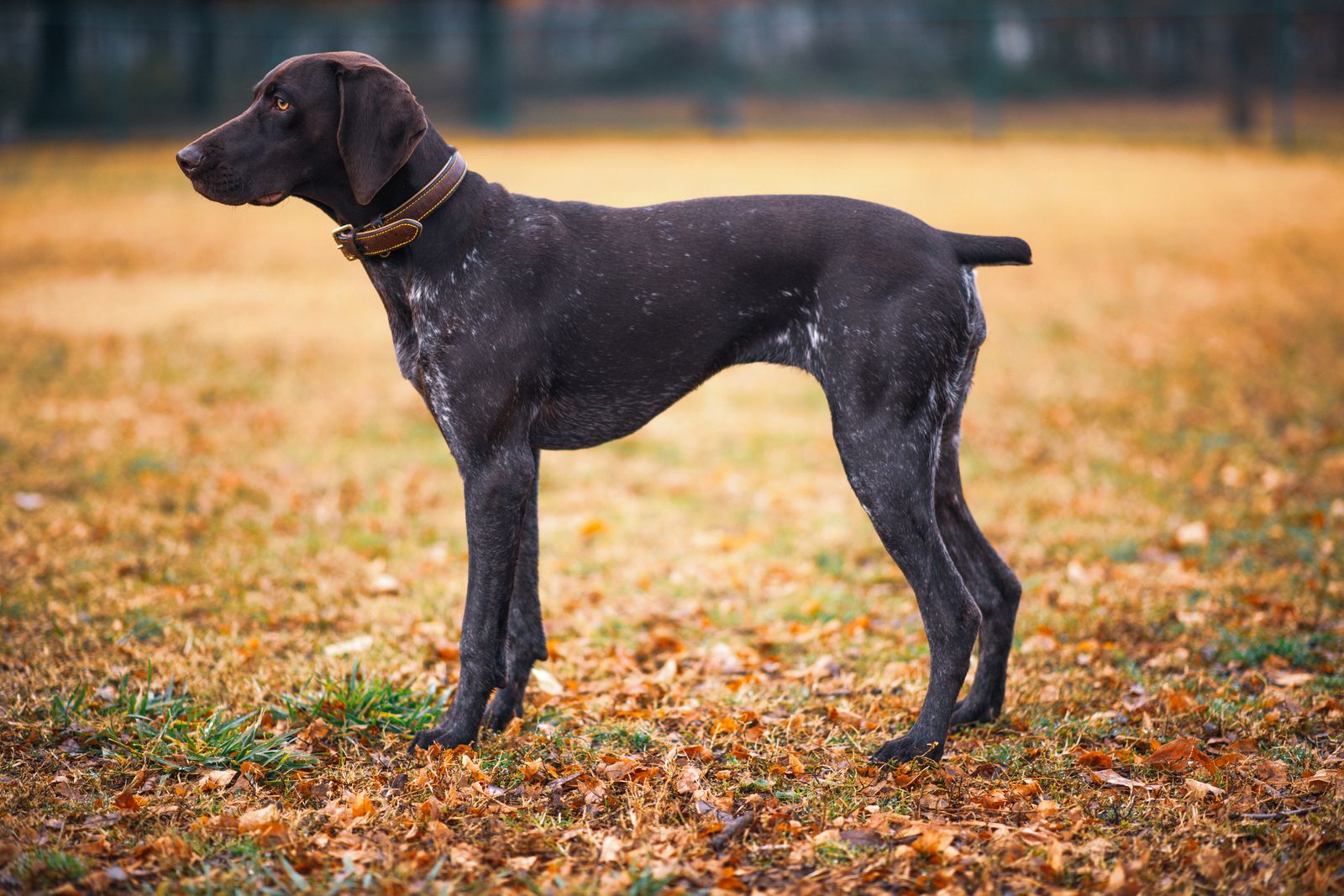
German Shorthaired Pointer snapshot
The American Kennel Club describes the German Shorthaired Pointer as a versatile, medium sized, enthusiastic gundog of all trades who thrives on vigorous exercise, positive training, and a lot of love. The breed was developed to hunt, point, and retrieve, on land and in water, and that versatility is still the daily reality. A shorthair that does not get real work will invent a job at home. For insurance, the useful facts are the athletic build, the deep chest, and the drive itself, because a dog that runs hard for years meets its joints, its knees, and the field itself at full speed.
| Height | Males 23 to 25 inches at the shoulder. Females 21 to 23 inches. |
|---|---|
| Weight | Males 55 to 70 pounds. Females 45 to 60 pounds. |
| Lifespan | 10 to 12 years, as listed by the AKC. |
| Coat | A short, dense coat in solid liver, or liver and white in patched or ticked patterns. Black and white dogs are also seen under the current standard. The coat is smooth, never wiry, and there is no beard. |
| Temperament | Friendly, smart, and eager to please, with the intensity and stamina of a dog bred to work beside hunters all day. |
| Energy and exercise | Very high. Needs vigorous daily exercise and training work, not only a walk. Many dogs hunt, run, swim, and retrieve well into their adult years. |
Two snapshot facts carry the insurance story. The first is the chest. The breed standard produces a deep chested, athletic dog, and chest shape is the risk factor the surgical literature names for bloat. The second is the working life. A companion pet that jogs twice a week and a field dog that trains, hunts, and swims through a season do not present the same accident risk, even though they share a breed name on the policy. Honest answers about how the dog actually works belong in the enrollment conversation, and the training log described later in this guide is how an owner proves that story.
Health tendencies in German Shorthaired Pointers
The German Shorthaired Pointer Club of America, the breed's parent club, runs its health program through the Canine Health Information Center, known as CHIC, with the Orthopedic Foundation for Animals. The screening list is unusually complete: a hip evaluation, an elbow evaluation, a cardiac evaluation by a board certified cardiologist, an eye examination by a board certified ophthalmologist, and a DNA test for cone degeneration. That list is the map for this section. A breed club does not require five screenings for conditions that do not matter in the breed. Sporting life then adds the knees, the ears, and the injuries that come with cover, water, and speed.
This section is general information about conditions a breed can be prone to. It is not veterinary advice and it is not a diagnosis of any dog. Signs listed here are possible signs owners may notice, and many of them have several causes. Only a veterinarian who examines your dog can say what a sign means.
Bloat (gastric dilatation volvulus, or GDV)
What it is
An emergency in which the stomach fills with gas and fluid and can then twist on itself. The American College of Veterinary Surgeons calls GDV a rapidly progressive, life threatening condition that requires immediate medical attention, and notes that the rotation can block the blood supply to the spleen and the stomach. The ACVS lists a deep chest, described as an increased height to width ratio of the chest, among the known associations, along with being older, eating a single large meal once a day, and being related to a dog that has had the condition. The German Shorthaired Pointer build fits the deep chested shape, which is why this condition leads this guide. The German Shepherd guide in this series carries the same emergency, with a full bloat claim walkthrough.
Signs owners may notice
- Repeated retching or trying to vomit with little or nothing coming up.
- A belly that looks swollen or distended, drooling, restlessness, pacing, or standing and stretching.
- Looking at the abdomen, panting, or signs of belly pain.
- Pale gums, weakness, or collapse as the condition progresses.
How vets usually evaluate and treat it
Emergency teams usually stabilize first, with intravenous fluids and oxygen where needed, bloodwork, an electrocardiogram to check for the abnormal heart rhythms this condition commonly causes, and an abdominal X ray to confirm whether the stomach has twisted. Treatment is surgery to decompress and return the stomach to its normal position, check the stomach wall and the spleen, and fix the stomach to the body wall in a procedure called gastropexy so it cannot twist again. Monitoring follows, because rhythm and circulation problems can appear after the surgery itself. The ACVS also describes preventive gastropexy, done before any emergency in a dog at risk, often at the same time as a spay or neuter. That preventive version raises a separate coverage question, covered in the policy table and the FAQ below.
Hip and elbow dysplasia
What it is
An inherited condition in which the hip joint forms incorrectly, so the ball and socket fit loosely instead of snugly. Cornell's Riney Canine Health Center explains that the looseness wears the joint unevenly over time, arthritis develops, and pain and loss of mobility follow. The breed club requires a hip evaluation for its CHIC health program, done through an OFA radiograph evaluation or a PennHIP evaluation. In a breed that runs hard, a loose hip meets more miles than it would in a quieter dog, which is why conditioning and weight belong in this card.
Signs owners may notice
- Stiffness after rest or after a hard training day, or trouble rising, lying down, and climbing.
- A swaying rear end, or a bunny hopping run where both back legs move together.
- Limping on a back leg, worse after exercise, and less drive to run, jump, or retrieve than the dog showed before.
- Thinning muscle over the hind legs as the dog shifts weight forward.
When it can be urgent
Hip dysplasia itself usually develops slowly and is a prompt appointment rather than an emergency. A dog that suddenly cannot bear weight or will not rise after a fall in the field may have an injury on top of the joint disease, and that change deserves same day care.
How vets usually evaluate and treat it
Evaluation usually combines a hands on orthopedic exam with hip X rays, sometimes taken under sedation so joint looseness can be measured properly. Treatment depends on age and severity. Categories include weight control down to a lean working condition, controlled and consistent exercise rather than weekend bursts, pain and anti-inflammatory medication, physical rehabilitation, and, in more severe cases, surgery.
Elbow dysplasia, the front leg half
Elbow dysplasia is a group of developmental problems in the elbow joint of the front leg, where the bones that form the elbow do not grow and fit together cleanly. Abnormal loading then damages cartilage and leads to arthritis. The breed club includes an elbow evaluation in its required CHIC screenings, done through the OFA at adult age, which tells owners plainly that front legs belong in the same conversation as hips in this breed. Signs owners may notice are front leg lameness in a young, growing dog, often worse after exercise or after rest, stiffness in the front end, a shortened stride, and reluctance to jump down or work rough ground. A persistent limp in a growing sporting puppy should not be watched for months at home, and sudden non weight bearing lameness or a swollen joint needs prompt care. Vets usually start with a gait and joint exam and elbow X rays. Some cases need advanced imaging, such as a CT scan. Treatment categories include rest and controlled exercise during flare ups, weight control, pain medication, rehabilitation, and surgery in selected cases.
Cone degeneration (day blindness)
What it is
An inherited condition of the retina in which the cone cells, the cells that handle daylight and detail vision, lose function. The UC Davis Veterinary Genetics Laboratory explains that loss of cone function results in day blindness and decreased visual acuity, that the condition is inherited as an autosomal recessive trait, and that the German Shorthaired Pointer is one of the breeds the laboratory lists for testing. The breed club describes the picture at home clearly: affected puppies show trouble as the cones degenerate, with problems in depth perception, discomfort in daytime light, and difficulty finding a light colored object on a light background, while vision in low light stays better. The club notes that day blindness is a loose name, because the dog sees better when the light is low.
Signs owners may notice
- A young puppy that bumps into things, hesitates, or misjudges distance in bright light but moves confidently in dim light.
- Squinting or avoiding bright outdoor light, and trouble finding a pale toy or a light colored object on a light background.
- Missing a thrown object in daylight that the same puppy tracks easily at dusk.
When it can be urgent
Cone degeneration itself is not an emergency, and the UC Davis laboratory notes that signs appear as retinal development completes, early in a puppy's life. A routine eye exam can look normal in an affected dog. The condition is confirmed by a test of retinal function rather than by looking at the eye. Any sudden vision loss in an adult dog, or a painful or red eye, is a different problem and needs prompt, same day care.
How vets usually evaluate and treat it
Evaluation starts with the history in bright and dim light, a full eye exam, and referral to a veterinary ophthalmologist when an inherited retinal condition is suspected. A retinal function test can confirm loss of cone function, and the DNA test identifies a dog as clear, a carrier, or affected. The breed club is plain that a carrier has one copy of the genetic material and does not have the disease, while an affected dog has inherited both copies and will show signs. There is no treatment that restores cone function, so care is practical: consistent layouts, care in bright light, and training that leans on hearing and scent.
Heart screening and subaortic stenosis
What it is
Subaortic stenosis is a congenital narrowing below the aortic valve that forces the heart to work harder to push blood out to the body. It is the cardiac condition the breed's screening program is built around. The breed club's CHIC requirements call for a cardiac evaluation performed by a board certified veterinary cardiologist, by listening to the heart or by an ultrasound examination of the heart called an echocardiogram, at adult age. That specialist requirement is the point. A mild narrowing can be quiet, and grading a murmur properly is specialist work.
Signs owners may notice
- Many dogs show no signs at home at all, and the first finding is a heart murmur heard at a vet visit. That silence is why screening exists.
- In more severe cases, tiring sooner than a dog of this drive should, or slowing down in work the dog normally loves.
- Fainting or collapse during hard exercise, and labored breathing at rest, in advanced disease.
How vets usually evaluate and treat it
Evaluation usually starts with listening to the heart. A murmur, or any screening concern, leads to referral to a cardiologist for an echocardiogram, which images the valve area and measures how hard the heart is working. Severity grading drives the plan. Categories include exercise management set by the cardiologist, medication in some cases, and recheck imaging over time. Honest value sits in diagnosis, grading, and monitoring.
Cruciate ligament injury and field injuries
What it is
The cranial cruciate ligament is one of the main stabilizers inside the knee, called the stifle, in the back leg. The American College of Veterinary Surgeons explains that rupture of this ligament is one of the most common reasons for hind limb lameness, pain, and later knee arthritis in dogs, that partial tearing is common and progresses to a full tear over time, and that the condition usually develops from a mix of ligament aging, body condition, genetics, and shape, with a sudden injury sometimes finishing a ligament that was already weakening. A sporting dog adds the field version on top: hard turns at speed, holes under grass, slips on wet ground, wire and stick wounds, torn nails, and cut pads. The knee carries the largest claim, so it carries this card, and the log in the checklist section covers the rest of the field list.
Signs owners may notice
- Sudden hind leg lameness during or right after running, sometimes with a cry, and sometimes with the dog holding the leg up.
- Lameness that seems to improve over a few days and then returns the next time the dog works hard.
- Stiffness after rest, trouble rising, reluctance to jump into a vehicle, or a knee that looks thicker than the other side.
- For field wounds: bleeding from a pad or nail, a cut that keeps opening, licking at one spot, or a limp that starts with a visible wound rather than a joint story.
When it can be urgent
A dog that will not bear any weight on a leg, a knee or leg that is swollen, a deep cut, a wound that will not stop bleeding, or lameness after a fall or a collision needs prompt, same day care. A mild limp that settles with a day of rest is a book it this week problem, and it should still be booked, because an early exam note is what separates an injury story from a slow degeneration story later.
How vets usually evaluate and treat it
Vets usually evaluate the knee by hand, testing for the abnormal movement that shows the ligament is not holding, and take knee X rays to rule out other causes. The ACVS notes that surgical treatment is typically the way to permanently control the instability in the joint. Conservative care, meaning strict rest, weight control, pain medication, and rehabilitation, suits some older or less active dogs, but a young sporting dog that will run again is usually a surgical conversation. Field wounds are cleaned, assessed for depth and foreign material such as a thorn or a splinter, and closed or bandaged as needed.
Ear infections (otitis externa)
What it is
Inflammation and infection of the outer ear canal. The Merck Veterinary Manual's owner guide calls otitis externa the most common disorder of the ear canal in dogs, and lists allergies, bacteria, yeast, parasites, and objects in the canal among its causes. This breed adds water in practice. A dog bred to retrieve from water swims with long ears that cover the canal, limit airflow, and hold moisture in after every session. A canal that stays damp gets inflamed more easily, so ear care in a shorthair is a weekly habit, not a yearly surprise.
Signs owners may notice
- Head shaking after swimming or bathing, scratching or rubbing at one or both ears, and tilting the head.
- Redness inside the ear, discharge, scaly skin, and a noticeable foul odor, which are the signs Merck lists for this condition.
- Pain or pulling away when an ear is handled, in a dog that normally tolerates it.
When it can be urgent
Most ear infections are a prompt routine visit. A head tilt that comes with loss of balance, circling, or eye movements the dog cannot control can mean the problem has reached the middle or inner ear, and that needs same day care. A swollen, fluid filled ear flap from vigorous head shaking, called an aural hematoma, also deserves a prompt visit.
How vets usually evaluate and treat it
Vets usually examine the canal with an otoscope, check whether the eardrum is intact, and look at a swab of ear material under the microscope to tell yeast from bacteria. Treatment categories include professional cleaning, topical medication placed in the ear, drying the ears after water work, treatment of any underlying allergy, and a recheck visit to confirm the infection has cleared. Merck stresses that unless every cause is treated, the condition often returns.
Policy decisions that matter for a German Shorthaired Pointer
For this breed, a policy has to do two jobs at once. It has to stand behind one midnight emergency, and it has to handle the orthopedic and screening file of a dog that works hard for a decade. A plan built for only one of those jobs will disappoint in the other.
| Policy feature | Why it matters for a German Shorthaired Pointer | Stronger wording looks like | Watch out for |
|---|---|---|---|
| Emergency care terms | GDV happens at night, often at a hospital that is not your usual clinic, and minutes matter. | Emergency treatment at any licensed hospital is covered without prior approval. | Requirements to call for authorization first, or reduced coverage for out of hours or emergency hospitals. |
| Annual limit | One GDV night, or one knee surgery on a dog of this size, can consume a small limit in a single event. | A high annual limit, or no annual cap, that resets each policy year. | Low annual limits and per-condition caps that split one emergency into several capped buckets. |
| Hereditary condition coverage | Hip and elbow dysplasia, cone degeneration, and the breed's heart tendency all run in lines. | Hereditary and congenital conditions are covered on the same terms as other illnesses. | Hereditary exclusions, or breed specific exclusions aimed at conditions like these. |
| Orthopedic and ligament waiting periods | Joint and knee claims are exactly the claims a young sporting dog is most likely to make early. | Defined waiting periods, stated up front, with the end date clear for your dog. | Long special waits for cruciate or orthopedic conditions buried in definitions rather than stated at sale. |
| Bilateral condition rule | Hips, elbows, and knees all come in pairs, and a problem on one side raises the chance of the same problem on the other. | Each side is judged on its own record, with clear terms for the second side. | Wording that treats the second hip, elbow, or knee as pre-existing after the first is diagnosed. |
| Accident definition and field injuries | Training and hunting produce cuts, pad and nail injuries, and sudden lameness with a clear time and place. | Accidents are defined plainly, and a dated injury at a known time is treated as the accident it is. | Narrow accident definitions that reclassify working injuries as illness, wear, or excluded activity. |
| Cardiac and eye diagnostics | Value in this breed sits in echocardiograms, ophthalmologist exams, and retinal function testing, not only in surgery. | Specialist exams and advanced diagnostics are covered categories for a covered condition. | Policies that pay for surgery but exclude or tightly cap specialist exams and diagnostic testing. |
| Rehabilitation and follow up cover | Knee and joint recoveries are built in rechecks, controlled exercise, and rehabilitation over months. | Rehabilitation, recheck visits, and follow up imaging for a covered condition are reimbursable. | Cover that ends at the surgery invoice and leaves the recovery that makes surgery work unpaid. |
Life stages: puppy, adult, and senior
Puppy
The puppy stage sets the whole file. Collect the breeder's screening packet before the puppy comes home where you can: hip and elbow results for both parents, the cardiologist cardiac results, eye examination results, and the cone degeneration DNA results. Keep the actual result pages, not a verbal summary. At the first vet visits, ask for a clear baseline record, a heart listen with the result written down, an eye check, and a gait and joint note. Watch bright light behavior as the puppy grows, because cone degeneration signs appear early, as retinal development completes. Enroll in this stage, before training loads the joints and before any note exists, so the waiting periods run while the dog is sound. Keep growth steady and lean.
Adult
Adulthood is the working life, and the insurance work is documentation. This is the deep chested prime for GDV risk, so every adult owner should know the signs and the nearest emergency hospital. Start the field and training injury log described in the checklist section and keep it honestly, including the quiet weeks. File claims as they happen, keep itemized invoices, and recheck at each renewal that joint, heart, and eye wording has not changed. Conditioning matters as medicine here. A fit, lean dog that trains consistently is a lower risk than the same dog asked for weekend bursts after quiet weeks.
Senior
With an AKC lifespan of 10 to 12 years, the senior stage can arrive while the dog still wants to work. Arthritis from hips, elbows, and knees deepens, heart monitoring matters more, and exercise shifts from distance to steadiness. Review the policy at renewal for age based changes and any reduction in cover at advanced ages. Check that chronic joint care, pain medication, rechecks, and rehabilitation are still described as covered, because senior spending in this breed is mostly steady management, not one last surgery.
A claim, step by step: a cruciate tear in field training
The example below is hypothetical. It is not a real dog, a real claim, or a guarantee of how any insurer will decide. It follows an adult German Shorthaired Pointer through a knee injury in training, because it shows how this breed's accident file works: a clear event, a prompt exam, a waiting period question, and a recovery that lasts longer than the surgery day. Pet insurance generally reimburses after you pay the vet, as explained in how pet insurance works.
The turn, the yelp, and the first log entry
During a morning training session, the dog plants a back foot to turn for a retrieve, yelps once, and comes back holding the leg up. Training stops. The owner writes the log entry that evening: the date, the place, what the dog was doing, and that the leg was non weight bearing at first and toe touching by the drive home. That entry, written the same day, is worth more than a memory reconstructed at claim time.
The prompt vet exam
The dog is examined the next day. The vet finds knee instability on the hands on tests, takes X rays, and records a suspected cranial cruciate ligament tear, with pain medication and strict rest started. The visit record and the date line up exactly with the training log. That match is the spine of the claim. A first exam delayed by weeks would have left the insurer a gap to argue about.
Checking the waiting period and the record
On paper, the insurer lines the injury up against the policy. The policy was started when the dog was a puppy, the general waits ended long ago, and there is no earlier note of hind leg lameness or a knee concern. The remaining question is the special one this breed teaches owners to ask at purchase: does a ligament specific waiting period apply, and had it passed. In this example it had, because the owner checked it before the first season of hard training.
Referral, surgery, and paying as you go
The dog is referred to a surgeon, who confirms the tear and recommends surgery to stabilize the knee. The owner pays the clinic directly and collects the same two documents every time: the itemized invoice and the complete records, including the surgical report and the rehabilitation instructions. Keeping the general vet and surgeon records together matters, because the insurer reads the injury as one story.
Submitting the claim
The claim is filed with the invoices and records from both clinics, the date and place of the training injury stated clearly, and a copy of the log entry for that day. The submission describes one event and one leg. The log shows a fit dog with no prior lameness entries, which is exactly the context a fair reading of this claim needs.
Recovery, rehabilitation, and how reimbursement works
Recovery settles into controlled leash exercise, recheck visits, follow up imaging, and a rehabilitation plan that rebuilds muscle before any return to running. Each eligible bill moves through the same mechanics described in what pet insurance costs and why. Charges count against the deductible first, the reimbursement rate applies after that, and totals are tracked against the annual limit. Whether rehabilitation itself is reimbursed depends on the wording checked in the policy table.
The second knee, and where claims like this get denied
Months later, the honest question arrives: what happens if the other knee goes. Pressure points in this breed story are a ligament waiting period that had not finished, an earlier vague lameness note read as the start of the same condition, a bilateral clause that treats the second knee as pre-existing after the first, and rehabilitation charges classified as not covered. Each is a clause question that can be asked in writing before the first training season.
What drives a German Shorthaired Pointer premium
No responsible guide will name a price for your dog, because the quote depends on the dog, the address, and the settings chosen. What can be explained is the shape of pricing for this breed and the choices that move it. The full mechanics are in what pet insurance costs and why.
Breed risk profile. Insurers see a medium to large, deep chested sporting dog with a real emergency on its list, a screened joint file, and an active life that produces accident claims. The GDV risk and the knee risk do most of the work in the profile, because both can become a major surgery on a dog of this size.
Size. A dog in this weight range costs more to anesthetize, image, and medicate than a small dog, and less than a giant breed. Size sits in the middle here, and it multiplies whatever the breed list produces, because the same operation on a larger dog is a larger operation.
How the dog actually works. Owners should expect questions about activity, and should answer honestly. A field and hunting dog and a house dog with weekend walks do not live the same accident life. Misdescribing the dog's work to save on premium risks the claim later, when a record shows how the dog really lives.
Age curve and lifespan. Premiums generally rise with age. Joint wear, heart monitoring, and senior management cluster in the later years of a 10 to 12 year life, while accident risk runs through the whole working life.
Location and plan settings. Vet prices in your area set the bill sizes the insurer expects. Your deductible, reimbursement rate, and annual limit choices trade premium against claim returns. For this breed, the annual limit deserves care, because the defining claims are single large events, and a limit chosen to lower the premium is the setting most likely to be regretted on a GDV night.
Pre-purchase checklist for a German Shorthaired Pointer policy
- Confirm emergency care at any hospital is covered without pre-authorization, since GDV does not happen on a schedule.
- Choose an annual limit that can absorb one emergency surgery or one knee surgery on a dog of this size, or a plan with no annual cap.
- Confirm hereditary and congenital conditions are covered, including hip dysplasia, elbow dysplasia, cone degeneration, and heart conditions.
- Find every waiting period that applies to this dog: illness, orthopedic, and any ligament specific wait, and write down the date each one ends.
- Read the bilateral clause for hips, elbows, and knees, and ask what happens to the second side after the first is diagnosed.
- Ask how a DNA test result in the record is treated, for a clear dog, a carrier, and an affected dog.
- Check that cardiologist exams, echocardiograms, ophthalmologist exams, and retinal function testing are covered categories.
- Confirm rehabilitation, recheck visits, and follow up imaging after a covered surgery are reimbursable.
- Collect the breeder screening packet for both parents and bring it to the first vet visit. Enroll as a puppy, before any limp, murmur, eye finding, or digestive note reaches the record.
The field and training injury log: this breed's tool
No other breed guide on this site needs this tool, because no other breed here works the way this one does. Insurers decide accident claims on timing. When did it happen, where, and was there anything before it. A sporting dog's owner is the only witness to most of those answers. A simple log, kept honestly at the time, turns memory into evidence. Keep it in a notebook or a phone note, one entry per incident, and keep the quiet weeks too.
| Log entry field | What to write | Why it matters at claim time |
|---|---|---|
| Date, time, and place | The day, the rough time, and where the dog was working or training. | Places the event inside the policy period and after every waiting period. |
| Activity and ground | What the dog was doing, and the surface: grass, mud, water, gravel, ice, or rough cover. | Shows a real accident setting instead of a vague limp with no story. |
| What was seen | The moment itself: a yelp, a slip, a cut found at the tailgate check, a limp on the walk back. | Separates a sudden injury from a slow condition that was noticed gradually. |
| Signs that evening and next morning | Weight bearing or not, swelling, bleeding, appetite, and how the dog moved the next day. | Matches the vet record, or explains honestly why a visit waited a day. |
| Care given and vet visit | Cleaning, bandaging, rest, and the date and clinic of any exam, with the record kept. | Links the log entry to an invoice and a medical record the insurer can read. |
| Return to work | When rest ended, when controlled exercise started, and when full training resumed. | Shows the recovery was followed, which matters if the same leg is claimed again. |
Two habits make the log work. First, do a tailgate check after every session and write down what it found, even when the entry is one line that says the dog finished sound. Pads, nails, ears after water, and a hands on pass over the legs take minutes. Second, bring the log to vet visits after any incident. A vet record that lines up with a same day log entry is the strongest simple evidence an owner can hand an insurer.
Questions to ask an insurer, in writing
- Is emergency GDV surgery covered at an emergency hospital without prior approval, and is the gastropexy performed during that surgery covered? How is a preventive gastropexy treated?
- Are hip dysplasia and elbow dysplasia covered for this breed, and what waiting period applies to each?
- Is there a separate waiting period for cruciate ligament claims, and how is the second knee treated after the first is diagnosed?
- How do you treat a cone degeneration DNA result in the record: clear, carrier, and affected?
- Are cardiologist exams, echocardiograms, ophthalmologist exams, and retinal function testing covered categories?
- Are rehabilitation, recheck visits, and follow up imaging covered after a covered knee or joint surgery?
Questions German Shorthaired Pointer owners ask
Is bloat surgery covered for a German Shorthaired Pointer?
Gastric dilatation volvulus is an illness emergency, so an accident and illness policy that has passed its illness waiting period will generally treat it like other covered emergencies, subject to the deductible, reimbursement rate, and annual limit in the policy. Speed matters more than paperwork in the moment. Go to an emergency hospital first, keep the itemized invoice and the surgical report, and file the claim after your dog is stable.
Does pet insurance cover hip dysplasia in German Shorthaired Pointers?
Many accident and illness policies can cover hip dysplasia when hereditary conditions are included, the orthopedic waiting period has passed, and no limp, pain note, or hip finding was recorded before enrollment or during that waiting period. The breed club screening record helps the dog, not the claim, so keep breeder OFA or PennHIP results for the parents, enroll early, and read the hereditary, bilateral, and orthopedic waiting period wording together.
What does a cone degeneration DNA result mean for coverage?
The DNA test sorts a dog as clear, carrier, or affected for the inherited cone degeneration found in this breed. A carrier does not have the disease. An affected puppy shows day blindness early in life, usually as retinal development completes. Ask the insurer in writing how it treats a known DNA result and an inherited eye condition, because a test result in the record is not the same as a diagnosed illness, and policies define those situations differently.
Is a cruciate tear during field training covered, and what about the other knee?
A cruciate ligament injury can be covered as an accident or as an illness depending on how the policy classifies ligament disease, and many policies apply a special orthopedic or ligament waiting period before any knee claim is eligible. The second knee is the harder question. Some policies treat it under a bilateral rule once the first knee is diagnosed. Keep a dated field and training log, get the lameness examined promptly, and ask in writing how the first knee affects the second before you enroll.
Does insurance pay for preventive gastropexy in this breed?
Often not, because many policies exclude preventive or elective procedures, and a gastropexy done in a healthy dog before any emergency is preventive. A gastropexy done as part of emergency bloat surgery is a different situation, because it is part of treating a covered emergency. The wording varies, so ask the insurer in writing how it treats gastropexy in both situations before you count on either one.
When is the best time to enroll a German Shorthaired Pointer?
As a puppy, before a first limp, a joint note, an eye finding, or a digestive emergency reaches the record, and before serious field training begins. Early enrollment lets the illness and orthopedic waiting periods run while the dog is young and sound, and it keeps the breed screening story clean. Bring the breeder health records, including hip, elbow, eye, heart, and cone degeneration results for the parents, to the first vet visit and keep copies with the policy.
Sources and further reading
- American Kennel Club, German Shorthaired Pointer breed page for size, lifespan, temperament, coat, and breed character.
- German Shorthaired Pointer Club of America, All About GSPs for the breed's health clearances, hip and elbow certification, eye clearance, and cone degeneration explained for buyers.
- Orthopedic Foundation for Animals, CHIC requirements for the German Shorthaired Pointer for the breed's required hip, elbow, cardiac, eye, and cone degeneration screenings.
- American College of Veterinary Surgeons, Gastric dilatation volvulus for the rapidly progressive emergency, the deep chest association, its signs, stabilization, surgery, gastropexy, and preventive gastropexy.
- American College of Veterinary Surgeons, Cranial cruciate ligament disease for ligament rupture as a common cause of hind limb lameness, partial tears progressing, and surgical stabilization.
- Cornell Riney Canine Health Center, Canine hip dysplasia for joint looseness leading to arthritis, diagnosis, and treatment categories.
- UC Davis Veterinary Genetics Laboratory, Cone degeneration for day blindness from loss of cone function, recessive inheritance, the gene involved, and the breeds the test covers, including this breed.
- Merck Veterinary Manual, Disorders of the stomach and intestines in dogs for gastric dilatation volvulus signs and emergency treatment.
- Merck Veterinary Manual, Ear infections and otitis externa in dogs for ear canal inflammation, its signs and causes, otoscope examination, and why untreated causes lead to recurrence.