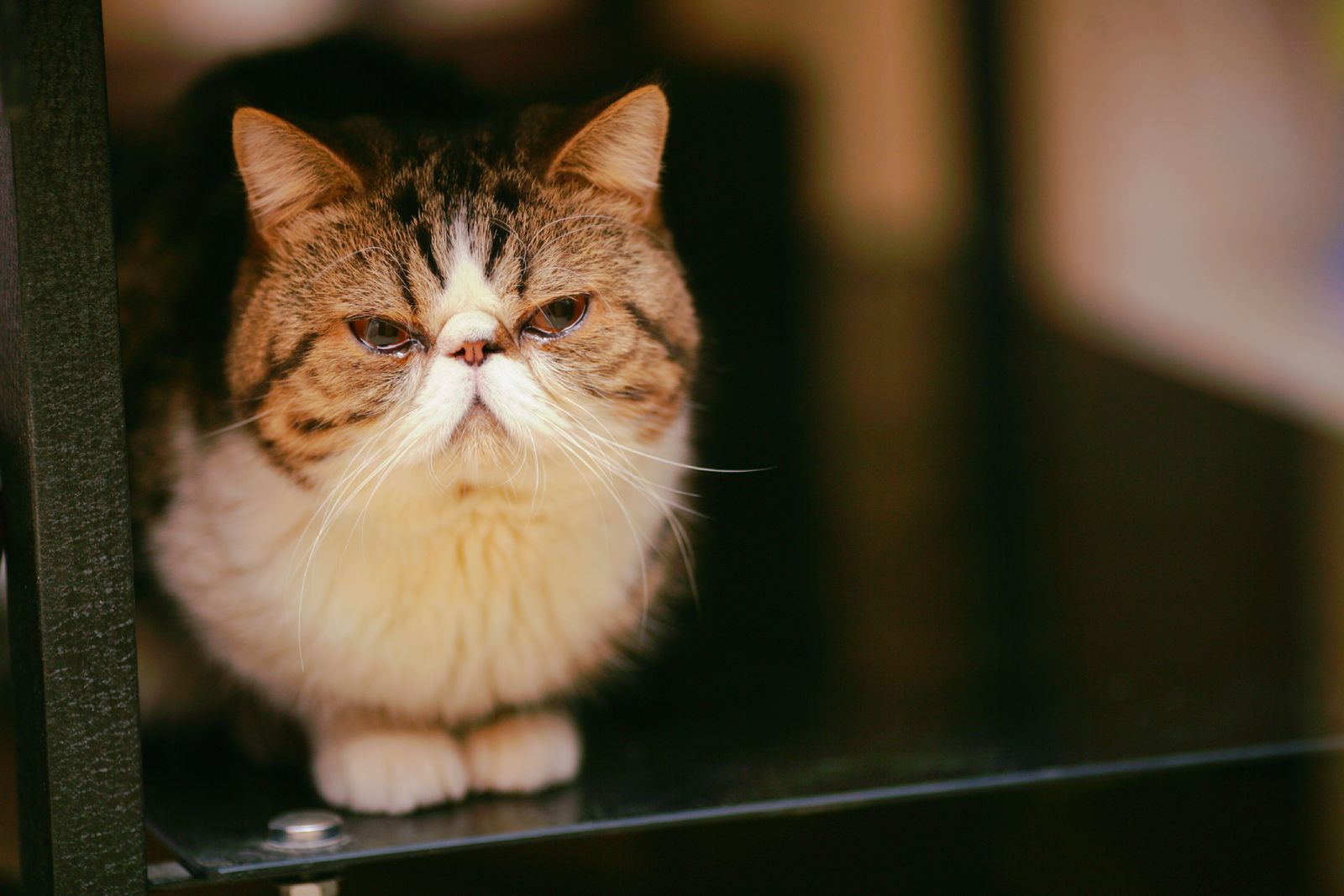
Exotic Shorthair snapshot
The International Cat Association, known as TICA, places the Exotic Shorthair in the Persian Breed Group, alongside the Persian and the Himalayan. TICA explains that the breed began when American Shorthair breeders crossed to Persians, and that the offspring were then bred back to Persians, so as Persian type changed, Exotic type changed with it. TICA is direct about the result: the standards are now identical except for coat length, and the breed has had championship recognition in TICA since June of 1979. The Cat Fanciers' Association, known as the CFA, tells the same story. Once the original cross was made, Exotics were consistently bred back to Persians rather than to their shorthaired ancestors, which is why the CFA finds practically no difference between the two breeds in personality. The CFA's popularity list for 2025, based on registrations in 2024, placed the Exotic fourth among its breeds.
| Size and build | Medium sized, and heavily boned and massive in TICA's words, with a broad round head on a robust, short, square body, short thick legs, and a short thick tail. TICA notes that these cats appear larger than they really are because of the dense fur, and that males are larger than females. |
|---|---|
| Head and face | A round head with fat cheeks, low set ears, and large, round eyes opening up a short face and giving it a sweet expression. The nose is short and snub. This short headed shape is called brachycephalic, meaning short headed. |
| Coat | Short, dense, and plush, with a thick undercoat that stands away from the body and softens the lines of the cat. TICA calls it a Persian in its pajamas. Colors and patterns are the Persian range, including pointed cats that are a shorthaired version of the Himalayan. |
| Temperament | Gentle, affectionate, and quiet, with the quiet manners of the Persian and a livelier, more inquisitive streak from the shorthaired ancestry. The CFA describes quiet, loyal companions that are devoted but not intrusive, and notes that meows are rare. |
| Grooming and daily care | Simpler than a Persian, not care free. TICA describes simple combing that removes loose dead hair, plus a wipe of the eyes, which can be irritated by dust because of their large surface. The CFA notes that the Exotic coat requires much less combing than a Persian's and will not mat or tangle. |
| Life expectancy | TICA gives a life expectancy of eight to eleven years for the breed on its breed page. Individual cats vary, and the kidney and airway care in this guide is written for the long version of that span. |
Two snapshot facts shape the insurance picture. The first is the breeding history. Because Exotics were bred back to Persians for generations, the health file that follows the Persian lines follows this breed too, and the laboratory that runs the main kidney DNA test names the Exotic Shorthair in its own breed list. That is not a guess made from resemblance. It is written into the test's own paperwork. The second fact is the division of labor the breed asks of its owner. The coat takes minutes a week. The face asks for a daily glance: eyes wiped, breathing noticed, appetite and litter habits watched. That daily glance is genuinely useful in an insurance story, because findings written down early, with dates, are what claims are later judged on.
Shared Persian-line risk, and the Exotic's own file
Owners are often told to just read the Persian page, because the breeds are the same cat in different coats. That is half true, and the half that is wrong matters at claim time. This table separates what travels down the Persian lines from what belongs to the Exotic's own record.
| Topic | Shared down the Persian lines | The Exotic's own file |
|---|---|---|
| Kidney DNA testing | The PKD1 variant and the test itself come from Persian breeding history. | The UC Davis laboratory lists the Exotic Shorthair by name as a breed appropriate for the PKD1 test, and it lists the Exotic Shorthair again for the Persian derived retinal test. Your cat's result stands on its own, under its own breed name. |
| The flat face | The head standard is the Persian standard. Airway narrowing, tear drainage problems, prominent eyes, and crowded teeth follow the same shape in both breeds. | The findings are recorded in your cat's own chart, under its own name and dates. A Persian's breathing note proves nothing about your Exotic, and your Exotic's clear kitten exam proves nothing about a Persian. |
| Coat and grooming | Almost nothing. This is the one trait the breed was created to change. | A short, plush coat that needs regular combing rather than daily grooming. Skin and coat claims in this breed are judged on a short coated cat, not on the matting and grooming story of a long coat. |
| Breeder paperwork | The document types are the same: DNA results for the parents, a kitten's own results where tested, and early exam notes. | The names on the papers are Exotic names, the registration is an Exotic registration, and longhaired kittens can appear in Exotic litters because the longhair gene travels in these lines. Keep the papers that match the kitten in front of you. |
The practical lesson is simple. Use the Persian experience to know which questions to ask. Use your Exotic's own papers to answer them. An insurer will do exactly that.
Health tendencies in Exotic Shorthairs
Two families of conditions run through this breed, and both arrive through the Persian doorway. The first is inherited: a kidney condition with a DNA test, the later kidney failure it can become, and a rare inherited eye disease that also has a DNA test in these lines. The second follows the shape of the head, and covers breathing, eyes, and teeth. These are tendencies, not predictions about an individual cat. Many Exotic Shorthairs live comfortably with careful care, and some of these conditions never appear in a given cat. What follows is the honest shape of the risk, condition by condition, with the exact policy wording each one makes worth checking.
This section is general information about conditions a breed can be prone to. It is not veterinary advice and it is not a diagnosis of any cat. Signs listed here are possible signs owners may notice, and many of them have several causes. Only a veterinarian who examines your cat can say what a sign means.
Polycystic kidney disease (PKD)
What it is
An inherited condition in which small, closed, fluid filled sacs, called cysts, develop in the tissue of the kidneys. The Cornell Feline Health Center explains that PKD occurs most frequently in Persian cats, and that the cysts tend to multiply in number and grow in size over time, eventually overwhelming normal kidney tissue and often leading to kidney failure. The Exotic connection is documented, not assumed. The UC Davis Veterinary Genetics Laboratory describes the tested form, called PKD1, as a heritable form commonly seen in Persians and in cats with Persian ancestry, and its list of breeds appropriate for testing names the Exotic Shorthair directly. PKD1 is autosomal dominant, which means a single altered copy of the gene is enough for a cat to be affected. UC Davis notes that a cat with one copy will transmit the variant to about half of its offspring, and that the severity of symptoms in an affected cat cannot be predicted from the DNA result. The same laboratory notes that kidney cysts in this form present early, often before twelve months of age, while kidney failure usually occurs at a later age. Cornell adds that cysts are present at birth and may be diagnosed in kittens as young as six months of age, and that clinical signs are most often recognized at around seven years of age.
Signs owners may notice
- Often nothing at all for years. Early PKD commonly has no outward signs, which is exactly why testing and screening find it before owners do.
- Later, the same signs as kidney disease in general: drinking more water and urinating more, a smaller appetite, and gradual weight loss.
- Nausea, occasional vomiting, and a cat that seems tired, quiet, or less interested in its routine.
- In an advanced case, kidneys that feel enlarged at a vet exam, which is a finding for the vet to assess, not something an owner can judge reliably at home.
When it can be urgent
PKD itself develops slowly and is a planned care condition, not an emergency. The urgent version of this story is sudden kidney trouble on top of it. A cat that stops eating entirely, vomits repeatedly, produces little or no urine, or becomes weak or disoriented needs same day care whatever the underlying cause, because those signs can mean the kidneys are no longer keeping up.
How vets usually evaluate and treat it
There are three separate tools, and they answer three separate questions. A DNA test, usually done on a cheek swab, shows whether the cat carries the tested PKD1 gene change. Cornell is clear that the genetic test cannot show how seriously a cat is affected. An ultrasound scan of the kidneys shows whether cysts are actually present, how many there are, and how large they have grown, and Cornell calls ultrasound the way to get a definitive diagnosis. Blood and urine tests, covered in detail in the chronic kidney disease card below, show how well the kidneys are working right now. There is no cure that removes the cysts. Cornell describes management as the same approach used for kidney failure in general, built on diet control, fluid therapy, and medications a veterinarian prescribes, with the goal of keeping the kidneys working as well as possible for as long as possible.
Chronic kidney disease (CKD), the later kidney story
What it is
The persistent loss of kidney function over time. This card is not a second, unrelated disease sitting next to PKD. It is the later chapter of the same story. When cysts multiply and grow, they crowd out working kidney tissue, and the kidney slowly loses its ability to filter the blood, make urine of the right concentration, and help regulate blood pressure. The Cornell Feline Health Center describes chronic kidney disease as one of the most common diseases of older cats generally, with age as the known risk factor. In an Exotic with PKD, the road into that same loss of function starts earlier and has a named cause. An Exotic can also develop chronic kidney disease for other reasons, like any cat, which is why this card and the PKD card must be read together rather than counted twice.
Signs owners may notice
- In the early stages, often no obvious signs at all, because the body compensates while function declines, as Cornell notes.
- Urinating larger volumes and drinking more water to keep up, with bigger or more frequent clumps in the litter box.
- Loss of appetite, weight loss, and a coat that looks dull or less well kept than this breed's usual plush finish.
- Later, tiredness and feeling unwell as waste products that healthy kidneys would remove build up in the bloodstream.
- Signs linked to complications: sudden vision change, disorientation, or weakness, which Cornell connects with the high blood pressure that can accompany kidney disease, and pale gums or deep tiredness, which it connects with anemia, meaning a low red blood cell count.
How vets usually evaluate and treat it
Evaluation rests on blood tests and urine analysis together, because Cornell stresses that no single test gives a complete picture of kidney function. Blood tests measure waste products the kidneys normally filter, including blood urea nitrogen, creatinine, and a marker called SDMA, which can rise earlier than creatinine as function falls. A urine test looks at how concentrated the urine is, whether protein is being lost through the kidneys, and whether infection is present. Blood pressure measurement is part of the evaluation, and ultrasound can show kidney size, shape, and cysts. Vets often base their judgment on repeat samples from a stable, well hydrated cat, and many use the staging system of the International Renal Interest Society, called IRIS, which groups kidney disease into stages and adds notes about urine protein and blood pressure. There is no cure that restores lost function. Cornell describes the goals as slowing progression and protecting quality of life: a therapeutic kidney diet, good hydration, control of blood pressure and urine protein loss, and treatment of problems such as anemia, nausea, appetite loss, and mineral imbalance as they arise, with regular monitoring to adjust the plan.
Three kidney records that are not interchangeable
Exotic owners collect kidney paperwork that other cat owners never see, and the papers are easy to confuse because all three mention the kidneys. They prove different things. A breeder file, a vet record, and an insurance claim can each turn on which paper says what, so keep them separate in your own file and use this table when a breeder, a vet, or an insurer uses one result as if it were another.
| Record | What it actually shows | What it cannot show |
|---|---|---|
| PKD1 DNA result | Whether the cat carries the one tested gene change linked to this heritable form of kidney cysts. UC Davis states that a cat with a clear result will not have this heritable form and cannot transmit this variant to its offspring. | Whether cysts are present today, how many there are, or how well the kidneys are working. A clear result also does not rule out kidney disease from other causes. |
| Kidney ultrasound report | Whether cysts can be seen in the kidneys at the time of the scan, and their number, size, and pattern. Cornell calls ultrasound the definitive way to diagnose PKD. | The gene result by itself, and, on its own, how much kidney function remains. A scan is a picture of structure, not a measure of filtering work. |
| Kidney function tests (blood, urine, blood pressure) | How well the kidneys are filtering and concentrating right now, whether protein is being lost in the urine, and whether blood pressure is high. These are the tests behind kidney staging. | Why function changed. Normal function tests do not prove that no cysts exist, and abnormal tests do not by themselves prove that PKD is the cause. |
The practical lesson is timing. A kitten can carry the gene change, show cysts on a scan, and still have completely normal function tests, all at the same time, because structure changes years before function fails. That is why the order of events in the medical record matters so much to an insurer, and why the document checklist at the end of this guide asks about each record separately.
Brachycephalic airway disease (breathing problems of the flat face)
What it is
Brachycephalic means short headed. In the Exotic, the shortened skull leaves less room for the airway inside it. International Cat Care describes brachycephalic obstructive airway syndrome, shortened to BOAS, as common in flat faced cats of these lines. The narrowing can sit at several points at once: a very narrow opening of the nostrils, called stenotic nares, narrow nasal passages, and a soft palate, the soft back part of the roof of the mouth, that is long relative to the shortened head. The Universities Federation for Animal Welfare, called UFAW, describes the same condition and notes that the greater the distortion of the skull, the narrower the nostrils and airways tend to be. Breathing through a narrowed airway takes extra effort on every breath, in sleep as well as awake. Nothing about the short coat changes this story. The airway belongs to the head, and the head is the Persian head.
Signs owners may notice
- Noisy breathing, snoring that is new or getting louder, or a cat that breathes through its mouth at rest.
- Less tolerance for play, heat, or excitement, with the cat stopping to recover its breath sooner than other cats do.
- Restless sleep, sleeping in stretched out or unusual positions, or waking and repositioning often.
- In more affected cats, effort visible in the chest or neck with each breath, even when the cat is calm.
How vets usually evaluate and treat it
Evaluation starts with watching and listening to the cat breathe, examining the nostrils, and asking how the cat sleeps, plays, and copes with warmth. A fuller airway assessment, including the soft palate and the back of the throat, usually requires sedation or anesthesia, because those structures cannot be seen in an awake cat. Management categories range from weight control, since extra weight loads a narrow airway, and avoiding heat and overexertion, through to surgery in more severe cases, such as widening narrowed nostrils or shortening an overlong soft palate. Which path fits depends on where the narrowing sits and how hard the cat works to breathe, which is individual to the cat in front of the vet.
Dental disease and malocclusion (crowded teeth in a short jaw)
What it is
Two linked problems. The first is fit. International Cat Care explains that in short nosed cats of these lines the teeth do not align properly, a misalignment called dental malocclusion, because the jaws and teeth are affected by the same skull shortening that flattens the face. The second problem is the disease that follows. The Cornell Feline Health Center names gingivitis, inflammation of the gums, periodontitis, the deeper disease that destroys the tissue and bone holding the teeth, and tooth resorption, in which the tooth structure itself breaks down, as the most common dental diseases in cats. The Merck Veterinary Manual explains that periodontal disease is caused by plaque bacteria accumulating on the tooth surface, that factors in its development include genetics, tooth crowding, and age, and that risk factors include abnormally positioned, plaque retentive surfaces such as malocclusion. A short jaw full of teeth is exactly that kind of surface.
Signs owners may notice
- Bad breath, along with red, swollen, or bleeding gums where the gum meets the tooth, which Cornell lists among the common signs of dental disease.
- Hesitating at the bowl, chewing on one side or turning the head while eating, dropping food, drooling, or a new preference for soft food.
- Visible buildup on the teeth, a tooth that looks pink or defective where it meets the gum, or a cat that resists having its mouth touched.
- Teeth that meet unevenly, poke at an angle, or press into the opposite gum, which an owner may notice during the weekly combing session or a yawn.
When it can be urgent
Most dental disease is a prompt appointment problem, not an emergency. A cat that stops eating entirely, drools heavily, bleeds from the mouth, has a swollen face or jaw, or cries out when eating needs same day care, because those signs can mean a tooth root infection, a fractured tooth, or pain the cat can no longer work around. Cornell notes that dental disease can cause a cat to stop eating, and an Exotic that is not eating should never simply be watched for days.
How vets usually evaluate and treat it
A complete dental evaluation usually means an examination under anesthesia, probing around each tooth, and dental X-rays, because much of the disease sits below the gum line where an awake exam cannot reach. Merck describes diagnosis and treatment of periodontal disease as work done under general anesthesia by trained veterinary professionals, using periodontal probing and dental radiography to assess attachment loss. Cornell describes treatment categories by condition: cleaning and scaling to remove plaque and tartar for gum disease, deeper cleaning and sometimes removal of teeth that have lost their support in periodontitis, and removal of teeth affected by painful resorption. A tooth that is badly misaligned and injuring soft tissue may also be removed or otherwise treated so the bite stops doing damage. Daily tooth brushing with products made for cats is the home care Cornell recommends for preventing gum disease where a cat will accept it.
Eye problems of the flat face (constant tearing, sequestrum, and entropion)
What it is
A group of problems with one root: the eye sits in a shallower socket, more exposed, in a face whose drainage plumbing no longer lines up. International Cat Care explains that the extremely flat face gives the cat large, protruding eyes with a reduced ability to close the eyelids fully, which increases exposure of the cornea, the clear front surface of the eye, and contributes to inflammation of the cornea, called keratitis, and to corneal sequestrum, an area of dead corneal tissue that appears as a dark patch on the eye. The same source explains that tears normally drain through ducts into the nose, that those ducts are short and deformed in flat faced breeds, and that tears therefore spill onto the face instead, a constant overflow called epiphora. TICA's breed page makes the everyday version of the same point: an Exotic's eyes can get irritated by dust because of their large surface, and a wipe of the eyes is part of normal care. UFAW adds entropion, in which the eyelid rolls inward so its hairs rub the cornea with every blink, and notes that Persians are predisposed to it because of facial anatomy, and that chronic rubbing raises the risk of corneal ulceration, a sore on the surface of the eye.
Signs owners may notice
- Tears running onto the face, damp fur under the eyes, and tear staining or sore skin in the fold below the eyes.
- Squinting, blinking more than usual, pawing or rubbing at an eye, or keeping one eye partly closed.
- A cloudy spot, a brown or dark patch, or a visible sore on the surface of the eye.
- Redness, discharge, or an eye that suddenly looks different from the other one.
How vets usually evaluate and treat it
Evaluation usually includes a full eye examination, staining the surface of the eye to reveal ulcers or damaged areas, checking tear production and eyelid position, and sometimes referral to a veterinary ophthalmologist, a specialist in eyes. Treatment categories depend on the finding: medication for inflammation or infection, protective care while a surface injury heals, surgery to correct an inward rolling eyelid, and surgery to remove a sequestrum that is causing pain or will not heal. Constant tearing without pain is often managed with the daily gentle cleaning TICA describes and with monitoring, because the drainage shape itself cannot be replumbed, which makes the distinction between harmless tearing and a painful eye the judgment owners most need their vet's help with.
Progressive retinal atrophy, Persian derived (PRA-pd)
What it is
An inherited disease of the retina, the light sensitive layer at the back of the eye, in which the light sensing cells are lost early and vision fails. The UC Davis Veterinary Genetics Laboratory describes the Persian derived form as a severe, recessive form of progressive retinal atrophy that leads to retinal thinning and eventual blindness, and it lists the Exotic Shorthair among the breeds appropriate for testing for this variant. Recessive means a cat needs two copies of the variant, one from each parent, to be affected. A cat with one copy is a carrier: it keeps normal vision but can pass the variant to its kittens. UC Davis notes that loss of the light sensing cells begins at around five weeks of age in affected kittens and is severe by around sixteen weeks, which makes this a disease of very young cats rather than seniors. A DNA test exists for this variant, and testing is how breeders identify carriers before mating.
Signs owners may notice
- A kitten whose eyes move in an uncoordinated way, a sign UC Davis lists for affected cats.
- Eyes that seem to shine more than usual in dim light, which owners may report as the retina thins.
- A young cat that misjudges jumps, bumps into furniture in dim rooms, or hesitates in new surroundings in a way that suggests it cannot see well.
When it can be urgent
PRA-pd itself is not painful and is not an emergency. Sudden vision loss in an adult cat is a different problem and needs same day care, because causes such as high blood pressure can sometimes be treated if they are caught quickly. A kitten that gradually stops seeing well needs a prompt eye examination and a clear diagnosis, both for the cat's own care and because the diagnosis and its date matter to the record.
How vets usually evaluate and treat it
Evaluation is an eye examination, often with a specialist, looking at the retina at the back of the eye, supported by the DNA test that confirms whether the known Persian derived variant is present. There is no treatment that restores the lost cells or reverses the blindness. Care is practical: keeping furniture, litter, food, and water in consistent places, supervising access to stairs and outdoors, and letting the cat navigate by scent, hearing, and whiskers, which most blind cats do well indoors. The insurance value in this condition is therefore mostly in the diagnosis work itself, the specialist examination and testing, rather than in years of treatment.
Policy decisions that matter for an Exotic Shorthair
An Exotic tests a policy in two directions at once. The kidney story tests duration: one inherited condition, testable before any sign exists, monitored for years, claimed at renewal after renewal. The face story tests definitions: whether problems that follow breed shape count as illness at all, and whether dental and eye care are real coverage or decorative coverage. Read these rows with both stories in mind. A premium, the amount you pay for the policy, buys only what these clauses actually say.
| Policy feature | Why it matters for an Exotic Shorthair | Stronger wording looks like | Watch out for |
|---|---|---|---|
| Hereditary and congenital coverage | PKD is inherited and present from birth, and PRA-pd is inherited. Between them they cover the breed's most serious diagnoses. | Hereditary and congenital conditions are covered on the same terms as other illnesses. | Hereditary exclusions, congenital exclusions, or a breed specific exclusion list that quietly names kidney cysts or retinal disease. |
| Genetic test and screening wording | Exotic kittens come with DNA results, breeder screening papers, and sometimes ultrasound reports that other breeds never generate. The PKD result is the first document in the file. | A clear written position on how DNA results, screening scans, and breeder records are treated, given to you before you buy. | Silence. If nobody will say in writing how a positive DNA result or a screening ultrasound is treated, the claim, not the sales call, is where you will find out. |
| Chronic condition renewal terms | Kidney disease, once present, is managed at every renewal for the rest of the cat's life. | A condition covered in one policy term stays covered in later terms while enrollment continues. | Wording that caps a condition per term, ends coverage for a condition at renewal, or reclassifies it as pre-existing each year. |
| Diagnostics and imaging coverage | The Exotic diagnoses are test driven: ultrasound for cysts, blood and urine panels for function, eye staining and specialist exams, dental X-rays under anesthesia. | Ultrasound, lab work, imaging, and specialist examinations are covered categories for a covered condition. | Policies that cover treatment but exclude or separately cap the tests that establish the diagnosis, or that treat screening and diagnosis as the same word. |
| Monitoring and diet coverage | Most kidney spending is rechecks: repeat blood tests, urine tests, blood pressure checks, and a therapeutic diet fed every day. | Monitoring tests for a covered chronic condition are reimbursable, and the position on prescription diets is stated plainly. | Wording that covers a condition but excludes its routine monitoring, or that classifies all food, including a prescribed kidney diet, as never covered without saying so up front. |
| Dental terms | A short jaw crowds teeth, plaque collects on misaligned surfaces, and gum disease, resorption, and extractions are realistic lifetime events. | Dental illness is covered, including anesthesia and X-rays used to treat it, with any cleaning history requirement stated in the policy. | Dental exclusions, accident only dental cover, malocclusion carve outs, or a cleaning requirement that is only mentioned when a claim is denied. |
| Eye condition terms | Prominent eyes in shallow sockets meet ulcers, sequestra, and inward rolling eyelids, often needing a specialist. | Eye disorders, including hereditary and shape related ones, are covered, with surgery and specialist care included. | Eye exclusions, cosmetic labels placed on eyelid surgery, or specialist care that needs an approval step nobody mentioned at purchase. |
| Airway and conformation wording | Breathing difficulty follows the shape of the skull itself, which makes it the condition most likely to meet a breed related exclusion. | Airway disease diagnosed after enrollment is treated as illness, with nostril and soft palate surgery addressed by name. | Brachycephalic exclusions, conformation exclusions, or breathing problems classed as expected for the breed and therefore not illness. |
Life stages: kitten, adult, and senior
Kitten
The kitten stage is when the paperwork is written that the rest of the cat's insurance life will be judged against. Ask the breeder for the parents' PKD1 DNA results and keep them, ask whether PRA-pd testing was done in these lines, and keep any DNA result, ultrasound report, or first exam note for your own kitten in one file, using the three record table in the health section to keep what each paper proves straight. Kidney cysts in the inherited form can already be present in a young kitten even though function is normal and signs are years away, and the retinal disease in these lines shows its first changes in the first weeks of life. The flat face declares itself early too, in noisy breathing, running eyes, and a bite the vet can already assess. Enrolling in this window, before any of those findings is written into your cat's own record as a concern, and letting the waiting periods run while the kitten is well, is the strongest position available. A waiting period is the set time after enrollment during which new conditions are not yet covered, so early enrollment is really about letting that clock finish quietly.
Adult
Adulthood is when the two Exotic stories usually surface. A screening or workup ultrasound finds kidney cysts in a cat that feels perfectly well. Kidney values begin to drift at a routine panel earlier than the owner expected. Breathing that was merely noisy becomes effort in warm weather. A dental under anesthesia finds gum disease and resorption that an awake look had missed. The insurance work of this stage is keeping the story in order: file claims as care happens, keep ultrasound reports with the blood and urine results from the same period, save blood pressure readings, and at each renewal confirm that the conditions the cat now carries are still described as covered. If a dental cleaning history matters to your policy, adulthood is when keeping that rhythm protects later dental claims.
Senior
A senior Exotic is often a cat managing a list rather than a single problem: kidney monitoring on a schedule, blood pressure checks, dental decisions weighed against anesthesia in a cat with kidney values to respect, eyes that need watching, and breathing that sets the limit on how much stress any procedure should involve. Review the policy each year for premium increases, age based changes, and any thinning of coverage at advanced ages. A pre-existing condition, meaning a condition or sign recorded before the policy started or during a waiting period, cannot be created by a renewal if the wording is sound, and that protection matters most in these years, when nearly every visit adds a note. The goal of the senior review is simple: the cat's real conditions should still be the covered ones.
A claim, step by step: kidney cysts found on ultrasound
The example below is hypothetical. It is not a real cat, a real claim, or a guarantee of how any insurer will decide. It follows a young adult Exotic Shorthair whose ultrasound finds kidney cysts, through kidney staging, diet and monitoring decisions, and into renewal claims for ongoing kidney care, because that full arc is what Exotic kidney coverage has to handle. Pet insurance generally reimburses after you pay the vet, as explained in how pet insurance works. A reimbursement is the share of an eligible bill the insurer pays back to you after the deductible and the policy's reimbursement rate are applied.
The ultrasound that changes the file
During a workup in early adulthood, an ultrasound of the abdomen shows multiple fluid filled cysts in both kidneys. The cat feels well, eats normally, and has no signs at home. The sonographer's report, describing the number, size, and position of the cysts, becomes the founding document of the kidney file. The owner asks for a copy the same week. In this breed, that report is not a curiosity. It is the diagnosis of polycystic kidney disease in written form, and every later kidney claim will be read against its date.
The vet visit that puts the finding in context
The primary vet reviews the cat's whole record: the kitten exam notes, the breeder papers the owner kept, and the parents' PKD1 results from the document checklist. The cat is examined, weighed, and its blood pressure is measured. The vet explains the three records distinction. The ultrasound has answered the structure question. It has not yet answered the function question. Blood and urine tests are booked to answer that second question, because treatment and monitoring decisions follow function, not pictures alone.
Checking the timeline against the policy
On paper, the insurer will line the ultrasound date up against the policy dates. In this example the cat was enrolled as a kitten, the illness waiting period ended long ago, and the record contains no earlier kidney note: no cyst mentioned at a kitten scan, no abnormal kidney value, no comment about enlarged kidneys. That clean timeline is what makes this a straightforward first kidney claim. The pressure point in real Exotic cases sits exactly here. A screening ultrasound done before enrollment, or a breeder note recording a parent's positive DNA result and a vet comment repeating it into the kitten's own chart as a diagnosis, can be argued as earlier knowledge. This is why the written questions about DNA results and screening scans belong before purchase, not after an ultrasound.
Staging: blood, urine, and blood pressure
The staging workup measures how the kidneys are performing. Blood tests cover the waste products the kidneys filter, including creatinine and SDMA, alongside minerals and red blood cell counts. A urine test shows how well the urine is concentrated and whether protein is being lost. Blood pressure is checked, because kidney disease and high blood pressure travel together and each changes the care plan. The vet may repeat key tests once the cat is stable and well hydrated before assigning a stage, since staging done on a dehydrated or unwell cat can overstate severity. The owner collects every result, because the stage, and the substage notes about protein and blood pressure, are what future rechecks will be compared with, by the vet and by the insurer alike.
Submitting the first claim
The claim is filed with the itemized invoices and the complete records: the ultrasound report, the examination notes, the blood and urine results, and the blood pressure readings. The date of the ultrasound finding is stated plainly, with the enrollment date and the end of the waiting period easy to see in the same file. No treatment has been sold as a cure, because there is none. What is being claimed is the diagnostic work itself and the start of a management plan, which is why the policy's diagnostics wording, checked in the table above, decides whether this first claim is smooth or argued.
The management plan and how reimbursement works
Care settles into the pattern Cornell describes for kidney failure in general: diet control, attention to hydration and fluid therapy where the vet advises it, and medications prescribed for the problems that appear, such as blood pressure or nausea. Each eligible bill moves through the same mechanics described in what pet insurance costs and why. Charges count against the deductible first, the policy's reimbursement rate applies to eligible charges after that, and totals are tracked against the annual limit. The diet question surfaces here in real money terms. If the policy treats a prescribed kidney diet as food and never as care, that recurring cost stays with the owner every month, which is why it was worth a written answer before enrollment.
Renewal, repeat claims, and where they get denied
At renewal, the decisive question is whether kidney disease is still a covered condition or has been reclassified. Under wording that keeps covered chronic conditions covered, the recheck blood tests, urine tests, blood pressure checks, and repeat ultrasounds are filed the same way, referencing the original ultrasound date and the staging history. The denial pressure points in this breed story are a cyst or kidney value recorded before enrollment, a DNA result treated as a diagnosis when no cysts had ever been found, monitoring denied as routine care rather than care for a covered condition, and renewal wording that caps or ends a named chronic condition. Each of those is a clause question, and each can be asked in writing before you buy, not after the ultrasound.
What drives an Exotic Shorthair premium
No responsible guide will name a price for your cat, because the quote depends on the cat, the address, and the settings chosen. What can be explained is the shape of Exotic pricing and the choices that move it. The full mechanics are in what pet insurance costs and why.
Breed risk profile. Insurers see a cat whose lines carry a documented inherited kidney condition with a named DNA test, plus the airway, eye, and dental consequences of a flat face. That profile prices differently from a moderate faced, short coated cat with no testable inherited condition in its file. The kidney is the wildcard even inside the profile, because two cats with the same breed label can have very different DNA results and scan histories, and the profile is priced before any individual cat's story is known.
The pattern of care, not one big bill. Exotic spending tends to arrive as a rhythm rather than a single dramatic night: kidney rechecks and blood panels across years, dental work under anesthesia in a crowded mouth, eye visits when a prominent eye is injured or inflamed, and breathing assessments when the weather turns warm. A policy that reimburses that rhythm reliably, at renewal after renewal, is worth more to this breed than the same policy would be to a cat whose risks are mostly accidents.
Age curve. Premiums generally rise with age, and this breed's costs are back loaded in a specific way. The cysts can be present from kittenhood, the signs most often arrive in the middle years, and kidney management then runs for the rest of the cat's life, alongside senior dental and eye care. The total cost of insuring an Exotic is therefore a long horizon calculation. A slightly cheaper policy with chronic condition caps can cost more over that span than a stronger policy, because the caps bite at every renewal of a lifelong kidney condition.
Location and plan settings. Vet prices in your area set the bill sizes the insurer expects, and specialist availability for ophthalmology and advanced imaging varies widely by region, which affects both price and how care actually unfolds. Your deductible, reimbursement rate, and annual limit choices trade premium against claim returns. For this breed, deductible type deserves the same attention as deductible size, because an annual deductible and a per-condition deductible produce very different results across kidney monitoring, a dental claim, and an eye claim in the same year.
Pre-purchase checklist for an Exotic Shorthair policy
The PKD and breeder-document checklist
This breed's tool is a document file, because the DNA result is the first document in it. Build the file before you enroll, and keep it with the policy. Each item below names what to ask for or keep, and why it matters later.
- Ask the breeder for both parents' PKD1 DNA results, with the laboratory name, the date, and the result for each parent written out. A spoken assurance is not a result, and a result for one parent is not a result for both.
- Ask whether the parents were also tested for the Persian derived retinal variant, PRA-pd, and keep those results beside the kidney papers. The two tests travel together in these lines, and the UC Davis laboratory lists the Exotic Shorthair for both.
- If your own kitten has been DNA tested, keep the kitten's own report, not a summary of it. The report's wording is what a vet or an insurer will read, and the distinction between a clear result, a carrier note where that applies, and an affected result decides how the paper should be used.
- Keep any kidney ultrasound report ever done on your cat, with its date, even when the report is normal. A normal scan inside the policy period is evidence. A scan done before enrollment is a fact the insurer will find anyway, and knowing its date early lets you ask the pre-existing question before you buy.
- Keep the first vet exam notes that mention breathing, eyes, or teeth, word for word. In this breed those early comments are the notes later airway, eye, and dental claims are measured against.
- Write down, in one place, the enrollment date and the end of each waiting period. Kidney, dental, and eye timelines in this breed are all judged against those two dates.
- Ask the insurer, in writing, how a positive PKD1 result with no cysts found is recorded on the file. Keep the answer with the policy. That single answer is the document most likely to decide a future kidney claim.
The policy checklist
- Confirm hereditary conditions are covered, including polycystic kidney disease and progressive retinal atrophy.
- Check that ultrasound, blood and urine panels, and blood pressure checks ordered for a kidney concern are covered as diagnosis and monitoring, not dismissed as elective screening.
- Confirm repeat kidney monitoring and any covered kidney condition stay reimbursable at every renewal.
- Confirm dental illness coverage in plain terms, including anesthesia, dental imaging, and tooth removal, and ask how misaligned teeth are treated.
- Read the airway wording in full, and get a written answer on nostril and soft palate surgery.
- Confirm eye disorders are covered, including specialist visits, entropion surgery, and corneal sequestrum surgery.
- Choose between an annual and a per-condition deductible using this breed's pattern of steady monitoring claims across several body systems.
- Enroll as a kitten, before a kidney note, a breathing comment, an eye finding, or a dental remark enters the medical record.
Questions to ask an insurer, in writing
- How do you record a positive PKD1 DNA result when no cysts have ever been found on ultrasound: as a diagnosis, as a risk note, or as background information?
- Once kidney disease is diagnosed and covered, will it and its monitoring stay covered at every renewal while I stay enrolled?
- Is an ultrasound ordered because a vet felt enlarged kidneys, or as follow up to a DNA result, treated as covered diagnosis or as excluded screening?
- Are breathing problems linked to my cat's flat face covered, and are nostril surgery and soft palate surgery covered, limited, or excluded by name?
- Is dental illness covered, including anesthesia and tooth removal, and how are teeth that grew in misaligned because of jaw shape treated?
- Are eye specialist examinations, entropion surgery, and corneal sequestrum surgery covered for this breed?
Questions Exotic Shorthair owners ask
Does pet insurance cover polycystic kidney disease in Exotic Shorthairs?
An accident and illness policy can cover polycystic kidney disease when hereditary conditions are included, the illness waiting period has passed, and the condition was not known before enrollment. Known is the word to probe. Cysts seen on an ultrasound, kidney values in a vet record, or findings recorded before the policy started can be treated as pre-existing under many policy definitions. Ask in writing how a DNA result, an ultrasound finding, and kidney function tests are each treated before you buy.
My Exotic Shorthair's PKD DNA test was clear. Does that settle kidney coverage?
It settles one question, not the whole kidney story. The UC Davis Veterinary Genetics Laboratory says a cat with a clear result for the tested variant will not have this heritable form of polycystic kidney disease and cannot pass that variant on. The result does not show whether cysts are present today, and it does not rule out kidney disease from other causes. Ultrasound shows the kidneys themselves, and blood and urine tests show how well they are working, so kidney coverage questions are still worth asking in full.
An Exotic is a Persian in a short coat. Are the insurance questions the same?
Many are shared, because the breed was bred back to Persians and the standards are now identical except for coat length. The kidney DNA test, the flat face airway questions, the eye questions, and the crowded teeth questions all travel down the Persian lines. What is not shared is the coat work and the paperwork. An Exotic needs weekly combing rather than the Persian's daily grooming, its own registration and breeder documents name the Exotic, and an insurer will judge claims on your Exotic's own medical record, not on a Persian's record or a parent's clear test.
Are breathing problems from a flat face covered, or excluded as breed related?
Policies differ more on this point than on almost any other Exotic question. Some accident and illness policies cover airway disease when it is diagnosed after enrollment and the waiting period, even when breed shape contributed. Others limit or exclude conditions tied to breed conformation, or name brachycephalic airway problems directly. Because an Exotic cannot change its face, this wording deserves a written answer before purchase, including how nostril surgery and soft palate surgery are treated.
Does pet insurance pay for dental work in an Exotic Shorthair?
Routine cleaning is preventive care, and many accident and illness policies do not cover preventive care unless a wellness add-on is included. Treatment of dental disease is a different category. Policies differ on whether anesthesia, dental X-rays, treatment of gum disease, and removal of diseased teeth are covered, and on whether a regular cleaning history is required before dental illness claims are paid. An Exotic mouth crowds teeth into a short jaw, so read the dental section in full and ask how misaligned teeth are treated.
When is the best time to enroll an Exotic Shorthair?
As a kitten, before any kidney ultrasound note, breathing comment, eye finding, or dental remark is in the record. Kidney cysts in the inherited form can be present early, even though kidney failure usually comes much later, and a rare inherited eye disease in these lines shows its first changes in very young kittens. A clean early record and completed waiting periods are what keep later claims straightforward, and enrolling early means findings that appear as the cat matures are judged inside the policy period instead of before it.
Sources and further reading
- Cat Fanciers' Association, Exotic breed page for the breed's history of being bred back to Persians, its quiet and loyal temperament, its popularity, and why genetic screening matters for breeding cats in this breed.
- The International Cat Association, Exotic Shorthair breed page for the Persian Breed Group, the identical standard except for coat length, the heavily boned and massive build, the sweet flat face, eye wiping in normal care, and the life expectancy given for the breed.
- UC Davis Veterinary Genetics Laboratory, Polycystic kidney disease (PKD1) for the heritable form in Persians and cats with Persian ancestry, the Exotic Shorthair in the list of breeds appropriate for testing, dominant inheritance, cysts presenting early, and why severity cannot be predicted from the result.
- Cornell Feline Health Center, Polycystic kidney disease for cysts present at birth, diagnosis in young kittens, signs most often recognized at around seven years of age, ultrasound as the definitive diagnosis, and management built on diet, fluids, and medication.
- Cornell Feline Health Center, Chronic kidney disease for the loss of kidney function over time, blood and urine testing together, blood pressure and anemia as complications, IRIS staging, and the goals of slowing progression and protecting quality of life.
- UC Davis Veterinary Genetics Laboratory, Progressive retinal atrophy, Persian derived (PRA-pd) for the recessive inherited retinal disease, the Exotic Shorthair in the list of breeds appropriate for testing, cell loss beginning at around five weeks of age, and carrier results.
- International Cat Care, Persian cats and brachycephaly for the flat face as several problems at once, including airway narrowing, tear drainage, eye exposure, and dental malocclusion in these lines.
- Universities Federation for Animal Welfare, Persian brachycephaly for how skull distortion narrows nostrils and airways, entropion and corneal ulceration risk, and why deep ulcers and ruptured eyes are emergencies.
- Cornell Feline Health Center, Feline dental disease for gingivitis, periodontitis, and tooth resorption as the most common dental diseases of cats, their signs, and treatment categories including cleaning, scaling, and tooth removal.
- Merck Veterinary Manual, Periodontal disease in small animals for plaque bacteria as the cause, tooth crowding and malocclusion as factors and risk surfaces, and diagnosis and treatment under general anesthesia with probing and dental radiography.