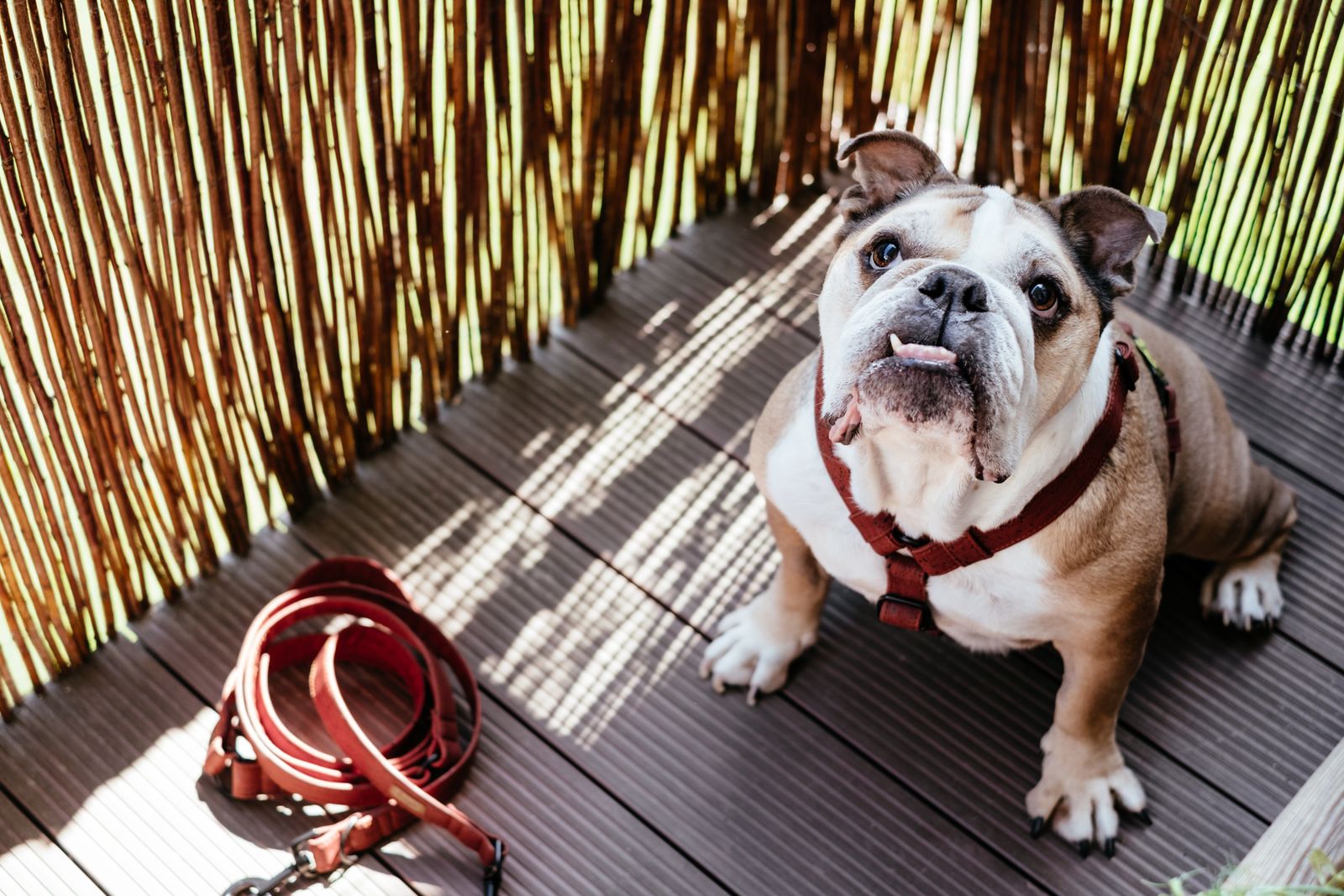
Bulldog snapshot
The American Kennel Club registers this breed simply as the Bulldog. It is often called the English Bulldog, but English is not part of the AKC name. The AKC describes a kind but courageous, friendly but dignified dog, thick set, low slung, and well muscled, with a distinctive pushed in face.
| Height | 14 to 15 inches at the shoulder. |
|---|---|
| Weight | About 50 pounds for males and about 40 pounds for females. |
| Lifespan | 8 to 10 years, as listed by the AKC. |
| Coat | Short, smooth, and fine, with loose skin and heavy wrinkles on the head and face, and folds at the throat. |
| Temperament | Calm, friendly, and dignified, with a courageous streak and a strong attachment to its household. |
| Energy and exercise | Low to moderate. Regular, gentle exercise helps control weight, and heat, humidity, and hard exertion are genuine risks because of the airway. |
Two snapshot facts shape the insurance decision. The first is weight for height. A Bulldog carries a large dog's mass on a short frame, so anaesthesia, imaging, medication, and joint load all behave more like a large breed than the height suggests. The second is lifespan. At 8 to 10 years, the Bulldog reaches the senior stage sooner than most breeds in this series.
The breed's own health program tells you where breeders look first. The Bulldog Club of America takes part in the Canine Health Information Center program run with the Orthopedic Foundation for Animals, often shortened to OFA. For Bulldogs, the required screening set in that program is a congenital cardiac evaluation, a patellar luxation evaluation, and a radiographic evaluation for tracheal hypoplasia, which is a windpipe that is narrower than it should be. Eye examination, hip evaluation, thyroid testing, a hearing test, and DNA testing for named urinary conditions are listed as optional and encouraged.
Health tendencies in Bulldogs
Cornell, the Merck Veterinary Manual, the breed club, and the OFA program point to the same core list for this breed. The airway comes first, then the skin folds, then the eyes, then the spine, with hips and kneecaps behind them. These are tendencies, not predictions about an individual dog. The point of reading the list before you buy a policy is that each tendency has a clause attached to it, and the clause is easier to check before a claim than during one.
This section is general information about conditions a breed can be prone to. It is not veterinary advice and it is not a diagnosis of any dog. Signs listed here are possible signs owners may notice, and many of them have several causes. Only a veterinarian who examines your dog can say what a sign means.
Breathing problems (brachycephalic obstructive airway syndrome, or BOAS)
What it is
A group of upper airway problems that travel together in short headed breeds. Cornell's Riney Canine Health Center lists the English Bulldog first among the breeds where this condition is seen most often. Cornell explains that the skull bones are compressed, while the tissues inside do not shrink by the same amount. The main findings can include narrowed nostrils that may collapse as the dog breathes in, a soft palate at the back of the mouth that is long enough to block airflow, small pouches of tissue near the vocal cords that get pulled inward, and in some dogs a windpipe that is narrower than it should be, called a hypoplastic trachea. Working harder to breathe can swell throat tissue over time, which narrows the airway further.
Signs owners may notice
- Noisy breathing at rest, snoring while awake, snorting, or a harsh sound on a short walk.
- Breathing that looks like hard work, with more chest and belly movement than you would expect.
- Tiring quickly, sitting down on walks, or struggling in warm or humid weather.
- Gagging or retching, trouble swallowing, or restless sleep with the chin lifted.
- Panting that does not settle after coming indoors, drooling, or wobbliness in heat.
How vets usually evaluate and treat it
Cornell notes that most dogs are diagnosed between one and four years of age, and that diagnosis rests on the breed, the signs, and a physical exam. Narrowed nostrils can be seen on a routine exam. Looking at the soft palate and the tissues near the vocal cords usually needs light anaesthesia, and X-rays of the neck and chest can show the width of the windpipe, with endoscopy or a CT scan used in some cases. Mild cases are often managed with weight control, a harness instead of a neck collar, controlled activity, and strict avoidance of heat, humidity, and stress. More severe cases may be referred to a surgical specialist. Surgery can widen the nostrils, shorten a long soft palate, or remove pulled in tissue. Cornell is clear that there is no surgical procedure to correct a narrow windpipe itself. Anaesthesia in this breed carries extra risk, and swelling after airway surgery is a known risk the care team plans for.
Skin fold infection and dermatitis (intertrigo)
What it is
Inflammation and infection of the skin inside a fold, where skin rubs on skin and air does not reach. The Merck Veterinary Manual describes fold pyoderma, also called intertrigo, as a surface bacterial skin infection, and notes that warm, moist areas such as facial folds, lip folds, neck folds, and tail folds carry higher bacterial counts than other skin and are at increased risk of infection. A Bulldog is built of folds. The face, the rope over the nose, the lips, the neck, and the pocket around the short tail all trap moisture, food, tears, and debris. Allergy can sit underneath the whole picture and keep restarting it, which is why one cleared infection is often not the end of the story.
Signs owners may notice
- Redness, moisture, or discharge inside a face, lip, neck, or tail fold, often with a strong sour smell.
- Brown staining below the eyes or around the mouth, and skin that looks raw when a fold is lifted.
- Rubbing the face on the floor or furniture, scratching, or pawing at a fold.
- Recurring ear redness or infection alongside the skin picture, which often points to an underlying allergy.
- A tail pocket that the dog scoots or strains to reach, or that smells even after a bath.
When it can be urgent
Most fold problems are a prompt routine visit, not an emergency. A fold that is rapidly swelling, bleeding, very painful, or oozing, a dog that stops eating because its face hurts, or skin trouble combined with a feverish, quiet dog needs a same day call. A deep tail fold infection that is left alone can become a much larger problem than the early cleaning and medication that would have settled it.
How vets usually evaluate and treat it
A vet will usually lift and examine each fold, look at material from the skin under a microscope to tell bacteria from yeast, and check the ears, because ear and fold problems often travel together. Care categories include gentle cleaning and thorough drying of the folds, topical treatment placed in the fold, and medicine for a deeper or wider infection where the vet judges it is needed. Weight matters here too. Heavier dogs have deeper folds, and a tail fold that cannot be kept clean in a severe, repeated case is sometimes discussed as a surgical problem.
Eye problems (cherry eye, entropion, and corneal ulcers)
What it is
Three eye problems share this card because Bulldog owners meet all three, and because a policy can treat each one differently. Cherry eye is the prolapse, or slipping out of place, of the tear gland of the third eyelid. It appears as a smooth pink or red lump in the inner corner of the eye. That gland helps make the tear film, so modern treatment aims to reposition and keep it rather than remove it. Entropion is an eyelid that rolls inward, so hairs rub on the clear front surface of the eye. In a breed with heavy facial skin and folds, that rolling is structural. Corneal ulcers are painful sores on that clear surface. A rubbing eyelid, dryness, or a scratch can start one, and a Bulldog eye sits prominently enough that surface injury is a standing risk.
Signs owners may notice
- A pink or red lump in the inner corner of one eye, sometimes appearing in the second eye later.
- Squinting, tearing, pawing at the eye, or holding one eye partly closed.
- A cloudy, bluish, or dull spot on the clear front of the eye.
- Thick discharge, redness of the white of the eye, or avoiding bright light.
How vets usually evaluate and treat it
Eye evaluation usually includes a full eye exam, a stain test that reveals surface damage on the cornea, a check of tear production, and a close look at how the eyelids sit against the eye. Cherry eye is usually corrected with surgery that tucks the gland back into a pocket and secures it. Entropion is usually corrected with surgery that removes a small strip of skin so the lid rolls outward into a normal position. Ulcers are treated by depth and cause, with topical medicine, pain control, protection from rubbing, and close rechecks.
Spine malformations (hemivertebrae)
What it is
A hemivertebra is a spine bone that did not form completely, so it is shortened or wedge shaped instead of block shaped. The Merck Veterinary Manual lists hemivertebrae among congenital vertebral malformations, alongside fused block vertebrae and cleft butterfly vertebrae, and notes that hemivertebrae are most common in screw tailed dog breeds such as Pugs, Bulldogs, and Boston Terriers. The same build that produces the short screw tail can produce malformed bones further up the spine. Many of these findings are discovered by chance on imaging taken for another reason, and many never cause a sign in the dog's whole life. In some dogs, a wedge shaped bone angles the spine, narrows the canal the spinal cord runs through, or makes a section unstable, and then the cord itself is at risk.
Signs owners may notice
- Wobbliness or poor coordination in the back legs, or a gait that crosses or drags.
- Back pain, reluctance to jump, climb, or be lifted, or crying out when moving.
- Weakness in the back legs that builds slowly in a young adult dog.
- In a severe episode, loss of bladder or bowel control.
How vets usually evaluate and treat it
Evaluation starts with a physical and neurological exam to locate the problem and grade any weakness. X-rays can show a malformed bone, and Merck notes that specialised imaging such as a CT scan may be needed to judge whether a spinal defect can be corrected with surgery, with MRI used where the cord itself needs to be assessed. Where signs are present, care can include rest, pain relief, and weight control, and a dog with cord pressure may be referred to a neurology or surgery specialist to discuss stabilisation.
Hip dysplasia
What it is
The inherited hip problem, in a heavy dog on a short frame. The ball and socket of the hip fit loosely, the joint moves unevenly, and arthritis develops over time. The Merck Veterinary Manual describes hip dysplasia as joint laxity followed by degenerative joint disease. Hip evaluation sits on the Bulldog breed health program's encouraged list, and a heavy body makes a loose hip work harder on every step.
Signs owners may notice
- Stiffness after rest, trouble rising, or reluctance on stairs and jumps.
- A swaying or bunny hopping run, or limping in a back leg after exercise.
- Loss of muscle over the back legs, or slowing on walks that used to be easy.
When it can be urgent
Hip dysplasia develops slowly and is a routine appointment problem. A dog that suddenly will not bear weight, cries out, or holds a leg oddly after a fall may have an injury rather than simple arthritis, and that change needs prompt care.
How vets usually evaluate and treat it
Evaluation is a hands on joint exam plus hip X-rays to show looseness and arthritis. Treatment usually leans medical first in this breed. Weight control down to a lean condition, controlled exercise, pain and anti-inflammatory medication, joint support, and rehabilitation are the standing categories. Surgery exists for cases that do not respond, and is usually a specialist decision.
Luxating patella (slipping kneecap)
What it is
A developmental condition in which the kneecap slips out of the groove it should ride in. The Merck Veterinary Manual describes patellar luxation as displacement of the kneecap from its groove, often tied to the shape of the whole hind leg, and vets grade its severity by hand during an exam. In the Bulldog this is not a minor footnote. Patellar evaluation is one of the three required screenings in the breed's OFA and breed club health program, which means the breed's own experts expect the problem often enough to test every breeding dog for it.
Signs owners may notice
- A sudden skip or hop on a back leg for a few steps, then normal walking again.
- Holding a back leg up briefly, or stretching it out behind before continuing.
- In more severe cases, a crouched stance, bowed legs, or lameness that does not come and go.
When it can be urgent
A skipping gait is a book an appointment sign. A knee problem combined with a fall, a cry of pain, swelling, or a leg that will not bear weight at all could be a cruciate ligament injury or a fracture, and that combination needs prompt care.
How vets usually evaluate and treat it
Vets usually diagnose and grade the kneecap by hand during an exam, sometimes with X-rays to look at leg alignment and arthritis. Mild cases often suit conservative care, meaning weight management, controlled exercise, physical therapy, and pain medication. Surgery is usually considered for moderate to severe grades, persistent lameness, or a condition that is getting worse. Keep the grade from every exam. A kneecap recorded as loose at a puppy visit, graded at a breeder screening, or noted at a first vet check is exactly the kind of early record an insurer will later line up against a surgery claim.
Airway grading, in plain language
No other breed guide on this site has this section, because no other breed in the series has a grading scheme quite like this one. The Respiratory Function Grading scheme was developed by the BOAS Research Group at the University of Cambridge and is run with the Kennel Club. The test itself is simple and does not involve anaesthesia. A trained assessor listens to the dog's airway with a stethoscope at rest, then the dog trots for a short exercise test, and the assessor listens again right after. Breathing noise, breathing effort, and any signs of distress decide the grade.
The grades run from 0 to 3.
| Grade | What it means |
|---|---|
| 0 | Clinically unaffected. No respiratory signs of BOAS found. |
| 1 | Mild signs. The dog is not clinically affected. |
| 2 | Moderate signs. The dog is clinically affected. |
| 3 | Severe signs. The dog is clinically affected. |
For a pet owner, the grade does a different job. It is a dated, objective record of how this dog breathed on that day, made by a trained assessor using a standard method, rather than a casual note that a dog snores.
A grade is a medical record, and a Bulldog owner should understand what that means before getting a dog graded. A high grade, or a grade recorded before a policy started, can be read by an insurer as evidence that an airway condition was already present. It is a reason to grade thoughtfully, to keep the certificate, and to ask the insurer the airway questions in the checklist below in writing, ideally before the record and the policy ever have to meet.
Grading also has a limit owners should hear plainly. A grade describes function on the day. It does not measure the width of the windpipe, it does not promise how the airway will age, and it does not replace the anaesthetised airway exam a surgeon needs before operating. Treat a grade as one strong page in the file, alongside the breeder screening results, the weight record, and the ordinary vet notes, not as the whole file.
Policy decisions that matter for a Bulldog
For a Bulldog, read a policy from the exclusions inward, not from the benefits outward. Does the wording that carves things out carve out this breed? Work down this table in order, because the first rows can make the later rows irrelevant.
| Policy feature | Why it matters for a Bulldog | Stronger wording looks like | Watch out for |
|---|---|---|---|
| Breed condition exclusions | Airway, fold, eye, and spine problems are the breed's known conditions, so an exclusion aimed at breed conditions aims at this dog. | No exclusion for conditions a breed is prone to, or a short, named list that does not include the Bulldog core list. | Broad wording that excludes conditions common to a breed, or a brachycephalic exclusion buried in definitions. |
| Hereditary and congenital coverage | BOAS anatomy, hemivertebrae, cherry eye, entropion, hip dysplasia, and luxating patella are inherited or present from birth. | Hereditary and congenital conditions are covered on the same terms as other illnesses. | Hereditary or congenital exclusions, low separate limits, or coverage that starts only after a long special wait. |
| Airway surgery and anaesthesia | Airway correction is specialist surgery on a breed where anaesthesia and recovery swelling are part of the risk. | Corrective airway surgery, specialist care, anaesthesia, and hospital monitoring are covered when medically necessary. | Airway surgery treated as elective, or a narrow windpipe used to limit a claim the policy otherwise covers. |
| Eye surgery terms | Cherry eye and entropion both commonly need surgery, and the second eye can follow the first. | Eye disorders, including hereditary ones, are covered, with gland repositioning and eyelid correction named as treatments. | Cherry eye classified as cosmetic, entropion classified as elective, or an eye exclusion for this breed. |
| Skin recurrence and renewal | Fold infections return for anatomical reasons and can run for the dog's whole life, often with allergy underneath. | Repeat episodes are counted under a clear rule, and a covered skin condition stays covered at renewal. | Each flare treated as a new condition with a new deductible, or skin cover that thins out after the first year. |
| Spine and imaging terms | A hemivertebra found by chance is common, and judging its signs needs CT or MRI and a specialist. | Congenital spinal malformations are covered, and advanced imaging and neurology referral are covered services. | A congenital exclusion that removes spine care, or imaging covered only after a diagnosis the imaging itself is needed to make. |
| Bilateral condition rule | Eyes, hips, and kneecaps all come in pairs, and Bulldogs often meet the same problem on both sides over time. | Each side is judged on its own record, with clear terms for the second side. | Wording that treats the second eye, hip, or knee as pre-existing after the first side is diagnosed. |
| Waiting periods and pre-existing definitions | Bulldog signs can be noted early and casually, as snoring, a loose knee, or a red eye, long before a diagnosis. | Short, listed waiting periods, and a pre-existing definition tied to signs a vet recorded and explained. | Long orthopedic or airway waiting periods, and definitions that turn any early note into a permanent exclusion. |
Life stages: puppy, adult, and senior
Puppy
The puppy stage sets the whole file. Ask the breeder for the parents' screening results under the breed health program, including the cardiac, kneecap, and windpipe evaluations, plus any eye, hip, and DNA results the breeder holds. Ask whether either parent has had an airway grade, and what it was. Cherry eye often appears in young dogs, kneecaps can be graded at early exams, and breathing notes can be written at a first vet visit by a vet who means nothing by it beyond describing the puppy in front of them. Enrolling before those notes accumulate is the single most valuable move a Bulldog owner makes.
Adult
Adulthood is when the airway usually declares itself. Cornell places most BOAS diagnoses between one and four years of age, which is young, and that timing drives the adult insurance job. Do not let noisy breathing become background noise in the house. Get it examined, get it written down properly, and consider a formal airway grade while the dog is well. Skin and eye care settle into routine in this stage, and the administrative work matters. File the small claims, keep the fold and ear records together, and check at each renewal that the conditions the dog now carries are still described as covered. If you change insurers in adulthood, the new policy will judge the dog on the record that already exists, and a gap in coverage can turn a managed condition into a pre-existing one.
Senior
A Bulldog senior arrives sooner than owners of longer lived breeds expect. Arthritis from hips and knees, an airway that has worked hard for years, ongoing skin care, and eye surface problems overlap, and anaesthesia decisions need more care than they did at two years old. Keep a simple home log of breathing comfort, mobility, appetite, and sleep. That log helps a vet judge change, and it creates the clear timeline any claim review will look for.
A claim, step by step: an airway workup that leads to surgery
The example below is hypothetical. It is not a real dog, a real claim, or a guarantee of how any insurer will decide. It follows an adult Bulldog through worsening breathing, a formal workup, corrective surgery, and the finding that cannot be corrected, because that full arc is what Bulldog airway coverage has to handle. Pet insurance generally reimburses after you pay the vet, as explained in how pet insurance works.
The signs, and the notes that start the file
Over one summer the dog's breathing grows louder. Walks end early, sleep is restless, and a warm afternoon leaves the dog panting long after coming indoors. The owner writes down when the change began, saves a short phone video of the breathing at rest, and books a vet visit instead of waiting for autumn. That timeline matters, because the insurer will later compare it with the policy start date, the waiting periods, and any earlier note about snoring.
The vet visit and the airway exam
The vet examines the nostrils, listens to the airway, checks the dog's weight, and records the findings. Because the soft palate and the tissues near the vocal cords cannot be judged properly in an awake dog, the vet explains that a full airway assessment needs light anaesthesia, possibly with neck and chest X-rays to measure the windpipe. The written record, with the exam findings and the reasoning for the next step, becomes the backbone of the claim.
Checking the breed condition wording before anyone operates
Before booking the procedure, the owner checks three things in writing. Whether BOAS is covered for a Bulldog under this plan, or sits inside a breed condition exclusion. Whether corrective airway surgery is a covered treatment. And whether any airway waiting period applied, and had passed before the first sign. A short written answer from the insurer at this stage is worth more than a long argument after the bill exists. If the answer is no, the owner learns it while there is still a choice about timing and provider.
The workup, the surgery, and the finding with no fix
The assessment proceeds under anaesthesia with a team prepared for a brachycephalic airway. The specialist finds narrowed nostrils and a long soft palate, and corrects both. The X-rays also show a windpipe that is narrower than it should be. There is no surgery for that finding, as Cornell notes, so it is recorded, and the recovery plan accounts for it. The owner pays the clinic directly and collects the itemised invoice, the full records, the anaesthesia and surgery reports, the imaging, and the discharge and recheck instructions.
Submitting the claim
The claim is filed with the invoices and the complete records, including the first visit where the breathing change was discussed and any earlier airway grade the dog holds. If the insurer asks for earlier records, sending them promptly and completely is better than sending selected pages, because a gap in the timeline invites the worst reading of it.
How reimbursement works in general
Once a claim is accepted, the mechanics are the same as in what pet insurance costs and why. Eligible charges count against the deductible first, the policy's reimbursement rate then applies to eligible charges, and totals are tracked against the annual limit. Charges the policy excludes stay with the owner. In an airway case those excluded pieces can be specific, such as an exam fee in some plans, or a part of the procedure a policy classifies differently, which is why the written check in step three mattered.
Where Bulldog airway claims get denied
The pressure points are timing and wording. A note about snoring or noisy breathing dated before coverage or during a waiting period. A breed condition or brachycephalic exclusion the owner had not found. Airway surgery described as elective. A narrow windpipe finding used to reframe the whole case as congenital where the plan limits congenital conditions. And incomplete records that leave the insurer unable to tell when signs began. Each risk is reduced by enrolling early, reading the airway clause before the dog needs it, and keeping the full record, grades included.
What drives a Bulldog premium
No responsible guide will name a price for your dog, because the quote depends on the dog, the address, and the settings chosen. What can be explained is why a Bulldog is priced the way it is, and which choices move the number. The full mechanics are in what pet insurance costs and why.
Breed risk profile. Insurers see a breed where the core conditions are anatomical. Breathing, folds, eyes, and spine do not depend much on luck, and several of them involve specialists, imaging, or surgery. Judge any Bulldog quote against the exclusions table above, not against the headline benefit list.
Size in a short body. A Bulldog is not tall, but it is heavy, and treatment cost follows mass more than height. Anaesthesia, medication doses, imaging, and surgical time for a dog of this weight sit closer to a large breed than to a small one.
Age curve and lifespan. Premiums generally rise with age. A breed that lives 8 to 10 years reaches the expensive years quickly, and its most likely claims cluster in young adulthood and middle age rather than only at the end of life. That makes the early policy years unusually important for this breed. A policy that is weak on airway and eye wording at age two is weak exactly when the dog is most likely to need it.
Location and plan settings. Vet prices in your area set the bill sizes the insurer expects, and specialist and emergency care vary widely by market. For this breed, picture one airway or eye surgery plus a year of skin care in the same policy year when you size the limit, because that combination is a normal Bulldog year, not a freak one.
Pre-purchase checklist for a Bulldog policy
- Read the breed condition exclusions first, and check the Bulldog core list against them one condition at a time.
- Confirm hereditary and congenital conditions are covered, including BOAS anatomy, hemivertebrae, cherry eye, and entropion.
- Get a written answer on corrective airway surgery for a Bulldog under the exact plan you are considering.
- Ask how a narrow windpipe finding, and an airway grade recorded before enrollment, would be treated at claim time.
- Ask how repeat skin fold infections are counted, and whether allergy care underneath them is covered as a chronic condition.
- Read the bilateral clause with eyes, hips, and kneecaps in mind, not just one pair.
- List every waiting period that could touch this breed, including illness, orthopedic, and any airway specific period.
- Check whether exam fees, specialist visits, advanced imaging, anaesthesia, and hospital monitoring are covered services.
- Keep the breeder screening results, any airway grade certificate, and your written insurer answers together with the policy.
- Enroll as a puppy, before a breathing note, a cherry eye, a fold infection, or a kneecap grade enters the medical record.
Questions to ask an insurer, in writing: airway, eyes, and skin
This is the tool this guide is built around. Copy each question exactly as written, name the breed, and keep the written answers with your policy documents. A verbal answer on a sales call is not part of your contract. A written answer shows what you were told before you relied on it.
- Airway. Is brachycephalic obstructive airway syndrome covered for a Bulldog under this plan, and is corrective surgery on the nostrils and soft palate a covered treatment, or is either excluded as a breed condition?
- Airway. If my Bulldog is found to have a narrow windpipe, a hypoplastic trachea, does that finding limit or remove coverage for other airway care, now or later?
- Airway. My Bulldog holds a Respiratory Function Grade from a trained assessor. How would that grade, and any earlier note about snoring or noisy breathing, be treated if I claim for breathing problems?
- Eyes. Is cherry eye covered for a Bulldog, and is surgery to reposition the tear gland a covered procedure rather than a cosmetic or elective one?
- Eyes. Is entropion surgery covered, and if one eye is treated, how does your bilateral rule treat the other eye if it needs the same correction later?
- Skin. How do you count repeated skin fold infections in a Bulldog: as separate episodes, as one recurring condition, or as part of an underlying allergy, and does that counting change at renewal?
- Skin. Are prescription skin medication, allergy testing, and long term itch control covered for a Bulldog, or does a skin exclusion apply to wrinkled breeds?
- Spine. Are hemivertebrae and other congenital spinal malformations covered for a Bulldog, including CT or MRI imaging and specialist care if back signs appear?
Questions Bulldog owners ask
Is BOAS covered by pet insurance for a Bulldog?
It depends on the exact breed condition wording. Some accident and illness policies cover brachycephalic obstructive airway syndrome as a hereditary or congenital condition, and some exclude airway conditions in flat faced breeds, limit corrective surgery, or apply a special waiting period. Ask the insurer in writing whether BOAS, narrowed nostrils, a long soft palate, and a narrow windpipe are covered for a Bulldog under the exact plan, and keep the answer with the policy.
What does an airway grade tell an insurer, and should I keep it?
The Respiratory Function Grading scheme run by the University of Cambridge BOAS Research Group with the Kennel Club grades breathing from 0, clinically unaffected, to 3, severely affected, after a trained assessor listens before and after a short exercise test. The grade is a health record, not a coverage promise. Keep the certificate and the vet notes with your policy file, because they give a dated, objective picture of breathing at that point in the dog's life.
Are cherry eye and entropion covered for Bulldogs?
They can be, as illness conditions, when eye conditions are not excluded as hereditary or breed related and the signs were not present before enrollment or during a waiting period. Cherry eye surgery is sometimes treated differently from other eye surgery, and entropion is a structural eyelid problem, so ask in writing how gland repositioning and eyelid correction are classified for this breed, and how the second eye is treated if it is affected later.
Will repeated skin fold infections stay covered?
That turns on how the policy counts recurrence and handles chronic conditions at renewal. Fold infections in a Bulldog often return because the folds themselves do not change. Ask whether repeat fold infections are treated as one ongoing condition, as separate episodes, or as part of an underlying skin condition, and confirm that a condition covered in one term stays covered in later terms while you stay enrolled.
Are hemivertebrae covered, or excluded as congenital?
Hemivertebrae are malformed spine bones present from birth, and they are common in screw tailed breeds such as the Bulldog. Many dogs with them show no signs at all. Because the finding is congenital, a policy that excludes congenital conditions can exclude both the finding and later care linked to it. Ask in writing whether congenital spinal malformations, advanced imaging for back signs, and any surgery linked to them are covered for this breed.
When is the best time to enroll a Bulldog?
As a puppy, before a breathing note, a cherry eye, a fold infection, a kneecap grade, or a spine finding enters the record. Bulldogs can show breed related signs early, and insurers read notes as well as diagnoses when they judge whether a condition is pre-existing. Early enrollment also lets the waiting periods run while the dog is least likely to need the care those periods gate.
Sources and further reading
- American Kennel Club, Bulldog breed page for the breed name, size, weight, lifespan, coat, temperament, and breed character.
- Cornell Riney Canine Health Center, Brachycephalic Obstructive Airway Syndrome (BOAS) for the English Bulldog among the most affected breeds, the airway findings, diagnosis between one and four years of age, conservative and surgical care, the narrow windpipe that has no surgical correction, and respiratory crisis as an emergency.
- University of Cambridge BOAS Research Group and the Kennel Club Respiratory Function Grading Scheme, for functional grading from 0 to 3 by a trained assessor listening before and after an exercise test, as adopted in the United States by the OFA.
- Bulldog Club of America, health statement for the breed club's Ambassador for Health program and its emphasis on health testing in this breed.
- Orthopedic Foundation for Animals, CHIC program by breed for the Bulldog screening set: congenital cardiac evaluation, patellar luxation evaluation, and tracheal hypoplasia evaluation, with eye, hip, thyroid, hearing, and DNA tests encouraged.
- Merck Veterinary Manual, Pyoderma in dogs and cats for fold pyoderma, also called intertrigo, as a surface bacterial infection, and for warm, moist folds carrying higher bacterial counts and a higher risk of infection.
- Merck Veterinary Manual, Congenital and inherited disorders of the nervous system in dogs for hemivertebrae, block vertebrae, and butterfly vertebrae, hemivertebrae as most common in screw tailed breeds such as Bulldogs, and CT imaging to judge whether a defect can be corrected.
- Merck Veterinary Manual, Disorders of the conjunctiva in dogs for the third eyelid and its tear gland, including prolapse of the gland known as cherry eye.
- Merck Veterinary Manual, Hip dysplasia in dogs for joint laxity leading to degenerative joint disease, diagnosis, and medical versus surgical care.
- Merck Veterinary Manual, Patellar luxation in dogs and cats for the slipping kneecap, its skipping gait sign, grading, and conservative versus surgical care.
Sources checked on November 6, 2026.