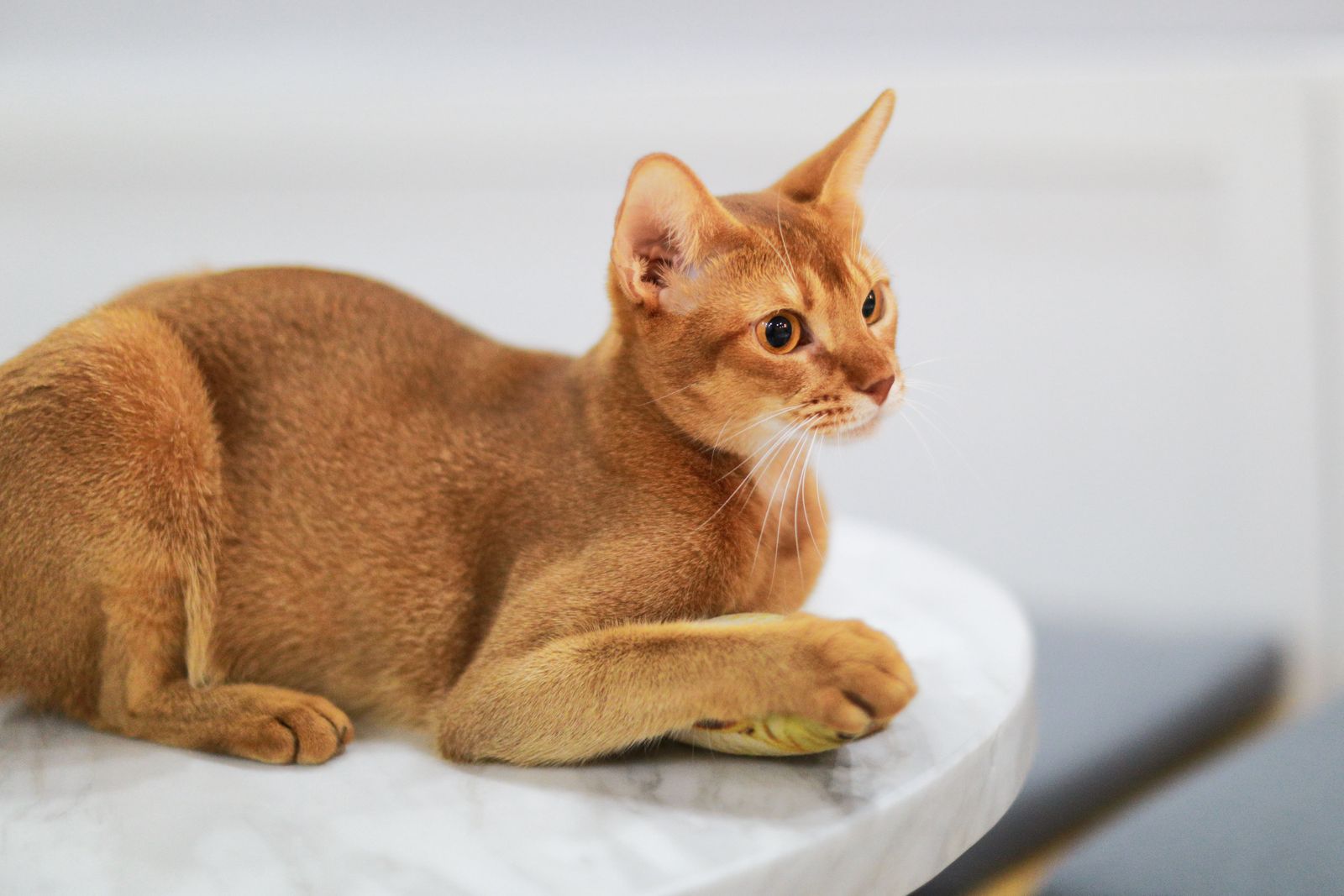
Abyssinian snapshot
The International Cat Association, known as TICA, describes the Abyssinian as a cat that looks like a small mountain lion or cougar, with almond shaped eyes in a dramatically marked, expressive face. It calls the breed athletic, alert, and very active, well muscled yet lithe, graceful, and quick in its movement. The Cat Fanciers' Association, known as the CFA, describes a cat that is intensely curious about everything, constantly on the move, and fond of high places from which to survey its territory. Both registries agree on the feature nobody mistakes: the ticked coat.
| Size | Medium. TICA lists males at 8 to 10 pounds and females at 6 to 7 pounds, with males proportionately larger. |
|---|---|
| Body | Medium long, lithe, and graceful, with well developed muscular strength. The legs are slim, long, and well muscled, and the cat can look as if it is standing on tiptoes. |
| Coat | Short, with agouti ticking. Each hair carries four to six bands of alternating color, which gives the coat its warm, shimmering look. CFA colors are ruddy, cinnamon, blue, and fawn. |
| Ears and eyes | Large ears, arched forward in alertness. Large almond shaped eyes in gold, amber, or green, ringed with a dark line that TICA compares to eyeliner. |
| Temperament | Active, intelligent, affectionate, and deeply interactive, in TICA's description. A cat that explores every niche, follows household activity, and is not usually a long term lap cat because its energy and curiosity keep it moving. |
| Rank | No. 6 in the CFA registration ranking for 2024 registrations, published in 2025, among the most registered cat breeds in the United States. |
Two snapshot facts shape the insurance picture. The first is the activity. This is a climbing, exploring, high places cat, and that athletic life is part of its accident profile as well as its charm. The second fact is that this breed's inherited list is unusually well documented. A laboratory can test for the blood condition. A laboratory can test for two forms of the eye condition. That makes the Abyssinian file more precise than most breed files, and it also creates a trap. An owner who holds clear DNA results can easily believe the health questions are finished. They are not, because the kidney condition at the center of this breed's serious risk does not appear on any DNA panel.
One more thing belongs in the snapshot, because owners meet it in breeder paperwork. Abyssinian kittens often arrive with DNA results for their parents, sometimes for the kitten itself. The CFA notes that genetic testing now lets breeders remove carriers of the inherited anemia from their breeding pools. Those records are genuinely useful, and a later section of this guide gives you a record card for keeping them properly. They describe inherited risk for the tested variants. They are not a medical record for your individual cat, and an insurer will judge claims on your cat's own veterinary record, not on a parent's clear test.
Health tendencies in Abyssinians
The conditions below are the ones with a documented link to this breed at a primary veterinary or academic source, plus one mouth condition group that matters to Abyssinian owners because the breed association itself raises it and because dental coverage varies so much. These are tendencies, not predictions about an individual cat. Many Abyssinians will never develop most of them. The point of naming them is not worry. It is that each one tests a different line of policy wording, and in this breed the first two test something no other cat breed tests as sharply: how a policy treats a condition that a DNA test can name before any sign appears.
This section is general information about conditions a breed can be prone to. It is not veterinary advice and it is not a diagnosis of any cat. Signs listed here are possible signs owners may notice, and many of them have several causes. Only a veterinarian who examines your cat can say what a sign means.
Pyruvate kinase deficiency (PK deficiency)
What it is
An inherited blood condition. Pyruvate kinase is an enzyme, a protein that helps red blood cells make the energy they need to survive. The UC Davis Veterinary Genetics Laboratory explains that when there is not enough activity of this enzyme, red blood cells become unstable and are lost too quickly, producing a hemolytic anemia. Anemia means the blood carries fewer red cells than the body needs. UC Davis lists the Abyssinian among the breeds found to be at higher risk, and recommends genetic screening for the mutation in those breeds. The condition is inherited as an autosomal recessive trait, a term that means a cat must inherit the mutation from both parents to be affected, while a cat with one copy is a healthy carrier.
Signs owners may notice
- Severe tiredness and weakness that come and go, because UC Davis describes the anemia in this condition as intermittent, with a variable age of onset.
- Weight loss and a reduced appetite during an anemia episode.
- Jaundice, a yellowing that owners may notice in the skin inside the ears, the whites of the eyes, or the gums.
- A swollen or enlarged belly, which UC Davis lists among the possible signs of this anemia.
When it can be urgent
A cat that is very weak, will not eat, breathes fast at rest, or has pale or yellow gums during a suspected anemia episode needs prompt, same day care. Anemia reduces the oxygen the blood can carry, and a fast worsening episode is not a wait and see situation.
How vets usually evaluate and treat it
Evaluation usually centers on blood tests that confirm whether the cat is anemic, how severe the anemia is, and whether the body is replacing red cells, alongside an exam and a search for other causes of anemia. A DNA test can identify whether the cat carries the mutation, which explains the cause, but UC Davis notes that for a cat with two copies the severity of symptoms cannot be predicted, so the blood results and the cat in front of the vet guide care. Treatment categories are monitoring over time, supportive care during anemia episodes, and emergency care in severe episodes, all directed by the treating vet.
Progressive retinal atrophy (PRA)
What it is
An inherited disease of the retina, the light sensitive layer at the back of the eye. The UC Davis Veterinary Genetics Laboratory describes the form called rdAc, which is seen in Abyssinian, Somali, and some Ocicat cats. In this form, degeneration of the photoreceptors, the rods and cones that register light, is first detected at about seven months of age, and vision loss progresses slowly and variably, with most affected cats becoming blind at about three to five years of age. The cause is a mutation in a gene called CEP290. UC Davis is direct that there is no treatment available for this condition. It is autosomal recessive, so a cat needs two copies to lose vision, and carriers have normal vision. A second, different form of blindness called rod cone dysplasia, or Rdy, has also been identified in Abyssinian and Somali cats, and the laboratory offers a separate DNA test for that mutation too.
Signs owners may notice
- Bumping into objects in dim light or in a rearranged room, or hesitating at stairs and jumps the cat used to take without thinking.
- A new caution at night, because the rod cells that handle low light are affected as the retina degenerates.
- Wide, dilated pupils, or eyes that seem to shine more than usual in photographs, as the thinning retina reflects more light.
- In many cats, very little at first. Vision loss here is slow, and cats memorize their home layout, so behavior can look normal long after change has begun.
When it can be urgent
This disease itself is slow and is not an emergency. Sudden blindness, a painful or cloudy eye, or an eye injury is a different problem and needs prompt care, because sudden vision loss has other causes that a vet will want to rule out quickly.
How vets usually evaluate and treat it
Evaluation centers on an eye examination, often with a veterinary ophthalmologist, a specialist in animal eyes. UC Davis notes that the earliest degeneration in the rdAc form is detected by an electroretinographic exam, a test that measures how the retina responds to light, at about seven months of age, before an owner is likely to see anything at home. A DNA test identifies whether the cat carries the CEP290 mutation, and a separate test covers the Rdy form, so a complete eye file for this breed names which form was tested. There is no treatment that restores vision. Care is monitoring, a stable home layout, and safety changes as vision fades, guided by the treating vet.
Two eye tests, one blood test: what the Abyssinian DNA file actually proves
This is the section no generic cat guide can write, because no other common breed asks an owner to hold this many separate test results at once. The table below separates the three tests that appear in Abyssinian paperwork, plus the one serious condition that no test covers. Keep it beside the record card in the checklist section.
| Question | PK deficiency DNA test | PRA DNA tests (rdAc and Rdy) | Renal amyloidosis |
|---|---|---|---|
| What it looks at | Whether the cat carries the mutation that reduces pyruvate kinase activity in red blood cells. | Whether the cat carries the CEP290 mutation behind the rdAc form, or the separate mutation behind the Rdy form. They are two different tests. | There is no DNA test that rules this condition out. Monitoring looks at blood and urine values over time. |
| What a clear result means | The cat does not carry that mutation and will not develop this form of anemia from it. | The cat does not carry the one variant that test covers. A clear rdAc result says nothing about the Rdy form, and the reverse is also true. | There is no clear result to hold. A normal blood panel is a picture of the kidneys on that day, not a promise about later years. |
| What a positive result means | One copy means a healthy carrier. Two copies mean the cat will have the deficiency, with a severity UC Davis says cannot be predicted. | One copy means a carrier with normal vision. Two copies of the rdAc mutation mean the cat will develop that form of retinal degeneration. | Diagnosis is made from the clinical picture and, definitively, from a kidney biopsy stained to reveal amyloid deposits. |
| Does it need repeating? | No. A DNA result does not change over a cat's life. | No, for the variant tested. The result is fixed for life, which is exactly why naming the right variant in the record matters. | Yes. Cornell recommends bloodwork at least once a year in a young Abyssinian and twice a year in an older one, precisely because monitoring is the only early warning. |
| How an insurer is likely to see it | Background risk information for a hereditary condition. It explains a cause. It is not, by itself, an illness claim. | Background risk information. A carrier result is not a diagnosis, and an affected result predicts a condition that monitoring claims will later document. | The monitoring record itself. The dated blood and urine results, and any biopsy report, are the documents a kidney claim will turn on. |
The practical takeaway is simple. File the DNA results once, labeled by test, laboratory, and date, and then keep the monitoring record forever. In this breed, owners tend to guard the genetic paperwork and let the routine blood panels scatter. For claims, the routine panels are worth just as much, because they are the only early record the kidney condition will ever produce.
Renal amyloidosis (kidney amyloid deposits)
What it is
A serious kidney condition in which abnormal amounts of a fibrous protein substance called amyloid collect in otherwise healthy kidney tissue. The Cornell Feline Health Center explains that as the amyloid increases, it gradually displaces normal, healthy kidney tissue. The kidneys then become inflamed and unable to filter waste products from the blood, and they begin passing valuable protein into the urine, including proteins the body needs. The Merck Veterinary Manual adds the breed frame: some types of amyloidosis are hereditary in cats, Abyssinian cats are known to be at risk for the hereditary form, and kidney amyloidosis is uncommon in cats except in Abyssinians, in which it is inherited. Cornell is equally direct about the breed link. When this condition is diagnosed, the patient is almost always an Abyssinian cat, although it also occurs more often in Oriental breeds. Cornell calls the condition serious and incurable, while noting that medicines and dietary therapies may slow the process if it is recognized early.
Signs owners may notice
- Increased drinking and excessive urination, which Cornell lists among the signs shared with serious kidney disease in general.
- Diminished appetite and weight loss, in a breed whose appetite and energy are usually conspicuous, so a change stands out.
- Swollen limbs, which Cornell connects to the protein the kidneys are losing, and vomiting.
- Often, nothing obvious early. Cornell notes one physical clue vets use: in other chronic kidney diseases the kidneys typically become small and shrunken, while with amyloidosis they remain normal in size.
How vets usually evaluate and treat it
Cornell describes diagnostic measures that include a complete blood count and a blood chemistry panel, urinalysis, X-rays, and ultrasound imaging. A definitive diagnosis requires a biopsy, a small sample of kidney tissue, because amyloid tissue can look normal to the naked eye and must be stained with a special dye that reveals the deposits. Cornell states plainly that amyloid development cannot be reversed once it has started, so care is built around slowing the process when it is caught early, with medicines and dietary therapy, and around managing the kidney disease itself. That early recognition is why Cornell recommends bloodwork at least once a year when an Abyssinian is young and twice a year when it is older.
Dental and periodontal disease (gingivitis and periodontitis)
What it is
A group of mouth conditions that begin with plaque, the film of bacteria that builds up on teeth. The Cornell Feline Health Center names gingivitis, periodontitis, and tooth resorption as the three most common dental diseases in cats. Gingivitis is inflammation of the gums where they meet the teeth, and Cornell explains that it is usually reversible. If gingivitis is not controlled, it can progress to periodontitis, in which the tissues that attach the tooth to the gums and bone are weakened and destroyed, leading to loose teeth and tooth loss, and that stage cannot be reversed. The Abyssinian link is practical rather than genetic, and it comes from the breed association itself. The CFA notes that some Abyssinian breeders now instruct kitten buyers on how to brush their cat's teeth to prevent dental issues such as gingivitis. When a breed's own association builds tooth brushing into its buyer advice, dental coverage stops being fine print for that breed.
Signs owners may notice
- Red, swollen gums at the line where the gums meet the teeth, and in severe cases bleeding at that line, which Cornell lists as the character of gingivitis.
- Bad breath, drooling, and a cat that is hesitant to eat, turns its head unusually while eating, or shows a new preference for soft food.
- Receding gums, visible tooth roots, or loose teeth in more advanced periodontal disease.
- A pinkish defect in a tooth at the gum line, which Cornell describes as the usual first visible sign of tooth resorption, a separate and painful breakdown of tooth structure.
When it can be urgent
A cat that cannot eat because of mouth pain needs prompt care, not a long wait. Cornell warns that dental disease can cause a cat to stop eating, which leads to further health problems. A cat that has stopped eating entirely should be seen quickly, whatever the cause turns out to be.
How vets usually evaluate and treat it
A vet examination looks at the whole mouth, and Cornell explains that a complete evaluation of periodontitis involves probing the gums and examining X-rays of the head and jaw, which require anesthesia. Treatment for gingivitis centers on removing plaque, including scaling of plaque from the teeth, usually under anesthesia, alongside home tooth brushing with products made for cats. Cornell is clear that there is little or no evidence that antibiotics alone treat gingivitis effectively. For periodontitis, the vet removes plaque and mineral buildup by scaling and polishing while trying to save teeth where possible, and in extreme cases removes teeth that cannot be saved.
Patellar luxation (kneecap slipping out of place)
What it is
A developmental problem of the stifle, the knee joint of the back leg, in which the patella, or kneecap, slips out of the groove it is meant to travel in. A clinical review of patellar luxation in cats published in the proceedings of the European College of Veterinary Surgeons reports that most feline cases are developmental rather than injury based, that the kneecap usually slips toward the inside of the leg, and that both knee joints are often affected. The review names the Abyssinian directly, reporting that certain breeds, such as Abyssinian and Devon Rex cats, have been reported as having a higher prevalence of this condition. It also notes that patellar luxation in cats seems to have a hereditary component, although the exact way it is inherited is unclear, and there is no DNA test for it. In an athletic breed that jumps and climbs as a way of life, a knee that slips matters more, not less.
Signs owners may notice
- An occasional skipping or hopping step in a back leg, where the cat lifts the leg for a few strides and then uses it normally again.
- Intermittent limping that comes and goes, or a leg that seems to lock or stretch out oddly before the cat carries on.
- Reluctance to jump to the high places this breed loves, or a new hesitation before a leap that used to be automatic.
- In mild cases, nothing at home at all. A loose kneecap is often first found by a vet's hands at a routine exam, which is why the exam note matters for the record.
When it can be urgent
A skipping gait is a book an appointment sign, not an emergency. A leg that will not bear weight at all after a fall, a cry of pain, swelling, or a knee that looks deformed could be a fracture or another injury, and that combination needs prompt care. In an Abyssinian, always separate a developmental knee tendency from an acute accident, because a policy may treat the two very differently.
How vets usually evaluate and treat it
Evaluation usually centers on a hands on orthopedic exam, in which the vet feels whether the kneecap slips, in which direction, and whether it returns on its own, which is how the condition is graded. X-rays can show leg alignment and any joint changes. Mild cases are often managed without surgery, with weight control, activity guidance, and pain relief when needed. More severe or persistent cases can involve surgery to realign the kneecap and deepen its groove. The treating vet's exam findings and grade, recorded with a date, are the documents any later claim will be read against.
Policy decisions that matter for an Abyssinian
For most cats, a policy is judged on one bad night. For an Abyssinian, it is judged on the file: a set of DNA results that each answer one narrow question, a kidney that can only be watched, teeth that the breed association itself warns about, and knees that come in pairs. Read these rows with that whole file in mind.
| Policy feature | Why it matters for an Abyssinian | Stronger wording looks like | Watch out for |
|---|---|---|---|
| Hereditary condition coverage | The breed list runs on inheritance: pyruvate kinase deficiency, progressive retinal atrophy, and hereditary renal amyloidosis. | Hereditary and congenital conditions are covered on the same terms as other illnesses. | Hereditary exclusions, or breed specific exclusions that quietly name this breed's conditions. |
| How DNA results are treated | Breeder paperwork can include carrier results for the blood and eye mutations, and a carrier is a healthy cat, not a diagnosed one. | The policy separates a genetic carrier result from a diagnosis or a sign of illness, in writing. | Wording that treats any recorded genetic result as a pre-existing condition, including a carrier result in a cat with no signs. |
| Kidney monitoring and diagnostics | Renal amyloidosis has no predictive test, so dated blood and urine monitoring is the early warning system, and a biopsy is the definitive step. | Vet ordered bloodwork, urinalysis, imaging, and biopsy for a suspected kidney condition are covered categories. | All kidney monitoring treated as elective screening and denied, even when a vet ordered it for a breed at known risk or after an abnormal value. |
| Chronic condition and renewal terms | Kidney disease and intermittent anemia are managed across years, with monitoring and medication continuing at every renewal. | A condition covered in one term stays covered in later terms, including its monitoring, while enrollment continues. | Renewal wording that caps a chronic condition, ends it at renewal, or reclassifies it as pre-existing. |
| Eye specialist coverage | The eye disease in this breed is diagnosed and staged by specialist examination, and one form is first detected by a specialist retinal test. | Ophthalmology referral and specialist eye examinations for a covered eye concern are covered categories. | Wording that covers eye treatment but leaves the examinations that establish an eye diagnosis outside the covered categories. |
| Dental illness terms | Gingivitis can progress to periodontitis, and care can involve anesthesia, dental imaging, scaling, and tooth removal. | Dental illness is included, with anesthesia and extractions for periodontal disease covered. | Dental disease excluded entirely, dental cover limited to injury only, or a cleaning history requirement you have already failed. |
| Orthopedic and bilateral terms | Kneecaps come in pairs, and both knees are often affected in this breed's luxation pattern. | Each side is judged on its own record, with clear terms for the second side. | A bilateral clause that treats the second knee as pre-existing once the first is diagnosed. |
| Deductible type | Repeat blood panels, urine checks, eye rechecks, and dental care produce steady claims across a year, every year. | An annual deductible that is met once, after which eligible claims across conditions are reimbursed. | A per-condition deductible that restarts the counting for the blood, the eyes, the kidneys, the mouth, and the knees separately. |
Life stages: kitten, adult, and senior
Kitten
The kitten stage is when the Abyssinian file is built, and this breed's file has more in it than most. Ask the breeder for the parents' DNA results, and read them using the comparison table above: the pyruvate kinase test, the rdAc eye test, and the Rdy eye test are three separate results, and a breeder who says the parents were tested should be able to say which tests, at which laboratory, on which dates. Keep the results on the record card in the checklist section below. Your own kitten's first examinations add the baseline notes an insurer will later read: blood values, gum health, kneecaps, and eyes. Enrolling in this window, before any of those notes describes a problem, is the single most valuable move an Abyssinian owner makes. Cornell's kidney advice starts here too, with bloodwork at least once a year in a young cat.
Adult
Adulthood in this breed is active, and the insurance work of this stage is rhythm. The blood panels and urine checks keep their schedule, because they are the only early warning for the kidney condition. Dental care becomes a real habit rather than a good intention, with home brushing where the cat allows it and professional cleaning when the vet recommends it. Vision changes, if they come, arrive slowly, and an adult cat that starts hesitating at night jumps deserves an eye examination rather than a wait. File claims as they happen, keep every laboratory report with its date, and at each renewal confirm that any condition the cat now has is still described as covered.
Senior
A senior Abyssinian carries the accumulated version of the breed list: kidneys watched for years, a mouth that needs continued attention, knees that may have been noted long ago, and eyes that should be checked when behavior changes. Cornell's monitoring advice steps up in this stage, to bloodwork twice a year in an older cat. Review the policy for age based changes, premium increases, and any reduction in coverage at advanced ages. Check whether the monitoring rhythm built up over the cat's adult life is still reimbursable on the same terms. A plan that quietly thins out exactly when a long monitored cat needs it most fails the purpose it was bought for.
A claim, step by step: tiredness that becomes a blood diagnosis
The example below is hypothetical. It is not a real cat, a real claim, or a guarantee of how any insurer will decide. It follows an adult Abyssinian from episodes of tiredness, through blood tests and a DNA result, to a diagnosis of pyruvate kinase deficiency and a monitoring routine that continues through renewal, because that full arc is what this breed's hereditary blood coverage has to handle. Pet insurance generally reimburses after you pay the vet, as explained in how pet insurance works.
Tiredness episodes at home
An adult Abyssinian, a breed famous for motion, starts having flat days. The cat skips play sessions, sleeps through household activity it used to supervise, and leaves food unfinished. The owner notes the dates and what was seen, including gums that looked paler than usual on one weekend. That home log, ordinary as it seems, becomes the first timeline document in the claim, because it shows when signs were first noticed relative to the policy dates.
The first blood panel
At the clinic, the vet examines the cat and runs blood tests. The results show anemia, a red blood cell count below what the body needs, with signs that the body is trying to replace red cells. That pattern points toward red cells being lost too quickly rather than made too slowly. The owner pays the clinic, keeps the itemized invoice, and keeps the complete laboratory report, not only the summary line, because the values and their dates are the medical core of everything that follows.
Ruling out the other causes of anemia
Before anyone names an inherited condition, the vet works through the other explanations for anemia, such as blood loss, infection, and other illness, guided by the exam and further tests where needed. This rule out stage is easy to undervalue and hard to reconstruct later. A record that shows the alternatives were considered and excluded is what turns a breed tendency into a supported diagnosis, and it is the part of the file an insurer reads most closely when a hereditary condition is claimed.
Checking the waiting period and the record
On paper, the insurer will line the first sign date up against the policy dates. In this example the policy was started when the cat was a kitten, the illness waiting period ended long ago, and no earlier record mentions tiredness episodes, pale gums, anemia, or a blood concern of any kind. The breeder paperwork is also in the file: the parents' pyruvate kinase results, recorded on the owner's test record card with the laboratory name and dates. That clean timeline makes this a straightforward claim. Contrast it with the harder version of the same story, where a tiredness episode was recorded at a vet visit before enrollment and never followed up. That one old note is the kind of record that turns a later blood claim into an argument about pre-existing signs.
The DNA test and the diagnosis
With the other causes ruled out, a DNA test is run for the pyruvate kinase mutation. The result shows two copies, which means the cat has the deficiency UC Davis describes, and the diagnosis recorded is pyruvate kinase deficiency. The owner files the DNA report with the claim alongside the clinic records and laboratory reports. Note what the DNA result does and does not do here. It names the cause. The severity of this cat's condition is still judged from its blood results and its clinical course, because UC Davis states that severity in a cat with two copies cannot be predicted from the result alone.
Monitoring, episodes, and how reimbursement works
Ongoing care settles into a rhythm: scheduled blood monitoring, supportive care during anemia episodes, and prompt visits when tiredness deepens or gums look pale. Each eligible bill moves through the same mechanics described in what pet insurance costs and why. Charges count against the deductible first, the policy's reimbursement rate applies to eligible charges after that, and totals are tracked against the annual limit. The intermittent shape of this condition makes deductible type matter in practice. With an annual deductible already met, a later episode in the same year is no longer reduced by it. With a per-condition design, the counting works differently, which is why deductible type was flagged in the policy table above.
Renewal, repeat claims, and where they get denied
At renewal, the decisive question is whether the blood condition is still a covered condition or has been reclassified. Under wording that keeps covered chronic conditions covered, the monitoring panels and episode care are filed the same way, referencing the original diagnosis date and the blood result history. The denial pressure points in this breed story are signs recorded before enrollment, an episode argued as a new condition each time it returns, a DNA carrier result in the paperwork misread as a diagnosis, and renewal wording that caps or ends a named chronic condition. Each of those is a clause question, and each can be asked in writing before you buy, not after the diagnosis.
What drives an Abyssinian premium
No responsible guide will name a price for your cat, because the quote depends on the cat, the address, and the settings chosen. What can be explained is the shape of Abyssinian pricing and the choices that move it. The full mechanics are in what pet insurance costs and why.
Breed risk profile. Insurers see a medium, athletic cat with a documented inherited list that spans blood, eyes, and kidneys, plus a dental pattern the breed association itself warns buyers about. That profile prices differently from a breed whose file is mostly accidents. The kidney condition is the wildcard inside the profile, because two cats with the same breed label and the same clear DNA results can still have very different kidney futures, and the profile is priced before any individual cat's story is known.
Activity and accident risk. An Abyssinian climbs, leaps, and investigates at an intensity many cats never reach. Insurers price accident risk at the breed level, and owners feel it in the details: falls, fractures, and wounds are the realistic accident claims in a cat that treats the top of the bookcase as a normal address. Sturdy, anchored climbing furniture and secure storage of small hazards are genuine risk reduction here, not decorating advice.
Age curve and the monitoring years. Premiums generally rise with age, and this breed's value from a policy concentrates in the monitoring years: repeat blood panels, urine checks, eye rechecks, and dental care, stretching from young adulthood into senior life. The total cost of insuring an Abyssinian is therefore a long horizon calculation. A slightly cheaper policy with chronic condition caps can cost more over that span than a stronger policy, because the caps bite at every renewal of a condition that is managed, never finished.
Location and plan settings. Vet prices in your area set the bill sizes the insurer expects, and specialist availability, especially ophthalmology, varies widely by region, which affects both price and how care actually unfolds. Your deductible, reimbursement rate, and annual limit choices trade premium against claim returns. For this breed, deductible type deserves the same attention as deductible size, because an annual deductible and a per-condition deductible produce very different results across blood monitoring, kidney checks, eye care, and a dental claim in the same year.
Pre-purchase checklist for an Abyssinian policy
- Confirm hereditary conditions are covered, including pyruvate kinase deficiency, progressive retinal atrophy, and renal amyloidosis.
- Ask in writing how DNA results are treated, and confirm that a carrier result for the blood or eye mutations is not counted as a diagnosis or a pre-existing condition.
- Confirm vet ordered blood and urine monitoring for kidney risk, and a kidney biopsy if one is needed, are covered categories rather than excluded screening.
- Confirm repeat blood monitoring for a covered blood condition, and kidney monitoring for a covered kidney condition, stay reimbursable at every renewal.
- Check that ophthalmology referral and specialist eye examinations for a covered eye concern are covered.
- Confirm dental illness coverage in plain terms, including anesthesia, dental imaging, scaling, and tooth removal for periodontal disease.
- Read the bilateral clause for knees, and any orthopedic waiting period that applies to a kneecap claim.
- Ask how an intermittent condition, such as the anemia of pyruvate kinase deficiency, is counted across episodes.
- Choose between an annual and a per-condition deductible using this breed's pattern of steady monitoring claims.
- Enroll as a kitten, and complete the genetic test record card below from the breeder paperwork on day one.
The Abyssinian genetic test record card
Keep one card per cat, in the policy file, and fill it from the actual laboratory reports, not from memory or a sales conversation. A result without a laboratory name and a date is hard to use later, whether the reader is a vet or an insurer. The card has five fields for each test: the test, the laboratory, the date, the result, and whose result it is, because a parent's result and your own cat's result are different documents.
| Test | Laboratory | Date | Result | Whose result |
|---|---|---|---|---|
| Pyruvate kinase deficiency (DNA) | Fill from the report | Fill from the report | Clear, carrier, or two copies | Sire, dam, or this cat |
| Progressive retinal atrophy, rdAc form, CEP290 (DNA) | Fill from the report | Fill from the report | Clear, carrier, or two copies | Sire, dam, or this cat |
| Progressive retinal atrophy, Rdy form, CRX (DNA) | Fill from the report | Fill from the report | Result as reported | Sire, dam, or this cat |
| Kidney monitoring (blood panel and urinalysis) | Your veterinary clinic | Each panel date, in order | Values as reported, with any abnormal value flagged | This cat only |
| Eye examination | Clinic or ophthalmologist | Each exam date | Findings as reported | This cat only |
Two habits make the card worth keeping. First, never merge the two eye tests into one line that just says PRA tested. They are different mutations, and the difference is the whole point of the card. Second, add the kidney monitoring rows as they happen, even when every value is normal. A run of normal dated panels is evidence too. It shows a monitoring history, and it is the record Cornell's advice for this breed asks you to build.
Questions to ask an insurer, in writing
- My kitten's breeder paperwork includes DNA carrier results for pyruvate kinase deficiency and retinal atrophy. How do you treat a carrier result, and is it ever counted as a pre-existing condition?
- Is vet ordered blood and urine monitoring for kidney risk in an Abyssinian treated as covered diagnostics, or as excluded screening?
- Once pyruvate kinase deficiency or a kidney condition is diagnosed and covered, will it and its monitoring stay covered at every renewal while I stay enrolled?
- Is dental illness covered, including anesthesia and tooth removal for periodontal disease, and what dental history do you require?
- Are ophthalmology referral and specialist eye examinations covered for a hereditary eye condition in this breed?
- If one kneecap needs treatment, how is the other knee treated under your bilateral rule?
Questions Abyssinian owners ask
Does pet insurance cover pyruvate kinase deficiency in Abyssinians?
An accident and illness policy can cover pyruvate kinase deficiency when hereditary conditions are included, the illness waiting period has passed, and no anemia, tiredness episode, or blood concern was recorded before enrollment. Check that repeat blood monitoring for a covered blood condition is reimbursable, and ask how an intermittent condition is counted when episodes improve and later return, because that counting interacts with the deductible.
My Abyssinian's DNA tests were clear. Does that settle the health questions?
No. A clear result settles only the exact variant that test looks for. The UC Davis Veterinary Genetics Laboratory offers separate tests for pyruvate kinase deficiency and for two different forms of progressive retinal atrophy in this breed, and each test detects one mutation. Renal amyloidosis, the kidney condition this breed is known for, has no DNA test that rules it out, so regular bloodwork and urine checks remain part of the file even in a cat whose genetic tests are all clear.
What is renal amyloidosis, and can it be tested for in advance?
Renal amyloidosis is a condition in which an abnormal protein called amyloid collects in the kidneys and gradually displaces healthy kidney tissue, so the kidneys lose their ability to filter the blood and begin leaking protein into the urine. Cornell notes that when this condition is diagnosed, the patient is almost always an Abyssinian, and that a definitive diagnosis requires a kidney biopsy with a special stain. There is no genetic test that rules it out in advance. The practical defense is monitoring: Cornell recommends bloodwork at least once a year in a young Abyssinian and twice a year in an older one.
Is progressive retinal atrophy covered for Abyssinians?
The eye examinations, specialist referrals, and monitoring for a covered hereditary eye condition can be covered when hereditary conditions are included and no vision or eye concern was recorded before enrollment. UC Davis explains that the rdAc form of this disease has no treatment and leads to eventual blindness, so the claim value in this condition is mostly in diagnosis and monitoring, not in a cure. Ask in writing whether ophthalmology referral and repeat eye examinations for a diagnosed eye condition are covered categories.
Are dental problems covered for Abyssinians?
Not automatically, and dental wording is one of the widest gaps between policies. Some accident and illness plans exclude dental disease entirely, some cover only dental injury, and some include dental illness with conditions attached. The Cat Fanciers' Association notes that some Abyssinian breeders teach buyers to brush their cat's teeth to prevent gingivitis, which tells you how real the mouth risk is in this breed. Ask in writing whether dental illness, anesthesia, dental X-rays, and tooth removal are covered, and what dental records or cleaning history the policy requires.
When is the best time to enroll an Abyssinian?
As a kitten, before an anemia episode, a vision note, a kidney value, a mouth finding, or a loose kneecap enters the medical record. This breed's testable conditions can be documented from the start with DNA results, and its kidney condition is watched through routine bloodwork that begins young. Enrolling early clears the waiting periods while the record is clean, and it makes the hereditary coverage, dental wording, and chronic renewal wording worth reading from day one.
Sources and further reading
- Cat Fanciers' Association, Abyssinian breed page for the breed's curiosity and activity, its ticking and colors, genetic testing removing carriers of the inherited anemia from breeding, and breeders teaching tooth brushing to prevent gingivitis.
- The International Cat Association, Abyssinian breed page for the cougar like look, athletic and affectionate temperament, four to six bands of ticking on each hair, large ears, and weights of 8 to 10 pounds for males and 6 to 7 pounds for females.
- The International Cat Association, Abyssinian breed group standard for the medium, lithe, graceful, and well muscled body, the slim long legs, and the agouti ticking pattern.
- UC Davis Veterinary Genetics Laboratory, Erythrocyte pyruvate kinase deficiency for the inherited hemolytic anemia, its intermittent course and variable signs, recessive inheritance, and the Abyssinian among the breeds at higher risk.
- UC Davis Veterinary Genetics Laboratory, Progressive retinal atrophy, rdAc form for the CEP290 mutation, degeneration first detected at about seven months, blindness at about three to five years, the absence of treatment, and the separate Rdy form in this breed.
- Cornell Feline Health Center, Renal amyloidosis for amyloid displacing kidney tissue, its signs, biopsy with a special stain as the definitive diagnosis, and the recommendation of bloodwork once a year in young Abyssinians and twice a year in older ones.
- Merck Veterinary Manual, Amyloidosis in cats for hereditary amyloidosis in Abyssinians and kidney amyloidosis as uncommon in cats except in this breed, in which it is inherited.
- Cornell Feline Health Center, Feline dental disease for gingivitis, periodontitis, and tooth resorption as the most common dental diseases in cats, their signs, and evaluation and treatment under anesthesia.
- Langley-Hobbs, Patellar luxation and patellar fracture in cats, European College of Veterinary Surgeons proceedings, via IVIS for developmental patellar luxation, both knees often affected, and the Abyssinian among the breeds reported with a higher prevalence.